Jesus Is In the Room (Luke 24:36b-48)

Jesus appears to the apostles, by Duccio di Buoninsegna (1255-1319)

Jesus himself stood among them and said to them, “Peace be with you.” They were startled and terrified and thought that they were seeing a ghost. He said to them, “Why are you frightened, and why do doubts arise in your hearts? Look at my hands and my feet; see that it is I myself. Touch me and see, for a ghost does not have flesh and bones as you see that I have.” 

And when he had said this, he showed them his hands and his feet. Yet for all their joy they were still disbelieving and wondering, and he said to them, “Have you anything here to eat?” They gave him a piece of broiled fish, and he took it and ate in their presence.

Then he said to them, “These are my words that I spoke to you while I was still with you—that everything written about me in the law of Moses, the prophets, and the psalms must be fulfilled.” 

Then he opened their minds to understand the scriptures, and he said to them, “Thus it is written, that the Messiah is to suffer and to rise from the dead on the third day and that repentance and forgiveness of sins is to be proclaimed in his name to all nations, beginning from Jerusalem. You are witnesses of these things. (New Revised Standard Version)

Hanging Out and Scratching Their Heads

Christ’s disciples were abuzz. Two dudes showed up and told eleven of the original disciples that they had seen and talked to Jesus himself! This was a lot to wrap both their heads and their hearts around. Could they dare to hope it is true?

Peter and John encountered an empty tomb. And now these guys from Emmaus are giving this wild testimony of a risen Savior. Into the weird mix of doubt, curiosity, grief, hope, wondering, and outright confusion, Jesus materialized out of the blue saying, “Peace be with you.”

Already feeling unsettled and uncertain, the disciples had anything but a peaceful response to the presence of their Lord. Startled, troubled, and frightened they were, as if somebody had just dropped a skunk into the room.

Why the fear? Why not be overjoyed or overcome with sheer delight at seeing Jesus?

The disciples were caught off guard, as if they had zero expectation of seeing Jesus. Believing him to be dead, they immediately went to thinking this was some ghost. After all, the door was locked. Nobody could have gotten into the room without the disciples knowing it. (John 20:19)

A fresco of Christ appearing to the disciples, in the Visoki Dečani Monastery, Deçan, Kosovo

Face to Face with Faith

As it turns out, faith and belief are not uniform static terms. There are layers to faith. Yes, the disciples really did believe, and their faith developed over time with Jesus. However, their belief had not yet come to full bloom. So, in this sense, they still possessed a lack of faith and were rebuked by Jesus for it. (Mark 16:14)

A full-orbed belief in the Lord Jesus Christ is more than words, more than making professions, and more than signing-off on a doctrinal statement of faith. Faith is shown for what it is through our actions. (James 1:19- 2:26)

Faith comes to fruition when the head, the heart, and the hands all align together and conspire to proclaim the gospel in thought, word, and deed. If they are misaligned or incongruent with each other, then that faith is inadequate. There is yet another level to the belief which needs to emerge.

Perhaps this is instructive for people today. While maintaining beliefs about the person and work of Jesus, and acknowledging Christ’s death and resurrection, some Christians live as though Jesus had never risen from the grave. If Jesus were to suddenly show up and say, “Peace be with you,” like a startled puppy, they’d likely have an accident on the floor.

It’s a Real Resurrected Body

As Jesus had done so many times before in his earthly ministry, he invited the disciples to experience him in a real, tangible, visceral way. This is no ghost. This is a Christ who has physical flesh and bones. You can eat with this Jesus, real food and drink. Look at his hands and feet. Touch and feel them if you must. But, by all means, believe!

Christ is risen. So, now what? This is what the earliest of disciples struggled to understand – how to live in the reality of resurrection, and how Jesus is present with his followers. Christ is with us as a real human and as the real God.

Although Jesus appeared to be a ghost because he could seemingly pass through things, he is not. Christ has a very real body with flesh and bones, although it is a glorified resurrected body which isn’t quite the same as our current earthly bodies. He feels hunger and eats food.

Today’s story follows the Emmaus Road experience in which two people encounter the resurrected Christ. They didn’t even notice that it was Jesus and that they were looking at a glorified body. In that story, Jesus went with them and had a meal around the table.

The Disciples Are Now Witnesses

The eyes of the disciples were opened so that they could truly see Jesus for who he really is. And it happened in their communal eating together – just as it did in the previous story with the friends from the Emmaus Road. Specifically, their new spiritual sight enabled them to be witnesses to the reality of Christ’s resurrection.

The disciples seeing Jesus empowered them to proclaim the good news that repentance for the forgiveness of sins is real; deliverance from our guilt and shame can really happen, when we confess it and turn from it. No more being locked-up in a room in fear, or in a metaphorical personal prison of anxiety.

We Are Now Empowered

The post-resurrection encounter of the disciples and Jesus would not be confined to a one room lock-in experience. The Spirit of God will come upon all sorts of people, all over the world. The sadness of crucifixion and death transforms into the joy and confidence of gospel proclamation. A true release from the shackles of fear and guilt result in a giddy blabbering about Jesus everywhere one goes.

It turns out that seeing and touching Christ’s wounds on his hands and feet doesn’t evoke bad nightmares, but elicits good dreams for the future of faith – that resurrection is a reality, is reachable, and is a path to experience the blessing of God.

Jesus is in the room, my friend. Let your fear be changed into joy.

Holy and righteous God, you raised Christ from the dead and glorified him at your right hand. Let the words of Holy Scripture, fulfilled in Jesus your Son, burn within our hearts and open our minds to recognize him in the breaking of bread. Amen.

Celebration and Lament (Matthew 2:13-18)

Coptic Church depiction of the holy family in Egypt

Now after they had left, an angel of the Lord appeared to Joseph in a dream and said, “Get up, take the child and his mother, and flee to Egypt, and remain there until I tell you, for Herod is about to search for the child, to destroy him.” Then Joseph got up, took the child and his mother by night, and went to Egypt and remained there until the death of Herod. This was to fulfill what had been spoken by the Lord through the prophet, “Out of Egypt I have called my son.”

When Herod saw that he had been tricked by the magi, he was infuriated, and he sent and killed all the children in and around Bethlehem who were two years old or under, according to the time that he had learned from the magi.Then what had been spoken through the prophet Jeremiah was fulfilled:

“A voice was heard in Ramah,
    wailing and loud lamentation,
Rachel weeping for her children;
    she refused to be consoled, because they are no more.” (New Revised Standard Version)

Smack in the middle of the great celebration of Christ’s birth is a great lament. That’s because not everyone views the birth of Jesus with joy; there are others who see it as a threat and want to stamp it out.

We are humans, with two ears, two eyes, two hands, two feet, two lungs, and two kidneys. Our paired organs exist because we need the two of them in order to function properly. Joy and sadness, celebration and lament, are emotionally paired so that our soul may serve us as it is intended to. We hold them both together – at the same time, all the time – in order to have a well-rounded and healthy way of life.

In this time of year, it can be easy to gravitate towards either one or the other. We might become engrossed in all the shiny things of the season; or we may get lost by all the sorrows which the season stirs up for us.

I invite you to approach the mundane and simple manger. Although it might seem dull and unattractive – the last place you may find wholeness and peace – it is truly the place where we find God. It is here that both our joys and our sorrows meet, because among the stinky animals and the lower class life we shall actually discover the real longing of our hearts.

The gracious and almighty God preserved and protected the child Jesus. Christ’s early life retraced the life of ancient Israel. Like the Jewish patriarchs, Jesus went down to Egypt (and would eventually go down and face hell for us in his crucifixion); and, like the ancient Israelites, Jesus was brought up out of Egypt (and would rise from the dead bringing freedom from sin and death once for all) in a New Exodus.

It is as if the disciple Matthew means to connect the two Testaments as a unified whole by saying, “Look, here is the Messiah, the coming King, the promised One of Israel and of all the nations. Jesus is our salvation, the fulfillment of all that we have hoped for.”

Jesus is the New Exodus

In the second of three dreams, Joseph is told to take Jesus to Egypt. Joseph obeyed the Lord and took responsibility for the role of protecting Jesus, as contrasted with Herod’s role in attempting to murder Jesus.

Yet, there is more to this story than Christ’s protection; this is the fulfillment of a biblical pattern, an identification of Jesus with the people of God. Matthew pulled forward the prophet Hosea to say that just as God brought the Israelites out of Egypt through a great deliverance, God brought up Jesus, the Great Deliverer, out of Egypt as the unique Son of God.

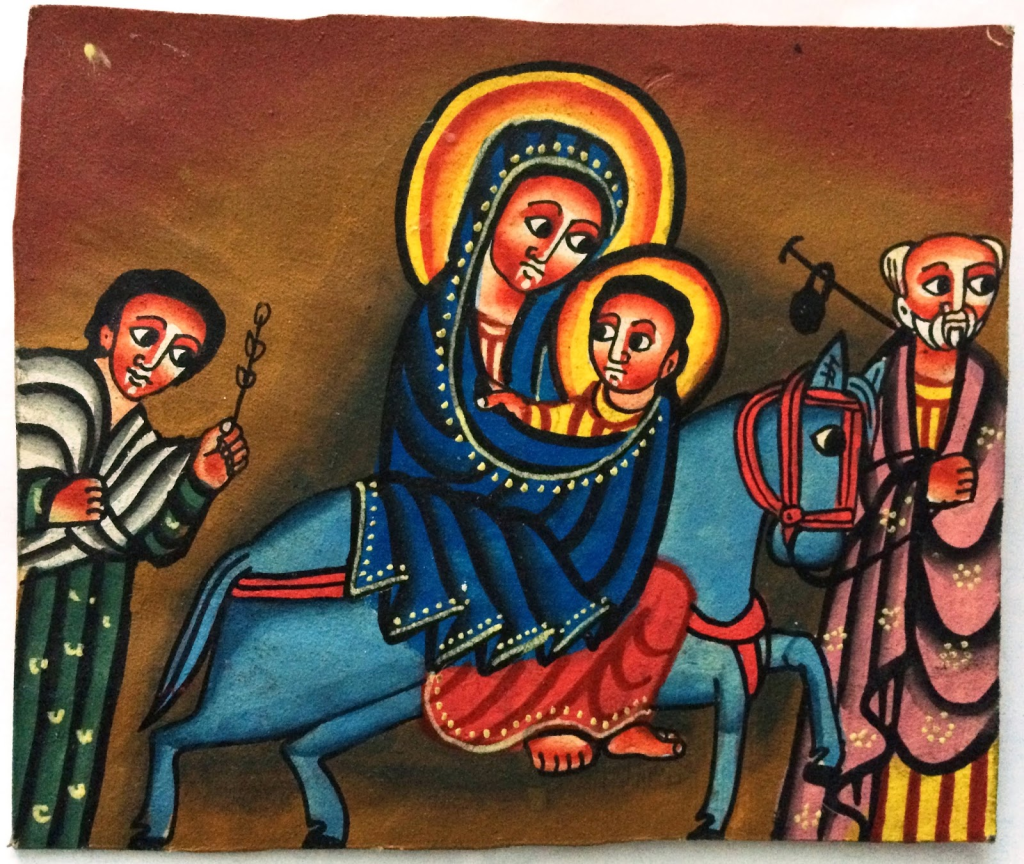
Ethiopian Orthodox icon of the holy family fleeing to Egypt

When we hold the pair of Testaments together in both hands, we feel the weight of Jesus as God’s divine Son; so therefore, Christ is the rightful Ruler in God’s kingdom.

Just as God preserved Israel from Pharaoh’s wrath, the Lord protected Jesus from Herod’s wrath. God’s kindness and loyalty extends to us as covenant people and preserves us from the wrath of the devil who seeks to keep as many people as possible in the realm of darkness.

Our hope is in the Lord Jesus, who conquered the devil by establishing a beachhead on this earth through an incarnation as the Son of God.

Jesus Brought Us Out of Exile

The scoundrel King Herod massacred innocent toddlers to ensure the destruction of Jesus. Behind his atrocity was the devil himself, who knew Jesus was the coming king who would one day bring salvation. Reflecting on a vision of Christ’s birth, the Apostle John identified the sinister plan and the divine deliverance:

The dragon stood in front of the woman who was about to give birth so that when she gave birth, he might devour her child. She gave birth to a son, a male child who is to rule all the nations with an iron rod. Her child was snatched up to God and his throne. (Revelation 12:4-5, CEB)

Satan wars against God’s Son and God’s people, whose roots go all the way back to the first prophecy of Christ after the Fall of humanity. God declared to Satan:

“And I will cause hostility between you and the woman,
    and between your offspring and her offspring.
He will strike your head,
    and you will strike his heel.” (Genesis 3:15, NLT)

There has been continual enmity ever since, between the serpent and the seed of the woman. It manifests itself with the Israelites constantly being threatened with extermination and tempted to conform to pagan ways.

King Herod was just another in a long line of demonically animated persons trying to perpetuate the kingdom of darkness. We must take this threat seriously because the devil knows that his time is short. A second Advent is coming which will be the final judgment.

Satan’s most powerful weapon, death, has lost its sting because of Jesus. Christmas is a hard time of year for many people, filled with depression instead of joy, grieving over lost loved ones for whom we will not spend another Christmas with.

Yet there is a reunion coming, the hope of a bodily resurrection in which we will be with Jesus and God’s people forever. Be encouraged to understand that there is no time in heaven; it will be only a moment and the people who have gone before us will turn around and see us; we will one day join them.

Matthew also used the prophet Jeremiah to communicate hope. Jeremiah’s prophecy dealt with children who were lost in war to the invading Babylonians. The prophecy is a lament with the hope that captivity will not be forever.

The disciple Matthew wanted us to see that the exile is over for us; Jesus has arrived, and the tears which were shed will shortly dry up. There may be a time of suffering we must endure, but there will be glory. Jesus is the Great Deliverer who brings us out of sin’s captivity and into the promises of God. He is our hope.

Jesus is the promised One who will deliver us from the tyranny of the devil. Christ is the hope of the nations, the Savior of the world. So, let us come back to the first Christmas which was the beginning of the end for evil on the earth.

Believers in Jesus are part of God’s victory, and they overcome the evil one by the blood of the lamb, acknowledging that Christ’s incarnation was essential for us. 

Just as Jesus made a radical break with his former life in heaven through the incarnation, we, too, must break with our old way of life.

God will save the people through this child Jesus. The greatest gift we can give in this season and throughout the coming year is the gift of grace, the presentation of the Christ child.

Loving God, help us remember the birth of Jesus so that we may share in the song of the angels, the gladness of the shepherds, and the wisdom of the wise men.

Close the door of hate and open the door of love across the world.

Let kindness come with every gift and good desires with every greeting.

Deliver us from evil through the blessing of the Christ child.

Teach us to be happy with pure hearts.

Grant us grateful thoughts, devoted hearts, and gracious hands, through Jesus our Savior in the might of the Holy Spirit. Amen.

Mary’s Magnificat (Luke 1:46b-55)

The Magnificat, a woodcut by Sr. Mary Grace Thul

Mary said,

“With all my heart I glorify the Lord!
    In the depths of who I am I rejoice in God my savior.
He has looked with favor on the low status of his servant.
    Look! From now on, everyone will consider me highly favored
        because the mighty one has done great things for me.
Holy is his name.
    He shows mercy to everyone,
        from one generation to the next,
        who honors him as God.
He has shown strength with his arm.
    He has scattered those with arrogant thoughts and proud inclinations.
    He has pulled the powerful down from their thrones
        and lifted up the lowly.
He has filled the hungry with good things
    and sent the rich away empty-handed.
He has come to the aid of his servant Israel,
        remembering his mercy,
    just as he promised to our ancestors,
        to Abraham and to Abraham’s descendants forever.” (Common English Bible)

Mary, the mother of Jesus, was able to wrap both her head and heart around an incredible reality – that God had done great things for her. And it was enough for her to erupt into a great song of praise. Indeed, the Lord shows mercy to everyone who worships and adores the mighty acts of God.

It strikes me that Mary, instead of being full of worry and afraid of the future, and as an unmarried teen with child, is full of the Spirit and faith. Mary neither complained nor fretted for the nine months of her pregnancy; she praised God and was clear-headed about the grace shown to her.

Mary’s canticle gives us insight into the mystery of the incarnation: God chooses the weak, those of low esteem, and the powerless. Mary was quite ordinary for her day. She had no wealth and nothing which would cause anyone to pick her out of a crowd.

Yet, Mary is the one chosen by God. And her wonderful response to grace demonstrated that there is so much more to any person than what we can see with our eyes and perceive through our earthly glasses of high positions and strength of personalities.

What’s more, Mary had the wisdom to discern that her situation typified the Lord’s egalitarian work of leveling the field so that all persons have what they need. Her son, the Messiah, would carry this into his own life and ministry – declaring good news to the poor, comforting the brokenhearted, proclaiming freedom for captives, telling those who mourn that the time of the Lord’s favor has come.

We may tend to think that the work of God is surprising, only because we might often experience so little of grace and mercy in this old world. But God is always full of grace, mercy, and power to those who are powerless and in need of help. The Lord has our backs. 

Perhaps if we all, both individually and corporately, continually used our words to identify and declare the great things God has done, we would then realize the consistent blessing of the Lord. 

I encourage you to take some time today and either journal and/or speak with another about the ways in which God has been good to you in this Advent season, and like Mary, offer praise for each act of mercy. Mary exhibited no helplessness but had her heart calibrated to detect the grace of God when it was present.

May the joy of the angels, the eagerness of the shepherds, the perseverance of the wise, the obedience of Joseph and Mary, and the peace of the Christ child be yours this Christmas. And may the blessing of God almighty – Father, Son, and Spirit – be among you and remain with you always. Amen.

A Great Restoration (Psalm 126)

When the Lord restored the fortunes of Zion,
    we were like those who dream.
Then our mouth was filled with laughter
    and our tongue with shouts of joy;
then it was said among the nations,
    “The Lord has done great things for them.”
The Lord has done great things for us,
    and we rejoiced.

Restore our fortunes, O Lord,
    like the watercourses in the Negeb.
May those who sow in tears
    reap with shouts of joy.
Those who go out weeping,
    bearing the seed for sowing,
shall come home with shouts of joy,
    carrying their sheaves. (New Revised Standard Version)

I personally think that God is amazing. The Lord not only brings restoration and wholeness to people; God also reverses people’s fortunes so that what was lost is found again. Indeed, reversal has a prominent place in today’s psalm, inviting us to recognize that God does more than compensate persons in a loss, but also brings about a complete reversal of reality.

God is the expert at restoring people’s fortunes. For a nation who was overrun by the Babylonians, sent into exile, and then had the ability to return from that exile back to Jerusalem, it very much indeed, felt like a grand restoration. The effect it had on the people was profound. The psalmist describes it like this:

It’s like waking from a dream and realizing that it’s reality.

It’s like the best party – full of celebration, singing, and laughter – that anyone has ever experienced.

It’s like being a real live miracle.

Being invaded, attacked, violated, taken away from your home and traumatized – and then living in oppression and having forced suppression in living your life the way you believe you ought to, is an awfully sad and discouraging way to exist.

But then, fortunes are restored. The grieving and lamenting give way to laughter and joy. That feeling of a 500 pound weight on your shoulders is lifted; you now feel light as a feather. And it isn’t only a personal reversal of tangible resources; it’s also a psychological turn around.

The nations frequently mock and ridicule God’s people. They look at the suffering, as if God has abandoned them – or wonder even if there is a God, at all. The thinking of other nations, is that Israel’s God is nothing but a local god who is impotent outside of Judah. Besides, he probably doesn’t care about a bunch of losers anyway, they reason.

Don’t give the other nations a reason to say,
    “Where is their God? Can’t he help them?”
Let us see you punish those people.
    Punish them for killing your servants. (Psalm 79:10, ERV)

But the God of the Bible is no limited territorial being; the Lord is sovereign over all the earth. And this God is able to effect a radical reversal of body, mind, and spirit – even to those other nations. The disrespectful mouths that once mocked are reversed to giving praise to Israel’s God and acknowledging that the Lord has done great things for the people.

This God has both the will and the ability to intervene and effect real change that completely reverses a person’s and even a nation’s life. Once someone has experienced what God can do, they forever know that God can do it again.

One of the things which personally motivates me is that the Lord has changed my life and my fortunes on many occasions – and even used me to help effect a reversal in other people’s lives, as well. So, no matter how bad things get (and sometimes they get awfully darned bad!) I have confidence and trust that a good, merciful, and loving God sees it all, knows it all, and has the power to do something about it. I may have to wait for a while – maybe even an agonizingly long time – yet I am convinced that the same God who restored the fortunes of Israel can reverse my situation, too.

And the change is so wonderfully dramatic, that it’s like a wadi in the desert, a life-giving river that emerges in the bone dry desert, bringing new growth and sustaining animal life, after the rains finally come and reverse the landscape and the environment completely.

We are, however, reminded that a great reversal and a complete restoration does not happen immediately. When the farmer plants in the Spring, it will be months before there is a harvest of crops. It takes time for the seed to germinate, break the soil, and grow into a mature plant, ready for the harvester.

Get-rich schemes rarely work in life, and never really happen in the spiritual life. Renewal, restoration, and a reversal of fortunes is not an instantaneous event, but rather a process that develops and eventually happens. A lot of blood, sweat, and tears go into any meaningful and sustainable process of change. Yet, where there is weeping, the end will be shouts of celebration and joy.

Believers can live expectantly, and fully convinced, that their suffering will eventually give way to glory. Grief and tears will not have the last word; God’s restorative and reversing grace will.

Many of you long for restoration – either for yourselves or for others you love and care about – because you recognize there needs to be a great reversal of fortunes. Advent is the season for waiting, the time for anticipation, knowing that deliverance will come in the form of a baby. And our waiting shall not be in vain.

O Lord our God, accept the fervent prayers of your people; in the multitude of your mercies look with compassion upon us and all who turn to you for help; for you are gracious, O lover of souls, and to you we give glory, Father, Son, and Holy Spirit, now and forever. Amen.