Job 4:1-21 – Where Is God?

Eliphaz and the other friends of Job, speaking down to him in his suffering, from a fresco in the Cathedral of the Annunciation in Moscow

Job, will you be annoyed if I speak?
    I can’t keep quiet any longer.
You have taught many people
    and given strength to feeble hands.
When someone stumbled, weak and tired,
    your words encouraged him to stand.
Now it’s your turn to be in trouble,
    and you are too stunned to face it.
You worshiped God, and your life was blameless;
    and so you should have confidence and hope.
Think back now. Name a single case
    where someone righteous met with disaster.
I have seen people plow fields of evil
    and plant wickedness like seed;
    now they harvest wickedness and evil.
Like a storm, God destroys them in his anger.
The wicked roar and growl like lions,
    but God silences them and breaks their teeth.
Like lions with nothing to kill and eat,
    they die, and all their children are scattered.

Once a message came quietly,
    so quietly I could hardly hear it.
Like a nightmare it disturbed my sleep.
    I trembled and shuddered;
    my whole body shook with fear.
A light breeze touched my face,
    and my skin crawled with fright.
I could see something standing there;
    I stared, but couldn’t tell what it was.
Then I heard a voice out of the silence:
“Can anyone be righteous in the sight of God
    or be pure before his Creator?
God does not trust his heavenly servants;
    he finds fault even with his angels.
Do you think he will trust a creature of clay,
    a thing of dust that can be crushed like a moth?
We may be alive in the morning,
    but die unnoticed before evening comes.
All that we have is taken away;
    we die, still lacking wisdom.” (Good News Translation)

The Christian spiritual classic, The Dark Night of the Soul, was written nearly five hundred years ago by St. John of the Cross. The gist of John’s observation is that God sometimes takes the Christian through dry times of hiding himself from the believer. 

The pain of wondering where God is and if he will even show up; experiencing unanswered prayer; enduring uncaring and misdirected comments from well-meaning people; all these and more are inevitably part of the Christian spiritual experience. 

The dark night of the soul is not to be confused with personal sinfulness. Its origin is not in self, but God. 

“Silence is God’s first language.”

St. John of the Cross

Whenever one knows with a settled confidence that personal integrity is intact, but trouble abounds, we need not immediately rush to the conclusion that something is wrong with us. It may be the Spirit of God thrusting us into a desert experience to test and approve our faith.

Job’s “friend” Eliphaz offered one of those tired age-old arguments that bad things only happen to bad people. He comes at Job with the inexperience and absurdity of making misguided assumptions. He rhetorically asks: Who that was innocent ever perished?  Where were the upright cut off? 

The conclusion of Eliphaz, therefore, was bound to be off the mark – believing secret sin must surely be the culprit behind Job’s awful misfortune. Certainly, Eliphaz thinks, Job cannot possibly go through such terrible suffering without having done something to anger God.

Times change; the basic nature of people, not so much. In today’s church and world, the same notions still endure. If I had a quarter for every time I heard crazy comments, like the following, I would be a rich man: 

“He’s poor because he is lazy and doesn’t want to work.”

“She keeps having chronic health issues. God is punishing her.”

“The pandemic is God’s judgment on us for not having the Ten Commandments in our courthouses.”

“If you just confess your sin and have faith, you’ll be healed.”

“They’re in big trouble. They obviously did something evil.”

On and on the wrong-headed statements continue, ad nauseum.

The Apostle Peter understood how to view trouble in a healthy way. He said we all suffer – both the good person and the wicked. It’s just a matter of whether we will suffer for doing good and the right thing, or suffer because of saying shallow, illogical, and stupid comments that offend God and hurt others. (1 Peter 3:17-18)

Even Christ suffered. And it wasn’t because of his own sin. It was because of ours. Jesus suffered once for sins, the righteous for the unrighteous, that he might bring us to God. 

Jesus suffered; so, the follower of Jesus will suffer. There is a big picture only God sees. Whenever we suffer, there is something going on behind the spiritual scene. We must allow God to do divine work, and then, trust that the Lord bends all human suffering for good and redemptive purposes.

“Where there is no love, pour love in, and you will draw love out.”

St. John of the Cross

So, let’s change the rhetoric. Instead of jumping to judgment, reflexively hop to grace with comments like these:

  • “He has poverty of spirit. He’s blessed and will inherit the kingdom of God.”
  • “She’s in chronic pain. God has allowed her the privilege of suffering in solidarity with her Lord.”
  • “We’re in a pandemic. Here’s a chance for us to live out of the Ten Commandments.”
  • “If we confess the world’s sins of pride, hate, and injustice, perhaps God’s mercy will deliver us.”
  • “We’re in a big pickle. No better time than now to grow in grace.”

Where is God? Beside you, quietly and confidently holding you up in your suffering.

Lord God, I entrust myself to you because you know what you are doing. Thank you for the trials of life which humbles my heart to pray. Do your work in me so that my faith is fortified for a lifetime of service in the church and the world, through Jesus Christ, my Lord. Amen.

Two Ways of Living: Blessed or Cursed

Blessed is the one
    who does not walk in step with the wicked
or stand in the way that sinners take
    or sit in the company of mockers,
but whose delight is in the law of the Lord,
    and who meditates on his law, day and night.
That person is like a tree planted by streams of water,
    which yields its fruit in season
and whose leaf does not wither—
    whatever they do prospers.

Not so the wicked!
    They are like chaff
    that the wind blows away.
Therefore the wicked will not stand in the judgment,
    nor sinners in the assembly of the righteous.

For the Lord watches over the way of the righteous,
    but the way of the wicked leads to destruction. (Psalm 1:1-6, NIV)

The Righteous and the Wicked

This psalm presents two ways we can choose to shape our lives: the way of the righteous and the way of the wicked, blessed or cursed. The way of the righteous leads to human blessing, flourishing, and living. The way of the wicked leads to human cursing, degenerating, and dying.

Distinguishing between the righteous and the wicked is not always as easy as it looks. Only at the end of the age, when Judgment Day comes, will we know for certain the righteous and the wicked.

To discern the difference between the two, let’s refer to the Reformer, Martin Luther, to help us. You might be familiar with Luther’s 95 Theses posted on the door of the Wittenberg castle church, sparking the Reformation of Christianity. Less familiar is the theological meat of Luther’s reforming spirit, his Heidelberg Disputation of 1518, written the year following the 95 Theses.

Theology of the Cross and Theology of Glory

Like Psalm 1, Luther contrasts two opposing ways. He calls these two ways the theology of the cross and the theology of glory. The cross, as expressed by Luther, is God’s attack on human sin. It is the death of Christ which is central to Christianity. Therefore, one must embrace the cross and rely solely upon Christ’s finished work on the cross to handle human sin. It is through being crucified with Christ we find the way to human flourishing and life. In other words, righteousness is gained by grace through faith in Christ.

The theology of glory is the opposing way of the cross. It’s important to understand Luther because he has a key which helps us unlock Scripture by not walking in the way of the wicked, as expressed in Psalm 1. For Luther, the wicked person, and the vilest offender of God, is not the person who has done all kinds of readily observable outward sinning. You, perhaps like me, have an idea in your head of what the worst of sinners is like. My guess is that it probably has something to do with certain lifestyles or evil acts. 

“Good” Works?

Luther, however, insisted the worst of sinners are people who do good works. Specifically, the wicked person is one who has clean living and does nice things but does them disconnected from God by wanting others to see their good actions. Another way of putting it: The wicked person seeks to gain glory for themselves rather than give glory to God.

Our good works can be the greatest hindrance to righteousness and living the way of the cross. It is far too easy to place faith in our good works, done apart from God, rather than placing complete trust in Christ alone. It can be too easy, doing good things, for the primary purpose of having others observe our goodness, rather than do them out of the good soil of being planted in God’s Word. 

The remedy for sin is the cross, and the sinner lives life apart from that cross, trusting in self, so that people will give personal recognition, respect, and accolades.

“It is impossible for a person not to be puffed by his good works unless he has first been deflated and destroyed by suffering and evil until he knows that he is worthless and that his works are not his but God’s.”

Martin Luther

Delight, or Not

The answer to this problem of doing good works to gain glory for self is not to avoid good works, but to do them from the good soil of being planted in God’s law and connected to Christ’s vine. The psalmist uses the word “law” in referring to Scripture as a whole, to all the acquired wisdom about how life is supposed to be lived in God’s world.

People who yield juicy abundant fruit have immersed themselves in the law. Because they delight in God; secretly rise early to meditate on God’s Word; privately read the Bible’s message; and pray to put that message into practice. They will be blessed. 

The wicked are too busy to notice the law. They serve to be seen and desire public recognition for their charity and works. But those works will not stand in the Judgment. Jesus described them this way:

“You are like white-washed tombs, which look beautiful on the outside, but on the inside are full of dead men’s bones and everything unclean….  On the outside you appear to people as righteous, but on the inside, you are full of hypocrisy and wickedness.” (Matthew 23:27, NIV)

Which is Which?

Identifying the righteous and the wicked is not as simple as saying the wicked are “those people” out there, and the righteous people are in here. The truly righteous person delights in God through the law. They have the humble sense they could easily drift from God if not staying connected, rooted in Jesus, and grounded in the way of the cross. 

The wicked, in contrast, are like chaff – worthless. They are arrogant and annoying – wanting all the attention which God rightly deserves. When I was a kid, I always wore a mask during the corn harvest because of the chaff and corn dust. Every year, from the time I was seven years old, I had the job of taking the tractor out and hitching up the wagons of corn and bringing them back. Then, I unloaded the wagon of corn into the auger which sent it up and into the corn bin. The corn dust flew everywhere. It was annoying and could easily take over my lungs if I weren’t masked up.

The wicked have nothing of substance to contribute to God’s kingdom – they add no value to what is going on. In fact, they are a hindrance to the harvest of souls God is trying to accomplish. Conversely, the righteous do good works which sprout from rich Iowa-type soil, producing a harvest of righteousness. 

The righteous person takes the time to know God’s law; satisfies the needs of those who are not able to pay them back or give them proper recognition; and cultivates relationships with those they help. The righteous are relational.

Righteous Job

The biblical character, Job, is an example of a righteous person. Job did all kinds of good works. And he did them because of his close walk with God. Job persevered through intolerable suffering and grief because he knew God. Job assisted the needy; helped others no matter their situation; championed the less fortunate; and gave glory to God even amid terrible trouble. Job did not throw in the towel when his reputation, his family, and his wealth were completely taken away. Instead, he said:

“Naked I came from my mother’s womb, and naked I will depart. The Lord gave and the Lord has taken away; may the name of the Lord be praised.” In all this, Job did not sin by charging God with wrongdoing. (Job 1:21-22, NIV)

Generosity marks the righteous because God is generous. Grace defines the righteous because God is gracious. Gentleness is the way of the righteous because Christ is gentle. Spiritual prosperity is born of a righteous relationship with Jesus Christ. The Lord watches over the way of the righteous.

Injustice and Judgment

However, the wicked perish. There are sixteen prophetic books in the Old Testament, all given to a single message: Judgment is coming because of wickedness. And the wicked turn out to be some of God’s covenant people. That’s because they selectively did their good works to gain glory for themselves. And they withheld the good they could have done because it did not add any value to their reputation or personal goals. 

For example, prophesying to those who fasted so that others would see their spirituality, the prophet Isaiah communicated God’s message:

“Is not this the kind of fasting I have chosen:
to loosen the chains of injustice
    and untie the cords of the yoke,
to set the oppressed free
    and break every yoke?
Is it not to share your food with the hungry
    and to provide the poor wanderer with shelter—
when you see the naked, to clothe them,
    and not to turn away from your own flesh and blood? (Isaiah 58:6-7, NIV)

God desires genuine spiritual growth. That happens when we eschew a theology of glory, and embrace a theology of the cross, which delights in God and God’s law, meditating on it day and night.

A Choice

We always have a choice between the way of the righteous and the way of the wicked, to embrace a theology of the cross or a theology of glory. Here is how that choice is framed in the book of Deuteronomy when the ancient Israelites were about to enter the Promised Land:

See, I set before you today life and prosperity, death and destruction. For I command you today to love the Lord your God, to walk in obedience to him, and to keep his commands, decrees and laws; then you will live and increase, and the Lord your God will bless you in the land you are entering to possess….

I have set before you: life and death, blessings and curses. Now choose life, so that you and your children may live and that you may love the Lord your God, listen to his voice, and hold fast to him. For the Lord is your life, and he will give you many years in the land he swore to give to your fathers, Abraham, Isaac and Jacob.” (Deuteronomy 30:15-20, NIV)

The idolatry which can easily seduce us are our own good works done for a human audience who will recognize and affirm. Jesus said we must play to the audience of one:

But when you give to the needy, do not let your left hand know what your right hand is doing, so that your giving may be in secret. Then your Father, who sees what is done in secret, will reward you.” (Matthew 6:3-4, NIV)

Our daily choice must be to love God supremely and give God glory for everything good in our lives. Perhaps Christianity needs another Reformation – one in which we do not just uphold the authority of Scripture, but reform our habits by loving God through basic disciplines of Bible-reading and simple obedience; and by loving our neighbor through giving them time and attention, the gift of relationship and friendship.

What will you choose this day?

Job 19:23-27 – His Journey is My Journey

Journey with Jesus by He Qi

I wish that my words
could be written down
    or chiseled into rock.
I know that my Savior lives,
and at the end
    he will stand on this earth.
My flesh may be destroyed,
yet from this body
    I will see God.
Yes, I will see him for myself,
    and I long for that moment. (CEV)

I am going to let you in on the reasons why I observe the Church Calendar each year and follow the Christian seasons. First, it is a way for me to know Jesus better. The Year is thoroughly centered around the person and work of Christ. Much like the seasons of Spring and Fall, I look forward to entering a new season and discovering the beauty of my Lord in a fresh way.

Second, observing the Christian Year reorients my use of time. Rather than think of time in secular terms or as my time, I submit to time that is dictated by a thorough attention to Jesus. And finally, moving through the Year is a journey with Jesus – his journey is my journey. 

All of Christ’s life was an act of redemption for us. His redemptive events of incarnation, holy life, teaching, death, resurrection, ascension, and glorification demonstrate that Christ is my Redeemer. What is more, I enjoy a union with Jesus, an intimate connection which is so close that his journey is my journey. Christ identified with me in his life on this earth. Jesus took on the death which should have been mine. He rose from death, ascended to heaven, and was glorified as King of all. 

I know that my Redeemer lives because I have walked with him. I, too, just like my Savior, will someday rise from death, ascend with him, and reign with him forever in his glorious presence. Jesus has made it all possible, and that is why I enter the Christian Year, time and time again, with expectancy, faith, and hope.

With the ashes of Ash Wednesday (the beginning of Lent) this is more than a reminder of my mortality. It is full of meaning and imbibed with hope. Yes, I am dust, and I will return to dust. But that dust will rise again and live with Jesus forever.

Merciful Lord and Savior, you lived the life on this earth which I could not in my weakness and shortcoming.  Through the gift of faith, I have an inheritance and a hope that someday I will be with you forever. Thank you for your abundant grace and the constant reminders throughout the Year that you are with me – your journey is my journey.  Amen.

Job 6:1-13 – A Response to Suffering

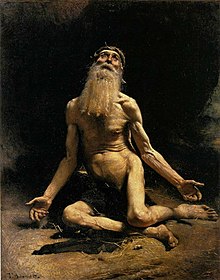
Job by French painter Léon Bonnat, 1880

Oh, that my grief was weighed,
    all of it were lifted in scales;
    for now it is heavier than the sands of the sea;
        therefore, my words are rash.
The Almighty’s arrows are in me;
    my spirit drinks their poison,
    and God’s terrors are arrayed against me.
Does a donkey bray over grass
    or an ox bellow over its fodder?
Is tasteless food eaten without salt,
    or does egg white have taste?
I refuse to touch them;
    they resemble food for the sick.

Oh, that what I’ve requested would come
        and God grant my hope;
    that God be willing to crush me,
    release his hand and cut me off.
I’d still take comfort,
    relieved even though in persistent pain;
        for I’ve not denied the words of the holy one.
What is my strength, that I should hope;
    my end, that my life should drag on?
Is my strength that of rocks,
    my flesh bronze?
I don’t have a helper for myself;
    success has been taken from me. (CEB)

The Old Testament character of Job is famous as the poster boy for suffering, grief, and sorrow. A divine and devilish drama was taking place behind the curtain of this world, of which Job had absolutely no clue about.  All he knew was that he lost everything – his family, his wealth, and his standing before others.  The only thing left was his own life – and he was in such physical pain and emotional agony that he was ready to die.

Yet, the greatest pain of all seems to be the silence of God. Job has no idea, nothing to grab ahold of no earthly sense of why he was going through such intense and terrible suffering. His cries, tears, pleas, and expressions of deep hurt seemingly go un-noticed. Job felt truly alone in his horrible pain of body and spirit.

“We must learn to regard people less in the light of what they do or omit to do, and more in the light of what they suffer.”

Dietrich Bonhoeffer

Job’s story is as old as time – probably having taken place 4,000 years ago. And here we are, all these millennia later, knowing the story of why Job suffered, as well as the end of the story. But Job himself never knew why he suffered, even when God spoke and restored his health and wealth.

It is so extremely easy and normal to ask the question, “Why!?”  When we are in the throes of emotional pain and our prayers seem to bounce off the ceiling, there is only trust left for us. We do what is unthinkable to others who have never known God – place our complete reliance and hope on the God for whom we know is not really sleeping or off on a vacation. We believe, even know, God is there. For whatever reasons which we might never know this side of heaven, God chooses to remain silent.

The genuineness of faith is not determined by giving the right answers to a theology questionnaire. Genuine faith is made strong through the trials, sufferings, pain, and lack of understanding in this life. We all suffer in some way. How we choose to respond to that suffering, either by cursing God and becoming bitter, or holding to God even tighter and becoming better, is totally up to you and me.

God of all creation, you see and survey all your creatures here on this earth. Sometimes I just do not understand what in the world you are doing or not doing. Yet today I choose to put my faith, hope, and love in you.  I may not know what the heck I am doing, but you always work to accomplish your good purposes, through Jesus Christ, my Savior, along with the Holy Spirit.  Amen.