Pass Along Values (1 Kings 2:1-11)

David’s Dying Charge to Solomon, by Ferdinand Bol (1616-1680)

David’s time was coming to an end. So he commanded Solomon his son, “I’m following the path that the whole earth takes. Be strong and be a man. Guard what is owed to the Lord your God, walking in his ways and observing his laws, his commands, his judgments, and his testimonies, just as it is written in the Instruction from Moses.

“In this way you will succeed in whatever you do and wherever you go. So also the Lord will confirm the word he spoke to me: ‘If your children will take care to walk before me faithfully, with all their heart and all their being, then one of your own children will never fail to be on the throne of Israel.’ 

You should know what Joab, Zeruiah’s son, has done to me and what he did to the two generals of Israel, Abner, Ner’s son, and Amasa, Jether’s son. He murdered them, spilling blood at peacetime and putting the blood of war on the belt around his waist and on the sandals on his feet. So act wisely: Don’t allow him to die a peaceful death. 

“As for Barzillai’s sons from Gilead, show them kindness. Let them eat with you. When I was running away from your brother Absalom, they came to me. 

“Now as for this Shimei, Gera’s son—a Benjaminite from Bahurim—who is with you, he cursed me viciously when I went to Mahanaim. When he came down to meet me at the Jordan, I swore to him by the Lord, ‘Surely I won’t execute you with the sword.’ But you don’t need to excuse him. You are wise and know what to do to him. Give him a violent death.”

Then David lay down with his ancestors and was buried in David’s City. He ruled over Israel forty years—seven years in Hebron and thirty-three years in Jerusalem. (Common English Bible)

David

On David’s deathbed, he ensured that his son Solomon would be king. And David had some pragmatic advice to pass along, before he himself passed away.

Along with an encouragement to remain faithful to God’s covenant stipulations, David communicated some personal scores to Solomon that needed to be settled. Old general Joab, as well as Shimei, a servant from Saul’s old house, were threats to the new king’s reign in Israel and Judah.

Joab and Shimei

King David had a complicated relationship with Joab. At issue for David was the murder of two opponents to the king. Joab had killed them in a time of peace, and not because of a wartime situation.

On top of that, Joab had thrown his lot in with Adonijah, Solomon’s half-brother, who had tried to wriggle onto the throne before David was even gone.

And then there was the character Shimei. He had cursed David repeatedly when yet another half-brother to Solomon, Absalom, engaged in a coup attempt against his father.

Once the threat had passed, Shimei made a quick about face back to David. The king told Shimei that he would not kill him. But with Solomon, David communicated that he was completely free to do what needed to be done with the old rascal Shimei.

Fathers

Ideally, all fathers would have the chance to communicate to their children at the end of their lives. Yet, having been at the bedside of many a father in my work as a hospital chaplain, I’ve not seen many who pass along wisdom and instructions on their deathbed.

Fortunately, there are times when I can help facilitate the conversation between father and family. Yet, unfortunately, there are far too many times when fathers simply die with no loved ones present; or they badger someone to promise to stop doing something.

Rare, however, are the experiences of expressing some sound instruction, along with instructions about how to deal with life.

I realize that wills and documents do much of this work nowadays, yet I still argue that face-to-face communication which reinforces one’s values is always a good idea – especially at the end of one’s life.

Honestly, nobody really needs to wait until they are nearly gone to communicate important values and sage advice to loved ones. It can be done now, before it’s too late.

I’m talking about more than healthcare decisions for the actual end of life situation – but about the grace, forgiveness, wisdom, and/or moral values one wants their loved ones to know; or to reinforce those things that are of upmost importance.

It seems to me that thinking through the following values, and how to communicate them, can be done now, and, if appropriate and possible, at the end of one’s life:

Empathy

Treat others with compassion and understanding. Practice kindness. Consider the emotions of others. Seek to understand another’s point of view. Encourage family members to talk about their feelings. 

Therefore, as God’s choice, holy and loved, put on compassion, kindness, humility, gentleness, and patience. (Colossians 3:12, CEB)

Relationships

In the end, the only thing permanent and enduring is relationships. We cannot take any of our stuff with us. Prioritize time with people, especially family. It only makes sense to value loved ones by putting our time into them.

Be happy with those who are happy, and cry with those who are crying. Consider everyone as equal, and don’t think that you’re better than anyone else. (Romans 12:15-16, CEB)

Honesty

Telling the truth is not always easy, but it’s essential to maintaining trust between people. Life requires knowing and living by the truth.

“You are truly my disciples if you remain faithful to my teaching. Then you will know the truth, and the truth will set you free.” (John 8:31-32, CEB)

Love

Deep affection and attachment connects people and keeps them together. It’s important to verbally express love, as well as to demonstrate it with actions.

Don’t be in debt to anyone, except for the obligation to love each other. Whoever loves another person has fulfilled the Law. (Romans 13:8, CEB)

Commitment

Support one another in difficult times; and do not intentionally harm each other. Don’t shame your family for mistakes they’ve made. Instead, express loyalty and encouragement.

Be the best in this work of grace in the same way that you are the best in everything, such as faith, speech, knowledge, total commitment, and the love we inspired in you. (2 Corinthians 8:7, CEB)

Respect

Treat everyone, and especially family members, with the upmost care and politeness; and discourage disrespectful words and offensive behavior.

Submit to each other out of respect for Christ. (Ephesians 5:21, CEB)

Perseverance

Your family will face many complex challenges in the years ahead. Encourage them to embrace shared goals, practice self-care, and patiently work together in order to overcome obstacles. 

We even take pride in our problems, because we know that trouble produces endurance, endurance produces character, and character produces hope. (Romans 5:3-4, CEB)

It is always open season on passing along wise and good values, no matter whether it’s in a calm or a calamitous season of life.

Almighty God, enable me to be mindful of your mercy and happy to do your will. Bless my family with honest work, sound learning, and good manners. Save us all from violence, division, and confusion; and from pride and arrogance, and all evil. Protect us, and keep us united.

Grant Your wisdom to all in positions of authority and influence, so that there may be justice and peace at home, and obedience and submission everywhere. In times of prosperity, fill our hearts with grace and gratitude, and in times of trouble, help us trust in Your divine justice, righteousness, and goodness; through Jesus Christ our Lord. Amen. 

Holding Both Victory and Defeat (2 Samuel 19:1-18)

David mourns the death of Absalom, by Gustave Doré (1832-1883)

Joab was told, “The king is weeping and mourning for Absalom.” And for the whole army the victory that day was turned into mourning, because on that day the troops heard it said, “The king is grieving for his son.” The men stole into the city that day as men steal in who are ashamed when they flee from battle. The king covered his face and cried aloud, “O my son Absalom! O Absalom, my son, my son!”

Then Joab went into the house to the king and said, “Today you have humiliated all your men, who have just saved your life and the lives of your sons and daughters and the lives of your wives and concubines. You love those who hate you and hate those who love you. You have made it clear today that the commanders and their men mean nothing to you. I see that you would be pleased if Absalom were alive today and all of us were dead. Now go out and encourage your men. I swear by the Lord that if you don’t go out, not a man will be left with you by nightfall. This will be worse for you than all the calamities that have come on you from your youth till now.”

So the king got up and took his seat in the gateway. When the men were told, “The king is sitting in the gateway,” they all came before him.

Meanwhile, the Israelites had fled to their homes.

Throughout the tribes of Israel, all the people were arguing among themselves, saying, “The king delivered us from the hand of our enemies; he is the one who rescued us from the hand of the Philistines. But now he has fled the country to escape from Absalom; and Absalom, whom we anointed to rule over us, has died in battle. So why do you say nothing about bringing the king back?”

King David sent this message to Zadok and Abiathar, the priests: “Ask the elders of Judah, ‘Why should you be the last to bring the king back to his palace, since what is being said throughout Israel has reached the king at his quarters? You are my relatives, my own flesh and blood. So why should you be the last to bring back the king?’ And say to Amasa, ‘Are you not my own flesh and blood? May God deal with me, be it ever so severely, if you are not the commander of my army for life in place of Joab.’”

He won over the hearts of the men of Judah so that they were all of one mind. They sent word to the king, “Return, you and all your men.” Then the king returned and went as far as the Jordan.

Now the men of Judah had come to Gilgal to go out and meet the king and bring him across the Jordan. Shimei son of Gera, the Benjamite from Bahurim, hurried down with the men of Judah to meet King David. With him were a thousand Benjamites, along with Ziba, the steward of Saul’s household, and his fifteen sons and twenty servants. They rushed to the Jordan, where the king was. They crossed at the ford to take the king’s household over and to do whatever he wished. (New International Version)

King David learns of Absalom’s death, by Unknown artist, c.1590

King David’s son, Absalom had become a bitter and angry man, especially toward his father. He took his time to build a conspiracy against David, in order to replace him as king. Absalom succeeded in taking Jerusalem.

However, King David escaped with those loyal to him. Although Absalom had the upper hand and could have followed through with overtaking David, a monkey wrench in counsel led to David gaining a fighting chance. It all eventually led to the death of Absalom in battle.

And this is where King David showed yet again the sort of incongruence that, it seems, only a parent can do. His loyal men won the battle, yet Absalom was slain because of Joab, the commander. David’s grief over his son’s loss was palpable; he wept and lamented, despite the great victory that had been achieved against the odds.

Indeed, David experienced the dilemma of being both a father and a king – and it ripped his heart.

Throughout the narratives of David, Joab is presented as a no-nonsense business-like guy. He didn’t have much tolerance for the touchy-feely stuff, and let the king know it. Joab often had a right assessment of things, but conversely, he often spoke and acted in a wrong manner.

Joab essentially picked up a strange parental role of scolding David into facing his present circumstance. The troops needed assurance; and it could only come from the king, whom they were fighting for in the first place.

So, David acquiesced to Joab, and took his public seat, receiving the army as victors. Yet, King David had enough of Joab’s unfeeling shenanigans, and summarily replaced him as commander of the military.

With Absalom dead, and David acting more like a king again, it isn’t long before Israel and Judah receive him back as their king, and take him to Jerusalem to once again rule over the land. David had to discover, yet again, in a new situation what it means to hold both victory and defeat, joy and sorrow, together.

It’s typical for us as biblical readers to ask, “What’s the point of the story?” We tend to like our bottom lines and neat summaries of things. After all, we’re busy people with things to do and people to see. Just give it to me straight, and I’ll go on my merry way.

But Scripture reading doesn’t work like that. It’s not fast food. Scriptural narratives require us to slowly chew on them, to sit with them for a while, and to take the time for reflection, prayer, and listening.

In doing this, we will likely discover that we could read the same story at different times and at various seasons of our lives, and come away with a different “bottom line” in each fresh reading of the text.

This is why I am a committed Bible reader (and thinker!). In some cases, I’ve read the same story hundreds of times. Nearly always, I walk away from the encounter seeing something new or discovering an insight of the text (or myself!) that I had never seen before.

So, these daily Bible reflections are my thoughts of Scripture that I had at a particular time and place. Having said that, I wonder what stirs within you as you read and encounter the story of King David after the death of his son Absalom…

Feel free to share your thoughts.

O Lord, we call upon You in times of both sorrow and joy. Give us the strength and the will to bear our heavy burdens, as well as to wisely carry our manageable ones. In all things, help us feel the warmth and love of Your divine compassion. Amen.

Family Drama (2 Samuel 13:37-14:24)

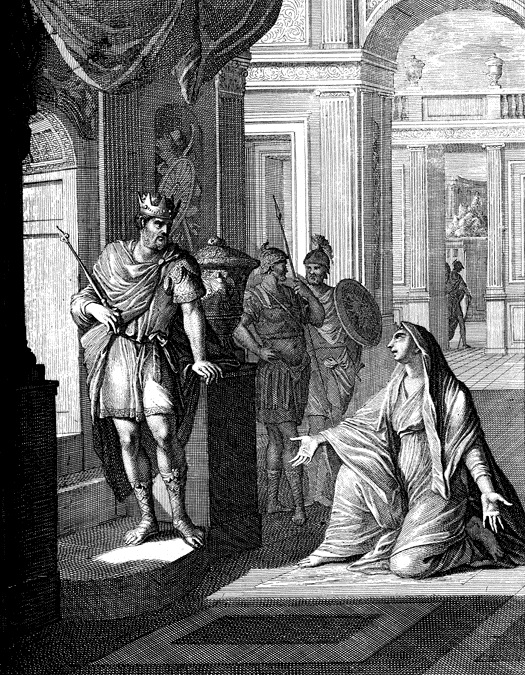
The woman of Tekoa before King David, by Caspar Luiken, 1700

Absalom fled and went to Talmai son of Ammihud, the king of Geshur. But King David mourned many days for his son.

After Absalom fled and went to Geshur, he stayed there three years. And King David longed to go to Absalom, for he was consoled concerning Amnon’s death.

Joab son of Zeruiah knew that the king’s heart longed for Absalom. So Joab sent someone to Tekoa and had a wise woman brought from there. He said to her, “Pretend you are in mourning. Dress in mourning clothes, and don’t use any cosmetic lotions. Act like a woman who has spent many days grieving for the dead. Then go to the king and speak these words to him.” And Joab put the words in her mouth.

When the woman from Tekoa went to the king, she fell with her face to the ground to pay him honor, and she said, “Help me, Your Majesty!”

The king asked her, “What is troubling you?”

She said, “I am a widow; my husband is dead. I your servant had two sons. They got into a fight with each other in the field, and no one was there to separate them. One struck the other and killed him. Now the whole clan has risen up against your servant; they say, ‘Hand over the one who struck his brother down, so that we may put him to death for the life of his brother whom he killed; then we will get rid of the heir as well.’ They would put out the only burning coal I have left, leaving my husband neither name nor descendant on the face of the earth.”

The king said to the woman, “Go home, and I will issue an order in your behalf.”

But the woman from Tekoa said to him, “Let my lord the king pardon me and my family, and let the king and his throne be without guilt.”

The king replied, “If anyone says anything to you, bring them to me, and they will not bother you again.”

She said, “Then let the king invoke the Lord his God to prevent the avenger of blood from adding to the destruction, so that my son will not be destroyed.”

“As surely as the Lord lives,” he said, “not one hair of your son’s head will fall to the ground.”

Then the woman said, “Let your servant speak a word to my lord the king.”

“Speak,” he replied.

The woman said, “Why then have you devised a thing like this against the people of God? When the king says this, does he not convict himself, for the king has not brought back his banished son? Like water spilled on the ground, which cannot be recovered, so we must die. But that is not what God desires; rather, he devises ways so that a banished person does not remain banished from him.

“And now I have come to say this to my lord the king because the people have made me afraid. Your servant thought, ‘I will speak to the king; perhaps he will grant his servant’s request. Perhaps the king will agree to deliver his servant from the hand of the man who is trying to cut off both me and my son from God’s inheritance.’

“And now your servant says, ‘May the word of my lord the king secure my inheritance, for my lord the king is like an angel of God in discerning good and evil. May the Lord your God be with you.’”

Then the king said to the woman, “Don’t keep from me the answer to what I am going to ask you.”

“Let my lord the king speak,” the woman said.

The king asked, “Isn’t the hand of Joab with you in all this?”

The woman answered, “As surely as you live, my lord the king, no one can turn to the right or to the left from anything my lord the king says. Yes, it was your servant Joab who instructed me to do this and who put all these words into the mouth of your servant. Your servant Joab did this to change the present situation. My lord has wisdom like that of an angel of God—he knows everything that happens in the land.”

The king said to Joab, “Very well, I will do it. Go, bring back the young man Absalom.”

Joab fell with his face to the ground to pay him honor, and he blessed the king. Joab said,

“Today your servant knows that he has found favor in your eyes, my lord the king, because the king has granted his servant’s request.”

Then Joab went to Geshur and brought Absalom back to Jerusalem. But the king said, “He must go to his own house; he must not see my face.” So Absalom went to his own house and did not see the face of the king. (New International Version)

By Bible Art

Absalom’s sister, Tamar, was sexually assaulted by their half-brother Amnon. As a result, Absalom brought Tamar to live in his house, because she had become a desolate woman.

When their father, King David, heard all this, he was, of course, furious; yet, he did nothing. And Absalom never talked to Amnon again; he hated Amnon because he had disgraced his sister Tamar.

For two years, Abasalom stewed on the terrible event of his sister’s assault. When the man’s bitterness came to it’s full poison, Abasalom created a ruse in order to kill Amnon. And the murderous plot was successful.

Then, Absalom fled and went to Geshur (north of Israel, in present day Syria) and stayed there three years. King David longed to go to Absalom, but he never did, nor did he do anything, either good or bad.

All of that stuff is what led up to today’s story about bringing Absalom back. When I was younger, I would read these stories of David and his sons and scratch my head as to why a guy that’s so wise to so many things seems stupid when it comes to his own family.

And then I became a father myself, with grown adult children. Now, I understand David’s actions and in-actions. I get it. When it comes to being a parent of adult kids, there is a very different perspective. It’s an outlook that’s hard to communicate and put into words.

Sometimes I wonder if it’s how God looks at us.

The nearest I can get to describing it, is that the sense of awe and wonder at that little baby being born never quite goes away.

The incredible and seemingly miraculous thing we call childbirth creates a view that this human being is so special, there is always hope they will become a little child again, that is, not literally, but in the sense of being yet again humble, right, good, and endearing – that the relational value will return.

In this sense, a parent never loses hope. And I think that is something of what King David was experiencing with his own adult children. What’s more, it seems that God has this unfailing love for us that continually longs for humanity to come back to the divine relationship.

God appears in Holy Scripture as this heavenly Father (and Mother) who is slow to judgment and long on steadfast love and covenant loyalty. The Lord is not slow in keeping promises or doing what is right. Rather, God is patiently waiting for humans to come to repentance and faith.

Admittedly, there is the sense that King David seems unreasonable, that he was unwilling to do something about his adult children’s shenanigans. Yet, there is also this sense of longing, of King David knowing the potential of his children, and holding out the hope that they will live into who they were created to be on this earth.

I definitely don’t think David always got it right. But he also didn’t always get it wrong, either. Which is pretty darned close to how every parent is doing, if we are honest about it. So, here is a blessing for parents of adult children:

May the Lord bless your adult children with the gift of the Holy Spirit. May they be filled with faith, hope, love, peace, truth, and spiritual power, so that they may be blessed and be a blessing to others.

And may God guide parents everywhere with discernment and wisdom, so that everything they do will come from the place of grace, truth, and love. Amen.

This Is No Time for Bitterness (2 Samuel 3:31-38)

David at the tomb of Abner, by Unknown Artist, 1850

Then David said to Joab and all the people with him, “Tear your clothes and put on sackcloth and walk in mourning in front of Abner.” King David himself walked behind the bier. They buried Abner in Hebron, and the king wept aloud at Abner’s tomb. All the people wept also.

The king sang this lament for Abner:

“Should Abner have died as the lawless die?
    Your hands were not bound,
    your feet were not fettered.
You fell as one falls before the wicked.”

And all the people wept over him again.

Then they all came and urged David to eat something while it was still day; but David took an oath, saying, “May God deal with me, be it ever so severely, if I taste bread or anything else before the sun sets!”

All the people took note and were pleased; indeed, everything the king did pleased them. So on that day all the people there and all Israel knew that the king had no part in the murder of Abner son of Ner.

Then the king said to his men, “Do you not realize that a commander and a great man has fallen in Israel this day? (New International Version)

To put it succinctly, Abner was a rascal. He was smart and savvy, as well as self-centered and treacherous. Abner was the general of Israel’s armies. In his shrewdness, Abner knew that King David of Judah would eventually win out.

So, he set things up to sell-out his position with Ish-Bosheth, the king of Israel, and bring all of Israel and Judah together as one people. Then, he would be the general in a united kingdom under David.

However, Abner had burned some bridges in his day, and created some enemies. Joab was one of them, David’s general. What’s more, Joab was loyal to King David and did not have intentions like those of Abner. All of this (and more) stirred within Joab, as Abner and David talked through a transition plan.

Joab was a bitter man. He and his brother Abishai did not like their king consorting with Abner. Abner had killed their brother Asahel in the battle at Gibeon. Bitterness turned Joab into a myopic person who could only see his own perspective. So he and his brother murdered Abner without David’s knowledge. Abner was a stinker in a lot of ways. But he didn’t go around murdering people, and he himself didn’t deserve to be murdered.

When David found out, he chose not to channel his anger into another murder. Instead, he wisely focused on grieving the loss of Abner and demonstrating to all Israel and Judah what sort of king he really was.

“Many people suffer because of the false supposition on which they have based their lives. That supposition is that there should be no fear or loneliness, no confusion or doubt. But these sufferings can only be dealt with creatively when they are understood as wounds integral to our human condition.” Henri Nouwen

Far too many people allow their spiritual and emotional wounds to fester – eventually poisoning their own character. With the illness of bitterness, someone is always bound to get hurt.

We all have to contend with adverse situations and hard circumstances. Our doubts, wonderings, hurts, and suffering may be legitimate, yet if addressed in an illegitimate way, those things become emotional wounds that seek to wound others.

Make every effort to live in peace with everyone and to be holy; without holiness no one will see the Lord. See to it that no one falls short of the grace of God and that no bitter root grows up to cause trouble and defile many. (Hebrews 12:14-15, NIV)

David had no picnic for a life. Saul had tried to repeatedly kill him, hunting David down like an animal. After Saul was killed in battle, there were all sorts of shenanigans going on with people like Abner and Joab. This was no idyllic setting for David to set up a kingdom.

And yet, David made it work by not succumbing to the bitterness which was so easy for others. King David did something different. He seemed to understand that his own woundedness, sufferings, and doubt was the place for personal and spiritual growth – a way of connecting with God.

The hurts which David acquired in his life never became a source of shame to him. Instead, those things became a source of healing – which made him a wounded healer who was able to rule Israel and Judah with mercy, wisdom, and justice.

For us, the same thing can happen. All of the stuff we’ve been through, from people who intended harm for us, doesn’t have to end with being poisoned by bitterness. Our actual woundedness can become the place where we bless the world.

Indeed, ‘tis our weaknesses which give us our true strength.

Bitterness, on the other hand, may fuel some anger and give us a false sense of strength; but it’s only really a matter of time until we implode. And before that happens, the bitter person will likely take down others with the inevitable spit of poison which is vomited up from the pit of their serpentine belly.

We are, like David, to take a different path in dealing with the troubles brought upon us by others:

And do not grieve the Holy Spirit of God, with whom you were sealed for the day of redemption. Get rid of all bitterness, rage and anger, brawling and slander, along with every form of malice. Be kind and compassionate to one another, forgiving each other, just as in Christ God forgave you. (Ephesians 4:30-32, NIV)

The road to a better life is full of twists and turns, and fraught with severe potholes and downed trees. But the road to a bitter life is quite easy, straight and paved perfectly smooth with asphalt. The problem is that it is a one way highway to the cemetery.

The clock is ticking, and it’s no time for bitterness. Which road will you take?

Blessed God and Father of our Lord Jesus Christ, please don’t let our appropriate anger morph into destructive revenge. Don’t let our raw hurts become a festering and putrid abscess of the soul, which is bent on getting even—repaying harm for harm, evil for evil, and death for death.

Holy Spirit, our Companion and Counselor, don’t let our hearts become gardens for the roots of resentment, growing into bushes of bitterness. Give us, instead, the desire to forgive others. May redemption and restoration have their way in us, through Christ our Lord. Amen.