Hebrews 3:1-6 – Jesus Is Better


Loving-Gods-House

“Therefore, brothers and sisters who are partners in the heavenly calling, think about Jesus, the apostle and high priest of our confession.  Jesus was faithful to the one who appointed him just like Moses was faithful in God’s house.  But he deserves greater glory than Moses in the same way that the builder of the house deserves more honor than the house itself.  Every house is built by someone, but God is the builder of everything. Moses was faithful in all God’s house as a servant in order to affirm the things that would be spoken later.  But Jesus was faithful over God’s house as a Son. We are his house if we hold on to the confidence and the pride that our hope gives us.” (Common English Bible)

It’s hard to be patient, difficult to persevere.  If the Christian life were a piece of cake, then there would be no need for the strengthening of faith and the development of perseverance.  But faith is a muscle.  If unused, it atrophies.  Faith needs exercise, and it must be tried in adverse circumstances to grow and mature.

The reason the author of Hebrews wrote his letter to Jewish Christians is because they were losing their grip, faltering in their faith.  The hard circumstances of those Christians were leading them to entertain the notion of returning to their old ways of life, apart from Christ.

It can be tempting to think of the past as “the good old days.”  But if you think about it for any length of time, you know better.  You’re just struggling in the present, and our minds turn to filter all the crud out from the past to make it look like things were better back then.

“Better” is what the book of Hebrews is all about.  The writer consistently and persistently insists that Jesus is better than anything from the Hebrew Christians’ past.  Moses was one the most respected and impressive figures of Old Testament history.  Jews revered him.  The book of Hebrews acknowledges that respect for Moses, but points-out and reminds the people that whereas Moses was faithful within God’s house, it is Jesus who is the Master over the house.  Jesus is better than Moses.

What’s more, we as believers and followers of Jesus are the house.  Jesus Christ is Lord – not Moses, or anybody else.  Jesus cares for and protects his house.  It might be tempting to believe that a previous house we lived-in in another city or town was better.  But the reality is that we live today in God’s house.  Therefore, we must hold on and not let go of the confidence we have in Jesus and the pride and privilege we have in living where we presently live.

When life is tough, reminiscing about the past is easy.  For sure, you can find all kinds of things you miss from your previous days somewhere.  Yet, trolling your personal history, like a time-wasting galavant on the computer, doesn’t do anything for your need of faith and perseverance.  But today, Jesus has a hold of you.  Today he wants to walk with you through your trouble, and not just transport you to the past.  Now is the time to follow Jesus into all the situations that are in front of you.  You are not alone.  You can do this.

Lord Jesus, you are sovereign over my past, present, and future.  Today has its situations and problems.  Help me walk into and through them with your gracious protection so that perseverance is developed within me and my faith in you is strengthened for tomorrow.  Amen.

Ephesians 1:7-14 – God Is Good

20180309_102748

Ephesians 1:8, Contemporary English Version of the Bible

“In him we have redemption through his blood, the forgiveness of our trespasses, according to the riches of his grace that he lavished on us. With all wisdom and insight, he has made known to us the mystery of his will, according to his good pleasure that he set forth in Christ, as a plan for the fullness of time, to gather up all things in him, things in heaven and things on earth.  In Christ we have also obtained an inheritance, having been destined according to the purpose of him who accomplishes all things according to his counsel and will, so that we, who were the first to set our hope on Christ, might live for the praise of his glory. In him you also, when you had heard the word of truth, the gospel of your salvation, and had believed in him, were marked with the seal of the promised Holy Spirit; this is the pledge of our inheritance toward redemption as God’s own people, to the praise of his glory.” (Common English Bible)

Believe it or not, verses 3-14 of Ephesians chapter one, 12 verses in all, are one single sentence in the Greek language the Apostle Paul originally wrote this in.  Thankfully, and understandably, English translators have created multiple sentences for us so that we can better make sense of the text.  It’s almost as if Paul was so excited to talk with the Ephesian church about who they are in Jesus Christ and what they possess in him that he blurted out with enthusiasm and wrote with fervor without stopping to take a breath.

Paul heaps word after significant word on top of each other in a flurry of provided spiritual blessings the believer in Christ enjoys.  Redemption, forgiveness, insight, protection, inheritance, and salvation are just some of the blessings given.  If that wasn’t enough, God has graciously given us his Holy Spirit, the Paraclete, the one who comes alongside and helps us to live into the blessings we possess because of the person and work of Christ.

redemption

It’s as if we came to Christmas day expecting a package of underwear and found instead a bunch of big boxes with some of the most lavish and expensive gifts we’ve ever seen!  This says much more about the giver than it says about us.  It was according to God’s good pleasure in Christ that believers in Jesus have such privileges.  Like the parent who sits back and watches the unpackaging of presents happen with great joy, so God delights and is pleased with what he has given to us.

First and foremost, in the entirety of Holy Scripture, all the stories and narratives, teachings and writings, are about God.  He is both the subject and object of each book of the Bible.  Every good thing we have in this life is because of God’s grace.  Each positive experience is a direct result of God’s steadfast love toward his people.  All good gifts come from a good God who is pleased to give them.

Not a one of us purchased our own gifts and stuck them under the tree.  God bought them all with the precious blood of Jesus and sent the Spirit to deliver them to us.

Take some time today in a quiet place and reflect on just one of these words in the text.  Think about redemption or forgiveness, salvation or grace, or any of the words which grab you.  Say it over and over, quietly and loudly, thoughtfully and with flavor.  Consider what God did to bring you that gift.  Contemplate the way(s) in which you have received the gift.  Plan one way in which you might share your gift with another person.  Then, give glory and praise to God for his grace to you.

May your meditation lead to a deeper appreciation of what God has done for you; and may that revelation result in praise, honor, and glory to the One who accomplished so much on your behalf.

Gracious God, you have revealed and made known the way of deliverance from the power of darkness and brought me into your marvelous light.  Help me to better understand all the ways you have acted on my behalf so that my life might reflect your grace and steadfast love to the world; through Jesus Christ, my Savior, in the enablement of the Holy Spirit.  Amen.

Hebrews 9:23-28 – Once and for All

atonement modern

“Just as people are destined to die once, and after that to face judgment, so Christ was sacrificed once to take away the sins of many; and he will appear a second time, not to bear sin, but to bring salvation to those who are waiting for him.” (New Revised Standard Version)

Once and for all.  Those are some of the most gruesome and beautiful words in the entirety of Holy Scripture.  The sacrifices of bulls and goats in the Old Testament had its place.  But those were mere shadows pointing to the reality of Messiah – the one whose sacrifice is so potent as to do away with sacrifice forever.

Christ’s cross was the once for all sacrifice that has settled the sin issue forever.

This is the heart of the New Testament’s good news.  Forgiveness of sins comes through the sheer grace of God in Christ.  Through faith, we have the privilege of entering the realm of new life.  In other words, Jesus has paved the way for eternal life, everlasting salvation, and complete remission of sins.

If it has not yet become self-apparent as to why Christ’s once for all sacrifice is such a game changer, then let’s take the cross from this angle: guilt is done away with, forever.  Do you think your life would change forever if you never had guilt hanging over your head?  What if all your past indiscretions; stupid life decisions; failures to speak or act; overt things done which you cannot take back; or, even the little things said or done in anger or hate; were all washed away, forever?

The precious blood of Jesus has nailed guilt to the cross once and for all.  There are three options of dealing with a guilty conscience when it happens.

1. Rationalize

First, you can rationalize it away, as if you have no responsibility or no culpability.  This is a one-way path to hardness of heart.  Whenever we sin in speech or in action, and don’t acknowledge it as our fault, then there is a little piece of us which hardens.  The next time it happens, it’s a bit easier to respond with callousness.  If you’ve ever encountered someone who seems utterly unfeeling to your situation, then there has likely been a pattern in that person’s life of keeping distance from pain.  It only leads to hardness of heart.

2. Punish

A second way of facing guilt is just the opposite of rationalization.  It is to punish and beat yourself for your faults and sins.  Heaping abuse on ourselves for our sins takes two different tracks with either: discouragement, defeat, and depression resulting in inaction; or, working like crazy to try and earn God’s favor with hyper-activity.  Both ways are a kind of self-imposed penance to try and atone for one’s sins or failures.

3. Confess

The third way is a biblical path to facing guilt.  When there is true guilt for things done or undone, said or unsaid, we must confess it, repent of it, and believe God has taken care of it.  Unlike dealing with guilt in unhealthy ways resulting in callousness, discouragement, and super-activity, the path of confession and repentance allows the person to have a clear conscience, resulting in freedom.  Christ’s once for all sacrifice is completely able to clear the conscience of the worshiper so that he/she may live into the grace and freedom of an enjoyable daily life.

Nothing needs to hang over the believer’s head because Jesus Christ, the pioneer of our salvation, has accomplished deliverance from and forgiveness of sin, once and for all.  He didn’t just put a nice-looking veneer over sin; he took care of it, thoroughly.  Jesus didn’t whitewash things so that we looked okay; the salvation he offers is permanent.

The cross which held Christ’s naked and tortured body exposed the true violence and injustice of sin.  The cross revealed what kind of world we have and what kind of God we have: a world of gross unfairness and sin; and, a God of extreme sacrificial love and grace.

What this world, and you and me, need more than anything else is forgiveness – not a cheap sentimental forgiving, but a real forgiveness that is so costly that it lasts forever and ever.

Either to justify or to judge is God’s business.  Our business is to believe in the once-for-all sacrifice of Jesus that brings permanent and lasting forgiveness; and, to share that life-giving message with others so that they, too, might experience deliverance from sin and its horrible effects.

“For he delivered us from the domain of darkness and transferred us to the kingdom of his beloved Son, in whom we have redemption, the forgiveness of sins.” (Colossians 1:13-14, NIV)

May you know the freedom and joy today which comes from knowing Christ as Savior.

John 2:13-22 – Sacred Space

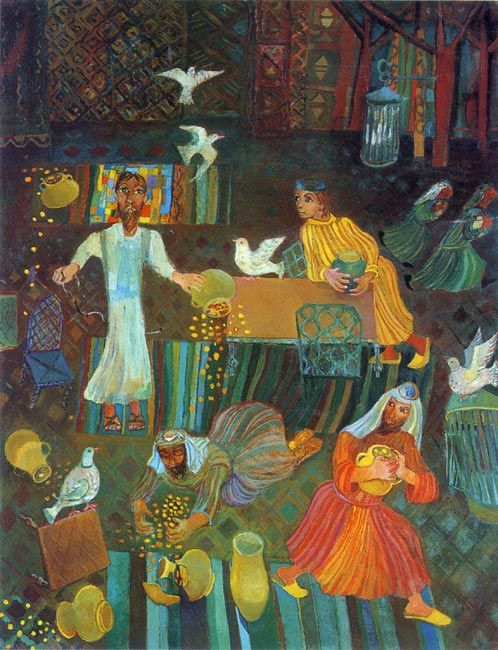
jesus and the moneychangers

“Not long before the Jewish festival of Passover, Jesus went to Jerusalem.  There he found people selling cattle, sheep, and doves in the temple. He also saw money-changers sitting at their tables.  So he took some rope and made a whip. Then he chased everyone out of the temple, together with their sheep and cattle. He turned over the tables of the money-changers and scattered their coins.  Jesus said to the people who had been selling doves, ‘Get those doves out of here! Don’t make my Father’s house a marketplace.’  The disciples then remembered that the Scriptures say, ‘My love for your house burns in me like a fire.’” (CEV)

Jesus, the human which he is, has a complexity to him.  Our Lord is not one-dimensional.  Christ not only extends grace and mercy, healing the least and the lost of society; he also turns his burning love for the Father on those who would treat the sacred with sacrilege.  There is a time for gentleness and meekness, and there is a time for zeal and action, done with flavor!

Jesus had a zero-tolerance policy toward using the representation of God, the temple, as the means to make money.  As people from all over the Middle East poured into Jerusalem for the Passover, savvy marketers set up their wares.  Knowing that not everyone could bring animals for sacrifice, the money-changers were more than ready to take advantage of the situation by providing sheep and cattle at inflated prices.  The temple looked more like a marketplace than a worship space, and Jesus would have none of it.

Christ the Lord was consumed with zeal for his Father’s house.  Jesus single-handedly took on the businessmen and drove them out of the temple courts with a homemade whip.  Whereas the people seemed to settle for the status quo of secular Passover protocol, Jesus restored worship to its rightful place in the life of God’s people.

Jesus still has zeal for proper worship.  As he did in the temple all those centuries ago, Christ rearranges the furniture and upsets how things have become.  Like an extreme makeover, the Lord overturns tables designed for selfish gain and re-establishes a connection between us and God.  He upholds holiness and righteousness so that you and I will have a clean and clear path of relationship with the sovereign God of the universe.

Sacred space is important, both as a physical room or building as well as in our own spiritual hearts.  That space becomes the meeting place between us and God.  The Lord wants a meaningful dialogue with us, and he will guard that place of connection with great zeal.

Christ Jesus, the one who zealously loves, you have gone before me and cleared the way for me to enter God’s presence.  Thank you for your movement toward me, and your careful guarding of our relationship.  May my time with you on this Lord’s day be an offering of praise and thanksgiving.  Amen.