Epiphany of the Lord (Isaiah 60:1-6)

Adoration of the Magi, Basilica of the National Shrine of the Immaculate Conception, Washington D.C.

“Arise, shine, for your light has come,
    and the glory of the Lord rises upon you.
See, darkness covers the earth
    and thick darkness is over the peoples,
but the Lord rises upon you
    and his glory appears over you.
Nations will come to your light,
    and kings to the brightness of your dawn.

“Lift up your eyes and look about you:
    All assemble and come to you;
your sons come from afar,
    and your daughters are carried on the hip.
Then you will look and be radiant,
    your heart will throb and swell with joy;
the wealth on the seas will be brought to you,
    to you the riches of the nations will come.
Herds of camels will cover your land,
    young camels of Midian and Ephah.
And all from Sheba will come,
    bearing gold and incense
    and proclaiming the praise of the Lord. (New International Version)

We are drawn to light. I don’t know if you have ever been in a situation with complete darkness surrounding you. When things are totally dark, we begin to fear and panic.

I grew up in a rural area in which there were no lights at night, other than the moon and the stars. More than once, I got myself into a situation, when the sky was overcast, in which I didn’t have a flashlight and could not see my hand in front of my face. I was groping to discern any little bit of light that I could see. Without the light, I was lost.

Our souls are also drawn to light. We no longer want to have darkness enveloping us; we cannot live with the darkness residing within our hearts. This is one reason why the Magi were attentive to the bright star over Bethlehem, and traveled toward it. We have a need for light because nobody can abide in darkness for too long.

The glory of the Lord is associated with bright light. Spiritually, we can find ourselves in such darkness that it’s impossible to discover light, unless God shows up displaying divine mercy and glory.

The Christian season of Epiphany has to do with this divine light. Each year on January 6, on the Church Calendar, and after the twelve days of Christmas, is the celebration of Epiphany. 
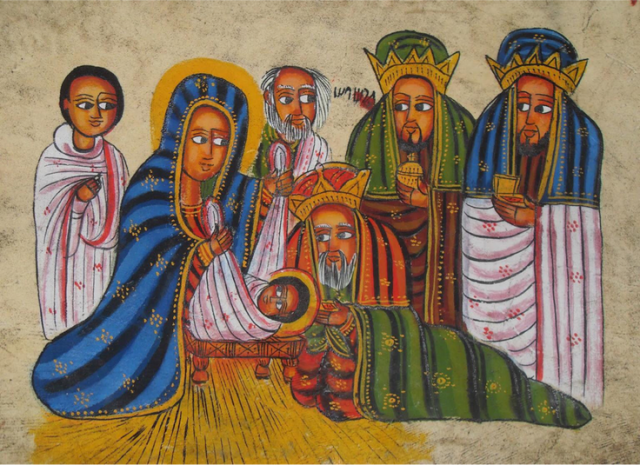
The Three Kings, Ethiopian Orthodox Church

It is a celebration of light – that Christ came to this earth as a child and became like us. Epiphany helps to bring a vision and understanding of God’s glory to all kinds of people in the world.

“Epiphany” literally means “manifestation” or “appearance.” The event most closely associated with this season is the visit of the Magi to Jesus. Included in this time of the year between the seasons of Christmas and Lent is a special emphasis on the teaching and healing ministry of Jesus. 

The people walking in darkness
    have seen a great light;
on those living in the land of deep darkness
    a light has dawned. (Isaiah 9:2; Matthew 4:16, NIV)

The great celebration and focus of these weeks is that salvation is not limited to Israel but extends to the Gentiles, as well.

“I will also make you a light for the Gentiles, that my salvation may reach to the ends of the earth.” (Isaiah 49:6; Luke 2:32; Acts 13:47, NIV)

In this season of Epiphany, the manifestation of God’s grace is one of the most scandalous truths of Christianity: God graces common ordinary people, who seem far from God, with the gift of Jesus. 

God grants repentance that leads to life for all kinds of people, no matter what their race, ethnicity, class, or background. It is a wondrous and astounding spiritual truth that God’s merciful concern is not limited to a certain type of person or a particular group of people.

Grace is (and ought to be) the guiding factor in how we interact with people. 

Losing sight of grace leads to being critical and defensive. Like King Herod of old, a graceless person becomes enamored with earthly power and control. But embracing grace, leads to humility, so that we see the image of God in people very different from ourselves. 

Like the Apostle Peter, who learned in a vision to bring the gospel to non-Jews, old legalisms begin to wear away so that people from all walks of life can have access to Jesus and his gracious saving and healing ministry. 

Grace brings down barriers and causes us to do away with unnecessary distinctions between others. And so, the appropriate response to such a grace is to glorify God for this marvelous and amazing work.

It is a gracious and merciful reality that the Magi, or Wise Men, who were really pagan astrologers, were directed to the Messiah. A light was provided to lead them to Jesus. Apart from God’s care and intervention they would have remained in darkness. 

And it is no less true for people today. This old broken world has a lot of shadowy places to it; there is darkness all around.  All kinds of people have no light at the end of the tunnel of their lives for hope and new life. But the gospel of Jesus Christ brings that light to those walking around with no ability to see. And Jesus exhorted his followers to be the reflectors of divine light for the world.

“Let your light shine before others, that they may see your good deeds and glorify your Father in heaven.”

Jesus (Matthew 5:16, NIV)

Sometimes, maybe oftentimes, the best way to bring resolution to our own troubles and problems is through helping others make sense of their lives through the gracious light of Christ so that they can see an appearance, an epiphany, of what their lives can be in the gracious rule of the kingdom of God. 

As we celebrate Epiphany and journey with Jesus through his earthly upbringing and into his gracious ministry to people, let us keep vigilance to not let our light grow dim. Instead, let us hunger and thirst after Christ’s righteousness so that our joy is full and our light is bright.

God of radiant light, your love illumines our hopes before we know them, and our needs before we ask. Kindle your flame within us, that in our prayers and service, we may know your transforming presence at work in the world around us. All this we ask through Jesus Christ, our Lord. Amen.

Who Is Jesus? (Luke 2:22-40)

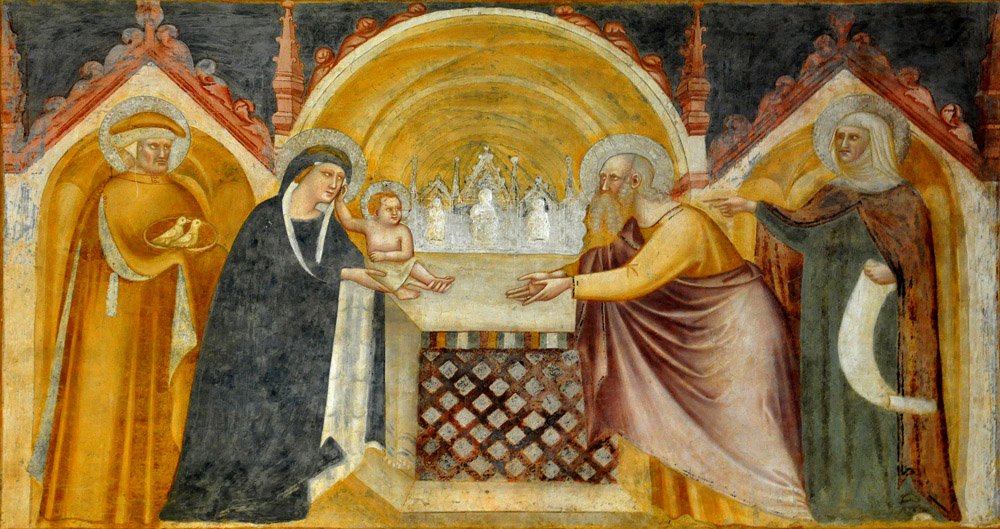
The Presentation in the Temple, 14th century fresco in Pomposa Abbey, Codorigo, Italy

When the time came for the purification rites required by the Law of Moses, Joseph and Mary took him to Jerusalem to present him to the Lord (as it is written in the Law of the Lord, “Every firstborn male is to be consecrated to the Lord”), and to offer a sacrifice in keeping with what is said in the Law of the Lord: “a pair of doves or two young pigeons.”

Now there was a man in Jerusalem called Simeon, who was righteous and devout. He was waiting for the consolation of Israel, and the Holy Spirit was on him. It had been revealed to him by the Holy Spirit that he would not die before he had seen the Lord’s Messiah. Moved by the Spirit, he went into the temple courts. When the parents brought in the child Jesus to do for him what the custom of the Law required, Simeon took him in his arms and praised God, saying:

“Sovereign Lord, as you have promised,
    you may now dismiss your servant in peace.
For my eyes have seen your salvation,
    which you have prepared in the sight of all nations:
a light for revelation to the Gentiles,
    and the glory of your people Israel.”

The child’s father and mother marveled at what was said about him. Then Simeon blessed them and said to Mary, his mother: “This child is destined to cause the falling and rising of many in Israel, and to be a sign that will be spoken against, so that the thoughts of many hearts will be revealed. And a sword will pierce your own soul too.”

There was also a prophet, Anna, the daughter of Penuel, of the tribe of Asher. She was very old; she had lived with her husband seven years after her marriage, and then was a widow until she was eighty-four. She never left the temple but worshiped night and day, fasting and praying. Coming up to them at that very moment, she gave thanks to God and spoke about the child to all who were looking forward to the redemption of Jerusalem.

When Joseph and Mary had done everything required by the Law of the Lord, they returned to Galilee to their own town of Nazareth. And the child grew and became strong; he was filled with wisdom, and the grace of God was on him. (New International Version)

The Gospel accounts of Matthew, Mark, Luke, and John actually contain very little information about the childhood of Jesus. That’s because the Gospels are not biographies – in the sense we think of them – but rather they are narratives that seek to answer a fundamental question about faith and life on this earth: Who is this Jesus?

C.S. Lewis went about exploring that very question. He reasons with us in his classis work, Mere Christianity:

“I am trying here to prevent anyone saying the really foolish thing that people often say about Him: I’m ready to accept Jesus as a great moral teacher, but I don’t accept his claim to be God. That is the one thing we must not say. A man who was merely a man and said the sort of things Jesus said would not be a great moral teacher. He would either be a lunatic — on the level with the man who says he is a poached egg — or else he would be the Devil of Hell. You must make your choice. Either this man was, and is, the Son of God, or else a madman or something worse. You can shut him up for a fool, you can spit at him and kill him as a demon or you can fall at his feet and call him Lord and God, but let us not come with any patronizing nonsense about his being a great human teacher. He has not left that open to us. He did not intend to.”

C.S. Lewis, Mere Christianity

St. Luke’s account of Christ’s childhood stories, seeks to make some important theological points about Jesus:

  • born a Jew amongst devout religious Jews in a thoroughly Jewish society, under Roman authority (Luke 2:1-7)
  • born of a woman, born under the law (Galatians 4:4-5)
  • obedient to his heavenly Father (Luke 2:49; Mark 3:35)
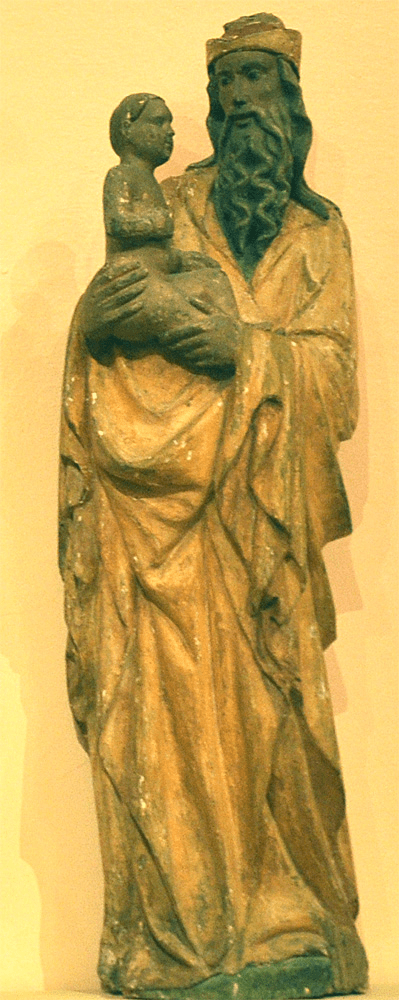
The Presentation in the Temple, 14th century marble statue in the National Museum of the Middle Ages, Paris, France

So, as such, the presentation of Jesus in Jerusalem at the temple is motivated by specific requirements of the law of Moses:

The Lord said to Moses, “Say to the Israelites: ‘A woman who becomes pregnant and gives birth to a son will be ceremonially unclean for seven days…. On the eighth day the boy is to be circumcised. Then the woman must wait thirty-three days to be purified from her bleeding. She must not touch anything sacred or go to the sanctuary until the days of her purification are over….

“‘When the days of her purification for a son… are over, she is to bring to the priest at the entrance to the tent of meeting a year-old lamb for a burnt offering and a young pigeon or a dove for a sin offering….

“‘These are the regulations for the woman who gives birth to a boy… But if she cannot afford a lamb, she is to bring two doves or two young pigeons, one for a burnt offering and the other for a sin offering. In this way the priest will make atonement for her, and she will be clean.’” (Leviticus 12:1-8, NIV)

What’s more, every first-born male (as Jesus was) specifically belongs to the Lord, and is set apart.

The Lord said to Moses, “Consecrate to me every firstborn male. The first offspring of every womb among the Israelites belongs to me… you are to give over to the Lord the first offspring of every womb….”

“In days to come, when your son asks you, ‘What does this mean?’ say to him, ‘With a mighty hand the Lord brought us out of Egypt, out of the land of slavery. When Pharaoh stubbornly refused to let us go, the Lord killed the firstborn of both people and animals in Egypt.

This is why I sacrifice to the Lord the first male offspring of every womb and redeem each of my firstborn sons.’ And it will be like a sign on your hand and a symbol on your forehead that the Lord brought us out of Egypt with his mighty hand.” (Exodus 13:1-2, 12, 14-16, NIV)

Luke was making the connection that when Joseph and Mary presented Jesus to the Lord in Jerusalem, they were essentially dedicating his life to God. Jesus will be the means of redemption for all the people.

Mary would have remembered the words the angel Gabriel told her, that her son will not only be holy, but also be called the Son of God. The life of Jesus – conception, birth, and presentation at the temple – is demonstrably dedicated fully and completely to his heavenly Father. Deliverance for both Jews and Gentiles is focused in the person of Jesus.

Simeon and the Child Jesus, 16th century statue in Zadar, Croatia

Simeon and Anna show up at the presentation of Jesus as devout Jews who are awaiting the fulfillment of God’s promises of consolation and redemption for Israel.

“I, the Lord, have called you in righteousness;
    I will take hold of your hand.
I will keep you and will make you
    to be a covenant for the people
    and a light for the Gentiles.” (Isaiah 42:6, NIV)

Break forth; shout together for joy,
    you ruins of Jerusalem,
for the Lord has comforted his people;
    he has redeemed Jerusalem.
The Lord has bared his holy arm
    before the eyes of all the nations,
and all the ends of the earth shall see
    the salvation of our God. (Isaiah 52:9-10, NRSV)

Simeon and Anna became the spokespersons for the redemption that is to come through Jesus. They both got a glimpse of the salvation that would, one day, reveal itself to the whole world. Forgiveness of sins, deliverance from death and hell, and freedom from guilt and shame all become laser focused on the suffering servant of God.

Who is Jesus? He is the ultimate meaning of Christmas, the incarnation of the Son of God, the Savior of the world. Amen.

The Great Task of Restoration (Isaiah 49:5-15)

Before I was born, the Lord appointed me;
    he made me his servant to bring back his people,
    to bring back the scattered people of Israel.
The Lord gives me honor;
    he is the source of my strength.

The Lord said to me,

“I have a greater task for you, my servant.
    Not only will you restore to greatness
    the people of Israel who have survived,
but I will also make you a light to the nations—
    so that all the world may be saved.”

Israel’s holy God and savior says
    to the one who is deeply despised,
    who is hated by the nations
    and is the servant of rulers:
“Kings will see you released
    and will rise to show their respect;
princes also will see it,
    and they will bow low to honor you.”

This will happen because the Lord has chosen his servant;
the holy God of Israel keeps his promises.

The Lord says to his people,

“When the time comes to save you, I will show you favor
    and answer your cries for help.
I will guard and protect you
    and through you make a covenant with all peoples.
I will let you settle once again
    in your land that is now laid waste.
I will say to the prisoners, ‘Go free!’
    and to those who are in darkness,
    ‘Come out to the light!’
They will be like sheep that graze on the hills;
    they will never be hungry or thirsty.
Sun and desert heat will not hurt them,
    for they will be led by one who loves them.
    He will lead them to springs of water.

“I will make a highway across the mountains
    and prepare a road for my people to travel.
My people will come from far away,
    from the north and the west,
    and from Aswan in the south.”

Sing, heavens! Shout for joy, earth!
    Let the mountains burst into song!
The Lord will comfort his people;
    he will have pity on his suffering people.

But the people of Jerusalem said,

“The Lord has abandoned us!
    He has forgotten us.”

So the Lord answers,

“Can a woman forget her own baby
    and not love the child she bore?
Even if a mother should forget her child,
    I will never forget you. (Good News Translation)

What is the source of your strength?

Where do you go when you are weak?

To whom do you look, whenever you need support?

And what do you do whenever things go sideways, or somebody pulls the rug out from underneath you?

How do you handle circumstances that have gone awry?

What if you feel hurt, abandoned, misunderstood, neglected, disrespected, or discarded?

It makes sense to me that one would want to put trust in something or someone who is steady, unchanging, and (like God) eternal. Is anyone ever really restored if the restoration project is done with temporary or shoddy materials?

Restoration is a major theme in the prophetic books of the Old Testament. In today’s lesson, God speaks of bringing Israel back to her original calling and purpose. This would be accomplished through the nation of Israel and focused upon God’s Servant, the Lord’s Messiah. 

The scope and vision of what the Savior would do is enunciated by God: rescue people, lead them home, and show unending mercy. The Servant of the Lord is made a light for the nations so that God’s salvation may reach to the ends of the earth.

“Messiah” is more than a Jewish thing. The Christian tradition discerns Jesus as the Servant, the Savior of both Jews, and Gentiles – Christ is given to reach the entire planet.

The incarnation of Christ was meant for more than gathering Israel together, as if it were some sort of Bill Gaither Homecoming tour. Rather, Messiah’s place and power is so significant that it is to be shared with everyone in the world. Although Israel was to be a holy entity, and separate from the surrounding culture, their mandate had always been to be a light to the nations.

This has great import for Christ’s Church and every individual believer in Jesus. The church is much more than a country club which only caters to club functions and members. The church is a missional community with an outward focus, as well.

It has always been God’s vision to reach the nations. The Lord wants more than one group of people; God wants everyone. Along with caring for its own, the church is designed as a missionary enterprise which puts significant resources into shining the light of Christ to every nook and cranny of creation.

However, we are a wounded people, living in a culture whose first response to differing voices is to accuse, attack, and injure. Our hurts are carried by all of us collectively and personally, and it gives rise to bitterness, isolation, and resentment. When our hope runs dry, we become marked by cynicism, apathy, and escapism.

The vision of Isaiah gives us an alternative approach. Reflection on God’s mercy, salvation, and loving guidance leads to repentance. We freely turn from all of our unholy thoughts, words, and deeds. It leads to a restoration of our true calling as missionaries of faith, hope, and love to the broken world around us.

Restoration – divine restoration with rich everlasting spiritual resources – brings healing of the stresses and anxieties that plague our planet, and ourselves. 

Since God has a missionary heart, all of God’s people are missionaries to the world. It therefore behooves each believer to be taught, trained, and led into God’s restorative mission to the nations. 

Let us, then, build caring relationships and extend loving actions both to those within the church and toward those outside of Christian fellowship, so that God’s intentions are carried out. For we know that not one person on planet earth is forgotten by God.

Restoring God, you bring us back to close relation and fellowship so that we might extend your gracious purposes throughout the world. Revive us again, God, so that we can hear your call to the nations through our Savior, Jesus Christ. Amen.

Celebration and Lament (Matthew 2:13-18)

Coptic Church depiction of the holy family in Egypt

Now after they had left, an angel of the Lord appeared to Joseph in a dream and said, “Get up, take the child and his mother, and flee to Egypt, and remain there until I tell you, for Herod is about to search for the child, to destroy him.” Then Joseph got up, took the child and his mother by night, and went to Egypt and remained there until the death of Herod. This was to fulfill what had been spoken by the Lord through the prophet, “Out of Egypt I have called my son.”

When Herod saw that he had been tricked by the magi, he was infuriated, and he sent and killed all the children in and around Bethlehem who were two years old or under, according to the time that he had learned from the magi.Then what had been spoken through the prophet Jeremiah was fulfilled:

“A voice was heard in Ramah,
    wailing and loud lamentation,
Rachel weeping for her children;
    she refused to be consoled, because they are no more.” (New Revised Standard Version)

Smack in the middle of the great celebration of Christ’s birth is a great lament. That’s because not everyone views the birth of Jesus with joy; there are others who see it as a threat and want to stamp it out.

We are humans, with two ears, two eyes, two hands, two feet, two lungs, and two kidneys. Our paired organs exist because we need the two of them in order to function properly. Joy and sadness, celebration and lament, are emotionally paired so that our soul may serve us as it is intended to. We hold them both together – at the same time, all the time – in order to have a well-rounded and healthy way of life.

In this time of year, it can be easy to gravitate towards either one or the other. We might become engrossed in all the shiny things of the season; or we may get lost by all the sorrows which the season stirs up for us.

I invite you to approach the mundane and simple manger. Although it might seem dull and unattractive – the last place you may find wholeness and peace – it is truly the place where we find God. It is here that both our joys and our sorrows meet, because among the stinky animals and the lower class life we shall actually discover the real longing of our hearts.

The gracious and almighty God preserved and protected the child Jesus. Christ’s early life retraced the life of ancient Israel. Like the Jewish patriarchs, Jesus went down to Egypt (and would eventually go down and face hell for us in his crucifixion); and, like the ancient Israelites, Jesus was brought up out of Egypt (and would rise from the dead bringing freedom from sin and death once for all) in a New Exodus.

It is as if the disciple Matthew means to connect the two Testaments as a unified whole by saying, “Look, here is the Messiah, the coming King, the promised One of Israel and of all the nations. Jesus is our salvation, the fulfillment of all that we have hoped for.”

Jesus is the New Exodus

In the second of three dreams, Joseph is told to take Jesus to Egypt. Joseph obeyed the Lord and took responsibility for the role of protecting Jesus, as contrasted with Herod’s role in attempting to murder Jesus.

Yet, there is more to this story than Christ’s protection; this is the fulfillment of a biblical pattern, an identification of Jesus with the people of God. Matthew pulled forward the prophet Hosea to say that just as God brought the Israelites out of Egypt through a great deliverance, God brought up Jesus, the Great Deliverer, out of Egypt as the unique Son of God.

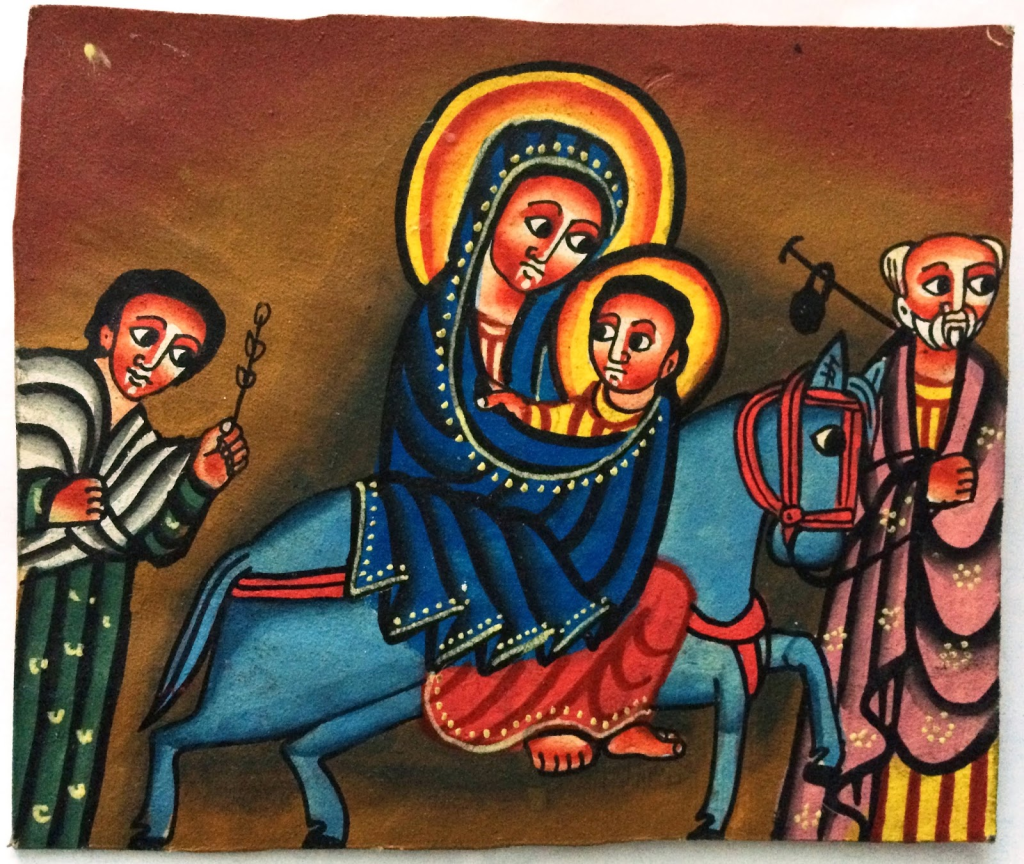
Ethiopian Orthodox icon of the holy family fleeing to Egypt

When we hold the pair of Testaments together in both hands, we feel the weight of Jesus as God’s divine Son; so therefore, Christ is the rightful Ruler in God’s kingdom.

Just as God preserved Israel from Pharaoh’s wrath, the Lord protected Jesus from Herod’s wrath. God’s kindness and loyalty extends to us as covenant people and preserves us from the wrath of the devil who seeks to keep as many people as possible in the realm of darkness.

Our hope is in the Lord Jesus, who conquered the devil by establishing a beachhead on this earth through an incarnation as the Son of God.

Jesus Brought Us Out of Exile

The scoundrel King Herod massacred innocent toddlers to ensure the destruction of Jesus. Behind his atrocity was the devil himself, who knew Jesus was the coming king who would one day bring salvation. Reflecting on a vision of Christ’s birth, the Apostle John identified the sinister plan and the divine deliverance:

The dragon stood in front of the woman who was about to give birth so that when she gave birth, he might devour her child. She gave birth to a son, a male child who is to rule all the nations with an iron rod. Her child was snatched up to God and his throne. (Revelation 12:4-5, CEB)

Satan wars against God’s Son and God’s people, whose roots go all the way back to the first prophecy of Christ after the Fall of humanity. God declared to Satan:

“And I will cause hostility between you and the woman,
    and between your offspring and her offspring.
He will strike your head,
    and you will strike his heel.” (Genesis 3:15, NLT)

There has been continual enmity ever since, between the serpent and the seed of the woman. It manifests itself with the Israelites constantly being threatened with extermination and tempted to conform to pagan ways.

King Herod was just another in a long line of demonically animated persons trying to perpetuate the kingdom of darkness. We must take this threat seriously because the devil knows that his time is short. A second Advent is coming which will be the final judgment.

Satan’s most powerful weapon, death, has lost its sting because of Jesus. Christmas is a hard time of year for many people, filled with depression instead of joy, grieving over lost loved ones for whom we will not spend another Christmas with.

Yet there is a reunion coming, the hope of a bodily resurrection in which we will be with Jesus and God’s people forever. Be encouraged to understand that there is no time in heaven; it will be only a moment and the people who have gone before us will turn around and see us; we will one day join them.

Matthew also used the prophet Jeremiah to communicate hope. Jeremiah’s prophecy dealt with children who were lost in war to the invading Babylonians. The prophecy is a lament with the hope that captivity will not be forever.

The disciple Matthew wanted us to see that the exile is over for us; Jesus has arrived, and the tears which were shed will shortly dry up. There may be a time of suffering we must endure, but there will be glory. Jesus is the Great Deliverer who brings us out of sin’s captivity and into the promises of God. He is our hope.

Jesus is the promised One who will deliver us from the tyranny of the devil. Christ is the hope of the nations, the Savior of the world. So, let us come back to the first Christmas which was the beginning of the end for evil on the earth.

Believers in Jesus are part of God’s victory, and they overcome the evil one by the blood of the lamb, acknowledging that Christ’s incarnation was essential for us. 

Just as Jesus made a radical break with his former life in heaven through the incarnation, we, too, must break with our old way of life.

God will save the people through this child Jesus. The greatest gift we can give in this season and throughout the coming year is the gift of grace, the presentation of the Christ child.

Loving God, help us remember the birth of Jesus so that we may share in the song of the angels, the gladness of the shepherds, and the wisdom of the wise men.

Close the door of hate and open the door of love across the world.

Let kindness come with every gift and good desires with every greeting.

Deliver us from evil through the blessing of the Christ child.

Teach us to be happy with pure hearts.

Grant us grateful thoughts, devoted hearts, and gracious hands, through Jesus our Savior in the might of the Holy Spirit. Amen.