Abide with Us

20180427_152607

“Abide in Me, and I in you. As the branch cannot bear fruit of itself, unless it abides in the vine, neither can you, unless you abide in Me….  If you abide in Me, and My words abide in you, you will ask what you desire, and it shall be done for you.” –Jesus (John 15:4, 7)

Today, as I look out of my office window, there are the signs of life everywhere.  A gentle rain is falling; the earth is slowly drinking the water; the flora of elm, maple, and oak trees support an animated fauna of robins, finches, squirrels, and the occasional white-tailed deer.  Evidence of the night stalking of raccoons, skunks, and possums are left in the soft mud.  Beyond what my eye can see, I also realize there is a vast unseen world of organisms thriving within that small patch of nature.

The ecosystem outside my little world is connected to the much larger world of massive earthly movements of seasons, weather, and people.  They are all connected in this immense and vast place we call “Earth.”  When we live and move and have our being in alignment and connection with God and his big world, we are truly blessed, enjoying God’s stamp of approval.

Perhaps we all feel some connection to this world because we originally came from the humus of the earth’s dirt.  In an impressive display of creation, God breathed into the people he made and they came alive to their Creator and the creation which surrounded them.

We were born for connection.  Inherent to our very design and nature, God made us in his relational image and his communal likeness.  We exist to have meaningful and enjoyable connection with God, his creation, and his people.

Yet, the world, as we also see evidenced in innumerable ways, is fundamentally broken.  Separation and anxiety rule far too many people’s lives and infect all kinds of human systems of institutions, corporations, and governments, and even families.  The current separation of immigrant parents and children on the U.S. border is not only reprehensible and morally repugnant, but serves as an overarching metaphor for a world that experiences a profound disconnect with their Creator.

The work of Jesus on this earth was to reset the brokenness; restore the dignity of humanity; renew and revive body and soul; and, redeem lost persons from the bondage of misguided ways resulting in agonizing separation, division, and disunion.  In short, Jesus came to heal his treasured people through helping others to reconnect with God.

To abide with Jesus is to remain with him, to be present with him.  God took the initiative to foster healing by sending his Son to this earth.  Jesus, in close connection with his Father, enabled and established a vital re-connection with God.  The Father and the Son graciously sent the Holy Spirit to help us abide with Jesus and know the joy of genuine healing and spiritual health and vitality.

“You did not choose Me, but I chose you and appointed you that you should go and bear fruit, and that your fruit should remain, that whatever you ask the Father in My name He may give you.” (John 15:16)

Think about what you need most today, perhaps even this moment.  Give some feeling to what they world is in desperate need of.  Maybe you are in physical pain.  It could be that your heart is broken over a severed disconnected relationship.  Perhaps someone is abusing you verbally, or neglecting you.  You might be separated from a loved one through geography or death.  Or, you might just know in the depths of your soul that something isn’t right – that your banal mundane existence in the daily grind lacks any real meaning or connection to the earth and its people.

Peace in the world, if and when it ever gets any traction, is little more than two groups of people not verbally decapitating and/or killing one another for awhile.  The earth is sick with dirty water and soil erosion, mirroring humanity’s erosion of internal virtue.  Love is sought in all the wrong places and lands lonely people into spiritual brothels of pain and disappointment.

In all kinds of ways, we each experience some sort of issue(s) that are askew, askance, and twisted.  We long for the ability to be a human Gumby who can bend back into some kind of normalcy.  We hunger to be noticed in a world of division that seems to notice nothing.

The good news of Holy Scripture is that the satisfaction of basic human needs will come through abiding with Christ.  Remaining with him enables one to ask and receive because God has conspired within himself as Father, Son, and Spirit to grant us deliverance from disconnection, and establish a loving kinship with those who have experienced the unlovely and ungracious elements of this world.  Jesus said:

“You are my friends….  No longer do I call you servants, for a servant does not know what his master is doing; but I have called you friends, for all things that I heard from My Father I have made known to you.” (John 15:15)

God, in Jesus Christ, through the power of the Holy Spirit, is laboring behind the scenes to make things right one human being at a time.  We look for miracles, yet the work of God is mostly to be found in the spiritual flora and fauna of the unseen ecosystem of the soul.  There, in the depths of our heart and our gut, the Lord does a wondrous work of connection which heals and restores to life.  In turn, we become Christ-like, being a mini-Jesus who points others to the re-alignment of body, soul, spirit, and all creation.

Based upon how Jesus interacted with others, and how he deals with you and me, we are to bless the individual who is right in front of our face in three simple ways:

Acknowledge the person through being fully present with them.

God blesses us, and we bless others when we affirm the sacredness of the people around us.  This enables us to provide focused and curious attention to the person God has before us.  We are to be “present” with them, giving our full devotion to listening, asking thoughtful questions, and being okay with hearing their musings on life.  As we abide with Christ, we learn to abide with one another.

Affirm the person’s inherent worth of humanity through validating their feelings.

Emotions are emotions.  Feelings are feelings.  You will not find an account in the New Testament Gospels of Jesus dismissing another’s feelings and telling them they shouldn’t have certain emotions.  To invalidate someone’s feelings is to shut them down and create an even wider disconnect and separation from the source of Christian healing and wholeness.  Instead, the human virtue of compassion sinks-into an abiding relationship when we affirm feelings as windows to the soul.

Act with the love and grace of Jesus toward the person through giving them the gift of fellowship and friendship.

Sometimes, maybe even most times, people just want to be heard.  They want to know that someone is listening.  They don’t want to feel forgotten, neglected, or dismissed.  They want a friend who will give them the time of day.  We all need friends.  We all need love.  The problem comes when too many persons have such a severe love deficit in their lives that they can’t give anything to anyone.  When we are all just trying to take, we are on survival mode and we end up hurting others instead of healing them.

One of the reasons we have burned-out people is because too often 20% of the people are doing 80% of the relational work.  Proper boundaries and a greater awareness of self and self’s needs is a much needed discipline today.  Spiritually healthy people bring hope and healing.  Spiritually sick people trying to do more is only a recipe for more separation, division, and disconnection because they’re running their engines with no oil of blessing on what they’re doing.

Abide with Christ.  That is our first and foremost task.  It isn’t our job to fix or save the world; that’s God’s job.  Our work is to remain in love and obedience, and simply point others to the vine of life through the blessing of respectful acknowledgement, emotional affirmation, and gracious action.  When our desires align with God’s desires, prayer becomes an organic response to basic human need, and those prayers will be honored.  The garden of the soul can hold and sustain life.  When it is shared with others it brings integrity and joy to all creation.

Easter

Empty tomb

One of the best things about what I do as a Pastor and a Chaplain is that I hear lots of stories.  As I sojourn in and out of hospitals, nursing homes, and churches, the many rich accounts of people’s lives continue to amaze me.  Some are profoundly sad, some are incredibly joyous, all include relationships of love and some of hate.  The narratives underlying the daily existence of many people is often an alchemical mix of genuine altruism and mindless neglect.  Since we live on this fallen planet with its strange combination of amazing beauty and severe conditions, it only makes sense that the people of the earth experience the wide range of emotions and experiences from grief to joy.  No matter who I speak with, wherever they are from, we all need hope.

Earl (not his real name) had brain surgery.  It effected his speech.  Earl labors to speak and communicate.  Indeed, he struggles so much to do so that I can only pick out bits and pieces of what he is trying to say to me.  The work of talking is made even more frustrating with the fact that Earl was once an extroverted pastor who made his living talking and speaking and offering words of hope.  Now he can barely get a sentence out his mouth.

Punctuated throughout most of our conversation were swear words of which he apologized.  Instead of poo-pooing this wonderful older minister for his imprecations, I invited us to swear together.  For several minutes, what must have looked kooky crazy to any angels looking on, we sat and swore.  Earl and I expressed our anger, disappointment, and tears over the loss of a precious gift.

Then, after we had a good session of lament, I read the timeless story of a person who conquered everything that is wrong and unjust in this world.  Jesus suffered like no other before or since.  He felt loss.  He knew grief firsthand.  He died.

But death could not hold him in the grave.  The power of God raised Christ the Lord to new life.  Now, the life of Jesus is my life, and Earl’s life.  I didn’t read the glorious story of Jesus to change Earl’s feelings or even to try and make him feel better.  I read the story because its real, its true, and it is the Christian’s hope.

I believe the words of 1 Corinthians 15:20 are right:

“Christ has been raised to life! And he makes us certain that others will also be raised to life.”

Every hope, each promise, and all expectations for Christians everywhere are completely and totally realized in the resurrection of Jesus Christ from the dead.  Easter, or more aptly, Resurrection Day, is the highest holy day of the entire year for followers of Jesus.  One of the great things about Easter is that it is not only one day in the Christian Year – it comprises 40 days leading to the day of Pentecost and the giving of the Spirit.  That means we celebrate the truth “Jesus is alive!” for six wonderful Spring weeks.  We purposefully take a good look at our hope.

The somber reflection of Lent with its emphasis on confession of sin and repentance now flowers into the exultant joy and celebration of new life.  The call and response of Christians in the glorious season of Easter is “He is risen!” “He is risen, indeed!”

If there ever was a time for the church to give testimony to the redeeming and saving work of Jesus, it is on Resurrection Day and throughout the Easter season (often referred to as “Eastertide”).  Now is the appropriate time for fellow believers to hear from their brothers and sisters in Christ, how he has brought them renewal – a new outlook and perspective; a new way of relating to others; a new purpose; a completely new life.  We are so tied and in union with Jesus that his resurrection is our resurrection.  Christ’s rising to new life gives us hope.

Earl has hope.  I have hope.  You have hope.  The effects of the fallen world will not always have its way on the earth.  Christ is crucified.  Christ is risen.  Christ is coming again.

Holy Saturday

tomb of jesus

“Christ suffered here on earth. Now you must be ready to suffer as he did, because suffering shows that you have stopped sinning. It means you have turned from your own desires and want to obey God for the rest of your life. You have already lived long enough like people who don’t know God. You were immoral and followed your evil desires. You went around drinking and partying and carrying on. In fact, you even worshiped disgusting idols. Now your former friends wonder why you have stopped running around with them, and they curse you for it. But they will have to answer to God, who judges the living and the dead. The good news has even been preached to the dead, so that after they have been judged for what they have done in this life, their spirits will live with God.  Everything will soon come to an end. So be serious and be sensible enough to pray.  Most important of all, you must sincerely love each other, because love wipes away many sins.” (1 Peter 4:1-8, Contemporary English Version)

I haven’t been Christian my entire life.  I can relate to Peter’s exhortation.  I know what it feels like to carry on without any thought to God, Jesus, or anything other than myself.  The thing about partying and immorality is that it’s a life filled with constant movement.  Slowing down only makes you come face-to-face with what is truly inside your soul.  And if you have an empty vacuous soul, or a damaged spirit, or a broken heart, then drinking or working away your inner pain makes sense when you have no regard for God.  The last thing I ever wanted to do was suffer, yet in my pre-Christian state it seemed I could never outrun the hurt no matter how hard I tried, even with all the constant locomotion.

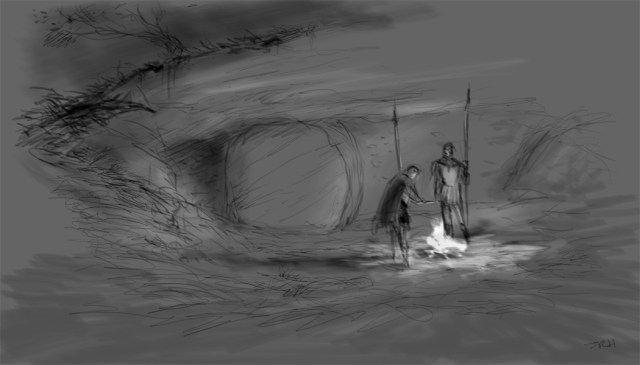
It is Holy Saturday – the quiet place sandwiched between the ignominy of the cross and the celebration of resurrection – the day of solitude, silence, and stillness.  Today isn’t a particularly popular day.  People don’t rave about Holy Saturday, in fact, many Christians haven’t had a thought that this day could have any significance.  Yet, this very day has its place in the scheme of the Christian life.

There cannot be resurrection and new life without a death and dying to self.  There must be suffering before there can be glory.  Whenever Christians quickly jump to triumphal language about victory and speak little to nothing about suffering, then we are left with nothing but cheap grace which has been purchased with the counterfeit currency of velocity.

Today is a day to get our heads and our hearts wrapped around the important reality that our Lord Jesus Christ was in the grave.  It was real suffering on Good Friday, and today it is a real death.  There is no movement.  All is silent and still.  Jesus is in the solitude of a dark tomb.  There is no getting around it.  If we want a Resurrection Day with all its celebration and glory, then we cannot circumvent Holy Saturday.

To put it in the Apostle Peter’s words: Are you ready to follow Jesus and suffer as he did?  Are you willing to stop your ridiculous striving, manifested through your crazy calendar of constant movement and embrace the Holy Saturday of solitude, silence, stillness with its contemplation and embrace of suffering?  Will you have sense enough to pray?  Will you practice a Christian counter-cultural shift and face the ridicule of your friends so that you can take some much-needed time to be with your Lord Jesus in the tomb?  Or, are you so antsy and anxious that you just want to leap into Easter with no solidarity with your Lord in the grave?

Perhaps you think I’m being a bit too hard or harsh or cold…. It’s because Jesus is cold.  He has a bonified cold dead body.  It’s no fake death.  There’s no “swoon theory” here, as if Christ only passed-out and did a weird divine fainting spell.  Nope.  He’s dead.  And if you and I want to live with Jesus, we must die with Jesus.

Anyone who tries to promise you a new life apart from journeying with Jesus into the grave is a spiritual charlatan.  Only through death can there be life.

Today, on this Holy Saturday, purposely slow down, do less, give yourself a large chunk of unstructured time, and put a lot of space between things you must do on this day.  Fill the time with unfettered access to God in Christ.  Slowly read the Gospel accounts of Christ’s death and burial.  Read the book of 1 Peter.  Allow prayers to arise from the careful and thoughtful reading of Scripture.  Feel the solidarity with Jesus, journey with him along the way from life to death… so that there might be a truly glorious resurrection filled with abundant life and flourishing – a life that doesn’t need constant partying, working, and schedule-filling to feel significant and happy.

May you die well so that you might live well.

Good Friday

christ on the cross

We all suffer.  In some way, whether with a chronic physical condition, emotional or moral distress, mental illness, or spiritual oppression, everyone must face living in a fallen world with its pain and heartache.  Suffering which seems to have no reason, the senseless kind and the type where nothing good appears to be going on at all can be very troubling to our souls.

At first glance, “Good Friday” might seem a bit oxymoronic for a day observing the torture and death of an innocent man.  Yet, it is very good in the sense that the crucifixion of Jesus Christ meant the redemption of the world.  On this day Christians remember and commemorate the events that led up to the cross; unpack those events and interpret them with profound meaning and significance; and, worship Jesus with heartfelt gratitude in light of this redemptive event.

The bulk of the New Testament Gospels of Matthew, Mark, Luke, and John are given over to the final week of Christ’s life, especially leading to the cross.  Good Friday worship services often take a somber form due to the brevity of Christ’s experience on the cross.  Christians remember the last words of Christ, and recognize the significant impact his death had on the immediate persons around him.  Believers also contemplate the lasting results of that singular death as an atoning sacrifice; perfect love; reconciliation between God and humanity; victory over evil; and, redeeming all creation.

Sadness, then, is far from the only emotive expression on this day.  It is appropriate to feel wonder, gratitude, and deep satisfaction for the accomplishment of deliverance from the power of sin.  There is the recognition that something profound and meaningful has truly happened in the egregious suffering of Jesus.  Thus, we not only remember the anguish of Christ, but what that horrible torment accomplished.  In fact, the cross of Jesus is so significant that an eternity of considering its impact could not plumb the depths of its far-reaching effects.

With all that has been said, one would think that Good Friday is a hugely observed day on the Christian Calendar.  Yet, it is not.  The bottom line is that the cross is not popular.  Perhaps that is because no one likes suffering and cares not to think about it.  Not only do unchurched folk care not to think about it, but church attenders would like to be mindful about other things than the cross.

Episcopal priest Fleming Rutledge has adroitly put her finger on the problem: “Religious people want visionary experiences and spiritual uplift; secular people want proofs, arguments, demonstrations, philosophy, and science.  The striking fact is that neither one of these groups wants to hear about the cross.”  Indeed, as the Apostle Paul has said, the cross of Christ is “a stumbling block to Jews and folly to Gentiles” (1 Corinthians 1:23).

Our contemporary religious milieu celebrates and promotes self-styled spirituality; it is the “in” thing to eschew church and develop a personalized religion that fits the demands of the modern (or postmodern) world.  The cross, however, is “out;” too much blood and sacrifice, and not enough of what I’m looking for in life.  Perhaps we should think long and hard on Hebrews 13:12-13 –

“Jesus suffered outside the gate in order to sanctify the people through his own blood.  Therefore let us go forth to him outside the camp, and bear the abuse he endured.”

The extent of Good Friday goes far beyond just a day on the calendar; it is the fulcrum upon which all of Christianity hinges.  Because Christ suffered, our suffering has meaning.  So, today, let us contemplate the cross, observe the salvation accomplished through Christ’s death, and offer prayers and petitions for those who need deliverance from the power of evil.  In short, let us worship God in Jesus Christ because of the suffering on the cross.  Amen.