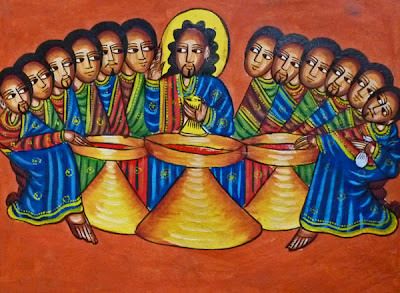
Colossians 1:15-23 – Worship That Is Fit for a King

The Son is the image of the invisible God, the firstborn over all creation. For in him all things were created: things in heaven and on earth, visible and invisible, whether thrones or powers or rulers or authorities; all things have been created through him and for him. He is before all things, and in him all things hold together. And he is the head of the body, the church; he is the beginning and the firstborn from among the dead, so that in everything he might have the supremacy. For God was pleased to have all his fullness dwell in him, and through him to reconcile to himself all things, whether things on earth or things in heaven, by making peace through his blood, shed on the cross.

Once you were alienated from God and were enemies in your minds because of your evil behavior. But now he has reconciled you by Christ’s physical body through death to present you holy in his sight, without blemish and free from accusation— if you continue in your faith, established and firm, and do not move from the hope held out in the gospel. This is the gospel that you heard and that has been proclaimed to every creature under heaven, and of which I, Paul, have become a servant. (New International Version)

Jesus is King. Neither you, nor I, are. 

A simple statement; yet, not easily engrafted into daily life. 

The original sin of Adam and Even was rebellion – to break the bonds of loving authority God provided for them. We (especially us Americans) have this nasty anti-authoritarian strain which runs rather deep in us. 

As a child, when my middle daughter was grappling with the implications of faith in Christ, she once blurted out an honest cry that we can likely resonate with: “I just don’t want another person in my life telling me what to do!” 

Indeed, Jesus is King; we are not.

The New Testament lesson for today is rich with the pre-eminence and lordship of Jesus Christ: 

  • All things were created through Jesus and for him. 
  • Everything in all creation is held together by Jesus. 
  • Christ is the head of the church. 
  • In Jesus Christ, complete divinity exists and reigns. 
  • Jesus made peace through the cross because he had the authority and the qualifications to do so. 
  • Broken relationships and proper lines of authority are now restored and redeemed in Christ.

We can also likely relate to, at times, indulging an illusion of being in control and independently dictating the course of our lives. Yet, mercifully, Jesus is the great Sovereign, and this is a good thing – because in Christ we find reconciliation and purity of life. 

“The supreme thing is worship. The attitude of worship is the attitude of a subject bent before the King… The fundamental thought is that of prostration, of bowing down.”

G. Campbell Morgan

Because Christ is King, we really ought to submit to him. In fact, we need to pay some attention to how our bodies are to submit to his lordship.

When the body moves to animating physical actions of submission, this helps the heart to follow. Whole person worship involves engaging the mind, spirit, emotions, and, yes, the body. To neglect the body in worship is to truncate the ability to connect with God in Christ.

A typical metaphor for the Church is the “Body of Christ.” We can live into that phrase through an embodied spirituality of submission. Our individual bodies are temples of the Holy Spirit, important for expressing worship. (1 Corinthians 3:16)

God created us with literal physical bodies. And Jesus has a literal physical body. Bodies are important for whole person worship. This means the physical postures we take in worshiping King Jesus are significant. We need to pay attention to them.  

A healthy practice for Christians is to kneel in the presence of the Lord. I realize some Christian traditions do it as a part of their worship, and some do not. Some like it, some don’t. Yet, bowing, even prostrating oneself (if you are physically able!) can be a powerful symbol of the heart’s desire and disposition to submit to the lordship and authority of Jesus Christ. 

Crawling out of bed in the morning onto one’s knees and beginning the day aiming to live into the will of God, and ending the day in the same manner, are a practical means of remembering who Jesus is and who we are.

I believe all believers need to feel free in adopting a physical posture of worship which helps them connect with God in Christ. For some, that will be sitting in a comfortable position in contemplation. Others will want to stand, raise their hands, even dance in praise.

It also behooves us to let our bodies respond to whatever is happening with us spiritually. Exuberant praise needs the expression of hand clapping and toe tapping. Confession of sin needs a bit of bowing, kneeling, even prostrating. For prayer, hands open and palms facing up to receive blessing from God is a good bodily position of worship.

You get the idea. Just remember we need to strive for congruence in our worship, that is, what is happening with our outward bodily movements needs to match what is occurring inward with our spirits. And when the two are in sync, meaningful worship can happen – worship of submission fit for a king.

Sovereign God, in your mercy you have sent your Son, the Lord Jesus, who has brought reconciliation to a once broken relationship.  I bow before you in obedience, submission, and worship.  Let me live a cross-shaped life through enjoying the peace you have given me in Christ in both body and soul. Amen.

Matthew 8:18-22 – The Path of Christian Discipleship

When Jesus saw that a curious crowd was growing by the minute, he told his disciples to get him out of there to the other side of the lake. As they left, a religion scholar asked if he could go along. “I’ll go with you, wherever,” he said.

Jesus was curt: “Are you ready to rough it? We’re not staying in the best inns, you know.”

Another follower said, “Master, excuse me for a couple of days, please. I have my father’s funeral to take care of.”

Jesus refused. “First things first. Your business is life, not death. Follow me. Pursue life.” (The Message)

Count the cost. Realize what it will take. Have some understanding of the time, energy, and resources needed. Discern the kind of commitment which is before you. It’s a matter of life and death, of spiritual survival.

If you had to carry everything you needed in a backpack, what would you put into it?

First off, for me and most people, that means identifying the barest essentials. It would likely take a long time to think simplistically about what is most important for survival. A lot of things would get left behind. And many items would gain greater attention and appreciation.

We would need some small basic tools including: a multi-tool with a knife and pliers; a source of illumination, like a flashlight and extra batteries; duct tape; rope; fishing line; a way of starting fire; a pot, pan, and mug; first-aid kit; emergency poncho; and just a few extra items of clothing.

If we were to live out of a backpack, it would very much change our lifestyle. And that is the point Jesus was trying to get across to some individuals who seemed like they couldn’t do that.

Trying to fit an existing life into a brand new life won’t work. It will not fit into the backpack of Christian discipleship.

Instead, we must adjust to a new reality, a completely different way of being.

When my wife and I were raising our girls, those precocious little females brought lots of life to the dinner table each night. There was never a dull moment with them. Today, however, they are all grown with their own families – which means we are empty-nesters.

It would be weird if my wife and I continued to live as if they were home – making large meals, dirtying lots of dishes, and engaging in mock conversations. Rather, although it took a while to get used to, we eventually came to grips with the new reality that our precious girls were grown and no longer living under our roof. And that meant a complete change of lifestyle for us.

A full-orbed Christian spirituality includes both the comfort of Christ to others, and the rugged responsibility to obey the words and ways of Jesus. In other words, the love of Jesus Christ is both tender and tough, at the same time, all the time.

Hurting and healing are both necessary for the follower of Jesus. Hard teachings and uncompromising commands for discipleship from Christ become the pathways of healing.

So, then, to go all out for Christ will involve much difficulty.

Jesus said to his followers, “If any of you want to be my follower, you must stop thinking about yourself and what you want. You must be willing to carry the cross that is given to you for following me. Any of you who try to save the life you have will lose it. But you who give up your life for me will find true life.”

Matthew 16:24-25, ERV

In today’s New Testament lesson, Jesus rather rudely rejected two would-be followers. When it comes to God’s upside-down kingdom, the eager beavers are turned away, and the half-hearted are called.

Jesus wants us, all of us, and not just our dedication. That is the demand of Christian discipleship. Anyone who believes they can remain the same person and simply fit a bit of Jesus into their lives, does not understand the cost of following Christ. The person who thinks it is Christianity’s lucky day when they decide to follow Jesus has not yet grasped what it means to be a Christian.

Whereas the religious scholar’s head was too big to fit through the narrow hole of Christian discipleship, the man who wanted to bury his father was too fainthearted and timid. He wanted to dip his toe in the water, and really had no intention of taking the all out plunge into the pool.

Nobody needs to do something “first” before following Jesus. Essentially, Jesus was neither invited nor welcome to the funeral. And Christ will have nothing to do with people picking and choosing which areas of their lives he will be invited into. It’s either a wholesale welcome or no welcome, at all.

When Jesus knocks on the door, he wants to be invited into the entire house, not just the foyer.

For Jesus, following him isn’t easy. The world is full of spiritual zombies, the walking dead. This old fallen world needs Christian disciples who will follow Jesus anywhere – into the hard places and rough terrain of engaging the sinful world.

We are meant to wholeheartedly follow Jesus, neither flippantly without counting the cost, nor procrastinating the hard road of Christian discipleship. Christians are to accept and maintain orders of first importance – which means full submission and obedience to Jesus Christ. Anything less is merely a cheap form of following.

When I Survey the Wondrous Cross by Isaac Watts

When I survey the wondrous cross
On which the Prince of glory died
My richest gain I count but loss
And pour contempt on all my pride.

Where every realm of nature mine
My gift was still be far too small
Love so amazing, so divine
Demands my soul, my life, my all.

Lord, you are all-knowing and full of wisdom. Your plan is masterful. Help me as your disciple to follow you in every thought, word, and deed. Give me a heart of obedience and trust so that I do not get wrapped up in my doubt or what I think is the right choice.

Help me to recognize that your good will does not always look the way I think it should, but that doesn’t make it any less good. I desire to be your disciple and follow you all the days of my life. Please give me the strength to do that. Amen.

Matthew 5:4 – Blessed are Those Who Mourn

“Blessed are those who mourn,
    for they will be comforted.” (NIV)

Throughout most of human history, there have been groups of people, typically women, who occupy a special role within their respective societies. Sometimes paid professionally, and many times not, these folks had an important function – so important was this vocation that a unique skill set was needed to support an entire community of people.

What is that role, that function? To be a mourner.

In Scotland and Ireland, they were referred to as “keeners.” Keening is mourning, and keeners were employed to help others grieve and lament the death of a loved one. Through their emotional wailing, family members could feel as though someone was putting a voice to their grief. It was also considered a way to honor the dead and share their accomplishments. 

The keen is a bygone practice, along with many of the funeral practices of other cultures. With the advent of modern institutional funeral homes, beginning in the nineteenth century, there has been more and more distance to the raw feeling and emotion of death. Keening was a tradition which included songs of lament, at least one of them being composed specifically for the occasion.

For millennia, cultures have recognized and affirmed the need for and importance of wailing and crying and deep grief to have its say.

Jesus believed mourning to be significant enough to include it, right off the bat, in his Sermon on the Mount. Authentic disciples of Jesus Christ mourn.

Mourning, in the Beatitudes, is the emotional response to spiritual bankruptcy. To be a spiritual mourner is to weep and wail over sin… loudly! It is to see that sin in all its foulness and degradation is terrible and destroys relationships. Because of this, we experience personal grief over both the world’s sin and ours.

The Christian disciple, the true follower of Jesus, knows death is coming, and must be faced. God is coming and will be known by all as either Savior or Judge. Sin is present all around us, even in us, and it is unspeakably ugly and black in the light of God’s holiness. Eternity is real, and every living human being is rushing toward it.

The alternatives of eternity are inexorably coming – life or death, forgiveness or condemnation, heaven or hell. These are all realities which will not go away. The person who lives in the light of them, and rightly assesses self and the world, cannot help but mourn.

They mourn for the sins of their nation and neighborhood. They mourn over the erosion of the very concept of truth. The keener mourns over the greed, the cynicism, and the lack of integrity all around. Indeed, the Christian mourner mourns that there are so few keeners expressing the biblical mandate to mourn.

I wonder if sin causes us to weep, even to wail. I am curious if the presence of sin in the world and within ourselves keeps us awake at night, or not.

If individuals can only locate sin out there somewhere and are never close enough to see lost souls entrenched in sin, needing a Savior, then they must come back to the first Beatitude of knowing their spiritual poverty and wrestle with putting pride in its place and fully embracing a humble spirit.

Those who do not mourn have a hard heart because mourners are sensitive to sin.

“But I’m not really a person who cries.” Perhaps you ought to explore why that is so. It could be that a thick callous has developed over the heart. The telltale signs of this are being comfortable with watching violence and having no problem with uttering violent speech.

Many Christians pray for revival; it will not occur apart from the way of the spiritual beggar who mourns over the violence, oppression, bigotry, arrogance, and injustice of the world. 

If there is to be any transformation of heart, it will come through seeing myself for who I am and seeing the sins of this world for what they are.  Without this, there is no hungering and thirsting for righteousness, no mercy, no purity, and no peace in the world or the church. 

Jesus told a parable to illustrate true righteousness versus self-righteousness, saying:

“Two men went up to the temple to pray, one a Pharisee and the other a tax collector. The Pharisee stood by himself and prayed: ‘God, I thank you that I am not like other people—robbers, evildoers, adulterers—or even like this tax collector. I fast twice a week and give a tenth of all I get.’

“But the tax collector stood at a distance. He would not even look up to heaven, but beat his breast and said, ‘God, have mercy on me, a sinner.’

“I tell you that this man, rather than the other, went home justified before God. For all those who exalt themselves will be humbled, and those who humble themselves will be exalted.” (Luke 18:10-14, NIV)

Jesus says the mourner, the keener, will be comforted; she will find the remedy to alleviate guilt and shame in her own life through Jesus, as well as the answer to the ills of the world, in Christ.

We do not need lots of money, a high position, a particular gender, or even be a faithful practicing religious person to be a mourner. Anyone can be one. And this is the door by which we enter the kingdom of God.

Almighty and most merciful Father, we have sinned and strayed from your ways like lost sheep…. We have left undone those things which we ought to have done; and we have done those things which we ought not to have done…. We acknowledge with great sorrow our great and many sins which we, from time to time, have committed by thought, word and deed, against your divine majesty…. O Lord, have mercy upon us.

Spare all who confess their faults and truly repent; according to your promises declared in Christ Jesus our Lord. We are cut to the heart and are sorry for our wrongs; remembering them now grieves us…. Forgive all our past wrongdoing; be merciful to us now in the present; and extend your kindness to us in the future, through Jesus Christ, your Son, our Lord, who with you and the Holy Spirit are one God, now and forever. Amen.

*Above painting by Hyatt Moore

Mark 6:45-52 – Facing Fear

Immediately Jesus made his disciples get into the boat and go on ahead of him to Bethsaida, while he dismissed the crowd. After leaving them, he went up on a mountainside to pray.

Later that night, the boat was in the middle of the lake, and he was alone on land. He saw the disciples straining at the oars because the wind was against them. Shortly before dawn he went out to them, walking on the lake. He was about to pass by them, but when they saw him walking on the lake, they thought he was a ghost. They cried out because they all saw him and were terrified.

Immediately he spoke to them and said, “Take courage! It is I. Don’t be afraid.” Then he climbed into the boat with them, and the wind died down. They were completely amazed, for they had not understood about the loaves; their hearts were hardened. (New International Version)

Sometimes, we are afraid – even terrified. And Christians aren’t immune to the feeling of fear and terror.

The truth of the Christian life is that it is a herky-jerky process of three-steps-forward, two-steps-backward, not always knowing with certainty everything we encounter.  

The expectation that we will have a consistent upward trajectory of spiritual development with no scary experiences is wrongheaded and misguided. Throw into the mix that our self-awareness is often skewed, and that we have difficulty assessing ourselves with any accuracy, and voila! we have a recipe for the true human condition.

Doubt, fear, failure, and stubbornness aren’t just endemic to other people – it also characterizes many Christians, as well. We will face severe storms in life. They will be harsh. We will wonder if we’ll even make it out alive, or not. And it may very well seem like Jesus is nowhere to be found. Then, when he does show up, we don’t recognize him, and it scares the bejabbers out of us.

This was the experience of Christ’s disciples, who too often reflect our own stories of faith and fear all rolled up in one person. Today’s Gospel lesson is this: Our fears and foibles do not need to define us because Jesus is Lord over the water, the weather, the wondering, the waiting, the wildness, and our own whimsical natures of seeing miracles accomplished in others, then not believing it can happen in our own lives.

So, what are we really afraid of? Failure? Fear itself? Death? Irrelevance? Loss? Change? Perhaps, everything? Yes, all of life is a risky scary business. There are no guarantees, except one: Christ is present with us, whether we are aware of it, or not.

If the worst scenario you worry about in your head would actually come to pass, it will still never change the reality that God loves you and is with you.  And it will not stop Jesus from assuring us of his presence and climbing into the boat to be with us.

We don’t have any accounts of Jesus freaking out in fear, or when other people flip out in their own fear. Jesus was a person of prayer, completely grounded in his relationship with the Father.   

Jesus made his disciples get into a boat and go out on the lake – all the while knowing what they were about to face with the weather. Even though the disciples were doing God’s will by going out on the lake, they were not spared from adversity. In fact, Jesus wanted them to experience the storm because it is through the storm that we really learn faith and to face down our fears. 

There is no shame in being afraid. We all experience it. And there is no shame in admitting we’re scared. Where shame exists, our instinct is to run away like our ancestors Adam and Eve and hide, thus hiding ourselves from the grace that could be ours.

Being out on the middle of a lake during a storm did not prevent Jesus from being present with the disciples – he just walked on the water to be with them. Even though the disciples had just seen and participated in the miracle of Jesus feeding the five thousand, they were not looking for another miracle – which is why they did not recognize Jesus and were afraid when they saw him.

Jesus never chided his disciples for their fear, or their hard hearts. He simply invited them, with the tone of grace and mercy, to not be afraid. And the Scripture is replete with continual encouragements to not be afraid because of God’s presence. Along with psalmist, we can say:

But when I am afraid,
    I will put my trust in you.
I praise God for what he has promised.
    I trust in God, so why should I be afraid?
    What can mere mortals do to me? (Psalm 56:3-4, NLT)

I sleep and wake up refreshed
    because you, Lord,
    protect me.
Ten thousand enemies attack
from every side,
    but I am not afraid. (Psalm 3:5-6, CEV)

When I called, you answered me.
You made me bold by strengthening my soul. (Psalm 138:3, GW)

Ultimately, fear has to do with disconnection. It is to feel powerless, separated from any resources, unable to do anything about what is presently staring us in the face and scaring us.

Yet, when we have an awareness and a sense of connection with Jesus, there are unlimited resources of grace to accept, cope, and transcend any and every storm we find ourselves in the middle of.

May the risen and ascended Christ, mightier than the hordes of hell, more glorious than the heavenly hosts,
be with you in all your ways. 

May the cross of the Son of God protect you by day and by night, at morning and at evening, at all times and in all places.

May Christ Jesus guard and deliver you from the snares of the devil, from the assaults of evil spirits, from the wrath of the wicked, from all base passions, and from the fear of the known and unknown. 

And may the blessing of God almighty – Father, Son, and Spirit – be upon you and remain with you always. Amen.

*Above painting of Jesus walking on water by Brian Whelan

**Above Orthodox icon of Christ walking on water

***Above painting: Christ walking on the sea, by French artist Amédée Varint (1818-1883)