
Mark 8:14-21 – Adventures in Missing the Point

The disciples had forgotten to bring bread, except for one loaf they had with them in the boat.“Be careful,” Jesus warned them. “Watch out for the yeast of the Pharisees and that of Herod.”

They discussed this with one another and said, “It is because we have no bread.”

Aware of their discussion, Jesus asked them: “Why are you talking about having no bread? Do you still not see or understand? Are your hearts hardened? Do you have eyes but fail to see, and ears but fail to hear? And don’t you remember? When I broke the five loaves for the five thousand, how many basketfuls of pieces did you pick up?”

“Twelve,” they replied.

“And when I broke the seven loaves for the four thousand, how many basketfuls of pieces did you pick up?”

They answered, “Seven.”

He said to them, “Do you still not understand?” (New International Version)

In today’s Gospel lesson, Jesus uses yeast as a metaphor for corrupting influences. It only takes a little bit of yeast to work through the whole batch of dough. Christ, upholding the teachings of Old Testament law, didn’t just want people to avoid eating actual unleavened bread. He desired his disciples to be unleavened themselves, a holy people, free of all crookedness and malevolent motives.

Christ’s disciples, bless their pea-pickin’ literal interpreting hearts, were too dense to pick up on the metaphor. They began anxiously chattering about how Jesus might be disappointed with them in having no actual bread to eat. Although they had just witnessed an amazing miracle of literally feeding thousands of people, the disciples did not discern what that miracle meant beyond just filling bodily stomachs.

Had Christ’s disciples been able to see beyond the literal to the metaphorical, they would have likely understood several lessons Rabbi Jesus was teaching them:

  • The provision of bread pointed to who Jesus truly is: Living Bread from heaven. Just like the miraculous provision of manna in the desert to the ancient Israelites, so God was graciously meeting the total needs of people through Jesus. Conversely, the yeast of corruption saps the life out of people.
  • The presence of bread doesn’t necessarily mean it’s all good. There’s leavened bread and unleavened bread. That is, there is the healthy bread of God’s Word to eat, and there are other words to eat which is unhealthy bread. A life set apart for goodness and mercy in the world brings life to others. A person with mixed motives and personal agendas of power and privilege brings no nourishment to others – only inedible bread.
  • The puny amount of bread became a huge feast. A little bit of Jesus is enough to feed thousands and satisfy empty stomachs. A little bit of false teaching and hypocrisy is enough to corrupt thousands of people and make them sick.
  • The prosperity of bread multiplied by Jesus was so much that there were leftovers. In the kingdom of God, there is abundance. The disciples served the bread to the throng of people, and they received bread for themselves with twelve basketfuls of bread pieces – enough bread to feed their families, as well. The leavened bread of corruption doesn’t satisfy; it only decreases health.

But the disciples didn’t get it. So, Jesus chided them for their profound lack of spiritual awareness. By this time, the disciples had been following Jesus for a while – watching him do miraculous works of healing and meeting people’s needs, as well as being on the inside track of receiving his gracious teaching. If anyone ought to get what’s going on, it was them.

If we continually possess only a one-dimensional interpretation of Holy Scripture, a literal one, we are most certainly going to miss most of what’s really happening with Jesus. Rigid and narrow hermeneutical approaches aren’t just inadequate; they’re a corrupting influence. It is an adventure in missing the point because there is only a dim awareness of self, others, God, and God’s Word. It doesn’t nourish anybody. In fact, it makes people sick.

That sad situation makes such people, along with disciples at the time, no better than those on the outside of God’s kingdom.

“You will listen and listen,
    but never understand.
You will look and look,
    but never see.” (Isaiah 6:9, CEV)

Spiritual blindness and deafness are the symptoms of an unexamined and unaware life. And the lack of awareness is a malady from the bread of corruption.

Jesus Christ has a mission, along with the authority to make it happen. He was hoping for a more adequate understanding of this from his disciples, instead of getting the obtuse deer-in-the-headlights response.

Although, in some ways, today’s Gospel story is downer, it is also hopeful. The disciples ultimately do not remain stuck. They illustrate for us the nature of faith. Faith is not a one and done event of praying a sinner’s prayer or accepting Jesus. Rather, faith is an unfolding drama of redemption.

We grow in and into faith. Faith is much more a gradual awareness of God’s character and working in the world, with maybe a few dramatic epiphanies along the way. It is piecemeal, rather than wholesale. It’s more like taking small bites of delicious bread and savoring it with friends, instead of ravenously devouring an entire loaf alone.

“I am the living bread which came down from heaven. If anyone eats of this bread, he will live forever; and the bread that I shall give is My flesh, which I shall give for the life of the world.” (John 6:51, NKJV)

Lord Jesus, as you came to serve us living bread, fill us with the compassion and insight to respond to human need by loving service. Let the fire of your goodness and justice burn into us and through us, that we may seek to transform the unjust structures of society. As you come into our lives to redeem all that is good, guide to renew and sustain the life of your creation. Let your glory fill our lives. Let your glory fill this world. Amen.

John 4:7-26 – Living Water

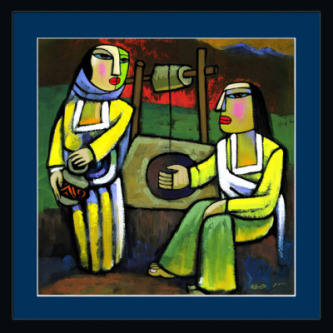
Samaritan Woman at the Well by He Qi

When a Samaritan woman came to draw water, Jesus said to her, “Will you give me a drink?” (His disciples had gone into the town to buy food.)

The Samaritan woman said to him, “You are a Jew, and I am a Samaritan woman. How can you ask me for a drink?” (For Jews do not associate with Samaritans.)

Jesus answered her, “If you knew the gift of God and who it is that asks you for a drink, you would have asked him, and he would have given you living water.”

“Sir,” the woman said, “you have nothing to draw with and the well is deep. Where can you get this living water? Are you greater than our father Jacob, who gave us the well and drank from it himself, as did also his sons and his livestock?”

Jesus answered, “Everyone who drinks this water will be thirsty again, but whoever drinks the water I give them will never thirst. Indeed, the water I give them will become in them a spring of water welling up to eternal life.”

The woman said to him, “Sir, give me this water so that I won’t get thirsty and have to keep coming here to draw water.”

He told her, “Go, call your husband and come back.”

“I have no husband,” she replied.

Jesus said to her, “You are right when you say you have no husband. The fact is, you have had five husbands, and the man you now have is not your husband. What you have just said is quite true.”

“Sir,” the woman said, “I can see that you are a prophet. Our ancestors worshiped on this mountain, but you Jews claim that the place where we must worship is in Jerusalem.”

“Woman,” Jesus replied, “believe me, a time is coming when you will worship the Father neither on this mountain nor in Jerusalem. You Samaritans worship what you do not know; we worship what we do know, for salvation is from the Jews. Yet a time is coming and has now come when the true worshipers will worship the Father in the Spirit and in truth, for they are the kind of worshipers the Father seeks. God is spirit, and his worshipers must worship in the Spirit and in truth.”

The woman said, “I know that Messiah” (called Christ) “is coming. When he comes, he will explain everything to us.”

Then Jesus declared, “I, the one speaking to you—I am he.” (New International Version)

Jesus and the Samaritan Woman by He Qi

Many years ago, I was the pastor of a small congregation north of Detroit, Michigan. Many of the people in the community viewed the big city as a place of disrepute. So, they avoided going into the heart of the great city as much as possible.

The locale of Samaria was viewed much the same way by many Jews back in Christ’s day. Samaritans were seen as untrustworthy, a mongrel people with a mix of Jewish and ancient Assyrian blood. And their religion was most suspect of all – an amalgam of Jewish and Gentile practices.

Jesus, however, didn’t avoid the territory. He confidently walked through Samaria and had no problem stopping to rest on his journey in a foreign area. That’s because Jesus didn’t class people into groups, nor did he attach adjectives to people, such as “those” Samaritans.

Jesus had no obstacles between himself and others.

Which is why an organic conversation happened between Jesus and a Samaritan woman. Christ simply saw a human being who happened to be a woman and a Samaritan. He acknowledged both her gender and her ethnicity without those being a problem. Not even Christ’s knowledge of her string of husbands was a problem in conversing with her.

Every time I read this narrative of Jesus interacting with the Samaritan woman, I wonder and use my imagination about all the non-verbal communication. I am sure the conversation was as much about Christ’s affect, gestures, and tone of voice, as it was his well placed words. I fully believe his verbal and non-verbal communication was perfectly congruent with each other, giving the woman a compelling sense that her ultimate needs could be met with the living well of a person in front of her.

Water gives life. And Jesus, as living water, gives new life. A bunch of failed relationships testified to the woman’s dissatisfaction. Even though we hear no more about her after this story in the Bible, we as readers get the overwhelming sense that the woman finally found satisfaction. The love which kept slipping through her fingers now had staying power.

I am sure the Samaritan woman discovered true worship, in spirit and in truth.

I still remember my first encounter, at least my first aware experience, with the living Christ. I am quite sure Jesus was near me for a long time, without me knowing his presence. Words will never truly capture the overwhelming sense of love, acceptance, mercy, kindness, and deep satisfaction – a contentment and gratification which has stuck with me now for decades.

Messiah, “Savior,” is an apt term for Jesus. He certainly saved me from myself. And Christ has never left me nor forsaken me – always there, always available, always loving with both tender love and tough love.

I’m glad that Jesus didn’t consider this earth like the city of Detroit – a place to avoid – but willingly came to encounter people like the Samaritan woman, and me. And this is the basis of true worship.

“Have faith in me, and you will have life-giving water flowing from deep inside you, just as the Scriptures say.” (John 7:38, CEV)

Lord Jesus, Son of God, Savior of humanity, there is a river flowing straight from your heart into mine — replenishing, renewing, sustaining. May you, as Living Water, be persistent in me, breaking through every barrier in its path. Send this hydro-power through the dark crevices of my heart like a mighty flood overcoming and pushing everything out of the way that blocks its path. I want my heart to be washed clean of any debris cluttering and blocking your life-giving flow. May your love overflow onto your people — your grace, your mercy — into the lives of those we encounter, to your glory and honor, in spirit, and in truth. Amen.

John 6:35-40 – The Bread of Life

I Am the Bread of Life by Joseph Matar

Jesus said, “I am the Bread of Life. The person who aligns with me hungers no more and thirsts no more, ever. I have told you this explicitly because even though you have seen me in action, you don’t really believe me. Every person the Father gives me eventually comes running to me. And once that person is with me, I hold on and don’t let go. I came down from heaven not to follow my own agenda but to accomplish the will of the One who sent me.

“This, in a nutshell, is that will: that everything handed over to me by the Father be completed—not a single detail missed—and at the wrap-up of time I have everything, and everyone put together, upright and whole. This is what my Father wants: that anyone who sees the Son and trusts who he is and what he does and then aligns with him will enter real life, eternal life. My part is to put them on their feet alive and whole at the completion of time.” (The Message)

Bread has always been a food staple throughout human history. Whereas many people today try and avoid bread because of either carbohydrates or gluten, a lack of bread in the ancient world usually meant people would starve to death. Bread is a big deal.

So, when Jesus gave a self-description as the Bread of Life, he was saying a lot.

The cup we use in the Lord’s Supper and for which we give thanks to God: when we drink from it, we are sharing in the blood of Christ. And the bread we break, when we eat it, we are sharing in the body of Christ. (1 Corinthians 10:16, GNT)

After the Israelites were delivered by God from their bondage in Egypt, and found themselves in the desert without food, the divine provision of manna – a unique kind of bread – literally showed up on the desert floor every morning. It was just enough for everyone for that day. Once the Israelites entered the Promised Land, the manna disappeared.

As Jesus entered fully into his earthly ministry, throngs of people began following him. At one point, the thousands of men, women, and children were together with nothing but a couple of fish and a few loaves of bread. Much like the miraculous provision of manna which sustained their ancestors centuries earlier, Jesus multiplied the measly morsels of bread into enough to feed the entire bunch, with leftovers.

Little is much when God is in it. Just a smidgeon of Jesus is enough to fill a crowd of growling stomachs.

The Lord Jesus is not like a loaf of bread bought in a grocery store which has all kinds of funky additives, loaded up with sugars, and questionable ingredients you can’t even pronounce. Christ is fortified with everything we need to thrive and flourish. Jesus is so packed with good stuff that a seemingly paltry communion wafer is filling and satisfying.

The bread that comes down from heaven isn’t like what your ancestors ate. They died, but whoever eats this bread will live forever. (John 6:58, CEV)

Just as bread is a simple mixture of water and flour, so partaking of Jesus is rather uncomplicated. There aren’t hoops to jump through or lengthy recipes to follow. If we simply align ourselves with Christ, come to him and believe, we will never be hungry again.

The world needs bread. They ask for bread. In response, Jesus gave them himself.

Give us the bread we need for today. (Matthew 6:11, CEB)

All the world has to offer, and of which so many humans strive to obtain and accumulate treasures on earth, money and possessions, does not bring ultimate satisfaction. The drive for more is never satiated. Humanity is afflicted with boredom, dissatisfaction, anxiety, and worry over losing what they have and fretting about how they can obtain just one more thing in the misguided belief their fear will finally melt.

But it doesn’t. So, like a hamster running in a wheel and going nowhere, there is the constant activity of racing thoughts and workaholic behavior to try and somehow keep ahead. Yet, authentic rest never comes. The more the striving, the more the anxiety.

There is a divine/human responsibility and cooperative at work. Jesus will hold us secure. And we need to let him do it, and fully align our lives according to Christ’s words and ways. The divine bread is available. God isn’t going to force feed us. We will need to take and eat.

It requires faith to take and eat. We might wonder: Will I like it? Is it really going to satisfy me? What if I’m allergic to it? Do I need some other food handy to eat in case I gag or vomit? Will there be pie? Mac & cheese? Bacon? (insert your own comfort food) Do I have to eat alone?

Try it. You’ll like it.

My own experience of having tasted much of what the world has to offer, and tasting the good flavor of God’s grace, I can say that I never want to go back to the gruel of guilt and shame.

I have tasted and seen that the Lord is good. And that is what I want for you, too.

Taste and see that the Lord is good; blessed is the one who takes refuge in him. (Psalm 34:8, NIV)

The bread is for me, and it is for you. There is plenty of bread for the life of everyone in the world. No rationing is necessary. This is the place of abundance.

“I am the living bread which came down from heaven. If anyone eats of this bread, he will live forever; and the bread that I shall give is My flesh, which I shall give for the life of the world.” (John 6:51, NKJV)

Almighty and everlasting God, I thank and praise you for feeding me with Jesus, the Bread of Life. Send your Holy Spirit so that I may by faith obtain and eternally enjoy your divine grace, the forgiveness of sins, unity with Christ, and everlasting life; through Jesus Christ my Lord. Amen.

Matthew 7:7-11 – Ask. Seek. Knock.

“Keep on asking, and you will receive what you ask for. Keep on seeking, and you will find. Keep on knocking, and the door will be opened to you. For everyone who asks, receives. Everyone who seeks, finds. And to everyone who knocks, the door will be opened.

“You parents—if your children ask for a loaf of bread, do you give them a stone instead? Or if they ask for a fish, do you give them a snake? Of course not! So, if you sinful people know how to give good gifts to your children, how much more will your heavenly Father give good gifts to those who ask him. (New Living Translation)

In the dog days of summer, and the long season of Ordinary Time in the Church Calendar, it is good to be reminded of what it is we need to keep doing without giving up.

At the conclusion of his Sermon on the Mount, Jesus issued a warning about the pitfall of failing to persist in a trusting relationship with God. We are to have an ongoing dynamic of asking, seeking, and knocking.

We might too often neglect to ask, seek, and knock because we rely on our own determination, abilities, education, or observations. The action of the three action words is a reference to prayer. The idea is that it is difficult to live a virtuous life, so we must continually ask, seek, and knock to receive an answer.

The demands of Christian discipleship are significant. Throughout Christ’s Sermon, he not only dealt with the outward actions of a follower but also the inward state of the heart.

Humility, meekness, mercy, purity, and peace characterize the inner person who walks in the way of Christ. Not only is murder wrong, but the bitter anger which it produces is to be dealt with. Adultery is also a violation of God’s law, along with the impure thoughts and intents of the heart which bring it about. Love for enemies, giving from the heart, praying with appropriate motives, fasting in secret, and building treasure in heaven are all expectations of the devout Christian believer.

These are inner attitudes and outward behaviors which require a constant stream of asking, seeking, and knocking on the door of heaven. They are more than natural abilities; what Jesus is looking for is to live a supernatural life. This, then, requires supernatural resources.

“I am the door, and the person who enters through me will be saved and will be able to come in and go out and find pasture.”

Jesus (John 10:9, NCV)

No one enters God’s realm because of sheer determination. God’s kingdom is only accessed through humble prayer. God is the One with the supernatural resources to help us live the Christian life.

And God is pleased to provide what we need to live that life. The Lord answers in love and not begrudgingly. Out of the infinite storehouse of grace, God delights in hearing our asking’s, responding to our seeking’s, and answering our knocking’s. With God, there is no daydreaming while we ask, no avoiding us when we seek, and no pulling the shades as the door is being knocked.

In love, God looks forward to our asking, seeking, and knocking.

The key takeaway from today’s Gospel lesson is repetition – not vain repetition which believes that the more prayer is repeated, the greater possibility of the answer we want – but a routine lifestyle of persistently and consistently praying.

Ask

You want things, but you don’t get them. So, you kill and are jealous of others. But you still cannot get what you want. So, you argue and fight. You don’t get what you want because you don’t ask God. Or when you ask, you don’t receive anything, because the reason you ask is wrong. You only want to use it for your own pleasure. (James 4:2-3, ERV)

James, learning from his brother, Jesus, gets behind the asking to the heart of why we ask and why we do not ask. This, in no way, is to discourage us from asking or to be doubtful whether God cares about our asking, or not. James also said:

But anyone who needs wisdom should ask God, whose very nature is to give to everyone without a second thought, without keeping score. Wisdom will certainly be given to those who ask. Whoever asks shouldn’t hesitate. They should ask in faith, without doubting. Whoever doubts is like the surf of the sea, tossed and turned by the wind. People like that should never imagine that they will receive anything from the Lord. They are double-minded, unstable in all their ways. (James 1:5-8, CEB)

Seek

If you seek the Lord your God, you will find him if you seek him with all your heart and with all your soul. (Deuteronomy 4:29, NIV)

Seek the Lord while he may be found, call upon him while he is near. (Isaiah 55:6, NRSV)

Prayer is much like a wrestling match. It requires a great deal of effort. In fact, every good thing in life demands blood, sweat, and tears. We are to keep on seeking, to continue searching and looking for God amid our life circumstances. The Lord will be found.

Knock

God has said, “When you pray, I will answer you. When you call to me, I will respond.” (Isaiah 58:9, GNT)

The balance to the continual searching and diligently seeking is the immediate answer to our knocking on heaven’s door.

And God has also said, “I will answer their prayers before they finish praying.” (Isaiah 65:24, CEV)

It is to God’s glory whether our prayers are answered quickly, or not. It is to our glory that we exercise our own ability to enter God’s throne room and ask, seek, and knock. We have the assurance that whatever the answer is from God, it will always be a merciful response.

For God mercifully gives us what we ask for, and also mercifully does not give us what we ask for.

We do not know what tomorrow may hold for us. All we know for certain is that we are known by a God who hears when we ask, is worth seeking, and answers when we knock.

O God, you are my God, early and often I will seek you. New are your mercies every morning, O Lord; and great is your faithfulness. Pour out on all who desire it the spirit of grace. Deliver us, when we draw near to you, from coldness of heart and wanderings of mind, that with steadfast thoughts and affections we may worship you in spirit and in truth, through Jesus Christ our Lord. Amen.