Matthew 5:13-20 – Live as Salt and Light

“You are the salt of the earth. But if the salt loses its saltiness, how can it be made salty again? It is no longer good for anything, except to be thrown out and trampled underfoot.

“You are the light of the world. A town built on a hill cannot be hidden. Neither do people light a lamp and put it under a bowl. Instead, they put it on its stand, and it gives light to everyone in the house. In the same way, let your light shine before others, that they may see your good deeds and glorify your Father in heaven.

“Do not think that I have come to abolish the Law or the Prophets; I have not come to abolish them but to fulfill them. For truly I tell you, until heaven and earth disappear, not the smallest letter, not the least stroke of a pen, will by any means disappear from the Law until everything is accomplished. Therefore, anyone who sets aside one of the least of these commands and teaches others accordingly will be called least in the kingdom of heaven, but whoever practices and teaches these commands will be called great in the kingdom of heaven. For I tell you that unless your righteousness surpasses that of the Pharisees and the teachers of the law, you will certainly not enter the kingdom of heaven. (New International Version)

There is a world of people in our sphere of influence, who need to see that Christianity is real and that it works.

Jesus used a few metaphors to help his followers understand their role in society and their effect on the world.

Salt

Obviously, in the ancient world, there was no refrigeration. So, salt was used to preserve food, with the added result that it brought some flavor when the food was eaten. Christians are meant to be a preservative in the culture, helping to stave off worldly decay and rot.

Sometimes, believers in Jesus feel a compulsion to complain about eroding cultural mores, the sad state of public affairs, or the declining value of religion. However, Christians can play a positive role, rather than a negative stance, by being salt in the world.

Christianity is meant to be therapeutic and helpful, adding value to culture and society – and not an added burden to an already bad situation.

Jesus said if Christians lose their saltiness, and are no longer impacting society, they are useless to the culture. Nobody would miss them if they were thrown out into the garbage dump of the street to be trampled on and forgotten.

Christians were never meant to simply exist for themselves. They are on this earth to be the continuing presence of Christ in the world by means of God’s Spirit.

This is not an exhortation from Jesus to be salt, because he says we are salt. It is rather a matter of allowing the world to taste Christianity and find it compelling and flavorful. 

For example, instead of being worried or upset that a low income housing project is being built next to church property, leading to discussions of erecting a fence, a salty Christian response would be to imagine creating a sidewalk so that the neighborhood kids will wander over to the church’s grounds.

Saltiness is a fundamental way of thinking and acting which orients itself around the common good of everyone and the community needs surrounding where Christians live, work, and play.

To drive his point home even deeper, Jesus used a second metaphor to describe what Christianity’s relation to the world is to be like….

Light

In the ancient world, there were no artificial lights. At night, it was pitch black. In the dark, any light, even a small candle, makes a real difference.

An individual person may mistakenly believe their life does not make much of a difference. Yet, it does! One person exhibiting the characteristics of humility, gentleness, grace, and peacemaking is able to have significant penetration into the darkness.

Here are some ways the church has always brought light into the darkest times of history:

  • Taking-in and adopting unwanted children who would otherwise be victims of infanticide.
  • Ministering to the sick and dying during periods of plague and disease, while others fled.
  • Caring for prisoners who had no family to provide them with necessary food and clothing.
  • Giving benevolence and kindness to the poor – especially to immigrants, widows, and orphans.

Christianity is designed to take a proactive approach – and not just a passive policy of waiting for needy people to show up – by searching, identifying, and meeting the needs of people.

The reason religious people wondered about Jesus and his teaching is because Christ offered a different perspective than what they typically heard. 

Jesus was concerned to uphold basic Old Testament ethics by offering a distinct interpretation that the Law is fulfilled in himself. For example, the entire book of Leviticus (which reads something like a B-grade slasher film) is a detailed account of regulations concerning the sacrificial system – with the actual intent of all these laws to expose sinfulness, and the need for a once-for-all sacrifice that would take care of the sin issue altogether. The ceremonial law was not intended to be permanent, but to be fulfilled by the Messiah, Jesus.

Christ made it clear that all of Scripture is important; not the slightest detail is unimportant. True righteousness shows itself when Christians do the right things for the right reasons.

Christians are people of the Word. They are to learn Scripture, know it, and live it. One opportunity of doing this is based on an ancient way of reading the Bible called Lectio Divina (Latin for “spiritual reading”):

  1. Lectio (reading with a listening spirit)
  2. Meditatio (reflecting or meditating on what are hearing from God)
  3. Oratio (praying in response to what I hear from God)
  4. Contemplatio (contemplating what I will do to live out the text)

Through listening, reflecting, praying, and obeying, Christians allow Holy Scripture to spiritually shape and form them into the people of God – thus becoming salt and light in the world.

May you discover the light of God’s grace through being a person of the Word.

May you be salty, flavorful and preserving the world in which you live.

May you know and connect with Jesus.

May Christianity be seen, felt, and known as the contribution to this old world it was always meant to be. Amen.

Acts 12:20-25 – Don’t Be Worm Food

Herod had been furious with the people of Tyre and Sidon for some time. They made a pact to approach him together, since their region depended on the king’s realm for its food supply. They persuaded Blastus, the king’s personal attendant, to join their cause, then appealed for an end to hostilities. On the scheduled day Herod dressed himself in royal attire, seated himself on the throne, and gave a speech to the people. Those assembled kept shouting, over and over, “This is a god’s voice, not the voice of a mere human!” Immediately an angel from the Lord struck Herod down, because he didn’t give the honor to God. He was eaten by worms and died.

God’s word continued to grow and increase. Barnabas and Saul returned to Antioch from Jerusalem after completing their mission, bringing with them John, who was also known as Mark. (Common English Bible)

Accountability is important. People need to be held to a clear, right, and just standard of attitude and behavior – especially when they mess with the food supply.

Herod Agrippa Is Worm Food

The King Herod in our New Testament story today, known as Herod Agrippa, was a grandson to Herod the Great. Simply put, King Herod Agrippa was a self-absorbed jerk. Although he only reigned four years, he was something like a modern day evangelical huckster. Herod knew how to turn a phrase and play on the emotions of people to get what he wanted while keeping up appearances with both the Empire and the Jewish people.

Yet, despite or because of his eloquence and power, Herod was vain and ruled for self – and neither for God nor country. So, he was stricken by God and died an unpleasant death. The connection is clear: Herod used the food people depended upon as a means of controlling the politics of the region, so God hit him directly in his intestines with a complete lack of control over his own body.

Just as Herod was an unwanted agent manipulating the food supply for his own ends, so the king received some unwanted guests in the form of worms. In the ancient world, when any ruler used food to control the people, there were individuals and families who ended up starving to death. For Herod, the worm turned, it was he who died.

Jesus Is Gospel Food

The swift judgment from God was both a rebuke to Herod’s personal kingdom building, as well as a means of protecting the fledgling church from severe persecution. With Herod Agrippa off the scene, the Apostles could freely move with regularity (pun intended) and proclaim the good news of Jesus Christ.

Paul, Barnabas, and Mark were able to go on a missionary journey. Nothing can thwart God’s good news and sovereign intentions for humanity – especially not an upstart demigod king who, as a Jew, knew better than to go rogue and mess with people’s food.

The church is to give literal and spiritual food – following the footsteps of their Lord Jesus who said:

“The bread of God is the one who comes down from heaven and gives life to the world…. I am the bread of life. Whoever comes to me will never go hungry, and whoever believes in me will never be thirsty…. I am the bread of life. Your ancestors ate manna in the wilderness, and they died. This is the bread that comes down from heaven so that whoever eats from it will never die. I am the living bread that came down from heaven. Whoever eats this bread will live forever, and the bread that I will give for the life of the world is my flesh…. I assure you, unless you eat the flesh of the Human One and drink his blood, you have no life in you. Whoever eats my flesh and drinks my blood has eternal life, and I will raise them up at the last day. My flesh is true food, and my blood is true drink. Whoever eats my flesh and drinks my blood remains in me and I in them. As the living Father sent me, and I live because of the Father, so whoever eats me lives because of me. This is the bread that came down from heaven. It isn’t like the bread your ancestors ate, and then they died. Whoever eats this bread will live forever.” (John 6:33-58, CEB)

God’s purpose and intent is to provide sustenance. Divine retribution is likely to happen when puny humans try and play their power games, putting entire people groups at risk for starvation. Jesus came to this earth for the provision of food that will nourish to eternal life.

The Lord will provide. God shall ultimately topple all systems of repression which deny people basic life needs. Almighty God seeks to eat away, like an intestinal worm, at contemporary political regimes and oppressive governments which put people in impossible situations of trying to fend for themselves.

Jesus is both Bread and Judge. Christ came in his first advent bringing food for the hungry. There is a time coming when he shall return in his second advent to bring the worm – good news to the suffering, and bad news for the ones who create the suffering.

Be encouraged with the spiritual reality that Christ brings spiritual sustenance and eternal life. And be assured that he knows the condition of all people and will extend grace or judgment with sage wisdom.

Grant, O God, that your holy and life-giving Spirit may so move every human heart, especially the hearts of political authorities, that barriers which divide us may crumble, suspicions disappear, and hatreds cease; that our divisions being healed, we may live in justice and peace so that everyone’s need for food is met, through Jesus Christ our Lord. Amen.

Matthew 23:29-39 – Against Hypocrisy

You religious teachers are nothing but show-offs, and you’re in for trouble! You build monuments for the prophets and decorate the tombs of good people. And you claim that you would not have taken part with your ancestors in killing the prophets. But you prove that you really are the relatives of the ones who killed the prophets. So, keep on doing everything they did. You are nothing but snakes and the children of snakes! How can you escape going to hell?

I will send prophets and wise people and experts in the Law of Moses to you. But you will kill them or nail them to a cross or beat them in your meeting places or chase them from town to town. That’s why you will be held guilty for the murder of every good person, beginning with the good man Abel. This also includes Barachiah’s son Zechariah, the man you murdered between the temple and the altar. I can promise that you people living today will be punished for all these things!

Jerusalem, Jerusalem! Your people have killed the prophets and have stoned the messengers who were sent to you. I have often wanted to gather your people, as a hen gathers her chicks under her wings. But you wouldn’t let me. And now your temple will be deserted. You won’t see me again until you say,

“Blessed is the one who comes
    in the name of the Lord.” (Contemporary English Version)

Christ’s scathing and damning critique is against a distorted spirituality, a false Christianity, a controlling leadership that stifled and snuffed-out the true worship of God.

Here is what Jesus is getting at with his woe on the leadership who are so concerned with the tombs of the prophets: Honoring dead people, while ignoring live people, is not good.  Respecting the prophets and pastors and godly people of the past means nothing if we ignore the prophet and pastor that is right in front of our face. 

The surest way to hell is to give credence to those long gone yet fail to honor their teaching and the people keeping the true spirit of that instruction. It is to call evil good, and good evil.

The telltale signs of hypocrisy include:

  • Not practicing what they preach, rather than embodying and modeling the message.

The goal I pursue is the prize of God’s upward call in Christ Jesus. So, all of us who are spiritually mature should think this way, and if anyone thinks differently, God will reveal it to him or her. 16 Only let’s live in a way that is consistent with whatever level we have reached. Brothers and sisters, become imitators of me and watch those who live this way—you can use us as models. (Philippians 3:14-17, CEB)

  • Keeping people out instead of inviting them in.

I tell you for certain that I am the gate for the sheep. Everyone who came before me was a thief or a robber, and the sheep did not listen to any of them. I am the gate. All who come in through me will be saved. Through me they will come and go and find pasture. (John 10:7-9, CEV)

  • Focusing on externals and refusing to do one’s own inner work.

God does not see as humans see. Humans look at outward appearances, but the Lord looks into the heart. (1 Samuel 16:7, GW)

  • Majoring on the minors through upholding the letter of the law while forsaking the spirit of the law.

You keep meticulous account books, tithing on every nickel and dime you get, but on the meat of God’s Law, things like fairness and compassion and commitment—the absolute basics! —you carelessly take it or leave it. Careful bookkeeping is commendable, but the basics are required. Do you have any idea how silly you look, writing a life story that’s wrong from start to finish, nitpicking over commas and semicolons? (Matthew 23:23-24, MSG)

Despite the presence of hypocrisy and the misplaced energy of people, the last word to everything is God’s grace.

At the end of his tirade, Jesus did something we would do well to follow: He broke into a tear-filled, heart-rending love song for his wayward people. Today’s Gospel lesson is not just a blast-the-bad-guys message; it is a deep concern for people to know the true worship of God.

Keeping the law only truly happens when we can connect our action to a face. For example, if we follow safety protocols at work because we have to, someone will get hurt sooner than later. But if we do it with the faces of people in mind, desiring to do what is best for them, there will likely be fewer incidents.

Jesus wants people to honor God’s law so they will live well. The Lord sees faces and the stories behind those faces. He doesn’t want people damaging one another with their detached sense of moral superiority.

So, let’s be gracious, merciful, and kind – not only because we must – but because we desire to be compassionate toward our fellow humanity, as well as honor our God.

Merciful God, help us to realize when we’re being judgmental of others. Lord, I confess I am neither above you nor the master of all things. I am your servant and your child. Thank you that you have wild and abundant grace for me. Teach me your ways and help me be receptive to them, so I will not fall. I surrender all my ways, thoughts, opinions, perceptions and decisions to you, Lord Jesus. Amen.

Matthew 17:14-21 – Use Your Faith

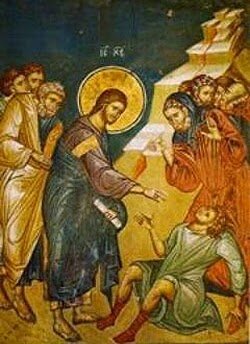
At the foot of the mountain, a large crowd was waiting for them. A man came and knelt before Jesus and said, “Lord, have mercy on my son. He has seizures and suffers terribly. He often falls into the fire or into the water. So, I brought him to your disciples, but they couldn’t heal him.”

Jesus said, “You faithless and corrupt people! How long must I be with you? How long must I put up with you? Bring the boy here to me.” Then Jesus rebuked the demon in the boy, and it left him. From that moment the boy was well.

Afterward the disciples asked Jesus privately, “Why couldn’t we cast out that demon?”

“You don’t have enough faith,” Jesus told them. “I tell you the truth, if you had faith even as small as a mustard seed, you could say to this mountain, ‘Move from here to there,’ and it would move. Nothing would be impossible.” (New Living Translation)

As we reflect on today’s Gospel lesson, let’s keep in mind that any time we see Jesus exorcising demons, we need to resist the idea that anyone having similar symptoms today is demonic in origin. Any chronic health condition a person experiences, without seeing any healing take place, does not necessarily mean the condition is due to the person’s lack of faith.

Conversely, it is also possible to relegate such healing accounts to a different time and place. My own view of Scripture, along with personal experience, informs me that demonization is real. We may underestimate how influential and widespread demonization occurs in this modern time and place.

The nature of faith is not located in its amount or intensity but in its object. All of life requires some faith. Even sitting in a chair. When I sit, the amount or intensity of my faith isn’t the issue – the object, the chair, is the issue. If a leg on the chair breaks and I flop to the floor, its not reasonable for me to conclude that it happened because of my lack of faith.

The disciples’ inability to heal the boy.

I’m not sure what is more difficult: to be the person suffering, or to observe a loved one suffering. The father is desperate and hurting, watching his son suffer with seizures. The man is utterly discouraged because Christ’s disciples were not able to help.

So, the desperate father approached Jesus and knelt, begging him to have mercy and help his son.

Our Lord’s response, I admit, is not likely what my response would be. I would be more like, “I’m so sorry this is happening to you. This is terrible. Let’s take care of this.” Jesus did honor the father’s request and healed the boy, but not before he had some words.

Jesus was exasperated, and he let everyone know about it. Why was he so disappointed?

Because his disciples knew better. The disciples were not ignorant or unable. They had what they needed to deal with the boy and his father. Jesus already equipped them to do this kind of ministry: 

Jesus called his twelve disciples together and gave them authority to cast out evil spirits and to heal every kind of disease and illness… “Heal the sick, raise the dead, cure those with leprosy, and cast out demons. Give as freely as you have received!” (Matthew 10:1, 8, NLT)

The reason for the disciples’ inability to heal was their lack of faith.

Jesus was perturbed with his disciples because they were not utilizing faith.

Jesus is bothered when believers don’t believe.

Up until this encounter, the disciples were healing people and doing the work Jesus gave them to do. Yet now they cannot. What changed? They relied on their own power, abilities, and experience, instead of relying on the power of God to heal. 

The Gospel of Mark includes Jesus saying that this kind of demon can only be dislodged through prayer (Mark 9:14-29). In short, the disciples didn’t pray. They didn’t tap into God’s power. They didn’t use the authority Jesus gave them. Rather, the disciples rested on their own laurels.

Their lack of prayer translated into a lack of power. 

If we are unable to do the work God has called us to do, it isn’t because we lack the authority or ability. It is a lack of faith.

Effective ministry happens because of faith.

The power of faith is in the person to whom it is directed. If we trust solely in ourselves, we will fail. However, if we trust in Jesus, then even the tiniest of faith will be able to do the impossible.

The power is not in particular words, or in a certain formula – the power is in faith rightly directed toward Jesus. Most demonic manifestations are much more subtle – such as thoughts of how I am not enough, how I have no right to try and help another, and how unable I am to do the will of God.

Conclusion

Here is a simple observation of Christ’s words: We are not told that if we have faith as big as a mountain that we can move one. Instead, Jesus tells us that if we have any faith at all, even as small as a tiny seed, directed toward God and not ourselves, the sky is the limit – we will have all the ability we need to do the will of God.

So, what is that impossible thing that could be done in your life with properly directed faith? 

What miracle, healing, or resistance to a bad spirit needs to take place around us? 

Discouragement is the most common tool of the devil in keeping us from realizing genuine manifestations of faith. Jesus has already accomplished victory over sin, death, and Satan. We must, then, claim all the will of God for today.

Resist the devil and he will flee from you (James 4:7). Step out in faith and do the will of God. The first step is always one of prayer….

High and Holy One, because your mercy is everlasting and your truth endures from generation to generation, show mercy to the sick and infirmed of either body or soul. Grant them deliverance from mental, emotional, spiritual, and physical illness. Blessed Lord, keep them under your care, for only in you can we live in safety and wellbeing. Visit them with your saving health. Do not let their hope be taken away, through Jesus Christ, our Lord. Amen.