There are, in reality, two reasons to celebrate today. Not only is it right to say, “Happy Thanksgiving,” it’s also appropriate to say, “Happy New (Christian) Year!” That’s because, for the past two-thousand years, Christians have marked time differently than their secular culture.
The “Christian Year” (or “Church Calendar”) refers to a yearlong calendar that marks time according to God’s activities rather than ours. It is to live life in a rhythm with Christ at the center of worship.
Time is referenced in the Bible as both chronological (Chronos) and seasonal (Kairos). The Christian Year is a co-mingling of both these kinds of time. Liturgical Christians celebrate events in which God acted in history for the benefit of his people. In order to remember those moments, dates have been assigned on the Christian Calendar so that we will not forget these significant events and praise God for what he has done.
So, then, to observe The Christian Year helps Christians as God’s people to recall and retell the story of God, especially the redemptive events of Jesus. In doing so, it provides a guide for spiritual growth. The Christian Calendar is arranged in such a way as to proclaim the gospel of Jesus Christ over the course of a year.
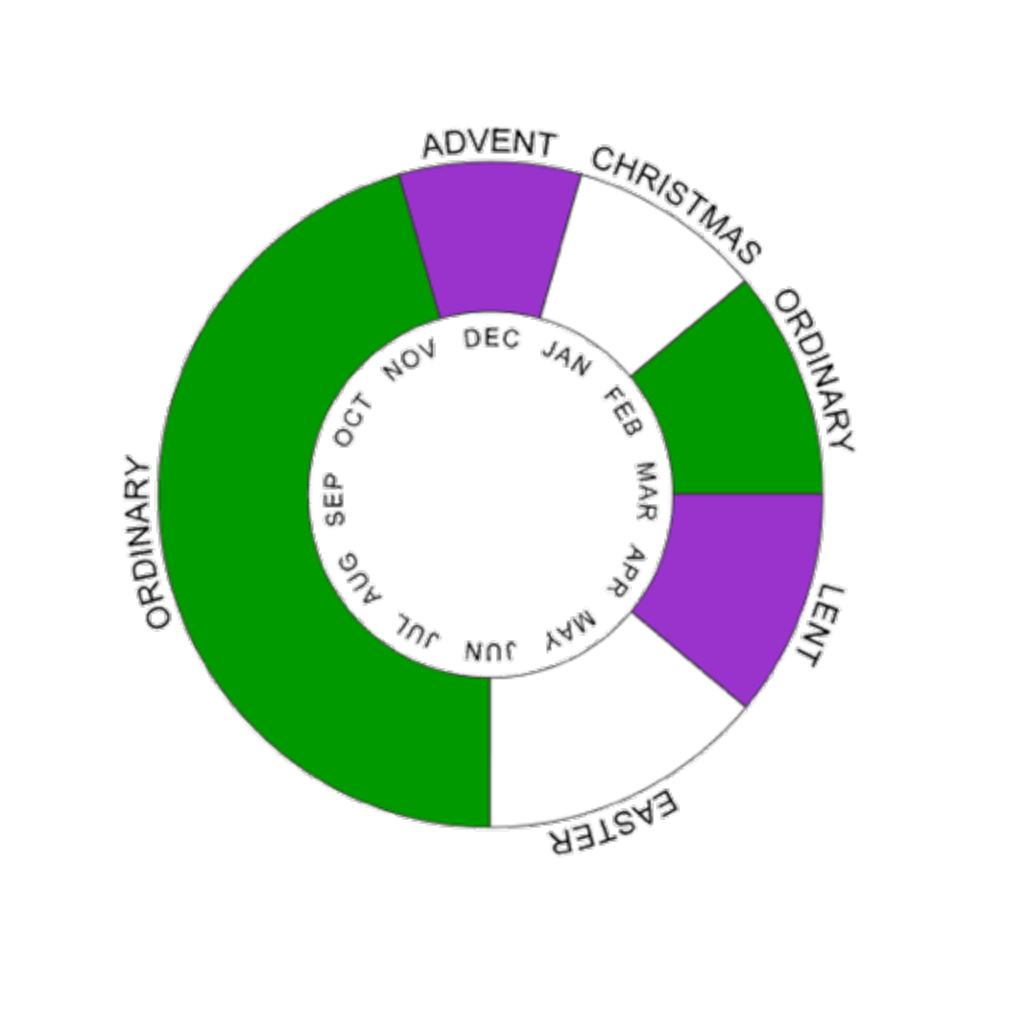
One of the ways this helps followers of Christ to remember distinct seasons is through the liturgical colors:
Purple signifies a time for preparation and penitence.
White represents celebration, joy, and victory.
Green lets us know it is time to focus on spiritual growth and mission.
Red helps us recall the Passion of Christ and the fire of the Holy Spirit.
The Christian Year is organized and arranged with these seasons:
Advent – The Christian Year begins not on January 1, but four Sundays before Christmas Day and up to Christmas Eve. The purpose of Advent is to anticipate Christ’s incarnation and prepare Christians to celebrate the coming of Jesus. We are also reminded that Jesus will return again at the end of the age.
Christmas – Yes, Christmas is more than just a day on the Church Calendar and encompasses the twelve days from December 25 to January 5 (you may recognize the “12 Days of Christmas”). Christmas is a celebration of the birth of Christ.
Epiphany – Epiphany follows Christmas from January 6 to the day before Ash Wednesday. The term Epiphany means “manifestation.” This is a celebration of God’s revelation, his manifestation to the entire world, not just to the Jews, but to the Gentiles, as well. Epiphany emphasizes Jesus Christ’s earthly ministry of teaching, healing, and preaching.
Lent – There are forty days in the season of Lent, from Ash Wednesday to Holy Saturday. Lent is a time to recall Christ’s temptation, conflict, suffering, and death. It is a season to contemplate Christian discipleship through the light of Christ’s Passion, engage in repentance, and put deliberate focus on spiritual disciplines that connect the penitent with Jesus.
Easter – As with Christmas, Easter is not just one Sunday; it is a season of fifty days up to the day of Pentecost. Easter celebrates the resurrection of Jesus; helps believers recognize new life in Christ; and includes celebrating the Ascension of the Lord.
Pentecost– This season runs from Eastertide to the Sunday before Advent. Pentecost celebrates the gift of the Holy Spirit, the birth of the church, acknowledges personal and communal spiritual power, and calls Christians to rejoice in receiving God’s power.
Ordinary Time – This is the same season as Pentecost. Ordinary time (also known as Proper Time) refers to the ongoing work of the church to spread the gospel of Jesus Christ, which is the typical, expected, proper and ordinary work of ministry that Christ’s followers are to do.
God of all time, you make all things new, bring hope alive in our hearts, and cause us to be born again. Thank you for this new Christian Year of following Jesus and all the potential it holds. Come and kindle in us a mighty flame so that in our time, many will see the wonders of God and live forever to praise your glorious name. Amen.
“Therefore, I tell you, do not worry about your life, what you will eat or drink; or about your body, what you will wear. Is not life more than food, and the body more than clothes? Look at the birds of the air; they do not sow or reap or store away in barns, and yet your heavenly Father feeds them. Are you not much more valuable than they? Can any one of you by worrying add a single hour to your life?
“And why do you worry about clothes? See how the flowers of the field grow. They do not labor or spin. Yet I tell you that not even Solomon in all his splendor was dressed like one of these. If that is how God clothes the grass of the field, which is here today and tomorrow is thrown into the fire, will he not much more clothe you—you of little faith? So do not worry, saying, ‘What shall we eat?’ or ‘What shall we drink?’ or ‘What shall we wear?’ For the pagans run after all these things, and your heavenly Father knows that you need them. But seek first his kingdom and his righteousness, and all these things will be given to you as well.” (New International Version)
Jesus cares both about what we do, and why we do it. That’s because he cares about our whole selves – our physical needs and our emotional/spiritual needs. In our anxiety about the future, Jesus guides us toward a non-anxious presence for our daily lives.
We all know what worry is. It’s that unsettling feeling in the pit of your gut about what’s going to happen tomorrow. Whenever we worry, we display an inability to see beyond our own little world. Worry bogs us down and saps our faith. Our worry is significant enough to warrant Jesus repeating the command to not worry six times. And he gives six reasons why:
Life is more than food and clothes.
When we are beset with worry, we need a big picture view of what’s going on. Being overly concerned about how the necessities of life are going to be met, we need a reminder that God cares for life itself, including us. If God cares about life, which is so valuable, he will sustain us with what we need to live that life.
God cares for the birds in creation.
People are the apex of God’s creation. And, since God cares for every other creature on this earth, and sustains their lives, God will certainly care for us, as well.
Worry begins to melt and be replaced by faith, not when we try and work up feelings of trust, but when we take the time to observe creation – watching the birds and seeing how God takes care of them. Birds don’t worry; they just enjoy God’s providence. Birds work hard, but they aren’t farmers who plant and harvest. Yet, God sustains them. So, if God will provide for small creatures that don’t plan to avoid starvation, how much more will God sustain you!?
Worryaccomplishes nothing.
Worry is like a rocking chair; it gives you something to do but doesn’t get you anywhere. Worry is simply unhelpful.
Don’t worry about the world coming to an end today. It is already tomorrow in Australia.
Charles M. Schulz
God cares for the flowers and grass in creation.
God clothes the flowers better than we ever could dress ourselves (which is what my daughters have told me for years). Jesus specifically identifies flowers and grass because they illustrate a short and precarious lifespan. Christ’s logic is from the lesser to the greater: If God cares for something as fragile and temporary as flowers and grass, how much more will God care for you?
Jesus links worry with a small faith. We have expectations in life about how things ought to go. If those expectations are grounded in God’s promises, then whenever adverse circumstances come, we will likely respond with peace and trust. However, if we are anticipating the future to turn out a particular way, then the worry sets in.
While we worry, we begin taking matters into our own hands. If the situation goes against our expectations, then we start to question if God is good or not, or if the Lord really has our best interests at mind. We must not tether ourselves to a specific outcome, rather, we need to rely on God’s care for us, no matter what the outcome will be.
Your heavenly Father knows your needs.
Unlike the ancient pagan deities who were aloof, fickle, and did not pay much attention to people, God is always watching us, always attentive, always knowing our every need. Pagan worshipers keep worrying about whether the gods will really care, or not.
However, with God there is no need for worry because we know the Lord has our backs and is trustworthy. Just as my girls used to jump from the stairway in a leap of faith because they knew for sure Dad was going to catch them, so also your heavenly Father is a reliable God.
The necessities of life will be given to you.
God’s business is to provide for our necessities; our business is to seek first God’s kingdom and God’s righteousness.
The verb form of “seek” is a continuous action of seeking. We are to daily seek God’s kingdom and submit to Christ’s lordship. We are to continually pray for God’s kingdom to come and bring all the world under the gracious authority of Christ.
We need to keep seeking social, political, cultural, institutional, and ecclesiastical reform because God cares about it all coming under Christ’s lordship. Continually seeking God’s kingdom means we dethrone wealth and possessions as our first pursuits, and instead seek heavenly treasure as defined by Jesus.
We are to continually seek God’s righteousness by seeking peace where there is discord; forgiveness when others sin against us; mercy instead of judgment; right relations with people in our family, at work, in the neighborhood, and in the church.
The will of God is clearly stated: Seek first the kingdom of God and God’s righteousness.
Conclusion
If we are busy with kingdom business, there is then no room for worry. Anxious fretting sets in whenever we are diverted from seeking the kingdom. There’s no need for worry about tomorrow because I am busy today doing God’s will.
So, how then do we overcome worry?
Confess and renounce worry. Call worry for what it is: a lack of faith.
Observe creation. Take regular walks in nature. See all the flora and fauna around you. Perceive how God cares for all of it – and you.
Get to know the God of the Bible. Spending time with God increases our faith and reliance upon the Lord. Knowing that he is trustworthy, increases our faith. Engaging in the spiritual practices of prayer, giving, and fasting build our trust in God.
Seek first God’s kingdom and righteousness. Busy yourself with kingdom pursuits, instead of worry.
May God’s blessing rest on you, as you value what Jesus values, and as you seek the Lord with all your heart, soul, mind, and strength.
“Though I have been speaking figuratively, a time is coming when I will no longer use this kind of language but will tell you plainly about my Father. In that day you will ask in my name. I am not saying that I will ask the Father on your behalf. No, the Father himself loves you because you have loved me and have believed that I came from God. I came from the Father and entered the world; now I am leaving the world and going back to the Father.”
Then Jesus’ disciples said, “Now you are speaking clearly and without figures of speech. Now we can see that you know all things and that you do not even need to have anyone ask you questions. This makes us believe that you came from God.”
“Do you now believe?” Jesus replied. “A time is coming and in fact has come when you will be scattered, each to your own home. You will leave me all alone. Yet I am not alone, for my Father is with me.
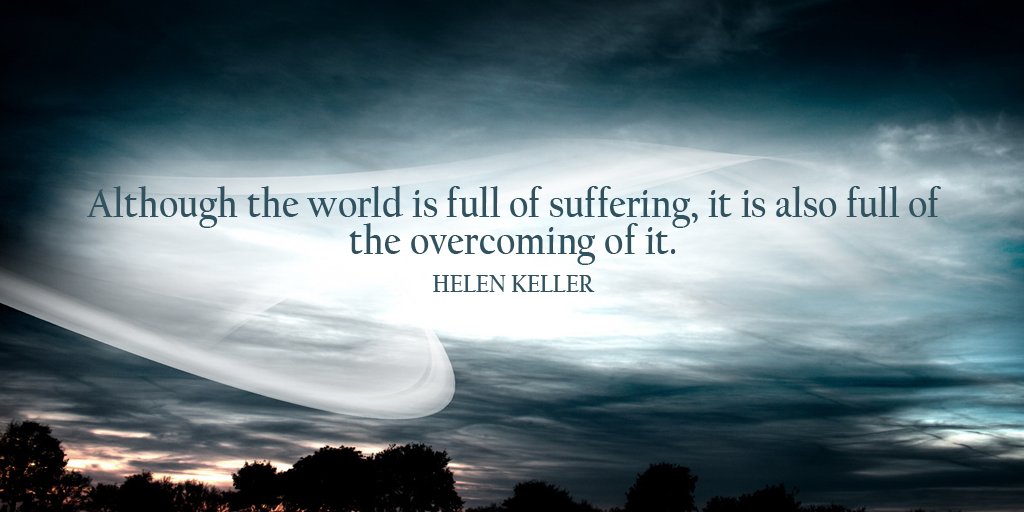
“I have told you these things, so that in me you may have peace. In this world you will have trouble. But take heart! I have overcome the world.” (New International Version)
Imagine you are with Jesus in the Upper Room celebrating Passover. And your Lord tells you he is leaving – going back to the Father. After three years of hard and incredible ministry, there is palpable grief in the room. It’s as if you got sucker-punched. You want this time with Jesus to never end….
Jesus Christ, Son of God, Son of Man, Savior of the world, does not forget you. The Lord is concerned and careful to provide wonderful words of assurance: Father God loves you. I give you my peace. I have overcome the world.
Whenever we encounter trouble; in those times when grief seems to be swallowing us whole; and when all is dark and we cannot see our hand in front of our face – it is in these moments the Lord comes alongside us and communicates a loving divine presence which grants us the peace of settled rest, even if and especially when our troubling situations do not change.
If you have had a life largely free of struggle, the privilege of knowing where your next meal is coming from, and the assurance of having your most basic needs met, then understand many people throughout the world know nothing of this experience.
However, this doesn’t necessarily mean those needy persons are unhappy, discontent, or bitter. Love and peace are neither bound nor limited by adverse circumstances. In fact, we know love and peace in a much deeper way whenever we have been hated and in conflict. That’s because love thrives and flourishes in an environment of hate; and peace takes root more surely where there is disharmony and misunderstanding.
If everything always goes our way, how then would we know the Lord’s great grace to us? How would we ever know God as Provider unless we were in want? How would we know Christ as the Healer unless we were broken? How could we ever know resurrection unless there was a crucifixion?
Jesus specializes in the improbable and the impossible, in landing on the Island of Misfit Toys and airlifting the discarded to be a gift to the world. You see, this is precisely how we overcome the world: We love and serve, just as our Lord did. Since he overcame, we walk in his footsteps.
The acquisition and presence of peace is anything but passive. Peace has been achieved through a bloody cross and settles within the spirit through an active pursuit of harmony, wholeness, integrity, and love.
Now that we have been put right with God through faith, we have peace with God through our Lord Jesus Christ. He has brought us by faith into this experience of God’s grace, in which we now live. And so, we boast of the hope we have of sharing God’s glory! We also boast of our troubles, because we know that trouble produces endurance, endurance brings God’s approval, and his approval creates hope. (Romans 5:1-4, GNT)
For the kingdom of God is not food and drink but righteousness and peace and joy in the Holy Spirit. The one who thus serves Christ is acceptable to God and has human approval. Let us then pursue what makes for peace and for mutual upbuilding. (Romans 14:17-19, NRSV)
God’s peace and love is free, but it is not cheap. It is obtained smack in the middle of worldly troubles.
May the peace of God be with you, my friends.
Almighty and everlasting God, you are the fountain of all peace, spiritual and temporal. We humbly pray, in your great goodness grant us that peace which the world cannot give, that we may ever live in your fear, obedient to your commandments, to the end that you may deliver us from all our enemies, through your dear Son, Jesus Christ, our Lord. Amen.
14th century painting of Jesus standing before Pilate by Italian artist Duccio di Buoninsegna
Pilate then went back inside the palace, summoned Jesus and asked him, “Are you the king of the Jews?”
“Is that your own idea,” Jesus asked, “or did others talk to you about me?”
“Am I a Jew?” Pilate replied. “Your own people and chief priests handed you over to me. What is it you have done?”
Jesus said, “My kingdom is not of this world. If it were, my servants would fight to prevent my arrest by the Jewish leaders. But now my kingdom is from another place.”
“You are a king, then!” said Pilate.
Jesus answered, “You say that I am a king. In fact, the reason I was born and came into the world is to testify to the truth. Everyone on the side of truth listens to me.” (New International Version)
In Christianity, to worship God means we praise the person and work of Christ and are also spiritually formed through that adoration. Christ the King Sunday focuses our worship on Jesus Christ’s reign over the entire world. It is a proclamation that everything and everyone in all creation is subservient to King Jesus. Furthermore, it is an invitation to actively enjoy Christ’s gracious and benevolent rule over us.
Jesus came to this earth to bring connection and intimacy to God and humanity. We all have relationships in which we want to be closer.
A parent might be dissatisfied, and sad, that one of their children is estranged from them, because they want intimacy.
A spouse may want to have a more relationally intimate marriage, having been distant for too many years.
A teenagers or twenty-something might want to get closer to that special someone.
A friend might be keeping their distance. And although you have conversations with them, they only let you in so far.
We want to go deeper, and it isn’t happening because the other party is not willing.
In this we reflect the image of God within us because God feels that same longing and desire to move deeper and closer to us. The Lord desires intimacy, yet we might keep treating him like he is some untouchable monarch like Queen Elizabeth – as if there is no chance of really getting close, and we wonder if there is any real power there to make a difference.
However, God is not a ruling figurehead, and does not want a casual superficial relationship with us. Christ’s kingship moves closer to people, not further away. Everything Jesus did on this earth was to bring people closer to God because God wants a personal and familiar relationship with us.
Jesus does not want us estranged from God, and he has gone to the greatest lengths possible to make that close relationship possible and real through the cross, resurrection, ascension, and a kingly reign which is near to us. The kingdom of God, with Jesus as King, is a kingdom of closeness and fellowship with the divine.
Christ the King Sunday appropriately challenges us to consider what it means to say that Jesus Christ is the Lord of our life. Jesus Christ, as our Lord and King, means much more than God calling the shots and issuing commands; it means Christ uses his lordship to satisfy his longing to be with us.
Our Gospel lesson for today plunges us into an event we associate with Holy Week. Christ has been arrested by the conniving of his enemies. Since the religious authorities could not put anyone to death, they bring Jesus to the Roman governor, Pontius Pilate, in the hope he will do their dirty work for them.
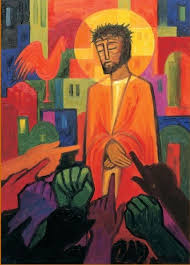
Jesus condemned to death, painting by the Benedictine Sisters of Turvey Abbey
The scene takes place early in the morning at Pilate’s palace. Pilate doesn’t like the Jewish authorities because they put a dent in his career plans through their constant complaints about him to his supervisors in Rome. For purely political reasons, Pilate decides he will satisfy their demand and interview this Jesus who they claim is an enemy of Rome.
The prisoner, Jesus of Nazareth, is brought to Pilate. He is a mess. Christ’s clothes are stained with dirt and blood. His face is bruised and haggard. He has not slept all night. Pilate has heard of Jesus, and so he’s curious to make a personal evaluation of him. Jesus looks nothing like a king to Pilate.
Pilate, in contrast, looks the image of a worldly leader with his power suit on and all the strength of Rome behind him. He hardly has time for this sideshow, this pathetic presentation of leadership in front of him. Jesus looks like nothing more than a kingly wannabe. There is nothing from Christ’s outward appearance that gives any impression he is qualified to be a leader of anybody. We can almost picture Pilate rolling his eyes, saying “so you are the King of the Jews?”
What follows is a strange, convoluted conversation about kingship and truth with a contrast between this world and a world to come. Repeatedly, Jesus makes it clear his kingdom is not of this world. Two thousand years have passed since that dialogue between Jesus and Pilate, yet the same issue remains.
The issue is this: Jesus is calling all of us to follow him – to put his Kingdom first in our lives. In Pilate, we have a symbol of worldly power, which is arbitrary, unprincipled, self-serving, and brutal. Pilate knows the right thing to do but chooses the path of least resistance. He caves to the political pressure, denying the truth which is right under his prominent Roman nose.
Earthly power seeks its own ends. It wants to hold onto control and call the shots. Conversely, Christ’s kingly power is used to serve, to wash feet and meet needs, to move closer to people. Earthly kingdoms use violence to conquer and maintain order and control its subjects. In stark contrast, Christ’s kingdom uses love to transform and unify people around Jesus so that the subjects are with the king and enjoy his rule and reign.
Christ’s kingdom is not of this world. It is counter-cultural and counter-intuitive to how every other leadership structure works on earth. It is an upside-down kingdom that seems like it won’t work or make sense: The way up is down; to be great is not to work for a high position, suck up to the boss, and climb the ladder of wealth and success. Rather, it is to embrace humility and be a servant.
In God’s kingdom, the way to pursue truth is not in forming original ideas and expressing opinions but is found in a person. Truth-seeking disciples will listen to this one voice of Jesus, and filter-out all others. It is a voice calling for submission to his lordship, and to do so because it brings us into an intimate relationship with God.
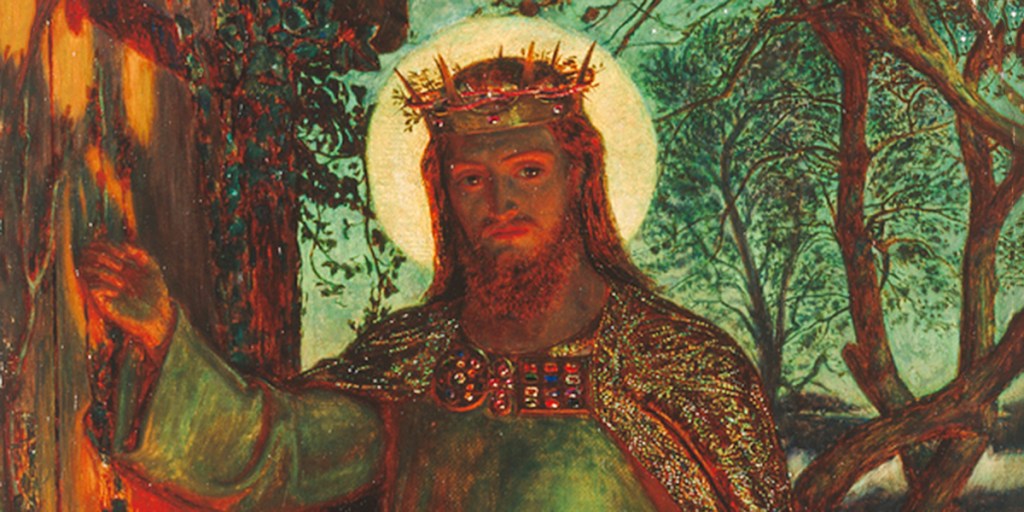
The Light of the World, by English artist William Holman Hunt, 1852
The message of our crucified Savior reigning as King in our lives is not that, having suffered for us, Jesus will somehow keep us from facing difficult times. Instead, Jesus faced a horrible death so that our own tough times can triumph with God’s power to save us and move deeper into our lives. God’s presence and promise is what sustains us, not the avoidance of suffering. Christ as our King means God is with us.
Black Friday and Cyber Monday are almost upon us. This season demonstrates a contrast between two kingdoms. The kingdom of this world calls on us to demonstrate our worth and gain meaningful relationship through grabbing control and obtaining stuff. The pressure in seeking the perfect gift at the perfect price in the hope that if we can bag it, wrap it, and get it under the tree, then we will be perfect, and the perfect family Christmas will happen, and relationships will be great, and everyone will act like I want. Right!?
In contrast, the kingdom Jesus describes assures us we don’t have to prove our worth through endless accomplishments and generous gifts. We don’t need to have the perfect Christmas experience to gain our deepest relational needs. Because, in our baptism, we have been accepted; we are sons and daughters of the living God; and we do not need to achieve greatness through financially and emotionally bleeding ourselves.
In his conversation with Pilate, Jesus said: “My kingdom is not of this world.” When Christians say Jesus Christ is our King, we acknowledge we are his subjects and that we march to the beat of a different drum. The heart of this relationship is our dependence on Jesus who came that we might have life and have it in abundance.
On this Sunday, followers of Jesus Christ boldly state our confidence that, at the end of time, Jesus will come again as King and Ruler of all.
Blessed are those who see the truth by faith and not by sight. Blessed are those who say “Jesus is the King and the Lord of Life” without rolling their eyes or with a selfish agenda but with a sincere conviction that they belong to Jesus and want to be ever closer to him who is the Way, the Truth, and the Life.
Almighty God, everlasting heavenly Father, you break the power of evil and make all things new in your Son Jesus Christ, the King of the universe. Our confidence is firmly in you, Lord Jesus, knowing you will redeem all things and make all things new.
We affirm that our security is not in personal abilities, clever plans, or lucrative jobs; our security is in you alone. Your creation still groans with the pain of living in a fallen world. But you have conquered sin through your love, and it is to your love we rely upon. May all things in heaven and on earth recognize the glory of your kingly rule and never cease to praise you. We ask this through our Lord Jesus Christ, your Son, who lives and reigns with you and the Holy Spirit, one God, now and forever. Amen.