Pillow Thoughts (Psalm 132:1-12)

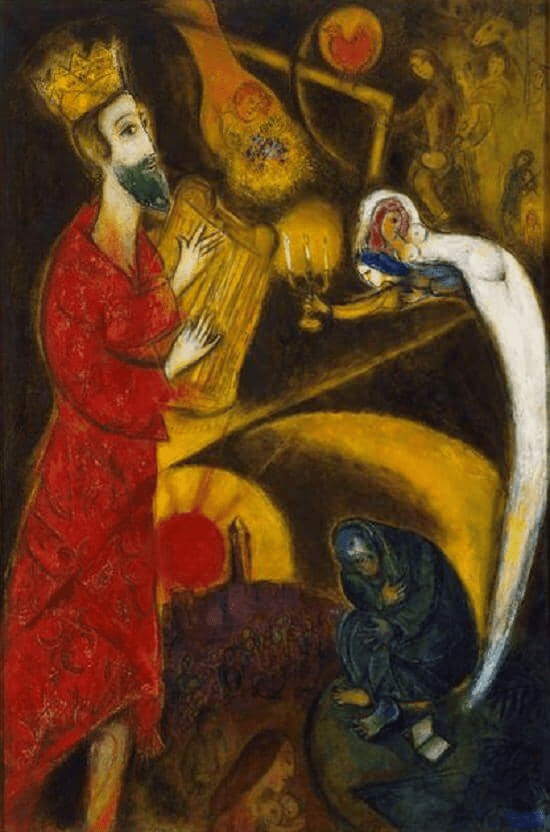
King David, by Marc Chagall, 1962

O Lord, remember in David’s favor
    all the hardships he endured;
how he swore to the Lord
    and vowed to the Mighty One of Jacob,
“I will not enter my house
    or get into my bed;
I will not give sleep to my eyes
    or slumber to my eyelids,
until I find a place for the Lord,
    a dwelling place for the Mighty One of Jacob.”

We heard of it in Ephrathah;
    we found it in the fields of Jaar.
“Let us go to his dwelling place;
    let us worship at his footstool.”

Rise up, O Lord, and go to your resting place,
    you and the ark of your might.
Let your priests be clothed with righteousness,
    and let your faithful shout for joy.
For your servant David’s sake
    do not turn away the face of your anointed one.

The Lord swore to David a sure oath
    from which he will not turn back:
“One of the sons of your body
    I will set on your throne.
If your sons keep my covenant
    and my decrees that I shall teach them,
their sons also, forevermore,
    shall sit on your throne.” (New Revised Standard Version)

King David took great pains in providing for the house of the Lord; and was very concerned about the worship of Yahweh. He went well out of his way to ensure that a temple would be built for his God.

David made as many preparations as he possibly could before his death, so that his son Solomon could follow through and build the temple. The editor of the Book of Chronicles commented on this:

David gave orders to gather together the aliens who were residing in the land of Israel, and he set stonecutters to prepare dressed stones for building the house of God. David also provided great stores of iron for nails for the doors of the gates and for clamps, as well as bronze in quantities beyond weighing, and cedar logs without number—for the Sidonians and Tyrians brought great quantities of cedar to David. 

For David said, “My son Solomon is young and inexperienced, and the house that is to be built for the Lord must be exceedingly magnificent, famous and glorified throughout all lands; I will therefore make preparation for it.” So David provided materials in great quantity before his death. (1 Chronicles 22:2-5, NRSV)

The king did all of this because God came to David and let him know that he would not be the one to build the temple; that job would fall to his son Solomon. (2 Samuel 7:4-13)

David’s final instruction to Solomon and the people had to do with the construction of a house for the Lord his God:

“Now set your mind and heart to seek the Lord your God. Go and build the sanctuary of the Lord God so that the ark of the covenant of the Lord and the holy vessels of God may be brought into the house built for the name of the Lord.” (1 Chronicles 22:19, NRSV)

The worship of God, for David, was to be the central feature of the Jewish people. All Israel and Judah were to encourage one another in worship at God’s house, the Lord’s Temple, in Jerusalem.

The priests of God wore special clothing, and handled the holy implements and the Ark of the Covenant of God. Yet, they were to be also clothed with righteousness, making sure that their outward ceremonial rituals reflected an inner moral purity and holiness before God.

David was bound and determined to not only worship the Lord himself, but to see that the entire nation of Israel had the opportunity to worship together in a central place.

Maybe a question arises for you about why David was so driven to construct a house for God. What is it that motivated King David to spend so much of his planning and energy on making sure that a temple would be constructed for the Lord?

Now when the king was settled in his house and the Lord had given him rest from all his enemies around him, the king said to the prophet Nathan, “See now, I am living in a house of cedar, but the ark of God stays in a tent.” Nathan said to the king, “Go, do all that you have in mind, for the Lord is with you.” (2 Samuel 7:1-3, NRSV)

A lot of events had transpired for David to be in the position of king, with peace all around him. The Lord had been with David, and brought him through the sort of adversities most of us will never know.

Once King David was at the pinnacle of peace and success, his thought were not about how to hold onto power, or to get more of it. He would lay his head on his pillow at night and wonder how he could give back to God for being so faithful.

And considering all that God had accomplished for him and for Israel, it seemed a travesty that he was luxuriating in a fine house, while the Ark of the Covenant – the objective presence of God among the people – was sitting in an old tent. So, David became determined to change that situation, because he could.

I wonder if when you and I are at a place in our lives where we feel safe and secure, prosperous and happy, our thoughts and dreams turn toward how we might give back to God in a worshipful way which will honor the Lord, as well as bless all the people of God.

I am curious what sort of things occupy your mind at night while your head is on your pillow, when you are feeling good about how your life is going.

Many, if not most, people will think about themselves, and what to do with what they have gained and/or accomplished. But what about you?

How will you respond to God’s grace, goodness, deliverance, and protection in your own life? What sort of ideas arise in your mind? What is in your heart to do for God and God’s people?

What are your pillow thoughts at night?

Presence itself is a great gift. The presence of God is incredibly gracious, good, and miraculous. And human presence, with each individual stamped with the image and likeness of God upon them, is also a wonderful gift from the Creator. And very much needed.

David enjoyed the presence of God, and longed for all the people to experience that divine presence. Although the Lord needed no temple to live in, David had in mind to provide one.

I imagine that King David understood that each person is a luminous icon of presence, reflecting God’s image, and needing the presence of God and others in order to have a nation who worships God as commanded in the Mosaic law.

Through communal worship at a designated site in Jerusalem, the Israelites could enjoy the beauty of God’s presence together, as well as the encouragement of one another.

Wherever there is presence and the acknowledgement of God and each other, there is freedom to offer affection, understanding, and respect.

It seems to me that these were the sort of thoughts that ran through King David’s mind, which made him determined to build a house for the Lord his God.

So, what will you do with your thoughts and your life?

Almighty God of all hope, of our thoughts and dreams: In humility, we give you thanks for all of creation; and for everything you give us. We praise you for forgiving us of our guilt and shame, even before we ask. You raise us from our broken state and make us whole. You give us the peace we yearn for.

Blessed God, fill us, your people, with your divine Spirit. Be our light in the darkness. Envelop us with your presence. Orient our hearts toward your justice; and help us always praise you. Let us ever be mindful of your power and grace in the world. Let us live as one with you in grace and in truth. Amen.


What Is It You Are Trying To Do? (Mark 10:2-16)

Jesus blesses the children

Some, testing him, asked, “Is it lawful for a man to divorce his wife?” He answered them, “What did Moses command you?” They said, “Moses allowed a man to write a certificate of dismissal and to divorce her.” But Jesus said to them, “Because of your hardness of heart he wrote this commandment for you. But from the beginning of creation, ‘God made them male and female.’ ‘For this reason a man shall leave his father and mother and be joined to his wife, and the two shall become one flesh.’ So they are no longer two but one flesh. Therefore what God has joined together, let no one separate.”

Then in the house the disciples asked him again about this matter. He said to them, “Whoever divorces his wife and marries another commits adultery against her, and if she divorces her husband and marries another, she commits adultery.”

People were bringing children to him in order that he might touch them, and the disciples spoke sternly to them. But when Jesus saw this, he was indignant and said to them, “Let the children come to me; do not stop them, for it is to such as these that the kingdom of God belongs. Truly I tell you, whoever does not receive the kingdom of God as a little child will never enter it.” And he took them up in his arms, laid his hands on them, and blessed them. (New Revised Standard Version)

Trying To Parse the Law?

The topic of divorce has always been a hot button issue throughout human history. And there have continually been diverse views and opinions about it. This is also true of Holy Scripture. A variety of interpretations are offered by many about the Bible’s view of divorce, and Christ’s words concerning it.

Much like today, divorce in the first century was accepted as part of what happens in society, even among Jews, although it was more proliferate in other cultures. Most of the discussions about divorce centered in legal details, with some speaking against it as bad for society.

Among the Jewish religious leaders and experts in the law, it was generally recognized that divorce occurs, with Mosaic legislation proscribing how to carry out divorce (Deuteronomy 24:1-4). Yet, other scripture texts frame the existence of divorce as questionable for God’s people. (e.g. Genesis 2:24; Malachi 2:13-16)

Trying to Test Jesus?

Anyone who doesn’t like another, will often confront them on a hot button issue that has plenty of diverse opinion to it. This is why the Pharisees sought to get Christ’s take on the topic of divorce.

Essentially, Jesus reframed divorce so that it was no longer simply a legal topic, but involves real people. Christ talked about divorce in a way that upheld the dignity of persons, especially women; and lifted up the true sanctity of marriage.

In turning the discussion from a legalities to God’s design for humanity and marriage, Jesus cut to the heart of the matter, to God’s intent, and to human frailty. He focused on relationships, because they were inherent from the beginning.

Yes, divorce is a reality, and it is has its place in society. But no, it’s not supposed to be this way. The very word “divorce” means there is a separation, a breech, a disconnection of relationship. This is why Christ went to another topic: adultery.

Trying To Divorce Women?

Jesus said that a person initiating a divorce in order to marry another person commits adultery. In saying this, he was not offering a legal conversation of details. Rather, Christ was focusing on people; he was concerned for wives and women.

The conversation between Jesus and the Pharisees was a discussion between men, and presupposed a man’s point of view on divorce. Women did not have the ability to initiate divorce in the ancient society.

And Christ seems to have had no stomach for being drawn into abstract legal debates between a bunch of men. Instead, he cared about the people involved in an actual divorce, especially the women.

For all intents and purposes, women (and their sexuality) were the property of men – the father, and then later, the husband. In this social milieu, whenever a husband initiated a break in the relationship, it was important for a woman to have a certified document of divorce. Without that certification, a woman divorcee would be landlocked, unable to do much of anything, as well as be the brunt of societal gossip, slander, or worse.

Since Jesus was talking to the men, the Pharisees, he pointedly looked at them and let them know that, although they might initiate a divorce, it in no way justified their sneaking and creeping around. It didn’t cover their adulterous relationship(s) nor their adulterous hearts.

All this is to say that Christ very much opposed divorce on the grounds of putting a wife away out of a desire for a different spouse. He intended on empowering women. In a divorce situation, because a man was in control of the process, it was then the man who commits adultery against the woman.

Both logically and legally, a woman could never commit adultery because of divorce – only the man. What’s more, adultery is not primarily a violation of the law, but of the woman. Jesus believed it was high time for some accountability with the men.

Even though contemporary Western society is much different than the ancient social structure, Christ’s teaching is still relevant. The need to uphold not just the law, but the rights of women is a must for today, as well.

Unless we can observe Christ’s concern for women’s justice and rights, there will be men who continue to leverage their own gender over and against females and wives. And there will continue to be both husbands and wives who initiate divorce for their own adulterous motives, thus putting their spouse in moral, legal, emotional, and spiritual jeopardy.

Trying To Keep Children Away?

The overarching ethics of Jesus, and the law of God, is to provide justice and righteousness for the most vulnerable among us. And this is why the teaching about divorce is coupled with instruction about children.

In our contemporary society, children have rights and are accorded significant status. That was not true in the ancient world. Children were mostly viewed as potential adults. Until then, kids were to stay quiet unless spoken to, and to obey their parents with absolutely no talk-back.

Christ’s disciples did what any student following their teacher would do; they kept the kids at bay so that Jesus could do his important ministry work. But what the disciples discovered is that the kids were actually part of that important ministry work. As children, they were vulnerable, at the low end of the social scale, and had no personal rights other than being part of a family.

To become like a little child in order to enter the kingdom of God did not mean becoming innocent; it meant becoming humble and dependent, and embracing meekness, gentleness, and lowliness. It meant to become the last and the least among us. Because the last will be first, and the least will become great.

Trying To Get It Right?

It’s important for us to uphold the sanctity of human life, and the spirit of the law. The law is intended to preserve and protect life – and is not to be used to find loopholes or ways to get what you want.

Meeting the needs of all people – whether they be men, women, children, and whether they be rich or poor – is to be everyone’s concern. Why? Because justice and righteousness are at the heart of God’s concern for humanity.

Merciful God, who discerns each heart: We confess our family is most often like strangers to us. So, give to all parents and children the grace to see one another as they truly are, and as you have called them to be. In the name of Jesus Christ, our mediator and advocate, we pray. Amen.

The Ways of Wisdom (Proverbs 30:18-33)

There are four things that are too mysterious for me to understand:

an eagle flying in the sky,
a snake moving on a rock,
a ship finding its way over the sea,
and a man and a woman falling in love.

This is how an unfaithful wife acts: she commits adultery, takes a bath, and says, “But I haven’t done anything wrong!”

There are four things that the earth itself cannot tolerate:

a slave who becomes a king,
a fool who has all he wants to eat,
a hateful woman who gets married,
and a servant woman who takes the place of her mistress.

 There are four animals in the world that are small, but very, very clever:

Ants: they are weak, but they store up their food in the summer.
Rock badgers: they are not strong either, but they make their homes among the rocks.
Locusts: they have no king, but they move in formation.
Lizards: you can hold one in your hand, but you can find them in palaces.

There are four things that are impressive to watch as they walk:

lions, strongest of all animals and afraid of none;
goats, strutting roosters,
and kings in front of their people.

If you have been foolish enough to be arrogant and plan evil, stop and think! If you churn milk, you get butter. If you hit someone’s nose, it bleeds. If you stir up anger, you get into trouble. (Good News Translation)

If there is an overall theme in the wise sayings from this chapter in the Book of Proverbs, it is that we ought to renounce arrogant greed; while at the same time, we should uphold and embrace a humble life of contentment.

The four lists of wisdom address four observations of creaturely ways on this earth: mysterious ways, antisocial ways, instinctive ways, and impressive ways. We are meant to observe that each of these four numbered lists contain wisdom that is available to all of us, that is, if we will but apply the observational understanding to our own lived situations.

Mysterious Ways

The first list observes four invisible ways; the way of the eagle, snake, ship, and man, all leave no trace of where they have been and what they are up to. Thus, their ways are mysterious, causing us to wonder what is really going on with them.

Why is the eagle flying, the snake moving over the rock, the ship navigating the water, and the man interacting with the woman?

We are to apply wisdom to our circumstances, and discern that a single act of one being is, in reality, up for interpretation. We simply do not know why each is doing what they’re doing.

As wise persons, we understand that intentions and motivations vary from person to person, and from one observer to another.

The eagle may be enjoying the spread of his wings and the feel of the wind; or he might be the predator surveying the land to attack an unsuspecting fish or squirrel.

The snake may be seeking to warm himself in the sun, or he could be slithering with malevolent intent.

The ship may be hauling needed goods to bring into port; or it might be moving to pirate others and steal.

And the man may be intending to love a fair maiden; or he might be attempting to seduce her for his own advantage.

The point is that we must be wise and discerning, not always having a singular interpretation or belief about what we are seeing and observing. What at first glance may appear innocuous, may in fact come from a place in the heart of covetous greed, and vice versa.

Antisocial Ways

The second list, dealing with general societal roles, cites four instances of role reversal which turns the social order into antisocial ways that cause trouble in society.

A slave who becomes king may believe that he knows better than the ruler. He probably talked about how he could do a better job. Yet, when given such a responsible position, such a person is way out of their expertise and depth. Statecraft is a real thing; and if one hasn’t been duly trained in it, and had some experience in it, things will go south quickly.

A fool who has all he wants to eat is like the person without any self-control. He goes out to eat at an all-you-can-eat buffet; and it will not end well, especially if it’s done a regular basis.

A hateful woman who gets married is a train wreck waiting to happen. I’m not sure I need to comment on this, because likely you are already covering your eyes, imagining what will happen in such a relationship.

And a servant woman who takes the place of her mistress has perhaps had a fantasy about how easy it is to be in charge and simply tell others what to do. Little does she know how stressful it truly is to be in charge and be the administrator of an entire household. Like the slave becoming a king, she will soon learn that the role she coveted is not all it’s cracked up to be.

All four of these persons do not (yet) have the wisdom to fulfill a role; they need training, experience, and a proper character to do the job. Their limited perspectives, and their foolish character, will lead to disaster.

Instinctive Ways

The third list, dealing with natural instincts, cites four creatures who model survival because of their instincts and wisdom, not their strength.

An ant may be small, and not carry near as much as a bigger creature, yet they have sense enough to diligently work and have everything they need when it is needed.

Rock badgers compensate for any lack of strength by making their home a fortress where a much stronger creature cannot penetrate. They have sense enough to know how to live in safety.

Locusts are many. Even though they have no leader, and are small creatures, they know enough to move together and work together in order to accomplish thriving and flourishing on this earth.

And even though lizards are common, and not all that difficult to catch and possess, nevertheless they can be found in high places. They are taken care of by bigger and greater creatures than themselves.

When any creature lives into their true self, and doesn’t try to be something they are not, their needs are cared for. Humanity could take a big lesson from such small creatures about how to get along in life.

Impressive Ways

The fourth list, dealing with displays of majesty, cites four creatures who are stately in their appearance because of their position, design, and context.

Lions are majestic creatures. Their very appearance and the sound of the male’s roar elicits awe and fear in others. This is an important part of how the lion pride gets around in this world and is able to meet their own needs.

Goats and roosters strut around like the own the place. Their sense of presence and confidence is palpable. If you’re ever around them, you’ll need to match or exceed their level of acting in charge.

Which is precisely what a king does within his realm. Each of these four are an example of taking charge and acting the part that you ought to be playing.

Whereas the earlier list had examples of people who were trying to act a role they weren’t ready for, this list of examples are creatures who are living into the role they need to exhibit, no matter whether they feel brave or competent, or not.

Concluding Ways

The wise person takes the time to observe, listen, and learn from a variety of sources, including all of creation. Everything and everyone can teach us, that is, if we will but put ourselves in a position to learn from them.

The first two lists describe people who covet for more, and are discontent with their situation. The last two lists observe creatures who know their limits and weaknesses, yet nevertheless, have found resilient ways to meet their needs – ways that are consistent with who God created them to be.

So, which way will you go?

Almighty God, I humbly ask that You fill me with the Spirit of wisdom and revelation in the knowledge of You. Open the eyes of my heart to see Truth more clearly. Sharpen my spiritual discernment to distinguish good from evil, good from bad, better from best.

Help me not lean merely on my own finite understanding, but trust wholeheartedly in Your infinite wisdom given to me in creation. May divine wisdom from above flow through me each day in thought, word, and action. Amen.

The Evil Within (Mark 7:1-8, 14-15, 21-23)

Now when the Pharisees and some of the scribes who had come from Jerusalem gathered around him, they noticed that some of his disciples were eating with defiled hands, that is, without washing them. (For the Pharisees, and all the Jews, do not eat unless they wash their hands, thus observing the tradition of the elders, and they do not eat anything from the market unless they wash, and there are also many other traditions that they observe: the washing of cups and pots and bronze kettles and beds.)So the Pharisees and the scribes asked him, “Why do your disciples not walk according to the tradition of the elders but eat with defiled hands?” He said to them, “Isaiah prophesied rightly about you hypocrites, as it is written,

‘This people honors me with their lips,
    but their hearts are far from me;
in vain do they worship me,
    teaching human precepts as doctrines.’

“You abandon the commandment of God and hold to human tradition…”

Then he called the crowd again and said to them, “Listen to me, all of you, and understand: there is nothing outside a person that by going in can defile, but the things that come out are what defile…”

For it is from within, from the human heart, that evil intentions come: sexual immorality, theft, murder, adultery, avarice, wickedness, deceit, debauchery, envy, slander, pride, folly. All these evil things come from within, and they defile a person.” (New Revised Standard Version)

There are many people who believe that evil resides out there, but not in here.

“Out there” is usually in places where people don’t live like me, think like me, and act like me. Rarely does anyone, when asked where evil is, points to their own heart.

The religious establishment of Christ’s day saw evil as something which existed “out there” where the sinners are; but not “in here” where I am.

Jesus had something to say on that subject. The exchange between the religious leaders and Christ began with a query toward Jesus about Jewish traditions and interpretations of the Mosaic law.

The leaders observed that Christ’s disciples were not holding to traditional purity practices. They were not washing their hands in a certain way prior to eating. This was less of a criticism on the followers of Jesus, and much more an indictment on Jesus as their rabbi.

It was believed that there are customs which properly trained disciples ought to know and follow. And Christ’s followers were not, it was assumed, trained well.

The religious establishment understood the words and ways of Jesus as an affront to the teaching of the elders, and of proper scriptural and legal interpretation.

Jesus, however, made a distinction between traditions of the elders and God’s commands. The former are human precepts, whereas the latter are to be obeyed. In no way did Christ demean Mosaic law, or any commandments of God.

Instead, Jesus rejected how particular interpretations – along with practices which arose from those interpretations – end up obscuring the spirit and intent of the law. In other words, purity does not come from hand washing, because neither purity nor impurity originates from the hands.

Christ reached back into the prophecy of Isaiah to show that there is a contrast between what the mouth utters and what is within the heart. The incongruence between the words spoken and the heart’s true state puts the issue of where impurity and evil really come from: The heart, not the mouth.

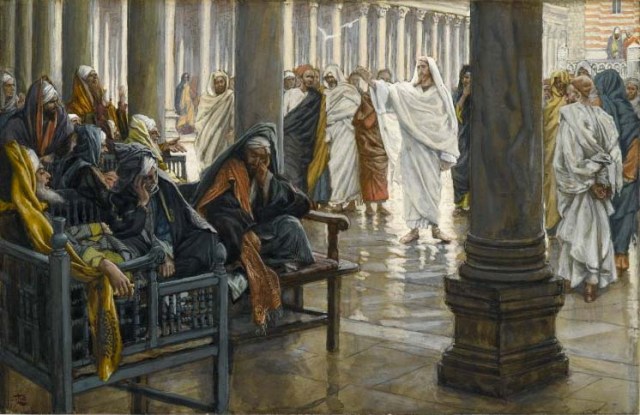
Jesus and the Pharisees, by French painter James Tissot (1836-1902)

Evil intentions originate within. Evil actions are animated by the heart. Evil attitudes are born in the heart. The human heart is the place which needs attention because, for ancient people, this is where a person’s rational will is located. It is where moral pollution dwells, deep within.

Let’s keep in mind that, in the verbal kerfuffle between Christ and the religious leaders, there is no evidence that Jesus disregarded Jewish dietary laws. He instead took the religious establishment to task on elevating outward human traditions, while simultaneously ignoring the inward human heart.

Food and hand-washing are not the chief concern, when it comes to purity and impurity. At issue is the source of defilement, that is, where the pollution is sourced. Jesus insisted that it’s more about who you are, and what is in your heart, than it is about the food you eat or avoid.

In truth, the problem of defilement is important. And keeping the Mosaic law is significant. Yet, Jesus was looking at these issues from a different angle. He affirmed the law’s purpose in restraining evil and avoiding impurity, along with the religious leaders. However, Christ disagreed with them on how the law is practically observed and obeyed.

Jesus did not come up with something new or strange in talking about evil emanating from the heart. Judaism is a religion of the heart, just as much as Christianity or any other religion.

The heart is devious above all else;
    it is perverse—
    who can understand it?
I the Lord test the mind
    and search the heart,
to give to all according to their ways,
    according to the fruit of their doings. (Jeremiah 17:9-10, NRSV)

So, what’s up with the conflict between Jesus and the religious leaders? Over time, many located evil outside, out there, with evildoers and law-breakers, with those disobedient to the law. Christ came along and reaffirmed where the problem originates, scripturally.

One isn’t defiled by improper handling of ritual; one is defiled because being unaware of, or not acknowledging, the dark shadows which reside within every human heart.

Therefore, the discussion of evil and impurity is useless, if we only talk about influences from outside. Deal, instead, with the influences from within.

The heart is not all bad; there’s a lot of good there. But there are spaces within the heart which are camouflaged in darkness. Those places need attention, before we launch into evil which exists elsewhere.

Everyone must come to the point of understanding that they are capable of both great good and great evil. A Pharisee is not all good. And a lawbreaker is not all bad. Until we can see the commonality between ourselves and those we separate ourselves from, we will continually miss the heart of true religion.

Whether a Jew, Christian, Muslim, or any other religious tradition, we must deal with our own collective house, and our own personal heart. Hate speech toward another group has no warrant from Jesus. Injustice has no place in Christianity or anywhere else.

Furthermore, not a one of us can rationalize any unjust words and/or inactions. If that happens, a terrible blindness has occurred in which someone or some group of people refuse to see their own culpability in evil, and project it outward onto another person or group.

If we keep the light of the gospel in our own hearts, then it is much less likely that we will demean or attack others, either verbally, physically, or both.

Using a self-constructed and janky flashlight to shine on another’s heart does nothing but keep the attention off of our own heart. That sort of dubious searching of splinters helps no one, especially ourselves, who already have nasty logs in our own eyes.

Evil is deeper than mere selfishness, bigger than a personal error in judgment, and greater than some individual bad decisions. That’s because there is also a collective heart in every organization, institution, corporation, and faith community. Injustice and unrighteousness resides in those hearts, as well. This makes all of us – personally and communally – both victims of evil, as well as perpetrators of wickedness.

This is why grace and mercy are the real answers to the evil in this world’s systems, and in the human heart. Jesus is trying to pave the way toward a solution of the problem of evil.

Let’s give him an honest look and hearing.

Most merciful God, we confess that we have sinned against you in thought, word, and deed, by what we have done, and by what we have left undone. We have not loved you with our whole heart; we have not loved our neighbors as ourselves. We are truly sorry and we humbly repent. For the sake of your Son Jesus Christ, have mercy on us and forgive us; that we may delight in your will, and walk in your ways, to the glory of your Name. Amen.