Deliver Us From Evil (Psalm 144:9-15)

I will sing a new song to you, God.
    I will sing praises to you on a ten-stringed harp,
        to you—the one who gives saving help to rulers,
        and who rescues his servant David from the evil sword.
Rescue me and deliver me from the power of strangers,
        whose mouths speak lies,
        and whose strong hand is a strong hand of deception,
    so that our sons can grow up fully, in their youth, like plants;
    so that our daughters can be like pillars carved to decorate a palace;
    so that our barns can be full, providing all kinds of food;
    so that our flocks can be in the thousands—
        even tens of thousands—in our fields;
    so that our cattle can be loaded with calves;
    so that there won’t be any breach in the walls,
    no exile, no outcries in our streets!

The people who have it like this are truly happy!
    The people whose God is the Lord are truly happy! (Common English Bible)

And lead us not into temptation, but deliver us from evil.”

Jesus (Matthew 6:13, KJV)

Evil lurks everywhere. It resides in the human heart, hidden in the dark shadows, coming out sideways through shameful lies and guilty actions.

The presence of evil is also found throughout the world in every institution, organization, and group, ensconced as systemic injustice – hoarding resources for the powerful at the expense of the powerless; showing prejudice and favoritism to some, while ignoring others.

Since there is wickedness found in all places and with all people, evil needs to be dealt with and expunged from both hearts as well as institutions and organizations. Part of the solution is to do away with all obstacles which stand in the way of human flourishing.

Save us from the Evil One. (Matthew 6:13, ERV)

To be sure, the heart of humanity must be dealt with and be the focus of change. Yet, if we only focus one-dimensionally on evil, it will persist, and even grow into monstrous proportions, unless we equally direct our right and just efforts on structural and systemic evil.

People and their institutions need deliverance from the power of evil in the world. And for that to happen, the hindrances and handicaps to human thriving must be eliminated.

Our entire concept of salvation needs a fuller scope. Not only do individuals need personal deliverance from sin, death, and hell, so do entire societies. Complete systemic rescue from oppressive obstacles is a must. Far too many people in this fallen world are weighed down from institutional sin.

Christ obeyed God our Father and gave himself as a sacrifice for our sins to rescue us from this evil world.

Galatians 1:4, CEV

In looking at the need for deliverance from evil in a different context, the genius of the American experiment was that the founding fathers (and mothers!) of the United States created a political and societal system which sought to eliminate class distinctions and allowed people of lower means to achieve land ownership and business acumen simply through hard work and thrift.

Unfortunately, the experiment only extended mostly to landowning white men. Native American and African American people still had huge systemic obstacles to overcome. And the new republic had different expectations for women.

It took a Civil War and decades of grueling work to address political and social change (not to mention religious). We are still today laboring to truly give liberty and justice for all, and to achieve the ideal of an egalitarian nation.

We, as both individuals and citizens, need divine intervention through deliverance. Like Gilligan and the crew of the Minnow stranded on a deserted island, we seek to be rescued – knowing we need help beyond ourselves for salvation.

Rescue us from the evil one. (Matthew 6:13, NRSV)

The psalmist looked ahead in hope, convinced that a good God will deliver and provide good people with everything they need to thrive and flourish in this life, and in the life to come.

If God doesn’t fight our overwhelming battles for us, we are lost. This present darkness, this both ancient and contemporary evil, is an extremely powerful foe. However, the Lord is greater and will have the last word.

Christianity asserts that Jesus is the pioneer of our salvation, and the once for all answer to the problem of evil, for both the world and the human heart. Christ, in other words, is the fulfillment of the psalmist’s prayers for deliverance, health, and hope.

Protect us from evil. (Matthew 6:13, CEV)

In his earthly ministry, Jesus did not give explanations for our pain and sorrow. Instead, Jesus comes where our pain is most acute, and takes it upon himself – bringing healing and hope.

The Lord tackles evil, not by having a Zoom conference on the subject of wickedness, but by allowing evil to do its worst to him. Christ exhausts evil by draining it of its power, emerging resurrected with new life for all.

The good news: Jesus is Lord and has defeated the powers of evil.

Now, renewal and reform can occur. Hearts can change. Systems can be revamped. God’s new world has begun.

God rescued us from the control of darkness and transferred us into the kingdom of the Son he loves. He set us free through the Son and forgave our sins. (Colossians 1:13-14, CEB)

I, personally, am a Christian because I believe God is the one who satisfies the passion for justice, the longing for spirituality, the hunger for relationship, and the yearning for beauty. I see God in Jesus of Nazareth, the world’s true Lord.

Hope, like the psalmist expressed, is what you get when you realize a different worldview is possible. Hope springs to life when those who feel the brunt of evil in the world become acutely aware that the rich, the powerful, and the unscrupulous are not the ones really in charge.

“Our task as image-bearing, God-loving, Christ-shaped, Spirit-filled Christians, following Christ and shaping our world, is to announce redemption to a world that has discovered its fallenness, to announce healing to a world that has discovered its brokenness, to proclaim love and trust to a world that knows only exploitation, fear and suspicion…” N.T. Wright

May you be delivered from evil, and saved from the Evil One. May you know the Savior, and take solace in his peace. And may you be buoyant in faith, confident in hope, and overflowing with love. Amen.

How It’s Built Matters (1 Kings 6:1-4, 21-22)

Artist depiction of Solomon’s Temple

Four hundred and eighty years after the people of Israel left Egypt, during the fourth year of Solomon’s reign over Israel, in the second month, the month of Ziv, Solomon began work on the Temple. Inside it was 90 feet long, 30 feet wide, and 45 feet high. The entrance room was 15 feet deep and 30 feet wide, as wide as the sanctuary itself. The walls of the Temple had openings in them, narrower on the outside than on the inside….

The inside of the Temple was covered with gold, and gold chains were placed across the entrance of the inner room, which was also covered with gold. The whole interior of the Temple was covered with gold, as well as the altar in the Most Holy Place. (Good News Translation)

The first major accomplishment – and the crowning achievement – of King Solomon’s reign was building the Temple in Jerusalem. His father, King David, had it in his heart to erect a great Temple for God as both a place of worship, and a permanent place for the Ark of the Covenant to rest. However, the Lord clearly instructed David not to build the Temple, but stated that his son would do so. (1 Chronicles 28:1-21)

Solomon spared no expense for building the Temple. He ordered vast quantities of cedar wood from King Hiram of Tyre, and had huge blocks of stone quarried for the building’s foundation. In order to complete the massive project, Solomon imposed forced labor on all his subjects, drafting people for work shifts that sometimes lasted a month at a time. (1 Kings 5:1-18)

And there was the gold – lots of it! The inside of the Temple was completely covered with gold. Gold is physically and metaphorically one of the most malleable metals on the planet: one gram of gold can be beaten into a 1-square meter sheet, and gold has been used as a symbol for everything from religious devotion to great wealth and immense power.

As glorious and elaborate as the Temple was, the most important room was perhaps the greatest theological statement of all; it contained almost no furniture. Known as the Holy of Holies, it housed the two tablets of the Ten Commandments inside of the Ark of the Covenant. The unseen and almighty God of the universe doesn’t really need a house, and most certainly cannot be contained within one.

Only once a year, on the Day of Atonement (Yom Kippur) the High Priest entered the most sacred Holy of Holies and pray to God on behalf of the Israelite nation. God’s world and God’s word are holy. It was understood that the Ten Commandments are very holy words, with the name of God being the holiest word of all. The Temple – by its sheer architecture – communicated what was most important about God.

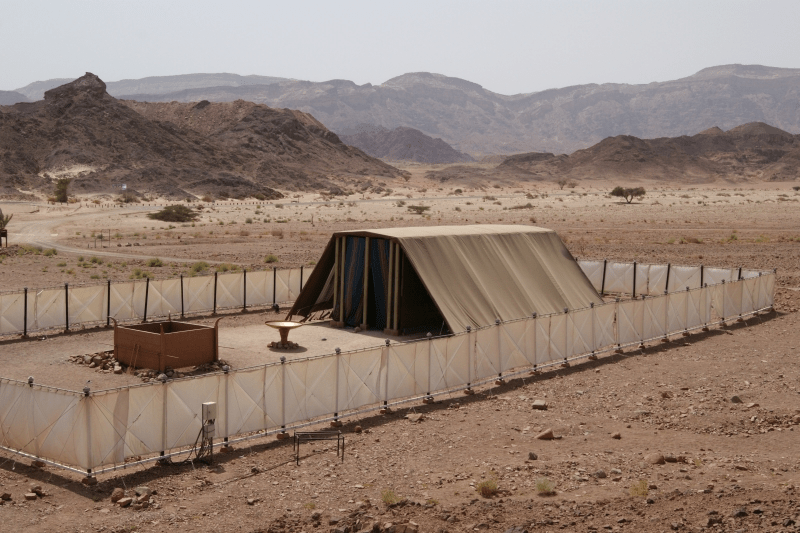
Model of the Tabernacle in Timna Valley Park, Israel

Yet, the way in which the Temple was constructed was very different from how the earlier Tabernacle was built. The Tabernacle was a sort of mobile temple for the wilderness journey. The entire community worked together in giving their possessions and services in order to make the Tabernacle a reality.

Without the contributions of the people, the project probably would not have happened at all. But the chance to help out in all the myriad ways of making things for the sanctuary, pulled everyone together in a high degree of compliance. (Exodus 36:1-6)

Indeed, the building of the Tabernacle was a consensual enterprise; the people’s faith was the wellspring of their philanthropy. Yet, in contrast, the mode by which Solomon carried out the construction of the permanent Temple was by sheer wealth, forced labor, and strong administrative business deals.

There was no community participation in the form of voluntarism in Solomon’s financing of the Temple build. To pay for the cedar and cypress wood provided by the King of Tyre and to quarry and transport the building materials, Solomon issued a massive levy. In other words, there wasn’t any free labor and no robust public spirit animating the construction.

The Tabernacle for which the people volunteered wholeheartedly never fell victim to evil. The Temple, however, eventually and certainly did – in large part due to the evil of the kings who presided over the theocracy.  

The fate of any institution is determined by how it is created in the first place. No matter what the polity and organizational structure is, it cannot long survive without popular support. Solomon’s Temple, despite all of its grandeur and gold, rested on a shaky foundation and sandy soil.

After the Temple was constructed, the sacrificial system was authorized only in Jerusalem and at the Temple. Everything was centralized under the behemoth of Solomon’s system. What’s more, practices like volunteerism and community participation were largely replaced with systems of heavy taxation and a large debt. That’s one reason the kingdom immediately split apart after Solomon’s death.

Perhaps if the selfless ethos that went into building the Tabernacle was utilized by Solomon in the building of the Temple, maybe the fate of king after king in Israel would have been quite different. For it is in the spirit of volunteerism and a concern for the public welfare that governments attentive to the common good of all persons are built. How something is built matters.

Almighty and gracious God of all, we humbly offer our gratitude for the blessing of selfless volunteers and those who participate freely in ministries of justice and service. Thank you for their tireless dedication and benevolence.

May your Spirit bless them with continual guidance as they faithfully serve others. Give them resilience, daring, and fortitude. Let joy, peace, and satisfaction be upon the good work that they do. Inspire and motivate them to persist through trying circumstances, steadfast in their dedication to aiding those around them.

Help us all to reflect the profound beauty and compassion of your divine love. Amen.

Human Plans vs. Divine Plans (Micah 2:1-13)

The Prophet Micah Preaching, by Peter Gorban, 1990

Woe to those who plan iniquity,
    to those who plot evil on their beds!
At morning’s light they carry it out
    because it is in their power to do it.
They covet fields and seize them,
    and houses, and take them.
They defraud people of their homes,
    they rob them of their inheritance.

Therefore, the Lord says:

“I am planning disaster against this people,
    from which you cannot save yourselves.
You will no longer walk proudly,
    for it will be a time of calamity.
In that day people will ridicule you;
    they will taunt you with this mournful song:
‘We are utterly ruined;
    my people’s possession is divided up.
He takes it from me!
    He assigns our fields to traitors.’”

Therefore you will have no one in the assembly of the Lord
    to divide the land by lot.

“Do not prophesy,” their prophets say.
    “Do not prophesy about these things;
    disgrace will not overtake us.”
You descendants of Jacob, should it be said,
    “Does the Lord become impatient?
    Does he do such things?”

“Do not my words do good
    to the one whose ways are upright?
Lately my people have risen up
    like an enemy.
You strip off the rich robe
    from those who pass by without a care,
    like men returning from battle.
You drive the women of my people
    from their pleasant homes.
You take away my blessing
    from their children forever.
Get up, go away!
    For this is not your resting place,
because it is defiled,
    it is ruined, beyond all remedy.
If a liar and deceiver comes and says,
    ‘I will prophesy for you plenty of wine and beer,’
    that would be just the prophet for this people!

“I will surely gather all of you, Jacob;
    I will surely bring together the remnant of Israel.
I will bring them together like sheep in a pen,
    like a flock in its pasture;
    the place will throng with people.
The One who breaks open the way will go up before them;
    they will break through the gate and go out.
Their King will pass through before them,
    the Lord at their head.” (New International Version)

One of the reasons the Daily Lectionary has been giving us a generous portion of prophetic and divine judgment, is that Advent is upon us. In other words, Jesus didn’t just show up in a vacuum. Christ came in his incarnation because the world needs him. The time was ripe for the Lord to come.

Sin is like a humungous rat’s nest that’s been intertwined with the human heart. You cannot simply destroy the nest without also destroying the heart. It takes painstaking attention and patience to undo the connection. And it requires such consummate skill that only God has the combination of motivation, endurance, and ability to do the job.

Perhaps you, like me, are weary of sin’s presence in this world – not to mention having to deal with it daily within the shadows of our own hearts. To keep going, we need God. Secularism cannot help us here, because secular answers cannot offer us good and permanent directives for life.

What’s more, even our religious institutions and faith communities have become, for many, a source of grief instead of hope. Churches can be wracked with sin as much, or more, than any secular system. Though religion ought to help connect us with our true selves, it too often causes us to stray from our authentic self.

Religious bodies too often wed themselves with secular bodies, and encourage us toward extreme independence. Thus, we forget that our real destiny is to live in community within a larger human context – to contribute to the whole of humanity, and in turn, be enriched by others.

This situation is one of the reasons God sent the prophets to warn the people and call them back to a healthy and holistic way of life, connected to the divine and to one another in vital and joyous community.

The prophet Micah, along with his fellow prophets, warned and lamented that the people are abandoning the soul of Holy Scripture – keeping up appearances of holiness, while actually planning to take advantage of others for self-centered purposes.

Religious faith in the prophet’s day, as well as our own, is continuing to wane because its biblical foundation is being undermined – not by liberal or progressive theologians, as much as conservative and fundamental adherents who lose sight of Scripture’s spirit and gospel, in favor of hardline law.

We need light – not the dark negations of those who insist on remaining religious masters of extremely small worlds. We must pay attention to, and cultivate, the vineyard of the Lord. Let the faithful concern themselves with clarifying the important elements of religion, such as the nature of prophecy, the Holy Spirit, redemption, and the sanctification of individuals and the community.

As long as we only absorb ourselves with one’s personal piety and one’s small group of cronies, and ignores the common good of all persons, and justice in the world, refusing to look beyond the end of one’s nose, then we will continue to turn away from the prophetic utterance we already have within Scripture. And we will have no ability to discern nor hear the modern day prophet when they speak.

Micah the prophet made a specific charge against his fellow citizens who were powerful businessmen. They spent their time devising schemes to get possession of land from small farmers. Much like the big corporation today, the ancient business people carried out their schemes because they had the financial backing, political influence, and judicial power to do it.

In response, God devises his own plans to thwart the evil machinations of greedy and powerful persons. Micah was supremely confident that the wrongs in this world would eventually be made right; he firmly believed that a sovereign and just God would handle it.

Also, much like today, the greedy business persons and corporations simply dismiss all this God-talk as irrelevant; calamity will not overtake them. But keeping God out of sight and out of mind doesn’t mean that God isn’t there. They will have to give an account for their unethical business practices.

It seems, as in the day of Micah, that our contemporary situation is not so different. Much of the world’s institutions, corporations, and governments are so out of touch with religion and religious ethics, that if a charismatic person comes along proclaiming a gospel of injustice, the business leaders would hire that person on the spot.

Lord, have mercy.