Against Arrogance and Injustice (Isaiah 47:1-9)

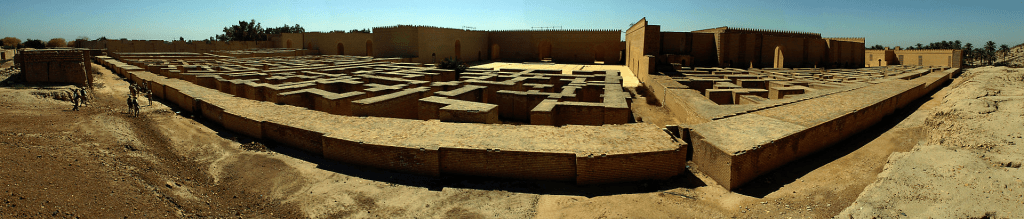
Ancient ruins of Babylon in present day Iraq

City of Babylon,
You are delicate
    and untouched,
    but that will change.
Surrender your royal power
    and sit in the dirt.
Start grinding grain!
    Take off your veil.
Strip off your fancy clothes
    and wade across rivers.
You will suffer the shame
    of going naked,
because I will take revenge,
    and no one can escape.
I am the Lord All-Powerful,
the holy God of Israel.
    I am their Savior.

Babylon, be silent!
    Sit in the dark.
No longer will nations
    accept you as their queen.
I was angry with my people.
So I let you take their land
    and bring disgrace on them.
You showed them no mercy,
but were especially cruel
    to those who were old.
You thought that you
    would be queen forever.
You didn’t care what you did;
it never entered your mind
    that you might get caught.

You think that you alone
    are all-powerful,
that you won’t be a widow
    or lose your children.
All you care about is pleasure,
    but listen to what I say.
Your magic powers and charms
    will suddenly fail,
then you will be a widow
    and lose your children. (Contemporary English Version)

The God of the Bible is not merely a local deity that the ancient Hebrews worshiped way back in history. From the biblical standpoint, God is the Lord of the universe, and the Creator of heaven and earth. Therefore, every nation on earth is accountable to the Divine Sovereign of all, the right and just Judge of the world.

Divine judgment extended to ancient Babylon. Just because they may not have worshiped and served the God of the Israelites, doesn’t mean they were off the hook for their violence and injustice.

For every nation and each person on this earth will have to give an account of their life and existence before God.

The prophet Isaiah likened Babylon to a princess who becomes a slave girl. It’s as if God is taunting her, putting her in her place; showing her who is really in charge.

Babylon had trusted in her own cleverly devised ways of manipulating reality to get what she wanted in this world. But she became helpless, stripped of her power and authority by the One who holds ultimate authority; and holds everyone accountable.

The mocking, taunting, and sarcastic nature of the Lord toward Babylon in Isaiah’s prophecy may seem out of sync with how we understand God. Yet, I invite you to remember how some great injustice of the past was done to you, or someone you care about, from someone with power and authority over you.

Allow me the liberty of reframing and retranslating today’s Old Testament lesson from the vantage of one person’s unjust victimization from another’s position of power and authority, with God exacting divine attention to such an injustice:

“Get off your high horse and sit in the dirt,
    Miss High and Mighty Babylon.
No more doing whatever the hell you want—No! Sit on the ground,
    daughter of Pride and Arrogance.
Nobody will be calling you anymore in order to get things done;
    you won’t be batting your big eyelashes and getting your way with me! So, get used to it.
Get a real job, a job where you have to do what you’ve made others do:
    Dig ditches, scrub toilets, stand at the factory line for hours on end.
You might as well get rid of your fancy clothes,
    and put on some real working gear—because the gig is up, sister.
Your true vulnerability will be on public display,
    and you will feel the criticism and manipulation that you did to others.
Now you have to contend with me. I’m intervening. And I’m taking vengeance.
    No one gets away with treating people like dirt. And if dirt is what you like, dirt is what I’m going to give you.”

Our Redeemer speaks,
    whose name is Yahweh of Armies, The Sacred One:
“Shut up and sit down in the dirt,
    Miss High and Mighty.
Because no one is ever again going to call you
    ‘Boss Lady in charge,’ or ‘Queen of the Empire.’
Believe me, I was angry with my own people,
    and was disgusted with my own children.
Which is why I let them be under your authority;
    but you didn’t show any compassion to them whatsoever.
You treated long-standing reliable people like cogs in a machine,
    and expected them to work at hard labor like they’re young men.
You arrogantly said, ‘I’m Miss High and Mighty!
    I’m here forever, and you will always serve me.’
You took no one seriously, took nothing to heart,
    never thought a wit about the consequences of your actions.
Well, Miss High and Mighty, you better start thinking!
    You’re acting as if you are the center of the universe,
saying to yourself, ‘I’m in charge. There’s nobody but me.
    I will always be in charge, I’ll never lose my authority.’
But two things are going to hit you between the eyes,
    suddenly, on the same day:
Your high position, and your company suck-ups, will be gone, a total loss,
    and your manipulative and gaslighting ways won’t help you, at all.”

Let it be known that the God of Holy Scripture hates injustice, and wants all people everywhere to extend basic human kindness and goodness to one another without prejudice or favoritism.

Individuals and even nations who selfishly grab power and control for themselves, shall have to contend with the ultimate authority in the universe. And that, my friend, is a very good thing for the righteous; and very bad thing for the selfish and arrogant.

Injustice, unfairness, and selfishness will not exist forever. Therefore, it is best for everyone to put their efforts into what lasts, what is permanent and enduring. In the end, peace and righteousness will have an unending rule and reign. Loving relationships will last. God’s justice shall endure.

So, be encouraged, in your own difficult experience and hardship. If you are the victim of another’s positional power used against you, know that the Lord sees, cares, and will do something about it.

Almighty God, who created us in your image: Grant us grace fearlessly to contend against evil and to make no peace with oppression; and, that we may reverently use our freedom, help us to employ it in the maintenance of justice in our communities and among the nations, to the glory of your holy Name; through Jesus Christ our Lord, who lives and reigns with you and the Holy Spirit, one God, now and forever. Amen.

Mercy and Judgment (Revelation 8:1-5)

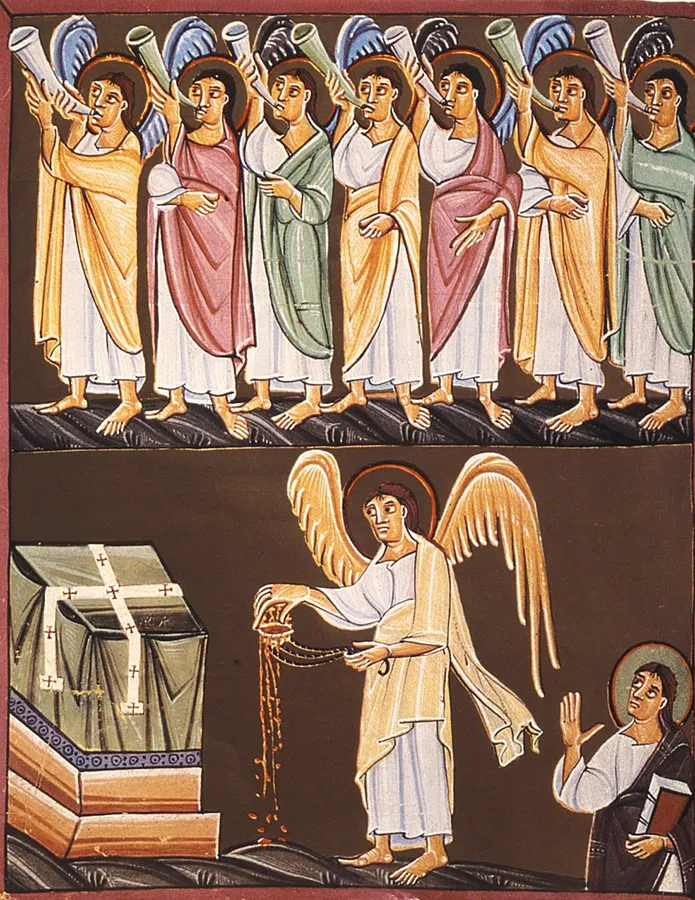
Seven angels with seven trumpets, and the angel with a censer, from the Bamberg Apocalypse, c.1020 C.E.

Then, when the Lamb opened the seventh seal, there was silence in heaven for about half an hour.

Then I saw the seven angels who stand before God, and seven trumpets were given to them. Another angel came and stood at the altar, and he held a gold bowl for burning incense. He was given a large amount of incense, in order to offer it on behalf of the prayers of all the saints on the gold altar in front of the throne. 

The smoke of the incense offered for the prayers of the saints rose up before God from the angel’s hand. Then the angel took the incense container and filled it with fire from the altar. He threw it down to the earth, and there were thunder, voices, lightning, and an earthquake. (Common English Bible)

When I was kid, growing up on a Midwest American farm, I remember times when severe weather was coming. I knew it was going to be bad whenever everything became still and there was complete silence: No wind, no birds singing, no insects chirping, nothing moving whatsoever. It was the eerie silence which precedes something big coming.

That is the way it will be in heaven when the seventh seal is opened. The silence is so quiet that you know a lot of noise and movement are about to happen. It’s not serene silence; it’s scary silent.

With the opening of the seventh seal, a climactic moment is reached. The silence is not only an anticipation of the coming drama, but is also a sign of reverence and awe.

The seventh seal initiates a series of woes: The seven trumpets. But before the trumpets begin, an angel appears. Standing before a heavenly altar, the angel mixes incense along with prayers from the people, then offers them on the altar.

These prayers of the people are for justice, and a longing for the kingdom to come, and God’s will to be done, on earth, as it is always done in heaven.

The imagery relates to us that God hears the prayers, and will act, according to the divine character and will.

The angel takes fire from the altar and hurls it down to earth, causing thunder and lightning, and an earthquake. In other words, the prayers are being answered; they are having an effect. Judgment on the earth begins with the blowing of the seven trumpets.

As we may expect, the incredible silence gives way to an equally incredible noise of weather and the earth moving. And the angel, serving as a quiet and contemplative high priest, now moves to becoming a judge upon the earth.

It turns out that mercy and judgment are not two contrasting concepts and actions; they are two sides of the very same coin. The altar of mercy becomes the source of judgment.

Whenever there is an injustice, we want (and expect) to have that act acknowledged and taken care of by a proper authority. To have a judge simply say that he/she is merciful and will acquit the guilty, does not work in every situation. Mercy only exists because of the presence of guilt and judgment.

God takes care of sin because God loves. An unloving deity would be unconcerned, random, and capricious in handling injustice. But not the God of the Bible. God shows mercy to the righteous, and will judge the wicked.

God’s mercy extends to the point of acquitting the guilty, if God so desires to do so. And everyone needs mercy, because we all have committed injustices in our lives.

Yet, by means of humble contrition and faith, we can mercifully discover gracious amnesty. This is why Jesus came, to take care of the sin issue once for all through the Cross.

We have been made holy by God’s will through the offering of Jesus Christ’s body once for all. (Hebrews 10:10, CEB)

In the time of the Apostle John’s vision, which is the Book of Revelation, Christians were facing persecution and martyrdom. The prayers of the suffering believers rose to heaven:

They cried out with a loud voice, “Holy and true Master, how long will you wait before you pass judgment? How long before you require justice for our blood, which was shed by those who live on earth?” (Revelation 6:10, CEB)

God’s response to the prayers of the saints is to send judgmental fire against the earth by the hand of the angel. In John’s apocalyptic vision, not only are the believers in Christ facing trials and tribulations for their faith, but the unbelieving persecutors who victimize the saints will be punished, as well.

If the persecutors use fiery elements against the believers, God can (and will) turn that fire back on the them. This is similar to the Book of Exodus, in which the plagues that struck and judged the Egyptians were, at the same time, a means of protecting and preserving the Israelites.

The Book of Revelation included in the Christian canon of scripture, not for the purpose of predicting the time or the season in which Jesus Christ will come back to judge the living and the dead. Rather, John’s Apocalypse is meant to encourage the followers of Christ that their suffering will not last forever; and neither will the arrogance of the wicked.

We don’t know when all of this end-of-the-age stuff is going to shake out. Which is why it is so important we learn to persevere through suffering. Because we might have to wait awhile.

Prayer for us then becomes not simply something we do if we have a bit of discretionary time; it becomes vital for us. We discern that we must speak with God. We are compelled to offer our prayers. We feel the great need to cry out and petition God for justice and righteousness.

It seems, if I don’t pray, I won’t make it. Therefore, I must pray. I will pray with all of my heart and soul, till I cannot pray anymore. And then I will pray some more, because I need God.

There is nothing easy about moving through suffering. It’s hard to persevere. It hurts to be the brunt of another’s violent tongue and/or hand. Yet, we do not experience this alone. The divine presence is with us. And that makes all the difference.

Oh God:
Give me strength to live another day;
Let me not turn coward before its difficulties, or fail in its duties;
Let me not lose faith in other people;
Keep me sweet and sound of heart, in spite of ingratitude, treachery, or meanness;
Preserve me from minding little stings, or giving them;
Help me to keep my heart clean, and to live so honestly and fearlessly that no outward failure can dishearten me, or take away the joy of conscious integrity;
Open wide the eyes of my soul that I may see good in all things;
Grant me this day some new vision of your truth;
Inspire me with the spirit of joy and gladness and make me the cup of strength to suffering souls; in the name of the strong Deliverer, our only Lord and Savior, Jesus Christ. Amen.

A Great Reversal (Esther 8:1-17)

Reversal, by Margarita Lypiridou, 2021

That same day King Xerxes gave Queen Esther the estate of Haman, the enemy of the Jews. And Mordecai came into the presence of the king, for Esther had told how he was related to her. The king took off his signet ring, which he had reclaimed from Haman, and presented it to Mordecai. And Esther appointed him over Haman’s estate.

Esther again pleaded with the king, falling at his feet and weeping. She begged him to put an end to the evil plan of Haman the Agagite, which he had devised against the Jews. Then the king extended the gold scepter to Esther and she arose and stood before him.

“If it pleases the king,” she said, “and if he regards me with favor and thinks it the right thing to do, and if he is pleased with me, let an order be written overruling the dispatches that Haman son of Hammedatha, the Agagite, devised and wrote to destroy the Jews in all the king’s provinces. For how can I bear to see disaster fall on my people? How can I bear to see the destruction of my family?”

King Xerxes replied to Queen Esther and to Mordecai the Jew, “Because Haman attacked the Jews, I have given his estate to Esther, and they have impaled him on the pole he set up. Now write another decree in the king’s name in behalf of the Jews as seems best to you, and seal it with the king’s signet ring—for no document written in the king’s name and sealed with his ring can be revoked.”

At once the royal secretaries were summoned—on the twenty-third day of the third month, the month of Sivan. They wrote out all Mordecai’s orders to the Jews, and to the satraps, governors and nobles of the 127 provinces stretching from India to Cush. These orders were written in the script of each province and the language of each people and also to the Jews in their own script and language. Mordecai wrote in the name of King Xerxes, sealed the dispatches with the king’s signet ring, and sent them by mounted couriers, who rode fast horses especially bred for the king.

The king’s edict granted the Jews in every city the right to assemble and protect themselves; to destroy, kill and annihilate the armed men of any nationality or province who might attack them and their women and children, and to plunder the property of their enemies. The day appointed for the Jews to do this in all the provinces of King Xerxes was the thirteenth day of the twelfth month, the month of Adar. A copy of the text of the edict was to be issued as law in every province and made known to the people of every nationality so that the Jews would be ready on that day to avenge themselves on their enemies.

The couriers, riding the royal horses, went out, spurred on by the king’s command, and the edict was issued in the citadel of Susa.

When Mordecai left the king’s presence, he was wearing royal garments of blue and white, a large crown of gold and a purple robe of fine linen. And the city of Susa held a joyous celebration. For the Jews it was a time of happiness and joy, gladness and honor. In every province and in every city to which the edict of the king came, there was joy and gladness among the Jews, with feasting and celebrating. And many people of other nationalities became Jews because fear of the Jews had seized them. (New International Version)

“So the last will be first, and the first will be last.”

Jesus (Matthew 20:16)

Knowing that someone is not who they present themselves as can be maddening. They’re selfish and enamored with having authority, yet everyone thinks they are okay.

Haman was a bad man who camouflaged himself as important. As the right hand man to King Xerxes of the vast Persian Empire, Haman valued position, power, and attention above all else. But his arrogance proved to be his downfall.

People who are concerned to be seen as important can never get enough. Haman was not satisfied to be the prime minister in the empire, even though millions of people bowed down to him.

Mordecai, a Jew, Queen Esther’s cousin, refused to bow down. He saw the pride and arrogance within Haman to have what only belongs to God.

Haman could not stomach this one Jew dismissing his power and authority. As a person who wanted only “yes men” around him, Haman was determined to eradicate Mordecai. And even that was not enough for him. So, Haman proposed the destruction of all Jews.

He was supposedly an imperial expert on “the Jewish problem.” So, King Xerxes listened to him when he hatched a devious strategy to rid the empire of all Jews. A decree was made that on a particular day the Jews could be destroyed and plundered.

But the real plan that resets all other plans is the plan of God. And God’s plans are for good, not evil; and for Jewish life, not death.

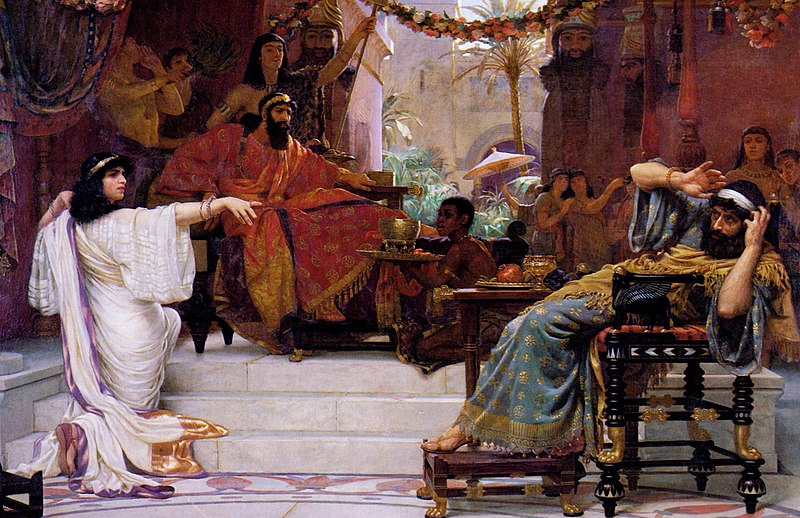
Esther Denouncing Haman, by Ernest Normand, 1888

Pride and arrogance never ends well for the proud and arrogant person. They may have their way for a while, but ultimately such people find that their evil plans come back on themselves.

So, one night when the king was unable to sleep, he had the annals of the kingdom read to him. He heard of Mordecai’s successful effort at saving the king’s life from an assassination plot. The king also learned that Mordecai had never been properly recognized and rewarded.

One of the main differences between the proud and the humble is that arrogant people are obsessed with recognition and rewards; whereas the humble person cares about what is right and just, viewing good deeds as their own reward.

As the king’s trusted right hand man, Haman was consulted as to what ought to be done for someone the king wants to honor. The proud person always believes the honored person is themselves.

So, Haman, believing Xerxes wanted to honor him, suggested an elaborate recognition ritual involving a parade and plenty of accolades.

The king, however, had this in mind for Mordecai. He ordered Haman to be the one who made sure the recognition happened. And that’s not all. Haman would also get retribution for his evil heart.

Behind the scenes of royal power and scuttlebutt, Esther and her people were praying and fasting. Esther had her own plans for good, and not for evil.

Of course, Haman believed that a banquet was being given in his honor by the queen. In reality, not at all.

Esther revealed to the king the true plot and hate against her own people. Enraged, King Xerxes demanded who would dare presume to do such a thing against his beloved queen and her people.

With Haman directly in front of them, Esther pointed out the adversary. And then, the gallows which Haman had made to hang Mordecai were used for his own execution. Thus ended the story of the villain Haman.

There was still, however, the problem of the royal decree to destroy the Jewish people on an appointed day. Haman had been dealt with, but there were still wide-ranging consequences of his actions that remained in effect, and that could only be dealt with at the political level.  

Queen Esther interceded to the king on behalf of her people. Although a decree from the king cannot be revoked, yet another decree could be written in another’s name that would counteract the first. And this is precisely what Mordecai and Esther did, with the king’s full knowledge and blessing to it.

Today’s Old Testament lesson is a great reversal of fortunes if there ever was one. The high position of Haman and his extreme hatred and arrogance are gone. The Jewish people, on the precipice of annihilation, are not only alive, but had the opportunity to pushback on their enemies. Mordecai was not hanged on a gallows, but became in charge of Haman’s entire estate.

This was a restoration beyond what anyone could have thought or imagined. And that is the sort of reversal which God specializes in.

You cannot fool God, so don’t make a fool of yourself! You will harvest what you plant. If you follow your selfish desires, you will harvest destruction, but if you follow the Spirit, you will harvest eternal life. Don’t get tired of helping others. You will be rewarded when the time is right, if you don’t give up. (Galatians 6:7-9, CEV)

God, I am far too often influenced by what others think of me. May I not pretend to be either richer or smarter or nicer than I really am. Please hinder me from trying to attract attention. Don’t let me gloat over praise on one hand or be discouraged by criticism on the other. Nor let me waste time weaving imaginary situations in which the most heroic, charming, witty person present is myself. Show me how to be humble of heart, like you. Amen.

For Such a Time as This (Esther 4:1-17)

When Mordecai learned of all that had been done, he tore his clothes, put on sackcloth and ashes, and went out into the city, wailing loudly and bitterly. But he went only as far as the king’s gate, because no one clothed in sackcloth was allowed to enter it. In every province to which the edict and order of the king came, there was great mourning among the Jews, with fasting, weeping and wailing. Many lay in sackcloth and ashes.

When Esther’s eunuchs and female attendants came and told her about Mordecai, she was in great distress. She sent clothes for him to put on instead of his sackcloth, but he would not accept them. Then Esther summoned Hathak, one of the king’s eunuchs assigned to attend her, and ordered him to find out what was troubling Mordecai and why.

So Hathak went out to Mordecai in the open square of the city in front of the king’s gate. Mordecai told him everything that had happened to him, including the exact amount of money Haman had promised to pay into the royal treasury for the destruction of the Jews. He also gave him a copy of the text of the edict for their annihilation, which had been published in Susa, to show to Esther and explain it to her, and he told him to instruct her to go into the king’s presence to beg for mercy and plead with him for her people.

Hathak went back and reported to Esther what Mordecai had said. Then she instructed him to say to Mordecai,“All the king’s officials and the people of the royal provinces know that for any man or woman who approaches the king in the inner court without being summoned the king has but one law: that they be put to death unless the king extends the gold scepter to them and spares their lives. But thirty days have passed since I was called to go to the king.”

When Esther’s words were reported to Mordecai, he sent back this answer: “Do not think that because you are in the king’s house you alone of all the Jews will escape. For if you remain silent at this time, relief and deliverance for the Jews will arise from another place, but you and your father’s family will perish. And who knows but that you have come to your royal position for such a time as this?”

Then Esther sent this reply to Mordecai: “Go, gather together all the Jews who are in Susa, and fast for me. Do not eat or drink for three days, night or day. I and my attendants will fast as you do. When this is done, I will go to the king, even though it is against the law. And if I perish, I perish.”

So Mordecai went away and carried out all of Esther’s instructions. (New International Version)

Mordecai and Esther (Bible Project)

King Xerxes was the royal sovereign over the greatest empire up to that time in history. Haman was the king’s right hand man who arranged a sinister plot to destroy the Jewish people. Queen Esther was a Jew, for which neither Haman nor Xerxes knew; she rose from obscurity to become the queen. And Mordecai was Esther’s cousin, having taken her in and raised her.

The Jewish people were exiles, due to the Babylonians capturing Jerusalem and taking the people into captivity. Although the Persians, who overthrew the Babylonians, began allowing some of the Jews to return to Judah, there were still many diaspora Jews who made a life for themselves in Persia.

Esther was an unlikely candidate as both a queen and a heroine. She was an orphan and not well-known, even within her own community. Yet, Esther was taken from her foster home with Mordecai, and was thrown into all the perturbations of Persian life in the empire’s court and the nation’s culture.

She was the ultimate outsider, thrust into insider status. Esther was a minority in a majority culture; a resident alien; and a foreigner to Persian society and royalty. It was a lot for her.

Try and put yourself in her shoes. Do you hide your Jewishness, or make it known, and how much? How do you navigate being raised in a culture very different than the one you are being immersed and assimilated in? Who am I? What am I really supposed to be about? Why am I here?

Expressing one’s spiritual identity requires some significant consideration and careful application. And it will be dynamic, with ongoing considerations of how to grow and sustain a healthy sense of self so that it will be impactful and lasting.

We may reflexively think that since Esther was queen, she could freely exercise power and leverage her position to achieve anything she wanted. However, Esther was in a totally new reality. She didn’t enter it with political savvy or understanding about how things work or get done. Esther was very much subject to the whims and plans of King Xerxes.

Queen Esther must have thought she was in an impossible position. Haman had hatched a strategy to rid the empire of her own people, the Jews. And they were beside themselves. Mordecai entreated Esther to do something. But Esther was green and scared and way out of her element.

And yet, the heroine was inside her all along; it just needed the proper experience to bring her out.

We might understand if Esther saw herself as a mere orphan Jew who was just trying to fake-it-till-you-make-it in a world and a situation that was way over her head. We could understand if she saw herself without any real agency to effect anything in a large overwhelming empire.

Yet, here we are, all these millennia later, talking about Queen Esther and her bravery. There is even a Jewish holiday, Purim, celebrated because of her extraordinary courage… But I am getting ahead of myself. Today’s piece of the story begins in tension, and ends with even more.

Mordecai arose and gave a coach’s speech to Esther. He told her that she must step up and step into this particular historical moment in time. Providence had led her to be in her unique position; and the Jewish people were in an awful position.

It was precisely the right time for Esther to dig deep and release the heroine within. Esther could save her own people. Nobody else could. Only her.

Like it or not for Esther, her Jewishness was part of the whole gnarly situation. She could deny it and hide it – which would mean suppressing and stuffing the heroine. Or she could put herself out there, speak truth to power in love, and let the consequences come what may.

What impresses me about Esther is that not only did she listen to Mordecai, but she took the further step of calling upon the support of her own Jewish community. Esther was straightforward in telling them exactly what she needed from them, and what she would do herself.

Esther staked out her identity and faith, and risked her life for an entire nation of people… but we are not to the end of the story yet.

For now, we need to sit with this painful and awkward tension between life and death. Three days of sorrowful and heartfelt prayer. Three days of darkness. Three days of seeming as if one is in a grave with a huge stone boulder in front of it.

Like Esther, it is important for us to struggle with our own identity, and to take risks in soliciting the help of the believing community. We all must grapple with the nature of faith, the challenges of living in this present culture, and the politics of it all.

We need to take a good hard look at ourselves and discern who we truly are – people created in the image and likeness of God, who have majesty stamped on our very souls; and who truly have it within ourselves to make a difference in this big world of ours.

If we are to truly become aware of our majesty as people, we shall be willing to take the risk of helping those who are vulnerable, powerless, and threatened. That’s because our identity shapes our choices and actions. We live into who we believe we are.

By realizing that we belong to God, we avoid becoming complicit in evil. Instead, we leverage our place and position in life to do what is right, just, and good. There is confidence, even if afraid, of doing what is right.

I am wondering if you can think the thought, and embrace the reality, that you were sovereignly placed here on this earth by God “for such a time as this.”

Just and right God, you sent your servant Esther into a life of privilege, so that those without would be taken care of. In our privilege, show us how to advocate for those who have less, so that your world might be peaceful and good. Amen.