The Contrast of Good and Bad (1 Samuel 2:11-17)

Top picture: Eli’s sons commit sacrilege; Bottom picture: Hannah and Elkanah bring the boy Samuel to the tabernacle; by William de Brailes, c.1230 C.E.

Elkanah and Hannah went back home to Ramah, but the boy Samuel stayed to help Eli serve the Lord.

Eli’s sons were priests, but they were dishonest and refused to obey the Lord. So, while people were boiling the meat from their sacrifices, these priests would send over a servant with a large, three-pronged fork. The servant would stick the fork into the cooking pot, and whatever meat came out on the fork was taken back to Eli’s two sons. That was how they treated every Israelite who came to offer sacrifices in Shiloh. Sometimes, when people were offering sacrifices, the servant would come over, even before the fat had been cut off and sacrificed to the Lord.

Then the servant would tell them, “The priest doesn’t want his meat boiled! Give him some raw meat that he can roast!”

Usually the people answered, “Take what you want. But first, let us sacrifice the fat to the Lord.”

“No,” the servant would reply. “If you don’t give it to me now, I’ll take it by force.”

Eli’s sons did not show any respect for the sacrifices that the people offered. This was a terrible sin, and it made the Lord very angry. (Contemporary English Version)

Stories in the Old Testament of the Bible typically have two or more contrasting characters within them. One of the characters is good and the other not so much. The narrative is set up without having to tell us who is good and who is bad because the unfolding story makes it patently obvious.

This method of contrast is meant for us to look at the narrative and say to ourselves that we don’t want to go down the bad path but to walk in the good way of helpful obedient service.

In today’s story, we clearly see that, in the case of Eli’s sons, the apple doesn’t fall far from the tree. Old Eli the priest is a contrast to the boy priest-in-residence Samuel.

Eli had many faults, especially when it came to dealing with his sons, who were also priests. Eli seems to have continually had an issue with not listening very well – which ended in making a mess of things.

His sons took the casualness to an entirely new level of bad. They were not only worthless but also interfered in the people’s sincere worship of God. The sons were more than simply incompetent; they were also downright evil.

The Law made it clear how the priests and their portion of the sacrificial animals was to occur. There were detailed instructions on the importance of what part of the animal the priests received; and that the sacrifice needed to have the fat boiled off before it was given to the priest. (Leviticus 7:30-36)

But Eli’s sons took whatever they wanted, and did whatever they wanted, with calloused impunity. They disregarded divine instructions. If they wanted to roast their meat, they did. If they decided to have a different part of the animal, they took it from the worshiper. The sons did not care about anyone, and especially about God. They were bullies of the worst kind.

When sincere worshipers tried to stop the insanity of the priests’ blatant neglect, the servant of the priests threatened them. Although Eli himself did not do this detestable practice, we are meant to see in the narrative that he is an absent father and grossly negligent as a priest.

That entire incompetent and insensitive situation raised the ire of a holy God. It would not end well for Eli and his sons. That particular branch of the Levite priesthood was completely eradicated by the direct judgment of the Lord.

The contrast between Eli and Samuel – both serving as priests – has an unexpected twist. Whereas one would reasonably expect Eli to be the good mentor because of his age and experience, it turns out that the much younger Samuel is the actual mentor to the good and right life of priesthood. Eli needed to take his cues from a child. But, alas, he did not.

Hannah presenting Samuel to Eli, by John Flaxman, 1783

Many adults seem to think that children have nothing to teach them. We who are the big people believe we’re the teachers, leaders, and mentors. Yet, in the kingdom of God, age hasn’t got much to do with it. In fact, generally speaking, children are closer and wiser to knowing how God’s kingdom works, often better than the adults do.

In many respects, I am more like an eight year old boy than the actual father and grandfather that I am. I consider that a good thing. It serves me well in living the spiritual life. And as a boy in an adult body, I say we need to take children more seriously. How can we do that?

Listen carefully. Listen with the intent to understand and learn. The best way of talking to a child is listening to them. Hear both what they’re saying and not saying. Jesus insisted that we must become like little children before we can enter the kingdom of heaven. (Matthew 18:2-5)

Since we are to become like children, there’s no reason not to do your very best in getting on a child’s level and hearing what they have to say. After all, they’re the experts on being kids. The young Samuel is our model: “Speak, Lord, for your servant is listening.” (1 Samuel 3:10)

Validate a child’s emotions, especially their fears. In truth, kids are some of the bravest souls on the planet. They typically have no real hang-ups on connecting with other people, whereas many adults have a lot of anxieties and fears concerning other people.

So, when a child is afraid of something, it’s wise to take notice. They have a special radar to reality that most adults lost a long time ago. I’ll bet the children of the community knew the score of Eli and his sons well before the adults caught on to it.

Observe children’s artworks. For those interested in learning from a child, their drawings with crayons say a lot; their sand sculptures and garbage art speak loads to us if we observe and take notice. Kids are communicating their worldview and how they make sense of things.

Art is about understanding life and the human spirit, connecting to the past and other cultures, and expressing emotions. Becoming open to what children create is a pathway to the divine and to what is important in this world. Eli’s sons removed the art and craft of priesthood; they made it a mere exchange of goods and services. And God was not happy with this arrangement. It took away something significant about connecting with the Lord.

By contrasting the way of Samuel with the way of Eli and his sons, we begin to see the wide chasm between a one-dimensional bullying approach to being a priest, with a multi-dimensional, beautiful, and authentic expression of priesthood that embodies the conduit between heaven and earth.

How will you go about living your life? What does the way you do things say about God?

Holy God, infuse in us your ability to remain present to your people. Help us to be there for the people who need us – for the young, the old, the needy, and the brokenhearted. Enflame our hearts with a spirit of service and obedience. And enable us to be open and ready to love. Amen.


A Controversial Christ (Mark 2:23-3:6)

Wheatfield with Crows, by Vincent Van Gogh, 1890

One Sabbath day as Jesus was walking through some grainfields, his disciples began breaking off heads of grain to eat. But the Pharisees said to Jesus, “Look, why are they breaking the law by harvesting grain on the Sabbath?”

Jesus said to them, “Haven’t you ever read in the Scriptures what David did when he and his companions were hungry? He went into the house of God (during the days when Abiathar was high priest) and broke the law by eating the sacred loaves of bread that only the priests are allowed to eat. He also gave some to his companions.”

Then Jesus said to them, “The Sabbath was made to meet the needs of people, and not people to meet the requirements of the Sabbath. So the Son of Man is Lord, even over the Sabbath!”

Jesus went into the synagogue again and noticed a man with a deformed hand. Since it was the Sabbath, Jesus’ enemies watched him closely. If he healed the man’s hand, they planned to accuse him of working on the Sabbath.

Jesus said to the man with the deformed hand, “Come and stand in front of everyone.” Then he turned to his critics and asked, “Does the law permit good deeds on the Sabbath, or is it a day for doing evil? Is this a day to save life or to destroy it?” But they wouldn’t answer him.

He looked around at them angrily and was deeply saddened by their hard hearts. Then he said to the man, “Hold out your hand.” So the man held out his hand, and it was restored! At once the Pharisees went away and met with the supporters of Herod to plot how to kill Jesus. (New Living Translation)

Jesus Heals the Man with the Withered Hand, by Ilyas Basim Khuri Bazzi Rahib, 1684

I am continually amazed whenever good people are surprised by being embroiled in the muck of human controversy. Since we live in a profoundly fallen world, good is often going to buck up against the bad. Besides, Jesus often found himself in a controversy of some kind; and we are not above our Lord.

There are two distinct yet similar controversies in today’s lesson; and they highlight why there were some folk who were all upset about the way Jesus went about things. Such people eventually came to the dark decision that Jesus needed to go away, permanently.

Much of the controversy between Jesus and the religious leaders came down to particular views of God’s law; and, of course, whose view was going to win out over the other. It ended up becoming what almost all controversies are about: Deciding who is really in power and calls the shots.

The Politics of Hunger

It was a Sabbath day. Jesus and his disciples were walking through the fields. And they were hungry. So the disciples took some grain, broke off the heads, and ate them. To any non-Jewish person, there’s no problem here. But the Pharisees were concerned.

First, they observed the disciples walking through grain fields. The Pharisees thought they should be staying put on the Sabbath. Second, and perhaps more significantly, the religious leaders saw Christ’s disciples gleaning – which was working on the Sabbath. To them, any respectable Jew prepared their food the day before. This is a lack of holiness, of not taking the Sabbath seriously. And this was completely unacceptable to the Pharisees.

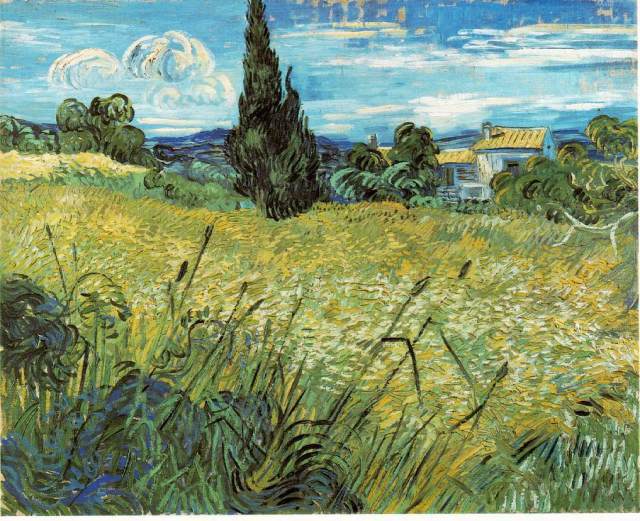
Wheat Field and Cypress by Vincent Van Gogh, 1890

Jesus, however, viewed walking through the fields differently. He did not consider the Sabbath as trivial; Jesus instead stood back and took a big picture perspective of it all. And that view included the ancient story of David, who took the consecrated bread in the tabernacle which was reserved only for Levite priests. (1 Samuel 21:1-6; Leviticus 24:8-9)

The reason David wanted the bread was because he was a fugitive, on the run from King Saul who was trying to take his life. Jesus insisted, on that day, the priest on duty did nothing wrong in giving the special bread to David. Yes, the strict letter of the law was broken; and, no, this was not wrong – because the priest was helping to save a life, and a very important one at that.

Jesus discerned there are times when particular laws come into conflict; so it’s necessary to maintain the spirit of a law in order to maintain a high value and meet a pressing human need. In a sense, Jesus gave a covenant code legal opinion on the subject.

It’s no surprise, to any reader of the New Testament Gospels, that Christ would behave this way; and that it would drive the religious leaders bananas. After all, they, the Pharisees, upheld law and rendered legal decisions – not this upstart wannabe. Jesus took an authoritative stance on what was happening, and the leaders did not at all like their own authority questioned.

This wasn’t some maverick interpretation by Jesus. He simply pointed out that the Sabbath is a gift, given to people to promote life and health – and not a burden that folks are to carry. Any decent Sabbath-keeper knew this.

It appears the leaders didn’t like being reminded of it from Jesus. What’s more, Jesus was much too close to likening himself to David. Yet another reason to despise this uppity teacher.

The Legality of Suffering

A second controversy brought the issue of who is in charge and who gets to arbitrate community values into a greater light. There is perhaps no other place for that conflict to happen than in the synagogue, the meeting place of worshipers. The juiciest things always seem to happen in a place of worship.

In the first story, the religious leaders were caught surprised over the behavior of Jesus and his disciples. They’re determined not to make that mistake again. From this point forward, it seems the Pharisees are continually waiting for a chance to put down Jesus as a lawbreaker and rabblerouser.

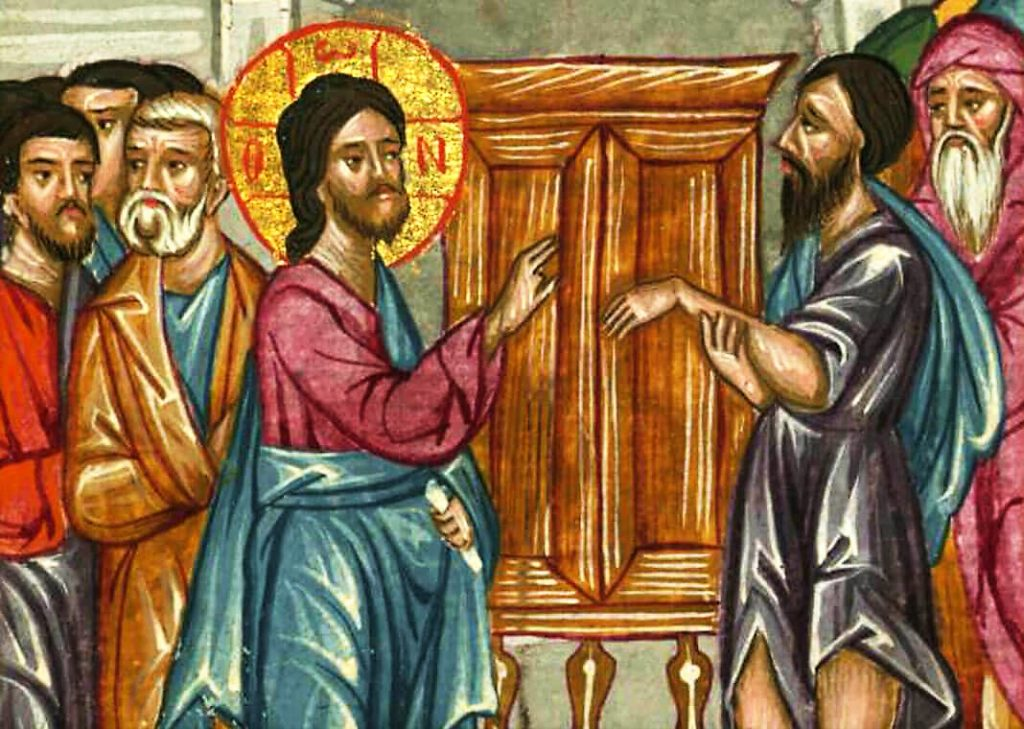
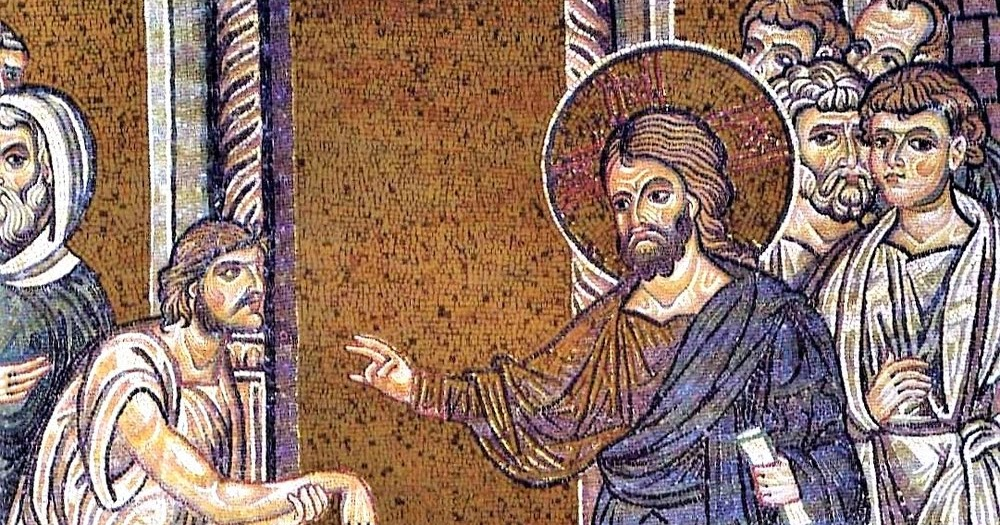
Byzantine mosaic of Christ healing the man with a withered hand, Cathedral of Monreale, Palermo, Sicily

For them, the issue wasn’t about the ability to heal, but whether it’s being done on the Sabbath. Much like the grainfield incident, healing is work, and working on the Sabbath is a direct violation of God’s immutable law. The religious leaders wanted to prove that Jesus has no regard for God’s will.

Law, for many Pharisees in Christ’s day, was meant to bring order so that chaos does not rule. Obedience to the law is a pre-condition for blessing. Without a clear demonstration of holy living, the community could be under a curse, much like their ancestors before them who were exiled for disregarding God’s law.

Yet again, Jesus cut through the anxious fear and authoritative posturing and went directly to the intended spirit of the law. The Sabbath, of all days in the week, ought to be a time for doing good, not harm; and to save life, not kill it. Jesus was not doing anything that could be considered work, anymore than his disciples were actually gleaning or harvesting grain.

There is no better day than the Sabbath for restoring a man’s withered and malformed hand, for giving him back his ability to make a living and contribute to the community. Much more was restored to the man than a physical ability; he now had the ability to better his life and his family, not to mention the local economy. It ought to be all good…

Unfortunately, the Pharisees didn’t see it that way, that the man gained his dignity back, his wholeness and his joy. They could only see a threat to their own hegemony.

The Beginning of the End

So, this marks the beginning of the end. The leaders are so upset and angry, they began plotting for Christ’s destruction. Unlikely political allies came together because of a common enemy. To view Jesus as a threat to society is, at the least, messed up. But that’s what happens when people cannot see beyond the end of their nose. They make bad choices.

Even though Jesus came to give life, others want to take his. Despite the fact that Jesus did not reject the law or demean the Sabbath, people with a short-sighted agenda and hard hearts could only see someone upsetting the status quo.

Today, these same things can quickly turn to hostility. The legal implications of one’s values and commitments can get nasty fast. Opinions can harden, resulting in oppression, persecution, and even death.

The most noble of motives can go sour; and the best of intentions, the highly educated, and the most gifted persons among us can become despotic in their leadership. Indeed, absolute power corrupts absolutely.

This is why the gracious and benevolent kingdom of God will win the day. Hard-hearted people become desperately out of touch with what is most important; they are calloused to the human need in front of their faces. I believe that the words and ways of Jesus can dispel those dark forces and impulses.

I’ll take a controversial Christ any day because that is the path to life abundant and everlasting.

Whenever unjust, oppressive, harmful, and fearful systems hold on, the ministry of Jesus exposes them for what they are, and will deliver us from evil.

Thanks be to God!

A Time of Woe (Isaiah 5:15-24)

The Prophet Isaiah, by Raphael, 1512

So people will be brought low
    and everyone humbled,
    the eyes of the arrogant humbled.
But the Lord Almighty will be exalted by his justice,
    and the holy God will be proved holy by his righteous acts.
Then sheep will graze as in their own pasture;
    lambs will feed among the ruins of the rich.

Woe to those who draw sin along with cords of deceit,
    and wickedness as with cart ropes,
to those who say, “Let God hurry;
    let him hasten his work
    so we may see it.
The plan of the Holy One of Israel—
    let it approach, let it come into view,
    so we may know it.”

Woe to those who call evil good
    and good evil,
who put darkness for light
    and light for darkness,
who put bitter for sweet
    and sweet for bitter.

Woe to those who are wise in their own eyes
    and clever in their own sight.

Woe to those who are heroes at drinking wine
    and champions at mixing drinks,
who acquit the guilty for a bribe,
    but deny justice to the innocent.
Therefore, as tongues of fire lick up straw
    and as dry grass sinks down in the flames,
so their roots will decay
    and their flowers blow away like dust;
for they have rejected the law of the Lord Almighty
    and spurned the word of the Holy One of Israel. (New International Version)

I’m willing to bet that you, like me, have had to contend with some rather annoying and obnoxious people from time to time in your life.

It’s the person whose head is so big, they can barely walk in and out of a room. And when they talk, it’s usually about themselves, the great things they’ve done, and what they think – not framed as opinions but as the truth.

Since this sort of person rarely listens to anyone, they have no clue about the real needs of people in front of them. Their self-inflated importance is to the degree that they don’t ask and are not curious; yet they demand of others. They see no problem with double-standards. It’s okay for them to bribe, even steal from another. But if you cross the self-important person, look out, because they’ll hunt you down like an animal.

Yes, such people exist. And there are typically some deep psychological reasons why they are so arrogant and difficult to be around. Yet the best thing to know about them is that the true Sovereign of the universe, God, is the rightful judge who will handle them.

If you see a path of destruction on the ground, you know a tornado has touched down and done its damage. And if you observe a bunch of people devastated and demoralized, you know that the haughty and self-important person has been through and laid waste to people’s lives.

The Lord almighty is not okay with such people moving about and hurting others with impunity; the wicked will have to contend with the One who knows what’s going on.

God looks and sees – and pronounces appropriate woes (curses) upon those who feign righteousness and holiness, yet in reality do anything but.

You can easily tell what God abhors by what sorts of behavior receives a disapproving woe upon it. God condemns self-indulgence and self-absorption. This shows itself in how one drinks and does business. The sheer accumulation of land, resources, and strong drink – without any sort of regard to one’s neighbor – is a foolish use of wealth.

The self-absorbed and self-important person becomes desensitized to the needs of others. They also become insensitive to God’s concerns and workings in the world. To disregard the poor and needy is to disregard God. Such injustice, resulting from only caring about oneself, is why the Lord levels divine woes upon them.

Actions and inactions both have consequences. Acting selfishly through wanton accumulation is an equal inaction against the community. As a result of so much economic disparity and carelessness in society, God displaces and deports the ones who arrogantly and smugly believed they are secure.

There is accountability in this world, even though it may not sometimes seem like it. There are ethical requirements and moral imperatives. The social laws contained in the covenant code between God and Israel were expected to be honored. So, when they were continually and habitually ignored, the Lord held the people accountable.

The selfishly proud and arrogant, who acquire all they can and become masters of small worlds, will eventually face ruin by means of divine judgment. It’s as if persons had so loaded their backpacks with sin, that it became heavy to the point of self-crushing.

Divine intervention is either a very good thing, or a very bad thing, depending upon who you are. People are expected to be self-aware enough to know the difference between right and wrong, bad and good, just and unjust. To not know this is to be self-addicted and unable to make proper discernments and decisions.

If you are reading or listening to this, you are likely a person who is concerned enough to care for others and is not lost in yourself. Yet, you likely have to contend with a few persons who are only in this life for themselves. So, watch out and do your best to avoid people who do the following:

  • Manipulate through deceptive language. There are some people in positions of authority or power who intentionally obscure, cover up, and confuse things. If you never know how things stand and are doing, then beware.
  • Independent without accountability. There is no interdependent relationships, and only obedience when it suits them. The constant caginess, and lack of vulnerability, is a warning. If you feel like you’re being micro-managed without much ability to ask specific questions and get straight answers, then look out.
  • Distort how things really are. I’m talking about gaslighting. Gaslighting is the attempt by another to accept the gaslighter’s view of reality as your own. And in the gaslighter’s quest, it seems to you as if there is continually chaos and you are off kilter. If you question it to them, then you will most likely be accused of having a problem. It’s not you. So, skedaddle the first chance you get.

The bottom line of it all is that God is rejected and there are people reneging on their commitments to the Lord. You need not be such a person, and you don’t need to live in such a way that another is in complete control of your life – other than God.

Take note of what the Lord dislikes and despises, and keep away from persons who set up themselves as being akin to God.

Grant us, Lord God, a vision of your world as your love would have it:
a world where the weak are protected, and none go hungry or poor;
a world where the riches of creation are shared, and everyone can enjoy them;
a world where different races and cultures live in harmony and mutual respect;
a world where peace is built with justice, and justice is guided by love.
Give us the inspiration and courage to build it, through Jesus Christ our Lord. Amen.

Learn To Do Right (Isaiah 1:1-4, 16-20)

Statue of Isaiah the Prophet, by Salvatore Revelli (1816-1859), Rome, Italy

The vision concerning Judah and Jerusalem that Isaiah son of Amoz saw during the reigns of Uzziah, Jotham, Ahaz and Hezekiah, kings of Judah.

Hear me, you heavens! Listen, earth!
    For the Lord has spoken:
“I reared children and brought them up,
    but they have rebelled against me.
The ox knows its master,
    the donkey its owner’s manger,
but Israel does not know,
    my people do not understand.”

Woe to the sinful nation,
    a people whose guilt is great,
a brood of evildoers,
    children given to corruption!
They have forsaken the Lord;
    they have spurned the Holy One of Israel
    and turned their backs on him…

Wash and make yourselves clean.
    Take your evil deeds out of my sight;
    stop doing wrong.
Learn to do right; seek justice.
    Defend the oppressed.
Take up the cause of the fatherless;
    plead the case of the widow.

“Come now, let us settle the matter,”
    says the Lord.
“Though your sins are like scarlet,
    they shall be as white as snow;
though they are red as crimson,
    they shall be like wool.
If you are willing and obedient,
    you will eat the good things of the land;
but if you resist and rebel,
    you will be devoured by the sword.”
For the mouth of the Lord has spoken. (New International Version)

Whenever the prophet has a vision, everyone better perk up and take notice.

After the northern Jewish kingdom of Israel fell to the Assyrians in 722 B.C.E., they lost their national identity. The southern Jewish kingdom of Judah, and its capitol Jerusalem, continued to exist for nearly a century and a half – even though they were vassals of either the Assyrians or the Babylonians.

Yet, Judah still functioned as its own nation in a semi-independent state. It was during this time that the prophet Isaiah had his vision, under the kingship of those descended from King David.

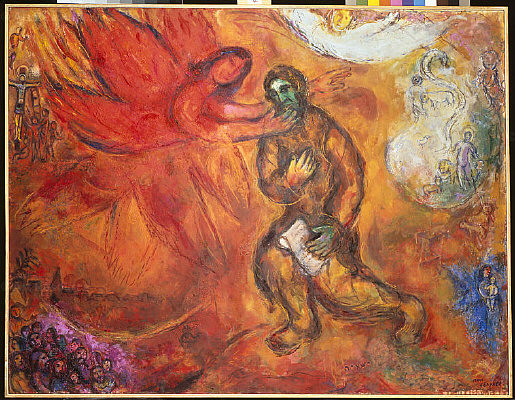
The Prophet Isaiah, by Marc Chagall,1968

The initial section of Isaiah’s prophecy is a series of oracles that establish the relationship between God and the nation of Judah, especially Jerusalem. The gist of God’s message is that the people are guilty of lots of sins.

However, the Lord left a gracious opening for them; their fate was not yet sealed. The nation could repent of their sins and experience a future restoration. God wanted to bring a resolution, and not have the people keep going in their unhealthy ways.

Throughout Isaiah’s vision, God is presented as a Father, with the children being Israel (both northern and southern kingdoms). And Father God has a complaint against them. The people’s principal sins were rebellion and ignorance. They spurned God’s authority, and did not accept their family intimacy with God.

Thus, the Lord is quite disappointed with the people. Heavenly witnesses are called to hear the charges of wrongdoing. The troubles of the nation were to be interpreted as warnings and disciplines, meant to lead them to stop and do right. Yet it seems that the warnings go unheeded by the people. It appears that God’s efforts to woo the people back are in vain.

Although the people’s continued sacrificial worship is merely done as a mere perfunctory act, and without true hearts of devotion for what is just and right, God offered them a chance to make things right, so that they could do justice and embrace righteousness.

God made it clear what it would take to repent: learn to do good; seek justice; recuse the oppressed; defend the orphan; plead for the widow. God even issued an invitation for a divine/human dialogue to happen.

Grace and cleansing from sin are possible, that is, if the people are willing and obedient, instead of remaining rebellious and refusing to do what is right, just, and good.

The nation was at a crossroads and had to make a decision. Would they choose wisely or foolishly?

Decision-making is critical. Some choices are harder than others. Yet the ability to decide is a God-given gift and ability.

Making decisions is fraught with consequences; we may try to anticipate or ignore what might happen with a particular choice. And how we go about decision-making is important. Who do we listen to? What information do we need? How will this choice shake out in the end?

Intentions are not choices, but are simply a mental resolve to do or not do something, at some point. And to not make a decision is to have already made a decision to either procrastinate or not do anything at all.

There are also decisions of duty. This may or may not be admirable. There is also the choice of attitude and energy given to the decision – because a choice of doing one’s duty can be done with joy or grumpiness, excitement or bitterness, with a bright disposition or a flat sullen affect.

It’s not really hard to guess or assess the choices of the people in Judah and Jerusalem in Isaiah’s day. They were doing an outward duty of temple worship, but without any heart to it.

Many of the people looked upon their duty as a sort of magical talisman that would ward off any trouble or army invasion. With that kind of approach, the people looked upon the rest of their time as their own, as discretionary, as the choice to do whatever they wanted to do.

If their business practices were dubious and not quite right, then big deal. After all, they give their money at the temple.

If the leaders played favorites and overlooked the needy person among them, then so what? The poor and oppressed can work harder, right?

And if orphans and widows – who were the most vulnerable persons in society – were not completely cared for, then that’s sad, but too bad for them.

I can picture an ancient city council saying something like, “We have a lot on our plate, dealing with foreign powers, the economy, and political issues. Those needy persons need to get a clue. It’s their own fault for hanging around and not leaving the city for greener pastures. Not our problem.”

Oh, but it very much was their problem. It was everyone’s problem, and each person’s responsibility, to ensure that God’s justice, goodness, and righteousness was infused throughout the entire city and nation.

Hence, the reason for the book of Isaiah. Tackle the moral and ethical problems head on before it’s too late and the gravity of judgment presses everyone out of the land.

What’s needed is a willing heart inclined to walk into divine obedience, without any talkback, and without any negotiations or deals.

God is merciful, and is willing to talk it out. But justice must be done. Needs must be met. People must be cared for. The Lord’s will must be done, here on earth, as it is always done in heaven. Is this what you are about, or not? Will you learn to do right?

Most merciful God, shine the light of your gracious love upon my cold hard heart. Enlighten my mind and dispel the darkness; speak the truth and help me obey; and have pity upon me. Forgive me yet again of my offenses, transgressions, and guilty acts. Grant me the grace to serve you with faithfulness and care for your people with love and purity, today and always. Amen.