
Learn a Lesson from Conflict (2 Samuel 10:13-19)

David Attacks the Ammonites, by Gustave Doré, 1866

Then Joab and the troops with him advanced to fight the Arameans, and they fled before him. When the Ammonites realized that the Arameans were fleeing, they fled before Abishai and went inside the city. So Joab returned from fighting the Ammonites and came to Jerusalem.

After the Arameans saw that they had been routed by Israel, they regrouped. Hadadezer had Arameans brought from beyond the Euphrates River; they went to Helam, with Shobak the commander of Hadadezer’s army leading them.

When David was told of this, he gathered all Israel, crossed the Jordan and went to Helam. The Arameans formed their battle lines to meet David and fought against him. But they fled before Israel, and David killed seven hundred of their charioteers and forty thousand of their foot soldiers. He also struck down Shobak the commander of their army, and he died there. When all the kings who were vassals of Hadadezer saw that they had been routed by Israel, they made peace with the Israelites and became subject to them.

So the Arameans were afraid to help the Ammonites anymore. (New International Version)

Outward Conflict with Ammon

You would think that showing basic human kindness to another would always end well… Yet, not always. And King David found that out, the hard way.

David, having become king of Judah and Israel, demonstrated that his reign would be characterized by extending the sort of mercy and kindness that is characteristic of God.

Whereas David’s kindness was most often accepted, when it came to King Hanun and the Ammonites, it was misunderstood and rejected. The Ammonites humiliated King David’s sent ambassadors.

The delegation wanted to express David’s condolences to Hanun in the event of his father’s death. Then, after the Ammonites saw that King David was upset about how his ambassadors were treated, they mobilized a mercenary force of Arameans with Hadadezer leading the charge.

Both the Ammonites and the Arameans underestimated the experience and skill of the Israelite army under their commander Joab. Even though Joab was outnumbered, he conceived of a strategy that evened the odds.

All of this conflict, with preparations for battle and an escalating war, came about because a king wanted to show kindness to another. Indeed, this can be a very messed-up world that we inhabit!

The result of it all is that the Ammonites and the Arameans were soundly defeated by a smaller, yet much stronger, army with King David at the head. The Arameans became subject to Israel, and the Ammonites were left slack-jawed, not knowing what hit them.

Inner Conflict with Oneself

So, here we have David, who like all of us, is a bundle of contradictions. On the one hand, King David had his heart set on showing kindness and reflecting the heart of God in his rule and reign. And on the other hand, David is a soldier and a man of blood, who does an awful lot of killing people in his lifetime.

King David is both a paragon of moral behavior, and an example of immoral living.

He did not lift a finger against his former king who was trying to kill him; and evidenced a tender spirit through musical skill and an ability to write the psalms and songs of Israel.
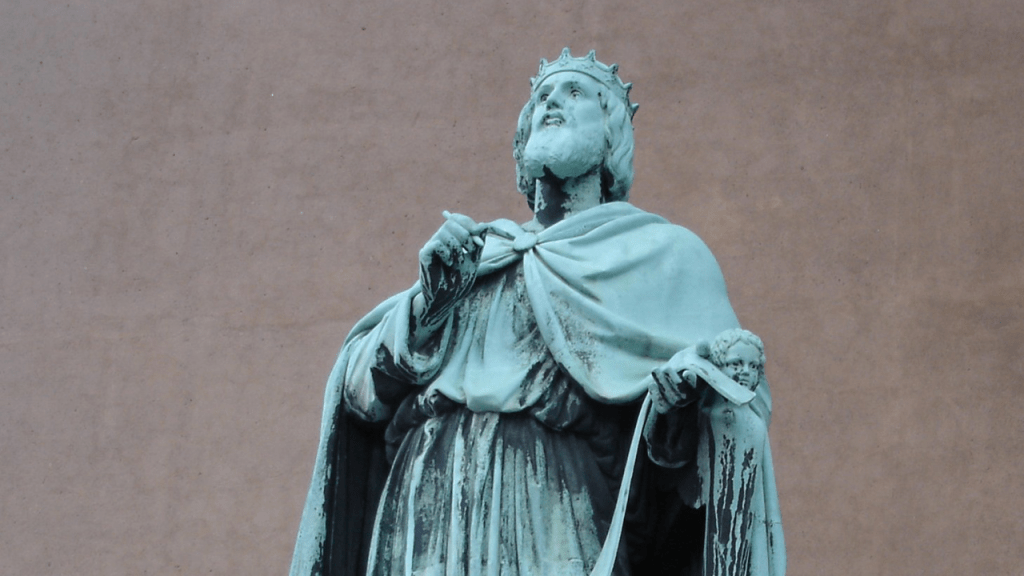
Statue of King David, Copenhagen, Denmark

Yet also, King David demonstrated for us some of the worst immorality, of which is clearly seen in the next few chapters of his story in the book of 2 Samuel. Throughout David’s adult life, he took thousands of human lives in battle.

He came to fame by beheading Goliath; made his mark in Israel by killing Philistines for King Saul; survived in the wilderness while Saul was trying to kill him by killing Amalekites; and secured Israel’s borders through an enormous amount of killing.

I won’t do to simply say that the people David killed had it coming to them, or that he did all the things he did for the sake of the nation. That sort of reductionism smacks of mental laziness and purposeful ignorance.

Coming to Grips with Conflict

At the least, it seems to me that we must accept the biblical narratives as they are, and not as we want them to be, whenever there is difficulty in understanding a story.

We have the human condition in front of us every time we read a scriptural story. Either making it all good, or all bad, just won’t do – because all of us, like David, are a bundle of contradictions and paradoxes that often don’t make sense.

It turns out that, throughout Holy Scripture, we find stories of people who are no better and no worse than we ourselves. The ancient persons, like David, are those for whom a gracious God chose to use and work through – despite either their sinning or their saintliness.

We get a glimpse of how things were and how the Lord operated through the people of the time in their own political, social, economic, and religious contexts.

God comes to us, not merely from the outside by simply mandating commands and imposing control, but enters our lives on the inside, taking us as we are and graciously working with and within us to accomplish good and just purposes on this earth.

And, as it turns out, God uses whomever God wants to use, without doing some sort of divine screening interviews to find out who the most moral candidate is available for the job.

If you are looking for a bottom line in all of this mayhem, then I believe it is this: God loves us. God is with us. And God holds us – all of us, with our maddening combinations of kindness and kookiness – to establish a truly right and benevolent world characterized by humility, gentleness, mercy, purity, and peace.

It’s a rather long and messy process of bringing in such a way of life, but God is patient and will take the centuries and even the millennia needed to accomplish it.

It’s Not All About Human Conflict

Although we are a flawed and fallible people, we are nevertheless God’s people. At the end of it all, we discover that none of this was really a story about Ammonites or Israelites or David or Joab or anyone else; it is actually a story about God – because God is both the object and subject of every biblical narrative.

And what we discover about God is that there are divine initiatives happening all the time which are meant to help us and save us from ourselves. The Lord is sovereign over all creation, and brings salvation despite what we do or don’t do.

God’s kindness – shown and expressed through our own human kindness – will eventually and always win the day.

Almighty and everlasting God, whose will it is to restore all things in your well beloved Son, the King of kings and Lord of lords: Mercifully grant that the peoples of the earth, divided and enslaved by sin, may be freed and brought together under his most gracious rule; who lives and reigns with you and the Holy Spirit, one God, now and forever. Amen.

A Prayer of Confession (Ezra 9:5-15)

Ezra In Prayer, by Gustave Doré, 1866

Then, at the evening sacrifice, I rose from my self-abasement, with my tunic and cloak torn, and fell on my knees with my hands spread out to the Lord my Godand prayed:

“I am too ashamed and disgraced, my God, to lift up my face to you, because our sins are higher than our heads and our guilt has reached to the heavens. From the days of our ancestors until now, our guilt has been great. Because of our sins, we and our kings and our priests have been subjected to the sword and captivity, to pillage and humiliation at the hand of foreign kings, as it is today.

“But now, for a brief moment, the Lord our God has been gracious in leaving us a remnant and giving us a firm place in his sanctuary, and so our God gives light to our eyes and a little relief in our bondage. Though we are slaves, our God has not forsaken us in our bondage. He has shown us kindness in the sight of the kings of Persia: He has granted us new life to rebuild the house of our God and repair its ruins, and he has given us a wall of protection in Judah and Jerusalem.

“But now, our God, what can we say after this? For we have forsaken the commands you gave through your servants the prophets when you said: ‘The land you are entering to possess is a land polluted by the corruption of its peoples. By their detestable practices they have filled it with their impurity from one end to the other. Therefore, do not give your daughters in marriage to their sons or take their daughters for your sons. Do not seek a treaty of friendship with them at any time, that you may be strong and eat the good things of the land and leave it to your children as an everlasting inheritance.’

“What has happened to us is a result of our evil deeds and our great guilt, and yet, our God, you have punished us less than our sins deserved and have given us a remnant like this. Shall we then break your commands again and intermarry with the peoples who commit such detestable practices? Would you not be angry enough with us to destroy us, leaving us no remnant or survivor? Lord, the God of Israel, you are righteous! We are left this day as a remnant. Here we are before you in our guilt, though because of it not one of us can stand in your presence.” (New International Version)

God had made a covenant with the Israelites. The Lord graciously gave them laws and stipulations to live by before entering the Promised Land.

Yet, much of Jewish history during the times of the kings was characterized by a breakdown in morality. Cheating on workers and preying upon the weak became commonplace. The poor were fleeced for what little they had, and reduced to servitude.

Failing to obey God completely, the people intermarried with the surrounding nations. The worship of Yahweh was, at times, in severe neglect, due to worshiping the gods of other places. As a result, divine judgment brought a Babylonian captivity and an exile of the people to a foreign land.

But God, who is rich in mercy, brought many of the people back to Palestine and Jerusalem. The Babylonians were conquered by the Persians, who had a different philosophy about how to handle the nations within their empire. And they were open to Jerusalem being rebuilt and the temple restored.

Ezra was a scribe (a copier of Scripture) and one of the returning exiles. Ezra left Babylon in 458 B.C.E. with a considerable group of people. Because of Ezra’s position as a Jewish scribe, and as a descendant of Levi, the Persian king authorized him to reinforce the Torah (the Law) by reading it and setting up the necessary administrative systems to ensure it would be followed.

Under Persian rule, each subject people was allowed to live by its ancestral laws, which were enforced by the imperial government. Violations of the laws of the group to which one belonged constituted an offense against the state precisely because they led to instability.

Soon after Ezra arrived in Jerusalem, he learned of the spiritual state of the Jews there. They had intermarried freely with the non-Jewish women of the land, and had ceased to keep the Jewish holidays and other commandments.

This situation devastated Ezra. He tore his clothes and sat in mourning the entire day until evening. After the evening sacrifice was brought, he got up and began praying loudly to God, weeping for forgiveness for the sins of his people.

Ezra read the Torah publicly to the entire people. Indeed, this was a covenant‑renewal ceremony in the strict sense. To make the Torah understandable to them, he had it explained, because Hebrew was no longer in most people’s vernacular. (Nehemiah 8:1-18)

In today’s Old Testament lesson, we have Ezra’s prayer, his great confession of sin, and concern that the people not get into the same situation which brought God’s judgment and exile upon them to begin with.

It is a prayer laced with love for the covenant code, the Jewish people, and most of all, for God. A very complicated situation prompted Ezra’s prayer, and would take much courage and wisdom to confront and deal with.

Whenever things are awry, circumstances are less than desirable, and situations seem overwhelming, the place to begin is to pray. Admittedly, prayer is not everything; but it is certainly something – and something powerful – for which we have both the duty and the delight to engage in.

And in praying, there is perhaps no better way to begin, than with a heartfelt prayer of confession:

Gracious God, our sins are too heavy to carry, too real to hide, and too deep to undo. Forgive what our lips tremble to name, what our hearts can no longer bear, and what has become for us a consuming fire of judgment.

Set us free from a past we cannot change; open to us a future in which we can be changed; and grant us grace to grow more and more in your likeness and image; through Jesus Christ our Lord. Amen.

The Issue of Holy War (Deuteronomy 7:1-11)

Joshua’s military campaign against the five Amorite kings, by Gilliam van der Gouwen, 1728

When the Lord your God brings you into the land you are entering to possess and drives out before you many nations—the Hittites, Girgashites, Amorites, Canaanites, Perizzites, Hivites and Jebusites, seven nations larger and stronger than you—and when the Lord your God has delivered them over to you and you have defeated them, then you must destroy them totally. 

Make no treaty with them, and show them no mercy. Do not intermarry with them. Do not give your daughters to their sons or take their daughters for your sons, for they will turn your children away from following me to serve other gods, and the Lord’s anger will burn against you and will quickly destroy you. 

This is what you are to do to them: Break down their altars, smash their sacred stones, cut down their Asherah poles and burn their idols in the fire. For you are a people holy to the Lord your God. The Lord your God has chosen you out of all the peoples on the face of the earth to be his people, his treasured possession.

The Lord did not set his affection on you and choose you because you were more numerous than other peoples, for you were the fewest of all peoples. But it was because the Lord loved you and kept the oath he swore to your ancestors that he brought you out with a mighty hand and redeemed you from the land of slavery, from the power of Pharaoh king of Egypt. 

Know therefore that the Lord your God is God; he is the faithful God, keeping his covenant of love to a thousand generations of those who love him and keep his commandments. But

those who hate him he will repay to their face by destruction;
    he will not be slow to repay to their face those who hate him.

Therefore, take care to follow the commands, decrees and laws I give you today. (New International  Version)

You may likely identify today’s Scripture as a difficult passage in the Bible. And rightly so. It doesn’t quite square with many people’s concept of a gracious and loving God. Yet, here it is. So, what do we do with this supposed loving God, commanding the new nation of Israel to completely wipe out the Canaanites?

Here are a couple of approaches I believe are completely unhelpful as we consider the text in front of us: 1) Ignore this text and relegate it as some antiquated piece of ancient literature which has nothing to do with us today; or 2) Reinterpret the text so that the killing doesn’t seem so bad, e.g. it’s not murder but a just war that was necessary to do.

However we choose to approach this text of Scripture, there’s no getting around the reality that it is talking about God commanding the Israelites to engage in a holy war of killing Canaanites – even though it was God who commanded, “Thou shalt not kill.” (Exodus 20:13, KJV)

Indeed, let’s face the reality that this is a moral and ethical conundrum for us. Let’s neither ignore it, nor do some interpretive gymnastics to make it say something it isn’t saying. In practical and objective terms, this is about God giving the Promised Land to the Israelites, of occupying and settling the land without any sort of residual contamination from the Canaanite way of life.

The taking of the land involved the exclusive worship of Yahweh. In order for that to effectively happen, the elimination of Canaanite gods needed to occur, according to God. And it was taken to the extreme limit of also eliminating those who worship the other gods.

An explanation is given for the method of holy war: To leave anything Canaanite in the land would end up being a snare to the Israelites because they would be led astray to serve those other gods.

For Israel to make it as a nation, they were to be holy and set apart exclusively for the worship of Yahweh. To have the Canaanites alongside them would be something like leaving a box of donuts on the desk next to you when you’re trying to work and attempting to lose weight.

Gathering, by Yoram Raanan, 2015

Covenant loyalty was highly important to both God and the Israelites. If the people would faithfully follow God’s will, as revealed in God’s Law, they could confidently go into battle against their enemies. Then, the Israelites will know that the Lord is going before them to give them success and victory.

However we try to understand holy war in the Old Testament, this was not really an issue for ancient cultures. Such an approach to taking land and occupying it was almost taken for granted. And in light of the Israelites having just lost an entire generation of people because of disobedience and complaining, they wanted nothing to do with that again – or with being under the slavery of an empire like Egypt.

Yet, here we are, trying to still make sense of the text of Scripture for today. And, it seems to me, every generation of Bible readers will continually grapple with this. There is something, however, that is important to consider: The nature of the ancient pagan worship.

There was a huge difference between the worship of Yahweh and the worship of the seven distinct gods in Canaan such as Molech and Chemosh. The abuse of both women and men in cult prostitution, as well as the practice of child sacrifice, were characteristics of that pagan worship.

Canaanite worship was so offensive to the Lord, that God as the rightful and just Judge, made the judgment to do away with them – not because Israel was so holy, but because Canaan was that immoral. In those circumstances of immoral and unethical ways of worship and life, the danger of Israel becoming morally and religiously corrupt was particularly acute.

So, this is why the Lord demanded that the Canaanite implements of worship be completely destroyed. And this situation was deemed of such high risk, that God commanded everything of the Canaanites – including the Canaanites themselves – be done away with. It was a war not just against people, but against their gods.

None of this necessarily makes a holy war justifiable from a contemporary perspective; but it does bring a needed context and understanding as to the extreme nature of ensuring the Canaanites were snuffed out altogether.

All of us are influenced by others. Bad relationships corrupt good character. No individual, group of people, or even an entire nation, can keep itself on a right, just, and good path if they are continually around others who harm people either verbally and/or physically.

It behooves us to be vigilant as to our relationships and to who we choose to listen to. One of the most significant issues for people today, in my opinion, is how we hear, and who we listen to. The poor choices that so many persons make as to the sort of people and ideas they hear every day significantly impacts our culture and society.

It is my ardent desire to be an agent of healthy religion, sound ethics, personal morality, cultural good, and societal justice. I neither need to be an obnoxious jerk in doing so, nor need to go on a holy war – namely because only God can call for such a thing. And if any person (especially a politician or a pastor) tries to tell you or me that it’s okay to destroy others and harm them, then that person is not speaking from a place of understanding or rationality.

In the end, we can choose to listen or not listen to whomever; yet we will eventually have to listen to the greatest force which exists in the universe.

Almighty God, the Sovereign of the universe who dispenses both judgment and grace: Deliver us from any sort of coldness and hardness of heart, or any kind of unhealthy and deluded thinking, so that we may have thoughts of steadfast love and affections of that which is just and true. Amen.

Raised Into a Spiritual Body (1 Corinthians 15:35-49)

But someone will ask, “How are the dead raised? With what kind of body will they come?” How foolish! What you sow does not come to life unless it dies. When you sow, you do not plant the body that will be, but just a seed, perhaps of wheat or of something else. But God gives it a body as he has determined, and to each kind of seed he gives its own body. 

Not all flesh is the same: People have one kind of flesh, animals have another, birds another and fish another. There are also heavenly bodies and there are earthly bodies; but the splendor of the heavenly bodies is one kind, and the splendor of the earthly bodies is another. The sun has one kind of splendor, the moon another and the stars another; and star differs from star in splendor.

So will it be with the resurrection of the dead. The body that is sown is perishable, it is raised imperishable; it is sown in dishonor, it is raised in glory; it is sown in weakness, it is raised in power; it is sown a natural body, it is raised a spiritual body.

If there is a natural body, there is also a spiritual body. So it is written: “The first man Adam became a living being”; the last Adam, a life-giving spirit. The spiritual did not come first, but the natural, and after that the spiritual. The first man was of the dust of the earth; the second man is of heaven. As was the earthly man, so are those who are of the earth; and as is the heavenly man, so also are those who are of heaven. And just as we have borne the image of the earthly man, so shall we bear the image of the heavenly man. (New International Version)

We have so far experienced, in this Christian Year:

  • Advent and the anticipation of Christ’s birth; a celebration of that birth in the Christmas season
  • Epiphany with it’s light shining on the salvation we enjoy for all kinds of people
  • Lent, as we moved slowly and silently toward the cross and practiced spiritual disciplines
  • Holy Week, by walking with Jesus in Jerusalem, to the Garden of Gethsemane, up the hill to where he was crucified

But that is not the end of the story. Christ is risen! On Easter Sunday we celebrated Christ’s resurrection from death. Now, we are in the season of Eastertide, an extended time of celebration in which we revel in new life. Life is possible and real because the resurrection of Jesus from death is real.

The resurrection is crucial and central to the entire Christian life. That’s why the Apostle Paul concluded his letter to the Corinthians with a long defense of its truth.

Today’s lesson zeros in on a particular point in Paul’s argument for the importance and place of resurrection in Christianity. He insisted that the resurrection – the spiritual body – is unique; it’s not like any other sort of body. And this is the body that believers will have in the future. Just as Christ was resurrected, we too, shall experience a resurrection.

We shall be transformed from being like Adam, the original person with a physical body, to being like the risen Christ, the first with a spiritual body.

Sometimes the Apostle Paul’s arguments can seem thick and hard to get through. So, allow me to put his line of thinking in a context which I deal with every day. In my work as a hospital chaplain, I visit patients on the cardiac units. The following is the sort of conversation I sometimes have:

Patient: “Ever since I had my heart operation, I don’t feel close to God. I’ve always had a good relationship with the Lord. But I don’t sense it. It’s as if God is distant. Did I do something wrong? Maybe God is punishing me.”

Chaplain: “Sounds like you really love God.”

Patient: “Yeah, I do. I don’t get it, why I’m like this now.”

Chaplain: “Think about this with me for a minute. Your body was just traumatized. Somebody opened up your chest and messed with your literal physical heart. And that doesn’t only affect your body. It messed with your spiritual heart, too. The two hearts are different, in some ways. But there’s a close relationship between the physical heart and the spiritual heart. Trauma is trauma. It impacts your whole person, not just part of you.”

Patient: “So, am I always going to feel this way?”

Chaplain: “It’s going to take a long time to physically heal from what your body has been through. It won’t take near as long for your spiritual heart to heal – but it will heal. You’ll be close to God again. But it probably isn’t going to happen today. What’s more, it’s possible that when you heal, you’ll actually feel even closer to God than before; after having been through this, it will be like you have a new lease on life.”

Paul’s understanding of the resurrection is not far off from these sort of interactions I have with hospital patients. We live the Christian life in the tent of this body, not knowing anything different. But we will eventually die. And when that happens, we never go back to the way things were when we were living on this earth.

We don’t just get resuscitated; we eventually get resurrected. We don’t become disembodied people after death, and at the end of the age when Christ returns. No, instead, we get a body – it’s our body, but it’s different, it’s changed, because it is a spiritual body. And it’s likely to be like nothing you’ve ever experienced before.

Life on this old fallen planet of ours is sometimes characterized by adversity, trouble, hardship, and even sometimes traumatic situations. But it will not always be this way. The resurrection of Jesus Christ from death changes everything.

Death will give way to life. There will be a spiritual body. We shall be healed in the complete sense of the word – physically, mentally, emotionally, and spiritually – without any more death, disease, and destruction. Suffering will lead to glory.

This is a Christian perspective on resurrection. Since Christ is risen from death, and now has a spiritual body, so too, will his followers be raised to life with just such a body – so that we can be with the Lord forever, as it was intended when God originally created people in God’s image.

Resurrection means hope. We have the confident expectation that promises of an eternal spiritual body is coming. Just as a tiny seed is transformed into a plant, so we will be changed. For those who have had to struggle with the constant debilitations of the body, this is truly good news. And it’s no April Fools.

Lord Jesus, You suffered death but conquered it. You laid in the tomb, but on the third day, You rose again. You are the resurrection, our hope and our life. O glorious and victorious Redeemer, help us not to be afraid of death, for we must pass through it to see you face to face. And on the last day we will rise again because You said so. Amen.