It’s a Bad Idea to Try and Handle God (1 Samuel 6:1-18)

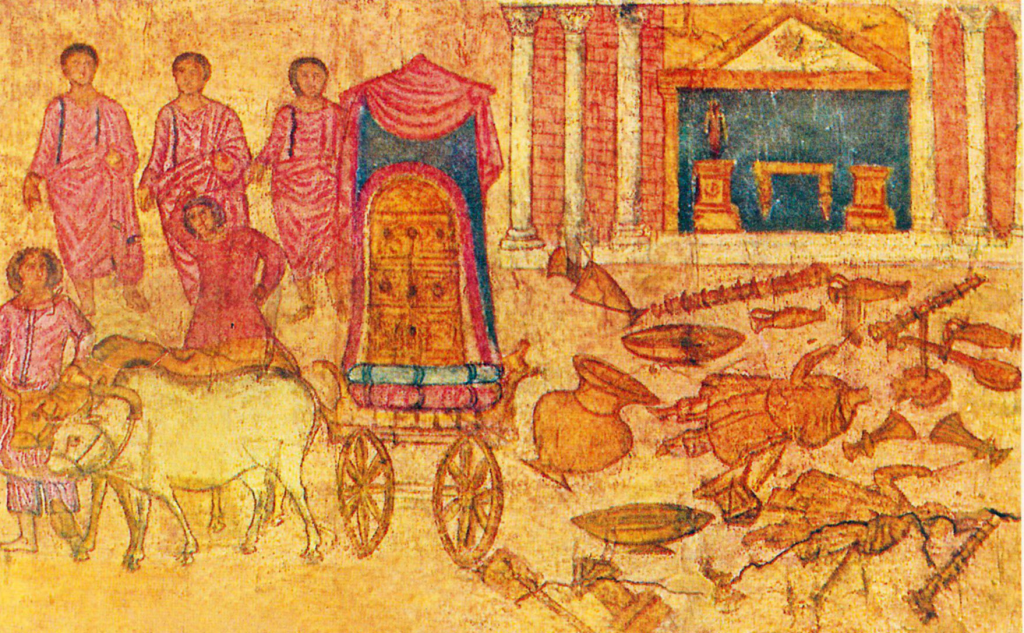
A fresco of the Philistine captivity of the Ark of God, from the ancient Dura-Europos Synagogue, excavated in 1932

The Ark of the Lord remained in Philistine territory seven months in all. Then the Philistines called in their priests and diviners and asked them, “What should we do about the Ark of the Lord? Tell us how to return it to its own country.”

“Send the Ark of the God of Israel back with a gift,” they were told. “Send a guilt offering so the plague will stop. Then, if you are healed, you will know it was his hand that caused the plague.”

“What sort of guilt offering should we send?” they asked.

And they were told, “Since the plague has struck both you and your five rulers, make five gold tumors and five gold rats, just like those that have ravaged your land. Make these things to show honor to the God of Israel. Perhaps then he will stop afflicting you, your gods, and your land. Don’t be stubborn and rebellious as Pharaoh and the Egyptians were. By the time God was finished with them, they were eager to let Israel go.

“Now build a new cart, and find two cows that have just given birth to calves. Make sure the cows have never been yoked to a cart. Hitch the cows to the cart, but shut their calves away from them in a pen. Put the Ark of the Lord on the cart, and beside it place a chest containing the gold rats and gold tumors you are sending as a guilt offering. Then let the cows go wherever they want. If they cross the border of our land and go to Beth-shemesh, we will know it was the Lord who brought this great disaster upon us. If they don’t, we will know it was not his hand that caused the plague. It came simply by chance.”

So these instructions were carried out. Two cows were hitched to the cart, and their newborn calves were shut up in a pen. Then the Ark of the Lord and the chest containing the gold rats and gold tumors were placed on the cart. And sure enough, without veering off in other directions, the cows went straight along the road toward Beth-shemesh, lowing as they went. The Philistine rulers followed them as far as the border of Beth-shemesh.

The people of Beth-shemesh were harvesting wheat in the valley, and when they saw the Ark, they were overjoyed! The cart came into the field of a man named Joshua and stopped beside a large rock. So the people broke up the wood of the cart for a fire and killed the cows and sacrificed them to the Lord as a burnt offering. 

Several men of the tribe of Levi lifted the Ark of the Lord and the chest containing the gold rats and gold tumors from the cart and placed them on the large rock. Many sacrifices and burnt offerings were offered to the Lord that day by the people of Beth-shemesh. The five Philistine rulers watched all this and then returned to Ekron that same day.

The five gold tumors sent by the Philistines as a guilt offering to the Lord were gifts from the rulers of Ashdod, Gaza, Ashkelon, Gath, and Ekron. The five gold rats represented the five Philistine towns and their surrounding villages, which were controlled by the five rulers. The large rock at Beth-shemesh, where they set the Ark of the Lord, still stands in the field of Joshua as a witness to what happened there. (New Living Translation)

The Ark Sent Away from the Philistines, by James Tissot, 1902

Out of all the stories in the Bible, this is one of them. The Philistines and the Israelites were fighting military battles. The Israelites did not do so well. Therefore, they decided to bring up the Ark of the Covenant of God (the symbol of God’s presence) to the front lines in order to win the battle.

The plan backfired. Israel lost, and the Ark of God (think Raiders of the Lost Ark, and not Noah’s ark) was taken by the Philistines. However, the five cities of Philistia likely regretted ever doing this. Wherever the Ark was, the people were plagued with nasty tumors, so that they suffered grievously. And that’s when the Philistines decided to hatch their own plan for ridding themselves of the Ark, while preserving their cities.

For three chapters (1 Samuel 4-6) we get various humans who made plans for the Ark of the Covenant. Since the Ark is a symbol of God’s presence, engaging in these plans is akin to deciding how things are going to go with God.

Humanity doesn’t get to flip-flop who is in control, God as sovereign over humanity to humanity manipulating God for their own purposes. Trying to leverage the Lord into what we want is a bit like believing we can make the sun spin around the earth. In other words, it’s not going to happen, no matter how much effort and ingenuity you put into it.

It’s a bad idea to try and handle God, instead of letting God handle us.

At least the Philistines quickly figured out it was a fool’s errand in possessing God’s Ark. And they had enough sense to consult somebody before they acted in getting the Ark away. Eventually, we’re all going to either humble ourselves, or just get humiliated; it’s our choice.

Yes, it seems like a weird plan – making gold objects in the shape of tumors – and yet the Lord often cares much more about the humility behind a plan than the actual plan itself. Despite being worshipers of pagan gods, God was picking up what the Philistines were putting down, and graciously received the Ark back into Israel.

Turn anywhere in Holy Scripture, begin reading, and you will quickly find that God will not tolerate any person or group of people trying to use, leverage, or manipulate heaven for it’s own purposes. The Lord has made it clear what is important; it’s up to us to live into it.

Holy and almighty God, help us to walk humbly with You and one another. Let your holy Spirit guide us on the right path to truth and reconciliation with humility. Help us to hear each other, for we do not want to walk by pride or self-sufficiency. Amen.


Are You In Need? (John 7:37-39)

On the last day of the festival, the great day, while Jesus was standing there, he cried out, “Let anyone who is thirsty come to me, and let the one who believes in me drink. As the scripture has said, ‘Out of the believer’s heart shall flow rivers of living water.’ ” Now he said this about the Spirit, which believers in him were to receive, for as yet there was no Spirit because Jesus was not yet glorified. (New Revised Standard Version)

Let’s take Christ’s words at the end of the Jewish Festival of Booths (or Tabernacles) at face value. Jesus said that if anyone is thirsty, they could come to him and drink. This is an unconditional statement with no caveats, qualifications, or fine print to it.

Jesus did not say that if anyone is spiritual enough, strong enough, or committed enough that then they could come to him.

The only qualifications one must have in coming to Jesus is to be needy. To be thirsty and want a drink is it, period. No interviews. No jumping through any hoops. No red tape. No having to go through one of the disciples to get to Jesus. No obstacles whatsoever.

Sheer need and want gets anybody an audience with Jesus.

“Thirsty” is Christ’s simple metaphor for need. Whenever we long to have our needs met, there is always the opportunity and possibility of going to Jesus. And all of us are thirsty because every single person has needs that aren’t getting met. These important and vital words of Jesus are encouraging. They help us admit whatever is going on, and say to him, “I need you, Lord.”

The Lord’s response to such a humble expression of need is this: “Please come here to me and drink till you are full.” No judgment. No condemnation. No big sighs. No snarky comments. No disappointed looks. Our confession of need accesses divine compassion and help.

Who will help us? The Holy Spirit will help.

Christ ascended and gave us the Spirit. On this day before the Christian celebration of Pentecost, we are reminded that Jesus delivered on his promise to give help. There is no better assistance in all the world than having a permanent live-in Guide, Helper, and Advocate who is continually alongside us, even in us.

Ask. Seek. Knock. That’s it. Help is just a call away.

We have a popular commercial figure in my city, a lawyer, whose one-liner is, “One call. That’s all!” And help will come. All we need to do is express our needs and wants.

And yet, that is so awfully hard for so many people. It seems weak or selfish to come right out and say what we need and what we want. Yet, if we are to embrace any sort of Christian discipleship, straight forward asking will be involved.

Believers can state their needs simply. They are breathed on by the Spirit. Then, we have our thirst satiated. If we make it more complicated than that, we lose the incredible simplicity of the gospel – good news for needy people. Yet, we sometimes make it complicated by not coming out and saying what we need.

Why, in tarnation, is it so hard for people to ask for what they need and want?

For many, it’s because they have never been given permission to do so. They were never encouraged to express their needs and wants. However, it is perfectly acceptable to state what you want, and what you really need. Ask for what you want, and you may be surprised at how often you get it.

The lack of asking goes much deeper than this. Our fear of vulnerability and being judged by God (and others) prohibits us from asking for what we really want.

Therefore, we must see and understand that vulnerability is crucial to having our needs met. Only through being open enough to share what you need will relational connection happen. A relationship with Jesus is based on humility and vulnerability. Without it, there is no relationship.

We also might be afraid of not getting what we ask for; so we don’t ask, at all. Or, conversely, we may be afraid of receiving our asking! On some level, it’s more comfortable to stay in a familiar situation. We think we want something different, but we’re worried about the downside of getting it. We fret and wonder about it, not trusting ourselves. So, we become paralyzed, unable to say what we really want or need.

All of this overthinking comes down to our own image of self. It’s as if we don’t believe we deserve to be treated well. But the reality is: This isn’t about whether you deserve to have something; it’s about your needing or wanting it. Plain and simple. There’s no shame, being in want or need.

Some folk are so used to putting others first and meeting another’s need that they become stymied by their own inability to state what they need. So, they try and feel better by meeting everyone else’s need. When they become bitter about being emotionally depleted, and when they are thirsty for someone to meet their needs, they end up not asking for help – because they feel they can’t.

But you can, and you must. Jesus says so. We don’t always get what we want in life. But we won’t get it if we don’t ask. It’s good to focus on what you want or need in life, instead of questioning whether you’re worthy to receive it. Jesus said:

“Keep on asking, and you will receive what you ask for. Keep on seeking, and you will find. Keep on knocking, and the door will be opened to you. For everyone who asks, receives. Everyone who seeks, finds. And to everyone who knocks, the door will be opened.” (Matthew 7:7-8, NLT)

So, what are you waiting for!?

Handling a Stressful Situation (Daniel 2:24-49)

Daniel Interprets Nebuchadnezzar’s Dream, by David Martin (1639-1721)

So Daniel went to Arioch, the man the king had appointed to wipe out Babylon’s sages. Daniel said to him, “Don’t wipe out the sages of Babylon! Bring me before the king, and I will explain the dream’s meaning to him.”Wasting no time, Arioch brought Daniel before the king, telling him, “I have found someone from the Judean exiles who will tell the dream’s meaning to the king.”

In reply the king said to Daniel (whose name was Belteshazzar), “Can you really tell me the dream that I saw, as well as its meaning?”

Daniel answered the king, “Sages, enchanters, dream interpreters, and diviners can’t explain to the king the mystery he seeks.But there is a God in heaven, a revealer of mysteries, who has shown King Nebuchadnezzar what will happen in the days to come! Now this was your dream—this was the vision in your head as you lay in your bed:

“As you lay in bed, Your Majesty, your thoughts turned to what will happen in the future. The revealer of mysteries has revealed to you what will happen. Now this mystery was revealed to me, not because I have more wisdom than any other living person but so that the dream’s meaning might be made known to the king, and so that you might know the thoughts of your own mind.

“Your Majesty, you were looking, and there, rising before you, was a single, massive statue. This statue was huge, shining with dazzling light, and was awesome to see.The statue’s head was made of pure gold; its chest and arms were made from silver; its abdomen and hips were made of bronze.Its legs were of iron, and its feet were a mixture of iron and clay.You observed this until a stone was cut, but not by hands; and it smashed the statue’s feet of iron and clay and shattered them.Then all the parts shattered simultaneously—iron, clay, bronze, silver, and gold. They became like chaff, left on summer threshing floors. The wind lifted them away until no trace of them remained. But the stone that smashed the statue became a mighty mountain, and it filled the entire earth.

“This was the dream. Now we will tell the king its meaning:You, Your Majesty, are the king of kings. The God of heaven has given kingship, power, might, and glory to you!God has delivered into your care human beings, wild creatures, and birds in the sky—wherever they live—and has made you ruler of all of them. You are the gold head.But in your place, another kingdom will arise, one inferior to yours, and then a third, bronze kingdom will rule over all the earth.Then will come a fourth kingdom, mighty like iron. Just as iron shatters and crushes everything; so like an iron that smashes, it will shatter and crush all these others.As for the feet and toes that you saw, which were a mixture of potter’s clay and iron, that signifies a divided kingdom; but it will possess some of the unyielding strength of iron. Even so, you saw the iron mixed with earthy clayso that the toes were made from a mixture of iron and clay. Part of the kingdom will be mighty, but part of it will be fragile.Just as you saw the iron mixed with earthy clay, they will join together by intermarrying, but they will not bond to each other, just as iron does not fuse with clay.

“But in the days of those kings, the God of heaven will raise up an everlasting kingdom that will be indestructible. Its rule will never pass to another people. It will shatter other kingdoms. It will put an end to all of them. It will stand firm forever, just like you saw when the stone, which was cut from the mountain, but not by hands, shattered the iron, bronze, clay, silver, and gold. A great God has revealed to the king what will happen in the future. The dream is certain. Its meaning can be trusted.”

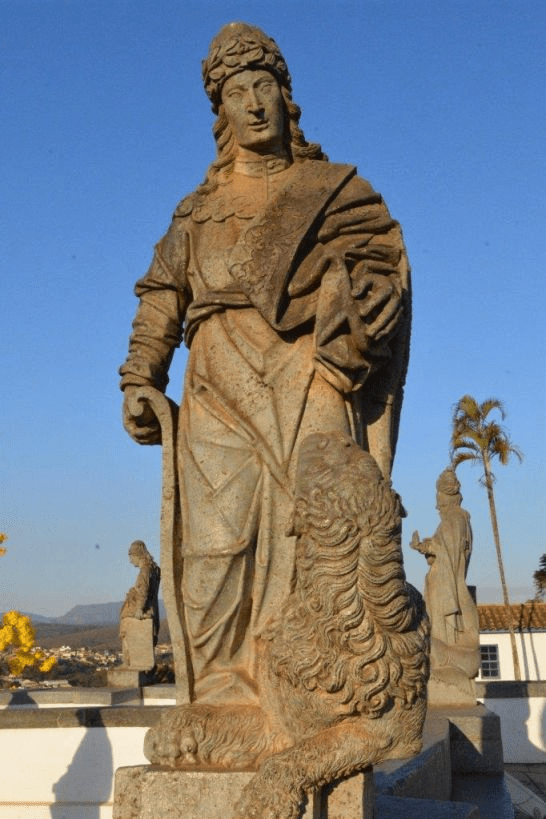
The Prophet Daniel, by Brazilian sculptor Aleijadinho (1738-1814)

Then King Nebuchadnezzar bowed low and honored Daniel. The king ordered that grain and incense offerings be made to Daniel. The king declared to Daniel, “No doubt about it: your God is God of gods, Lord of kings, and a revealer of mysteries because you were able to reveal this mystery!” Then the king exalted Daniel and lavished gifts on him, making him ruler over all the province of Babylon and chief minister over all Babylon’s sages. At Daniel’s urging, the king appointed Shadrach, Meshach, and Abednego to administer the province of Babylon, but Daniel himself remained at the royal court. (Common English Bible)

That was a close one. All the wise men of Babylon, along with Daniel and his three companions, were nearly snuffed out by the rage of a powerful king. Good thing God is the One who is really in charge of things!

King Nebuchadnezzar demanded that his court sages tell him the troubling dream he had, along with an interpretation. Daniel alone was able to provide both the dream’s content and its meaning, precisely because he immediately went to prayer and beseeched God to reveal the mystery. A lot of lives were on the line. And God answered him.

Daniel calmly and confidently handled the life-or-death situation with some deft wisdom. There are likely two reasons for his ability to step into a situation fraught with such heavy stress: 1) he was already a consistent person of prayer; and, 2) he was truly doing this for the benefit of everyone, not just himself. In other words, Daniel was humble, full of faith, and concerned for the common good of all.

It’s interesting to me that Daniel didn’t get all caught up in the specifics of the dream. What was most important to him was communicating to the king that it was the Lord who provided the dream and its interpretation; and doing his very best to ensure something like this wasn’t going to happen again.

After being made the acting ruler over the province of Babylon, Daniel’s first act was encouraging the king to put his three companions in charge of the province. Daniel himself remained at the royal court, close to King Nebuchadnezzar. Not only was Daniel wise in how he handled the potential debacle, but he was also quite wise in discerning that he was needed courtside. I picture Daniel becoming something of Nebuchadnezzar’s handler – maintaining a significant position in order to check the ego and the arrogance of the king.

What stands out to me most about today’s story is not the particulars about ancient history, with the empires coming and going. It’s about Daniel doing what needed to be done, being willing to step into a stress-filled situation and take it on. Then, when things settled down and he was recognized and awarded, Daniel didn’t get caught up in the hoopla near as much as diligently worked behind the scenes for stability in the royal court. Such humility is worth emulating, and is much needed in today’s world.

Gracious God, have mercy on me. As the day unfolds, please grant me humility, kindness, and courage to move toward the situations you have in front of me. Bring glory to yourself, gentleness to my heart, and a good and just outcome. Amen.

The Need to Defend a Ministry (2 Corinthians 10:1-11)

Mosaic of St. Paul Preaching, 12th century, Duomo, Monreale, Sicily, Italy

By the humility and gentleness of Christ, I appeal to you—I, Paul, who am “timid” when face to face with you, but “bold” toward you when away! I beg you that when I come I may not have to be as bold as I expect to be toward some people who think that we live by the standards of this world. 

For though we live in the world, we do not wage war as the world does. The weapons we fight with are not the weapons of the world. On the contrary, they have divine power to demolish strongholds. We demolish arguments and every pretension that sets itself up against the knowledge of God, and we take captive every thought to make it obedient to Christ. And we will be ready to punish every act of disobedience, once your obedience is complete.

You are judging by appearances. If anyone is confident that they belong to Christ, they should consider again that we belong to Christ just as much as they do. So even if I boast somewhat freely about the authority the Lord gave us for building you up rather than tearing you down, I will not be ashamed of it. I do not want to seem to be trying to frighten you with my letters. 

For some say, “His letters are weighty and forceful, but in person he is unimpressive and his speaking amounts to nothing.” Such people should realize that what we are in our letters when we are absent, we will be in our actions when we are present. (New International Version)

I don’t know about you, but I’m not a fan of feeling like I have to defend my ministry – my philosophy of how to go about things, my hermeneutics, my words, my actions, my clothes, my food – and pretty much everything about me. Believe it or not, I’ve been criticized for things like not having shiny enough shoes (and having too nice of shoes), the make and model of the car I drive (and don’t drive), being too serious (and not being serious enough).

So, for me, I detect in the Apostle Paul’s retort to the Corinthian Church, an exasperation. Reading between the lines, I can hear him saying something like, “I can’t believe I’m even talking about this stuff because you guys are about as spiritually aware as a bowling ball – and bowling balls haven’t even been invented yet. Heck, I don’t even know what a bowling ball is! That’s about how much you know what you’re talking about. Sheesh!”

Yet, despite Paul’s annoyance and displeasure with the Corinthians’ line of thinking, the Apostle still made up his mind to craft a response that was as humble and gentle as he could possible come up with.

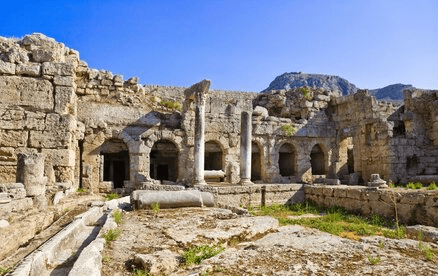
A modern archaeological site at Corinth, Greece

The Church’s first criticism toward Paul is that he is bold from a distance, but up close and personal, rather weak and unimpressive as an Apostle. I’m willing to be that every church pastor in the U.S. is more than able to know what this feels like in putting themselves in the Apostle’s shoes.

It’s an age old criticism that every preacher faces at various points, or at least with some sermons or writings. The people just don’t appreciate or like what they’re hearing or reading. It often comes out in the ubiquitous phrase, “I’m just not getting spiritually fed.” Wrapped up in that phrase is not only the criticism of oratorical skills, but also that they don’t like something about the preacher’s physical appearance, particular idiosyncrasies, or interaction with other people.

The second criticism of Paul by the Corinthians is that he acts too much according to human standards. In other words, the Apostle is just too worldly for them. If you happen to know anything about the ancient Corinthian Church, you’re either doing a major eye roll right now, or you’re just plain busting a gut in laughter.

There’s no more worldly church in the New Testament than the Corinthian Church. To have them bringing this point up to Paul is both laughable and downright sad. But again, every preacher nowadays knows the criticism all too well. For example, many pastors aren’t paid well with the convoluted reasoning that they shouldn’t be tempted toward worldliness – even though the parishioners themselves have no problem owning large homes, multiple cars, and high paying jobs.

The Corinthians were likely also concerned about Paul’s egoism – that he’s too much into worldly power and philosophies. Again, laughable stuff, considering the source. Yet again, these sorts of criticisms are rife within many churches. And the critics themselves tend to be ones who are enamored with wanting power and control for themselves, wanting to ensure that no one, including an upstart pastor, never treads upon their mastering of a very small world.

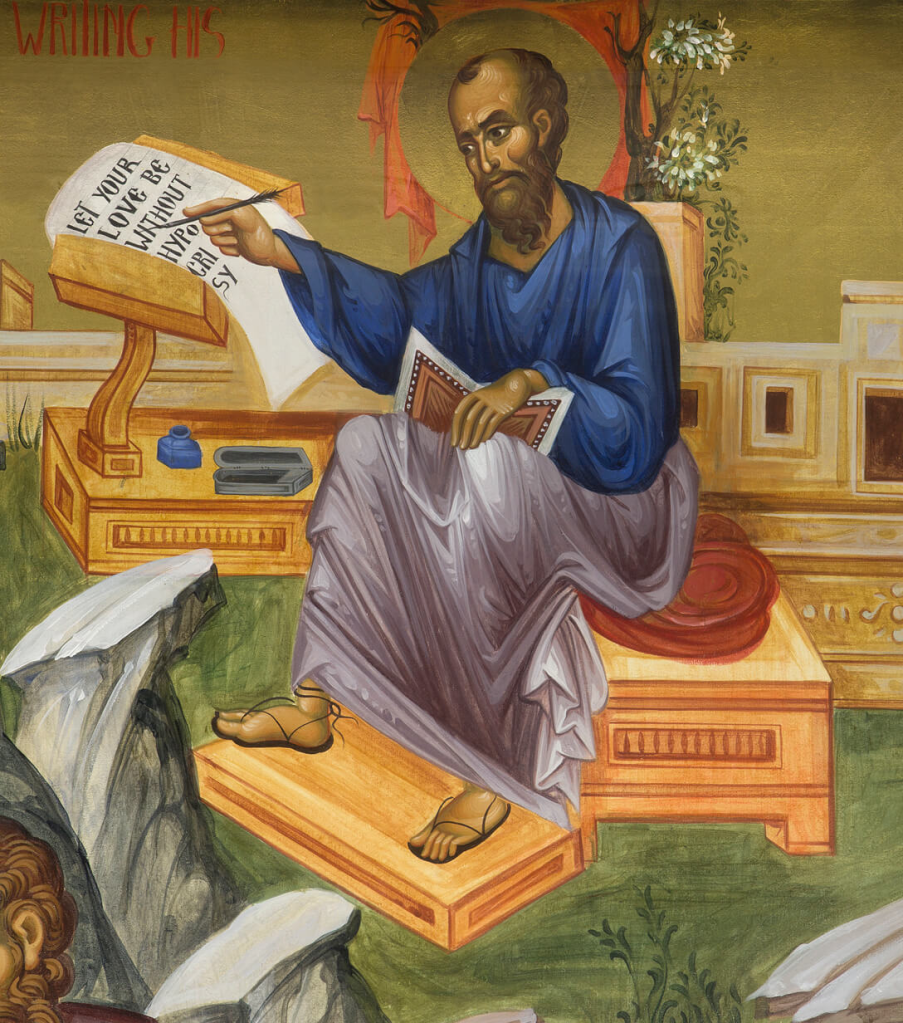
Orthodox icon of St. Paul writing to the churches

Paul responds to this by stating that he is, of course, a human being. However, he wields a different kind of power. Employing military metaphors, the Apostle describes the weapons that he uses as capable of destroying spiritual strongholds of arguments, and obstacles of pride against the knowledge of God – the very sorts of strongholds that were present among the Corinthians.

What’s more, Paul takes captive every thought and makes it obedient to Christ, and not to a self-serving agenda of worldly control and power. And he will use those weapons, if necessary, if the Corinthians keep up their petty criticisms and worldly behavior.

The bottom line of it all is that Christ made Paul an Apostle; and nobody in the Corinthian Church was made one. Paul’s authority was given, not taken, and he will use it to build up and not tear down. In other words, the Apostle Paul was committed to fulfilling his apostolic commission by establishing churches, building up those churches in the strength of faith, and protecting them from misguided and wrongheaded ways of operating.

All I have to say to this is that I am very glad that the Church belongs to Christ. Because that’s the only way we can still be talking about the Church still existing all these centuries later. God works, despite all the human foibles and nonsense.

Even though I talk like this (as does Paul!) there are still good Christian believers and good Christian churches in this world. Not every parishioner lacks self-awareness, is short-sighted, and has a plank in their eye. Nor are all pastors just in it for attention and some sort of worldly gain.

I’m still living and breathing, ministering and mentoring, after decades of Christian labor because of many good people who treated me well, spent good time with me, as well as those who received my teaching and my love, put it into practice, and have produced a harvest of righteousness beyond what I could imagine.

It would be good for all of us to experience supportive community, spiritual maturity, and wise ministry to others. If we can go through any process – no matter what it is – with the humility and meekness of Christ, then no matter what the end is, we have brought some peace and goodness into this old fallen world of ours.

And there is no shame in that!

Almighty and eternal God: Every good and perfect gift comes from you. Send down upon our pastors and parishioners alike a healthy spirit of grace and goodness, so that we all together may truly please you in all we say and do; and continually pour out your divine blessing upon us all. We ask this for the honor of your Son, our Advocate and Friend, Jesus Christ our Lord. Amen.