I Am Responsible and Accountable (Ezekiel 18:1-32)

The word of the Lord came to me: “What do you people mean by quoting this proverb about the land of Israel:

“‘The parents eat sour grapes,
    and the children’s teeth are set on edge’?

“As surely as I live, declares the Sovereign Lord, you will no longer quote this proverb in Israel. For everyone belongs to me, the parent as well as the child—both alike belong to me. The one who sins is the one who will die.

“Suppose there is a righteous man
    who does what is just and right.
He does not eat at the mountain shrines
    or look to the idols of Israel.
He does not defile his neighbor’s wife
    or have sexual relations with a woman during her period.
He does not oppress anyone,
    but returns what he took in pledge for a loan.
He does not commit robbery
    but gives his food to the hungry
    and provides clothing for the naked.
He does not lend to them at interest
    or take a profit from them.
He withholds his hand from doing wrong
    and judges fairly between two parties.
He follows my decrees
    and faithfully keeps my laws.
That man is righteous;
    he will surely live,
declares the Sovereign Lord.

“Suppose he has a violent son, who sheds blood or does any of these other things (though the father has done none of them):

“He eats at the mountain shrines.
He defiles his neighbor’s wife.
He oppresses the poor and needy.
He commits robbery.
He does not return what he took in pledge.
He looks to the idols.
He does detestable things.
He lends at interest and takes a profit.

Will such a man live? He will not! Because he has done all these detestable things, he is to be put to death; his blood will be on his own head.

“But suppose this son has a son who sees all the sins his father commits, and though he sees them, he does not do such things:

“He does not eat at the mountain shrines
    or look to the idols of Israel.
He does not defile his neighbor’s wife.
He does not oppress anyone
    or require a pledge for a loan.
He does not commit robbery
    but gives his food to the hungry
    and provides clothing for the naked.
He withholds his hand from mistreating the poor
    and takes no interest or profit from them.
He keeps my laws and follows my decrees.

He will not die for his father’s sin; he will surely live. But his father will die for his own sin, because he practiced extortion, robbed his brother and did what was wrong among his people.

“Yet you ask, ‘Why does the son not share the guilt of his father?’ Since the son has done what is just and right and has been careful to keep all my decrees, he will surely live. The one who sins is the one who will die. The child will not share the guilt of the parent, nor will the parent share the guilt of the child. The righteousness of the righteous will be credited to them, and the wickedness of the wicked will be charged against them.

“But if a wicked person turns away from all the sins they have committed and keeps all my decrees and does what is just and right, that person will surely live; they will not die. None of the offenses they have committed will be remembered against them. Because of the righteous things they have done, they will live. Do I take any pleasure in the death of the wicked? declares the Sovereign Lord. Rather, am I not pleased when they turn from their ways and live?

“But if a righteous person turns from their righteousness and commits sin and does the same detestable things the wicked person does, will they live? None of the righteous things that person has done will be remembered. Because of the unfaithfulness they are guilty of and because of the sins they have committed, they will die.

“Yet you say, ‘The way of the Lord is not just.’ Hear, you Israelites: Is my way unjust? Is it not your ways that are unjust? If a righteous person turns from their righteousness and commits sin, they will die for it; because of the sin they have committed they will die. But if a wicked person turns away from the wickedness they have committed and does what is just, and right, they will save their life. Because they consider all the offenses they have committed and turn away from them, that person will surely live; they will not die. Yet the Israelites say, ‘The way of the Lord is not just.’ Are my ways unjust, people of Israel? Is it not your ways that are unjust?

“Therefore, you Israelites, I will judge each of you according to your own ways, declares the Sovereign Lord. Repent! Turn away from all your offenses; then sin will not be your downfall. Rid yourselves of all the offenses you have committed, and get a new heart and a new spirit. Why will you die, people of Israel? For I take no pleasure in the death of anyone, declares the Sovereign Lord. Repent and live! (New International Version)

Every single one of us is accountable to one another for what we say and how we conduct ourselves. Above all, we are accountable to God for our motives, words, and actions in this life.

The flipside to stating that we are accountable, is saying that none of us are responsible for another person’s intentions, words, or actions.

Other people may influence us. We may be either participants in or victims of another’s actions. Some folks might take credit for something another person said or did. Yet, ultimately, we are responsible for our own life.

Whatever I think, say, or do is on me, period.

What’s more, one’s past actions do not replace our current actions. The prophet Ezekiel emphasized individual responsibility and accountability. All of the other Old Testament prophets addressed whole nations, and not individuals. They denounced the social, economic, and political systems and institutions, upholding communal ideals of justice.

Ezekiel communicated that children shall not be punished for their parent’s sins. Only the person who sins will face judgment.

A person ought only to pay for their own sins; punishment should not carry forward to future generations. The prophet also insisted that each individual person has the opportunity to change their behavior, and so, avoid their deserved penalty.

Every individual has the opportunity to change their personal ways of injustice or unrighteousness. For those who refuse, there is a and right and just Judge who knows how to dispense what is needed for each person – whether it is judgment to the arrogant, comfort to a victim, or justice for the underprivileged.

God cares that every person on earth receives what they need to thrive and flourish in this life. And to those who don’t give a wit about others, the Lord gives an opportunity to turn from arrogance and change.

Refusing to change, however, will end badly for the stubborn person.

The prophet Ezekiel calls on individuals to speak and act in ways that are helpful, not harmful. And whenever one harms another, that one must acknowledge the irresponsibility, because I am held accountable for what I say and do.

All words and actions come with consequences. It would do us a lot of good to consider how what we say and do (or fail to say and do) impacts the next generation of people. Everyone leaves a legacy of some sort – whether good or bad – so we need to be aware of how we live.

Each person must take up the mantle to do good, not evil; and to live righteously, not wickedly. Living selfishly with impunity leads to divine judgment. Yet, mercy is always there, if we seek to amend our ways.

Conversely, living righteously, and then resting on my laurels and living however I want, does not inoculate me from divine judgment.

You and I must live one day at a time, trusting God and seeking the welfare of others. And when I mess up, I am to keep a short account with God by admitting my fault and receiving grace.

We humans have quite enough responsibility in our lives without taking on the extra job of exacting judgment on another person. If we live a righteous life to begin with, then there is no need for a new heart and life.

Yet, if I need it, a new existence is there, through a change of direction which humility grants us.

Almighty God, help me to prioritize your values, and put my faith into action. Enable me to use the talents, resources, and time with which I have been blessed. Empower me to serve my community and my world. May I serve you always, and pray with a joyful spirit. Amen.

I Am Among You As One Who Serves (Luke 22:24-30)

The Last Supper, by Mamdouh Kashlan (1929-2022)

A dispute also arose among them as to which one of them was to be regarded as the greatest. But he said to them, “The kings of the Gentiles lord it over them; and those in authority over them are called benefactors. But not so with you; rather the greatest among you must become like the youngest, and the leader like one who serves. For who is greater, the one who is at the table or the one who serves? Is it not the one at the table? But I am among you as one who serves.

“You are those who have stood by me in my trials; and I confer on you, just as my Father has conferred on me, a kingdom, so that you may eat and drink at my table in my kingdom, and you will sit on thrones judging the twelve tribes of Israel. (New Revised Standard Version)

Jesus and his disciples had prepared for the Passover meal. They ate and drank together. Christ gave them words which have endured throughout Christian history as the Lord’s Supper. He spoke of the bread as his body, and the cup as the new covenant in his blood. Jesus communed with them and communicated about his impending death.

It was a moving experience for all. The disciples received from their Lord an intense act of love; and a new humanity around Christ’s body and blood. Indeed, the essence of new life is self-sacrificial love.

And then… the disciples began quarreling with each other about positions, and titles, and honors, and who was better, and who would be top dog in God’s kingdom….

It was a moment that I think every parent can relate to, at some level. Sitting around a dinner table, enjoying a rich conversation, becoming close with one another as a family… and then the kids begin bickering with each other about the most mundane of things.

Just a minute ago, you believed you were getting somewhere, and experiencing a shared family bond of love, commitment, and purpose… and then, in a matter of seconds, it all crashes down in a ridiculous display of posturing and positioning of one sibling over another….

I admit, this has happened to me more than once, when my own kids were growing up. And I also admit that I lost my sanctification on more than one occasion, watching this crazy schizophrenic scene play out in front of me.

Which is why I have a lot of respect for Jesus in responding to his disciples with humility, calmness, and a forthright spirit. He addressed their puny questions in a way that rebuked them without making them feel like they just got a Dad lecture.

In the sort of table fellowship that Jesus practiced with his disciples throughout his earthly ministry, he consistently sought to undermine the existing systems of domination in all levels of society. Even the religious system of Christ’s day had a distinct stratifying of persons in an inequitable structure of power.

The kingdom of God, however, is different. God’s economy is characterized by equality, mutuality, diversity, and shared power. It’s all based in a communal, as well as individual, relational connection with the Creator God.

God almighty, Creator of heaven and earth, is gracious, merciful, and kind. The Lord brings rain on both the righteous and the wicked. Thus, any sort of claim to being greater or superior or better than another person or group of people, has no place around the table of Christ’s body and blood.

Catholics are no better than Protestants. Evangelical Christians have no superiority over Progressive Christians. The Coptic Church doesn’t have the high ground on Eastern Orthodoxy. Christians who observe the Lord’s Supper as a remembrance are not greater than those who discern the Table as a sacrament.

And if one has the ears to hear it, Christians really ought to know better than to believe they should have greater control over the world and its systems than Buddhists, Muslims, or Jews.

Puffing up one’s chest and insisting that “My Dad is better than your Dad” is the stuff of childish preoccupations, and not of God’s kingdom.

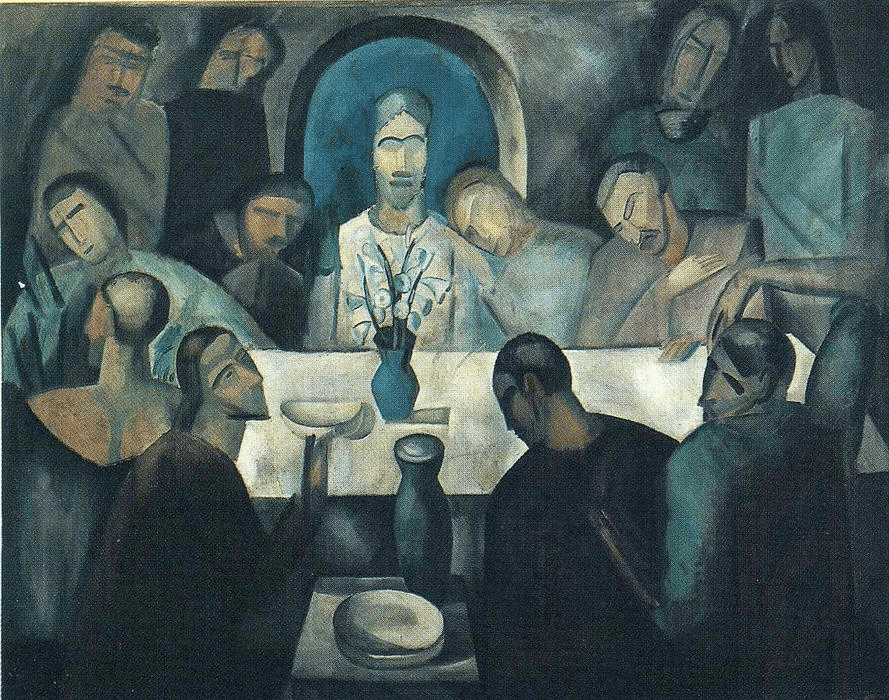
The Last Supper of Jesus, by André Derain (1880-1954)

There are plenty of people in this old messed-up world who lord their power and authority over others. If we take the words of Jesus seriously, Christians are not to be part of that structure and system.

And yet, here we are, in this contemporary time and place in history, having a chunk of the population thinking Christendom is the way to go, that a form of Christian Nationalism should be the political system – as if the kingdom of God and the kingdom of this world are what’s on the ballot.

Christians are the very folks who need to insist on serving, not leading; building up, not tearing down; loving, not hating; being integrated and connected, not fragmented and disconnected from others, as well as from reality.

Any sort of earthly power and authority the Christian has, must be used to include, help, and support, instead of excluding, ignoring, and destroying. The greatest among us must become like the youngest, and the leader like one who serves.

Christians must support and promote the idea of political office as a public service; and the concept of being a citizen as serving the common good of all persons, not just some persons.

Jesus came to this earth to serve. Therefore, his followers are also to serve. The words and ways of Christ centered in humble service, merciful justice, and prayer for one’s enemies. His followers must do no less.

Jesus Christ came to usher in a moral and ethical kingdom in which God’s gracious and benevolent will is done on this earth, as it is always done in heaven. He did not come to make sure Christians have lots of political power and authority over all the non-Christians.

Yes, indeed, we will be given power and authority – but not to baptize existing earthly structures so that the system serves the interests of Christians. We receive so that we can give. We give so that we might serve. And we serve because our Lord is a servant.

So, if Christians truly desire to bring change and transformation to this world, it will be through a compassionate and caring system of service to our fellow humanity – and not by imposing our beliefs and will upon others in a modern day form of the Inquisition.

Let us then, traffic in love; aspire to meekness; practice servanthood; and become the wait staff for the world’s needs.

That is what it really means to stand with Jesus in this time of trial.

Gracious and loving God, you work everywhere reconciling, loving, and healing your creatures and your creation. In your Son, and through the power of your Holy Spirit, you invite each of us to join you in your work.

I ask you to form me more and more in your image and likeness, through my prayers and worship of you; and through the study of Holy Scripture, so that my eyes will be fully opened to your mission in the world.

Send me into my family, church, community, workplace, and world to serve Christ with faith, hope, and love, through the power of the Holy Spirit. Amen.

A Great Reversal (Esther 8:1-17)

Reversal, by Margarita Lypiridou, 2021

That same day King Xerxes gave Queen Esther the estate of Haman, the enemy of the Jews. And Mordecai came into the presence of the king, for Esther had told how he was related to her. The king took off his signet ring, which he had reclaimed from Haman, and presented it to Mordecai. And Esther appointed him over Haman’s estate.

Esther again pleaded with the king, falling at his feet and weeping. She begged him to put an end to the evil plan of Haman the Agagite, which he had devised against the Jews. Then the king extended the gold scepter to Esther and she arose and stood before him.

“If it pleases the king,” she said, “and if he regards me with favor and thinks it the right thing to do, and if he is pleased with me, let an order be written overruling the dispatches that Haman son of Hammedatha, the Agagite, devised and wrote to destroy the Jews in all the king’s provinces. For how can I bear to see disaster fall on my people? How can I bear to see the destruction of my family?”

King Xerxes replied to Queen Esther and to Mordecai the Jew, “Because Haman attacked the Jews, I have given his estate to Esther, and they have impaled him on the pole he set up. Now write another decree in the king’s name in behalf of the Jews as seems best to you, and seal it with the king’s signet ring—for no document written in the king’s name and sealed with his ring can be revoked.”

At once the royal secretaries were summoned—on the twenty-third day of the third month, the month of Sivan. They wrote out all Mordecai’s orders to the Jews, and to the satraps, governors and nobles of the 127 provinces stretching from India to Cush. These orders were written in the script of each province and the language of each people and also to the Jews in their own script and language. Mordecai wrote in the name of King Xerxes, sealed the dispatches with the king’s signet ring, and sent them by mounted couriers, who rode fast horses especially bred for the king.

The king’s edict granted the Jews in every city the right to assemble and protect themselves; to destroy, kill and annihilate the armed men of any nationality or province who might attack them and their women and children, and to plunder the property of their enemies. The day appointed for the Jews to do this in all the provinces of King Xerxes was the thirteenth day of the twelfth month, the month of Adar. A copy of the text of the edict was to be issued as law in every province and made known to the people of every nationality so that the Jews would be ready on that day to avenge themselves on their enemies.

The couriers, riding the royal horses, went out, spurred on by the king’s command, and the edict was issued in the citadel of Susa.

When Mordecai left the king’s presence, he was wearing royal garments of blue and white, a large crown of gold and a purple robe of fine linen. And the city of Susa held a joyous celebration. For the Jews it was a time of happiness and joy, gladness and honor. In every province and in every city to which the edict of the king came, there was joy and gladness among the Jews, with feasting and celebrating. And many people of other nationalities became Jews because fear of the Jews had seized them. (New International Version)

“So the last will be first, and the first will be last.”

Jesus (Matthew 20:16)

Knowing that someone is not who they present themselves as can be maddening. They’re selfish and enamored with having authority, yet everyone thinks they are okay.

Haman was a bad man who camouflaged himself as important. As the right hand man to King Xerxes of the vast Persian Empire, Haman valued position, power, and attention above all else. But his arrogance proved to be his downfall.

People who are concerned to be seen as important can never get enough. Haman was not satisfied to be the prime minister in the empire, even though millions of people bowed down to him.

Mordecai, a Jew, Queen Esther’s cousin, refused to bow down. He saw the pride and arrogance within Haman to have what only belongs to God.

Haman could not stomach this one Jew dismissing his power and authority. As a person who wanted only “yes men” around him, Haman was determined to eradicate Mordecai. And even that was not enough for him. So, Haman proposed the destruction of all Jews.

He was supposedly an imperial expert on “the Jewish problem.” So, King Xerxes listened to him when he hatched a devious strategy to rid the empire of all Jews. A decree was made that on a particular day the Jews could be destroyed and plundered.

But the real plan that resets all other plans is the plan of God. And God’s plans are for good, not evil; and for Jewish life, not death.

Esther Denouncing Haman, by Ernest Normand, 1888

Pride and arrogance never ends well for the proud and arrogant person. They may have their way for a while, but ultimately such people find that their evil plans come back on themselves.

So, one night when the king was unable to sleep, he had the annals of the kingdom read to him. He heard of Mordecai’s successful effort at saving the king’s life from an assassination plot. The king also learned that Mordecai had never been properly recognized and rewarded.

One of the main differences between the proud and the humble is that arrogant people are obsessed with recognition and rewards; whereas the humble person cares about what is right and just, viewing good deeds as their own reward.

As the king’s trusted right hand man, Haman was consulted as to what ought to be done for someone the king wants to honor. The proud person always believes the honored person is themselves.

So, Haman, believing Xerxes wanted to honor him, suggested an elaborate recognition ritual involving a parade and plenty of accolades.

The king, however, had this in mind for Mordecai. He ordered Haman to be the one who made sure the recognition happened. And that’s not all. Haman would also get retribution for his evil heart.

Behind the scenes of royal power and scuttlebutt, Esther and her people were praying and fasting. Esther had her own plans for good, and not for evil.

Of course, Haman believed that a banquet was being given in his honor by the queen. In reality, not at all.

Esther revealed to the king the true plot and hate against her own people. Enraged, King Xerxes demanded who would dare presume to do such a thing against his beloved queen and her people.

With Haman directly in front of them, Esther pointed out the adversary. And then, the gallows which Haman had made to hang Mordecai were used for his own execution. Thus ended the story of the villain Haman.

There was still, however, the problem of the royal decree to destroy the Jewish people on an appointed day. Haman had been dealt with, but there were still wide-ranging consequences of his actions that remained in effect, and that could only be dealt with at the political level.  

Queen Esther interceded to the king on behalf of her people. Although a decree from the king cannot be revoked, yet another decree could be written in another’s name that would counteract the first. And this is precisely what Mordecai and Esther did, with the king’s full knowledge and blessing to it.

Today’s Old Testament lesson is a great reversal of fortunes if there ever was one. The high position of Haman and his extreme hatred and arrogance are gone. The Jewish people, on the precipice of annihilation, are not only alive, but had the opportunity to pushback on their enemies. Mordecai was not hanged on a gallows, but became in charge of Haman’s entire estate.

This was a restoration beyond what anyone could have thought or imagined. And that is the sort of reversal which God specializes in.

You cannot fool God, so don’t make a fool of yourself! You will harvest what you plant. If you follow your selfish desires, you will harvest destruction, but if you follow the Spirit, you will harvest eternal life. Don’t get tired of helping others. You will be rewarded when the time is right, if you don’t give up. (Galatians 6:7-9, CEV)

God, I am far too often influenced by what others think of me. May I not pretend to be either richer or smarter or nicer than I really am. Please hinder me from trying to attract attention. Don’t let me gloat over praise on one hand or be discouraged by criticism on the other. Nor let me waste time weaving imaginary situations in which the most heroic, charming, witty person present is myself. Show me how to be humble of heart, like you. Amen.

Approach Everything with Humility and Wisdom (Esther 5:1-14)

Esther, by Marc Chagall, 1960

On the third day Esther put on her royal robes and stood in the inner court of the palace, in front of the king’s hall. The king was sitting on his royal throne in the hall, facing the entrance. When he saw Queen Esther standing in the court, he was pleased with her and held out to her the gold scepter that was in his hand. So Esther approached and touched the tip of the scepter.

Then the king asked, “What is it, Queen Esther? What is your request? Even up to half the kingdom, it will be given you.”

“If it pleases the king,” replied Esther, “let the king, together with Haman, come today to a banquet I have prepared for him.”

“Bring Haman at once,” the king said, “so that we may do what Esther asks.”

So the king and Haman went to the banquet Esther had prepared. As they were drinking wine, the king again asked Esther, “Now what is your petition? It will be given you. And what is your request? Even up to half the kingdom, it will be granted.”

Esther replied, “My petition and my request is this: If the king regards me with favor and if it pleases the king to grant my petition and fulfill my request, let the king and Haman come tomorrow to the banquet I will prepare for them. Then I will answer the king’s question.”

Haman went out that day happy and in high spirits. But when he saw Mordecai at the king’s gate and observed that he neither rose nor showed fear in his presence, he was filled with rage against Mordecai. Nevertheless, Haman restrained himself and went home.

Calling together his friends and Zeresh, his wife, Haman boasted to them about his vast wealth, his many sons, and all the ways the king had honored him and how he had elevated him above the other nobles and officials. “And that’s not all,” Haman added. “I’m the only person Queen Esther invited to accompany the king to the banquet she gave. And she has invited me along with the king tomorrow. But all this gives me no satisfaction as long as I see that Jew Mordecai sitting at the king’s gate.”

His wife Zeresh and all his friends said to him, “Have a pole set up, reaching to a height of fifty cubits, and ask the king in the morning to have Mordecai impaled on it. Then go with the king to the banquet and enjoy yourself.” This suggestion delighted Haman, and he had the pole set up. (New International Version)

Esther Comes Before the King, by Johann Boeckhorst (1604-1668)

Three days of fasting by Esther and her attendants, along with all of the Jewish people in the Persian capital city, came to the point of approach and confrontation. But it was not confrontation in the sense of in-your-face; that would get you killed in the emperor’s court.

One did not approach the king without being asked to do so. Yet, Queen Esther was the only person in a position to try and speak to the king on behalf of the Jewish people. A royal edict had been pronounced; a day was coming when they would be slaughtered and plundered. Something had to be done. And that something became a someone: Esther.

Although Esther was a queen, it was not by her own choice. She was brought into the royal court through a long process of finding a queen for the king. Esther was taken from her home; she had to participate.

It seemed as if she had no agency of her own. But there came a time when Esther had to find that personal agency and speak her own voice – even though it was at great risk to her own life, as well as the life of her people.

Perhaps because Esther had no ability to seek status, she seems to have come to the conclusion that she could be used where she was – that somehow she came to the Persian court for just such a time as this, the saving of many lives.

Queen Esther evidenced a spirit of collaboration and wisdom. She knew she could not directly confront the king concerning Haman’s evil scheme to rid the earth of Jews. She needed to approach by coming in the side door of humility and gentleness.

Thus, Esther requested the presence of King Xerxes and his right hand man Haman to a banquet. There was no arrogant demanding of justice or rights. There was only a genuine spirit of trying to do right.

All of us have others who hold positions of power over us. They make decisions which impact us significantly, whether for good or for ill. The way in which we deal with people in authority can make all the difference, not only for ourselves, but also for many other folks as well.

Power dynamics exist everywhere, in every organization, institution, family, workplace, neighborhood, and faith community. We are not in control of those structures. Yet, you and I have control of ourselves. We can choose how to respond to any given situation.

We have the opportunity to decide whether to be respectful or disrespectful, patient or impatient, wise or foolish, encouraging or discouraging, helpful or obnoxious.

Esther chose wisely. Haman chose foolishly. He was self-centered, power hungry, status conscious, angry, and downright arrogant.

Haman was obsessed with everyone giving him honor. So, when Mordecai didn’t bow to him, Haman made it his personal mission to do away with him. But that wasn’t enough. He also created a devious plan to kill all Jews.

The misuse of power is one of the most devastating sins a person can do, namely because it affects so many people and makes their lives miserable, if not dead. Abusers are typically, at their core, insecure persons who overcompensate for feeling better by pushing others down.

Abusive persons in authoritative positions is a very bad combination. The only human life they value is themselves. And they don’t care who they destroy to get what they want to feel secure and important.

Unfortunately, those in high positions sometimes (maybe oftentimes) have no idea how to properly assess the character and competence of those who want authority. Xerxes was a terrible judge of character, choosing Haman for high office and listening to him.

There are far too many persons in this world, in our own societies and institutions, who are not fit to hold any sort of public office or responsible position of power. They may talk a good line on the outside, but inside they have a hollow spot where there soul should be.

Yet, we elect them, or are okay with them in office. There’s no pushback. We can even stump for some of those morally stunted individuals. It should not be that way. We can most certainly do better, in this day and age. King Xerxes isn’t around, and there isn’t any supreme sovereign emperor calling all the shots.

We need to take responsibility, first and foremost, by developing a just and wise character within ourselves.

One’s own spiritual growth and emotional maturity will help to make wise decisions and right judgments. It is imperative that we have enough discernment to judge between the genuine article and a charlatan; and between one who has authentic potential, and one who has none.

Haman was no good for anybody but himself. And that, he even screwed up. But Esther was the right person for the right time. She evidenced a solid character, a listening spirit, and moral sensitivity.

May her tribe increase.

O Spirit of God, we ask you to help orient all our actions by your good and wise inspiration, and carry them on by your gracious assistance, so that every prayer and work of ours may always begin from you; and through you be happily ended. Amen.