

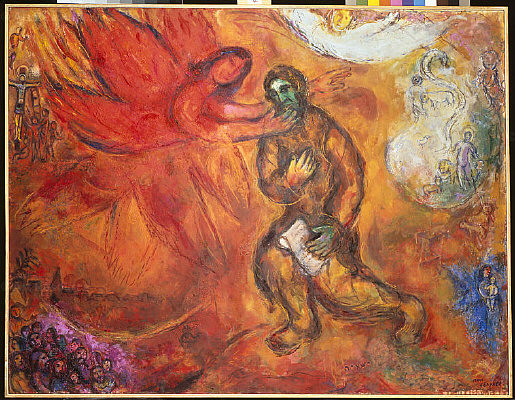
A Big Glorious Vision of Worship

In the year that King Uzziah died, I saw the Lord, high and exalted, seated on a throne; and the train of his robe filled the temple. Above him were seraphim, each with six wings: With two wings they covered their faces, with two they covered their feet, and with two they were flying. And they were calling to one another:

“Holy, holy, holy is the Lord Almighty;
    the whole earth is full of his glory.”

At the sound of their voices the doorposts and thresholds shook, and the temple was filled with smoke.

“Woe to me!” I cried. “I am ruined! For I am a man of unclean lips, and I live among a people of unclean lips, and my eyes have seen the King, the Lord Almighty.”

Then one of the seraphim flew to me with a live coal in his hand, which he had taken with tongs from the altar. With it he touched my mouth and said, “See, this has touched your lips; your guilt is taken away and your sin atoned for.”

Then I heard the voice of the Lord saying, “Whom shall I send? And who will go for us?”

And I said, “Here am I. Send me!” (Isaiah 6:1-8, NIV)

Uzziah was a king of Judah who reigned for fifty-two years. For most of his rule, he followed God faithfully. Under Uzziah the Jews had enjoyed the best political stability, economic security, and consistent worship of God since the days of King Solomon, hundreds of years before. 

Yet, if one were to look below the surface of Judah, it was also a time of spiritual complacency, apathy in worship, taking prosperity for granted, and self-centered – often oppressing others. The nation needed a fresh experience of God, and it came through the prophet Isaiah.

The essence of worship is a recognition and celebration of the triune God. Worship is a relational rhythm between God and humanity in which God self-reveals and people respond.

Worship is an experience of seeing and hearing divine revelation; repenting from wayward actions; and renewing missional service.

Worshiping the triune God ideally happens every day. It’s a lifestyle – not the result of one cleverly planned hour on Sunday. The people of Isaiah’s day were going through the ritual motions of worship without having their hearts in it. Worship was a kind of rabbit’s foot for them in which, if they had regular attendance within the temple, they believed they could do whatever they wanted with their lives outside the temple. 

As a result, the people did not see or hear God in their worship. Authentic worship of God does not have to do with the environment, the fellowship, or the music. True worship of the triune God is a heart desire to see and hear God. 

If worship does not happen in the sanctuary, that is because worship fails to occur daily life. Real worship is a life-changing encounter with Father, Son, and Holy Spirit. It experiences God’s revelation and changes our view of him. Bona fide worship leads to repentance and changes our view of self. True worship brings spiritual renewal and changes our view of mission and service.

Revelation: Worship Changes Our View of God

Isaiah saw a vision of God in the majestic divine throne room. It was a grand and transcendent vision of a God who dominates the entire setting. The train of God’s robe filled the temple. This is Isaiah’s way of saying the vision was incredibly large. If the train of his robe fills up the temple, then God is an immense Being. Gaining a vision of God’s hugeness is what causes our human problems to be seen as small. 

One time the Assyrian King Sennacherib invaded the land and approached Jerusalem during the reign of Uzziah’s great grandson, Hezekiah. The Assyrians were the dreaded horde of the ancient world, and it seemed no one could withstand them. So, the people prayed:

King Hezekiah and the prophet Isaiah son of Amoz cried out in prayer to heaven about this. And the Lord sent an angel, who annihilated all the fighting men and the commanders and officers in the camp of the Assyrian king… So, the Lord saved Hezekiah and the people of Jerusalem from the hand of Sennacherib king of Assyria and from the hand of all others. God took care of them on every side. (2 Chronicles 32:20-22, NIV)

Isaiah’s vision included seraphs – angels with the job description to glorify God with ceaseless praise. Their physical description symbolizes their function: covering their face symbolizes humility in God’s presence; covering their feet identifies it as holy ground; and flying symbolizes their work to do God’s will.

The seraphs have two-thirds wing power for worship, and one-third wing power for work. If this is any indication how God’s creatures are to conduct their lives, we as humans have a great deal of adjusting to do to accommodate the worship of God.

The sound of worship that came from the seraphs was proclaiming God’s holiness. Isaiah’s view of God changed as a result. As he saw God’s glory, Isaiah saw God as much bigger than he had before. For example, European visitors who come to the United States sometimes have no frame of reference as to how spacious the geography of our country is.

Some have a notion they can make day trips to places like San Francisco, Houston, or New York City because where they live is much more geographically compact. But once they get here, they experience the land in all its glory, and they gain an appreciation for the bigness of America. We all need to experience God’s glory and see God’s holiness because it will cause us to repent of old ways of seeing.

Repentance: Worship Changes Our View of Self

Isaiah was reduced to nothing after seeing a vision of the holy God. Humans cannot see God’s glory without also seeing their sinful selves. Isaiah’s response to God was not praise, but confession. Show me a proud, self-centered, and arrogant person and I will show you a person who has not seen God. Isaiah was unable to cleanse his own sin. Isaiah needed God to purge and purify his uncleanness. The New Testament says:

If we live in the light in the same way as he is in the light, we have fellowship with each other, and the blood of Jesus, his Son, cleanses us from every sin… If we confess our sins, he is faithful and just to forgive us our sins and cleanse us from everything we’ve done wrong. (1 John 1:7, 9, CEB)

Seeing God completely unravels us, for we see our depravity for what it truly is:

  • When the Apostle Peter saw the Lord’s immensity and power through a miraculous catch of fish he fell at Jesus’ knees and said, “Go away from me, Lord; I am a sinful man.” (Luke 5:8) 
  • When the Apostle John had a vision of Christ’s glory, and heard his voice, he fell at the Lord’s feet as though dead. (Revelation 1:12-17)
  • When the prophet Ezekiel had a vision of God and saw the appearance of God’s glory, he fell facedown. (Ezekiel 1:25-28)
  • Even Daniel, perhaps the most righteous prophet of all time, when seeing a vision of God’s glory, fell prostrate with his face to the ground, totally overwhelmed with God’s holiness and his own human sinfulness. (Daniel 8:15-18)

There is wickedness and indifference in the world. People do not see God’s glory and holiness. Because, if they did, they would be totally undone and see the foulness and degradation of hate and injustice. They would turn from apathetic and complacent ways of living. The world and the church need a vision of a holy God that comes from meeting with God. Isaiah saw the Lord. And because he repented, he was then able to hear the voice of God.

Renewal: Worship Changes Our View of Service

God is calling us. God’s voice has gone out. If we do not hear it, it’s because we have not experienced God’s self-revealing and have not responded with repentance. Apart from worship, we are unable to hear God. While Isaiah was worshiping God, he saw, responded, and heard the Lord. The early church heard the voice of God to service and mission:

The church at Antioch had several prophets and teachers…. While they were worshiping the Lord and fasting, the Holy Spirit told them, “Appoint Barnabas and Saul to do the work for which I have chosen them.” Everyone prayed and fasted for a while longer. Next, they placed their hands on Barnabas and Saul to show that they had been appointed to do this work. Then everyone sent them on their way. (Acts 13:1-3, CEV)

Isaiah was willing. He didn’t ask any clarifying questions. He neither inquired what the mission would be nor questioned God as to the plan. Isaiah plainly said, “Here I am, send me.”  It was an unconditional response to hearing God. Isaiah made no deals with God, did not try and negotiate terms of service. Isaiah simply told God he was willing to be sent. 

Many people fill their lives with stuff and activity. And they are unable to hear the voice of God. There’s just too much noise drowning out God. We have uncritically, without any discernment through prayer and worship, filled our lives to overflowing with never-ending things to do. And we have even sanctified it and called it holy, as if God’s will for us is to be constantly on the go.

Someday, we must give an account of our lives. God will ask why we did not take a risk, get involved, and go out into the world with a deep sense of mission. Too many people will say, “I never heard the call!” Yet, God was calling. “Whom shall I send? And who will go for us?” says the triune God.

Conclusion

God’s glory was revealed to Isaiah. Isaiah responded to that vision with confession and repentance. This brought a renewed sense of mission to his life. Isaiah was then able to hear God’s voice calling him to service. It is not our ability God cares about. Because God can equip anybody for any type of work. Instead, it is our availability God cares about.

We need to put ourselves in a position to see and hear God. The obstacles to visioning God’s glory and hearing God’s voice are legion: inattention to God’s Word and God’s creation; no mindfulness to the Holy Spirit; intense, constant, and prolonged preoccupations; lack of availability to the ways of Jesus; little sleep; unhealthy habits; a dull spiritual sense; lack of personal and divine awareness; a paucity of spiritual practices and disciplines; and a failure to be able to experience a vision of God.

God has graciously revealed himself to us as Father, Son, and Spirit. The Trinity is not so much a doctrine to believe as it is a powerful reality to live into. If we see and hear God today it will cause us to repent and be renewed in mission and service.

*Above painting of the prophet Isaiah by Marc Chagall, 1968

1 Corinthians 12:12-27 – One People for the Common Good of All

The body of Christ has many different parts, just as any other body does. Some of us are Jews, and others are Gentiles. Some of us are slaves, and others are free. But God’s Spirit baptized each of us and made us part of the body of Christ. Now we each drink from that same Spirit.

Our bodies don’t have just one part. They have many parts. Suppose a foot says, “I’m not a hand, and so I’m not part of the body.” Wouldn’t the foot still belong to the body? Or suppose an ear says, “I’m not an eye, and so I’m not part of the body.” Wouldn’t the ear still belong to the body? If our bodies were only an eye, we couldn’t hear a thing. And if they were only an ear, we couldn’t smell a thing. But God has put all parts of our body together in the way that he decided is best.

A body isn’t really a body unless there is more than one part. It takes many parts to make a single body. That’s why the eyes cannot say they don’t need the hands. That’s also why the head cannot say it doesn’t need the feet. In fact, we cannot get along without the parts of the body that seem to be the weakest. We take special care to dress up some parts of our bodies. We are modest about our personal parts, but we don’t have to be modest about other parts.

God put our bodies together in such a way that even the parts that seem the least important are valuable. He did this to make all parts of the body work together smoothly, with each part caring about the others. If one part of our body hurts, we hurt all over. If one part of our body is honored, the whole body will be happy. Together you are the body of Christ. Each one of you is part of his body. (Contemporary English Version)

“If instead of a gem, or even a flower, we should cast the gift of a loving thought into the heart of a friend, that would be giving as the angels give.”

George MacDonald (1824-1905)

It’s easy to take things for granted.

For instance, we don’t typically think too much about our toes… until we stub them, drop something on them, break them, or need a podiatrist to operate on them. Then, we not only know they’re still there, but our entire body (along with the mind and emotions!) feels the need to give a lot of attention to the lowest end of our body that enables us to stand and walk without thinking much about it.

The body is an apt metaphor for how to think about humanity and its various systems and institutions. We might see the face of any church or organization, but there are scads of people behind the scenes doing all kinds of good work. For example, the golfing profession understands the importance of caddies; lawyers know the need of paralegal professionals; healthcare facilities and organizations rely not only on nurses and social workers, but also on cooks and housekeepers; schools need the coordination of teachers, parents, students, volunteers, and the entire community to effectively realize the education of children.

Also, as you well know, it’s easy to take for granted services we receive… until we don’t receive them, or in a way to our liking. Then, we pay attention. We want action and resolution. We want our food now and to our exact specifications. Sometimes we might even forget that we are dealing with people, not cogs in a machine or parts in a system. Millions of people labor every single day, sometimes even seven days a week, just to make ends meet and provide for their families. When we neglect to see or understand this, we have done our fellow human beings a gross disservice.

It’s also awfully easy to forget how radical the Apostle Paul’s words were for first-century folks, especially in religious circles. Throughout the Old Testament, the Hebrew community was God’s people. If you wanted to worship the one true God, you came to Jerusalem and learned from Jews.

But Pentecost and the giving of the Holy Spirit changed things in such a profound and organic way that the world would never be the same again.

Paul preached with fervor and flavor that there would not be a separate Jewish church and Gentile church. They have become one Body of Christ through the redemptive events of Jesus. Both Jews and Gentiles have the same Spirit – not different Spirits for each group. Jesus did not die so that people could be fragmented from each other; Christ was crucified to end, once and for all, the segregation, discrimination, and ostentation of one group of people above another. 

The cross was the ultimate radical act of justice against the powers of this dark world that seek to rank people according to their relative importance and worth.

The power of resurrection is the energy of God raising Christ from death to triumph over the realm and system of evil throughout the earth. All kinds of people everywhere are to rise with Christ in a great demonstration of God’s power to subvert the status quo of discriminatory racism, extreme individualism, gender inequality, social and economic classism, and any kind of “ism” which places one group of people in subjection to another in misguided notions of superiority.

The church is to be a community of redeemed people reflecting the diversity of God’s big world.

No two groups of people could have been more different than Middle-Eastern Jews and Greek Gentiles. Yet, Paul adamantly insisted that they together, not separate, make up the one Body of Christ.

It isn’t easy listening to another group of people who think and act differently than you and me. But listen we must. And respond we must. It is our biblical responsibility as believers in the way of Christ. Believers are only the Body of Christ when we are united and together as one people of God.

There is no ability to look down your nose on another person if you are already kneeling on the ground in humble prayer at the foot of the cross. There is only the chance to look up. There is even the opportunity to allow someone less privileged and fortunate to assist you.

Yes, we all need one another – even if it doesn’t seem that way at first.

It isn’t our job to colonize other people’s culture and society to make it more like our own. It is our duty to share good news, make room at the Table, extend love in the name of Jesus, and work together as the one people of God, formed by the Spirit.

Almighty God of all creation, I understand we don’t struggle merely against flesh and blood but against powers and principalities – those institutions and systems that keep separatisms alive by perpetuating the lie that some members of the family are inferior and others superior.  Create in us a new mind and heart that will enable us to see brothers and sisters in the faces of those divided by human constructed categories of power disparities. 

Give us the grace and strength to rid ourselves of stereotypes that oppress some of us while providing entitlements to others. Help us to create a Church and nation that embraces the hopes and fears of oppressed people everywhere, as well as those around the world. Heal your family, God, and make us one with you, in union with our Lord Jesus, and empowered by your Holy Spirit. Amen.

*Above photo credit: music4life on Pixabay

Titus 1:1-9 – Effective Spiritual Leaders

From Paul, a slave of God and an apostle of Jesus Christ. I’m sent to bring about the faith of God’s chosen people and a knowledge of the truth that agrees with godliness.

Their faith and this knowledge are based on the hope of eternal life that God, who doesn’t lie, promised before time began. God revealed his message at the appropriate time through preaching, and I was trusted with preaching this message by the command of God our savior.

To Titus, my true child in a common faith.

Grace and peace from God the Father and Christ Jesus our savior.

The reason I left you behind in Crete was to organize whatever needs to be done and to appoint elders in each city, as I told you. Elders should be without fault. They should be faithful to their spouse and have faithful children who can’t be accused of self-indulgence or rebelliousness. This is because supervisors should be without fault as God’s managers: they shouldn’t be stubborn, irritable, addicted to alcohol, a bully, or greedy. Instead, they should show hospitality, love what is good, and be reasonable, ethical, godly, and self-controlled. They must pay attention to the reliable message as it has been taught to them so that they can encourage people with healthy instruction and refute those who speak against it. (Common English Bible)

Paul wrote his letter to Titus so that spiritually solid competent virtuous leaders might be appointed to guide the church on the island of Crete (located in the Mediterranean Sea, south of Greece). 

There was no ambiguity with Paul about the importance of leadership. The Apostle clearly laid out his expectations that church officials must have a good reputation – not bossy, quick-tempered, heavy drinkers, bullies, or dishonest in business. Instead, they must be friendly to strangers and enjoy doing good things. They must also be sensible, fair, pure, and self-controlled.  They must stick to the true message they were taught, so that their good teaching can help others and correct everyone who opposes it.

I find it interesting that very few biblical scholars view this teaching as an ideal to aspire – while many churches and believers think this is the case. There is neither any indication nor reason within the biblical text to think that Paul presented his expectations for the ideal leader, as if no one could really be this way. 

Furthermore, Paul did not provide his instruction as a strategy for getting apathetic people off their butts and into some form of service. No, it’s best to understand that Paul meant what he said. He knew that compromising on the character of leadership would erode and destroy the church.

“True leadership is found in giving yourself in service to others, not in coaxing or inducing others to serve you.”

J. Oswald Sanders

The selection of church leaders is important because just one bad belly-aching non-virtuous apple can upset the entire apple cart. Good people provide good teaching and good wisdom. Selfish people with a self-centered agenda find ways to subvert or manipulate sound instruction to get what they want. 

Everyone in the Body of Christ is to grow in the wisdom and knowledge of God. They are to be wise to all the shenanigans of myopic persons through understanding the commands and instruction of Holy Scripture. This is yet another reason to immerse ourselves in the Bible so that we will lead with confidence.

If a church or faith community feels the need to overlook character defects to fill empty leadership seats, then Houston, we have a problem. Any short order cook worth his salt would never crack open a rotten egg and mix it in with the rest to make an omelet. And any group of people who throw a bad egg into their leadership team had better be ready to get sick and vomit when meetings are called to order.

It is imperative that spiritual leaders possess the following:

  • A good reputation
  • Faithfulness and fidelity to their families.
  • A clear-mind and consistent good behavior.
  • Self-control
  • The moral courage to speak truth with grace.
  • A spirit and practice of hospitality.
  • An ability to communicate well so that people are built up in their faith.
  • Sobriety
  • Humility
  • Respectability
  • Gentleness
  • Patience
  • Generosity
  • Compassion
  • Maturity
  • Sincerity
  • Honesty
  • Empathy
  • Purity

All these traits are needed for effective and godly spiritual leadership. Compromising on virtue will never end well. Upholding moral character brings blessing.

“The authority by which the Christian leader leads is not power but love, not force but example, not coercion but reasoned persuasion. Leaders have power, but power is safe only in the hands of those who humble themselves to serve.” 

John R.W. Stott

God calls and sets apart individuals for service. The Lord desires to reveal and manifest the divine presence among people through leaders who reflect God’s good attributes. Jesus Christ wants his church to be built up through faithful service. The Spirit seeks to sanctify and empower for effective ministry.

Nowhere do we find in Scripture that a leader’s main job is listening to complaints. That’s because God has a zero tolerance policy toward murmuring, grumbling, and ingratitude. In fact, the New Testament clearly says to do everything without complaining or arguing. (Philippians 2:14)

Neither will you find the church is supposed to operate just like an American form of democracy. Spiritual leaders are not representatives of the people to do their will. Instead, they are representatives of God to the people so that God’s will is done in all things. 

That all means prayer to God and outreach to the world is the major work for spiritual leaders. And it takes virtuous and ethical persons leading to realize love to all kinds of people. So, feel free to exercise leadership. Just make sure that leadership is grounded in the God of integrity and the Word of grace and truth.

Almighty God, the One who gives good gifts to people, may every grace of ministry rest on divinely appointed leaders. Keep them strong and faithful so that your church may prosper in peace. Grant leaders wisdom, courage, discretion, and benevolence so that they may fulfill their charge to the glory of Jesus Christ and in the power of your Holy Spirit. Amen.

Mark 10:42-45 – True Leadership

Jesus called them together and said, “You know that those who are regarded as rulers of the Gentiles lord it over them, and their high officials exercise authority over them. Not so with you. Instead, whoever wants to become great among you must be your servant, and whoever wants to be first must be slave of all. For even the Son of Man did not come to be served, but to serve, and to give his life as a ransom for many.” (New International Version)

Leadership as Service

I remember a time when all politicians, government officials, and police were known as “public servants.” It was routinely assumed that such persons served the common good of all persons, regardless of who they are. I am also not delusional about the fact that, back in the day, just as today, there are those who served themselves first. However, at least, the ideal and vision of service was continually before the people.

Power is to be wielded for the benefit of the powerless. Authority is to be used to help those who cannot help themselves. Contemporary understandings of authority for many people today often do not have the common good as their guiding principles of leadership.

Misuse of Leadership

Rather, authority becomes the means of convincing others of the leader’s opinion or position. Power is used to influence, even arm-twist people toward the leader’s ideas. What’s more, those who enabled the leader to come to power expect that leader to use authority to benefit a particular agenda and only one slice of the human population. Lost is the vision of meeting needs for everyone, not just a certain constituency.

The ultimate use of power is to share it, even lay it down. Jesus did it in his incarnation, life, and death. He only took it up again after his mission was finished. We are to follow his cues on power and authority. We have opportunities galore to follow Christ in his leadership practice. For example, I once lived in a community with a large single parent family population. After talking with the elders of my church about this situation, they became excited about the prospects of reaching moms and children struggling to make it day to day.

The discussion did a hard turn of direction when I suggested we have some of those moms come in, sit around the table with us, and dictate what would constitute effective ministry which meets their needs. I was intentionally proposing that we, as church authority figures, share our power with the moms. The elders weren’t having it. One of them said outright, “Well, we can’t do that! We know better!” (than the moms do)

Whenever those in power and authority believe it is their mandate to make decisions without even having conversations with those whom those decisions effect, then they have become masters of small worlds, lords of folly, and ideational bullies. It is not the way of Jesus.

Appropriate Use of Leadership

Proper use of authority doesn’t mean we boss people around. It means we do what we need to do to help everyone in our scope of power. Taking charge must always begin with self. The self-control and self-discipline of the leader is the basis of leadership.

The heart of Christianity is loving service to one another as Christians, and humble service to a world which doesn’t believe, or act like us. Christian leaders are to focus on others’ well-being, success, and growth. They are to value character over career.

Christian disciples follow Jesus in the use of power and authority through:

  • Taking a humble posture of consulting and collaborating with others. And when decisions are made, they maintain relational connections.
  • Including others, and never vilifying or casting blame when stating a case for something.
  • Dealing with trouble and working to clear a toxic environment of noxious attitudes.
  • Directly confronting those they have an issue with, without creating destructive triangles to diffuse responsibility.
  • Encouraging a healthy dynamic of love and service which seeks listening before acting.

Leadership is more about being than about doing. Responsible use of authority comes from the person who understands themselves, is curious about others, and seeks to wisely apply Christ’s compassion to meet human need.

The Leadership of Jesus

Jesus healed people and delivered them from evil, sometimes at great risk to himself. He continually eschewed the perks of power to single-mindedly pursue the Father’s will. Even in his selection of disciples, Jesus purposely overlooked others to choose a rather motley band of men made up of uneducated country bumpkins, the poor, and the overzealous.

The Lord Jesus proclaimed a kingdom that belongs to children, using power to drive out demons and forgive sins. Christ delegated his authority to the disciples to do this same sort of work.

Jesus isn’t offering leadership theories; he is offering himself. Christ is our model of the appropriate use of power. Therefore, humbling ourselves must become our ambition! Our Lord, the ultimate authority above all authorities, humbled himself. Though being powerfully divine, he took the form of a servant, and became obedient to death, even the particularly shameful death on a cross—the ultimate humiliation. Yet God exalted Jesus Christ as Lord of the universe. (Phil 2:5-11)

Will you divest yourself of the pride in believing you know what is best for everyone around you? Will you cease speaking and start listening? Will you follow Jesus to the risky place of sharing power and authority with the powerless?

God, I am far too often influenced by what others think of me. I am always pretending to be either richer or smarter or nicer than I really am. Please prevent me from trying to attract attention. Don’t let me gloat over praise on one hand or be discouraged by criticism on the other. Nor let me waste time weaving imaginary situations in which the most heroic, charming, witty person present is myself. Show me how to be humble of heart, like you. Amen.