Welcome, friends! On this Transfiguration Sunday for Christians everywhere around the world, let us celebrate the good changes which come from our Lord Jesus Christ, who is our ultimate Deliverer and Revivalist to new hope and new life. Click the videos below to worship Christ and listen to Jesus…
Mark 9:2-9, Pastor Tim Ehrhardt
“Transfiguration” by Hillsong Worship. From the album “Open Heaven / River Wild”. Written by Scott Ligertwood, Aodhan King, Brooke Ligertwood, and Taya Smith. Worship leader is Taya Smith.
Not all is as it seems. There is glory hidden in everything, waiting to be revealed to the eyes of those who believe, beyond what seems inevitable, who do not want to live in the status quo but in the promises of God.
Hold onto this vision as we turn towards Lent and walk the more difficult path. There is yet a greater glory still to be revealed. Go in peace. Go in hope. Go in love, to serve the Lord Jesus, who is love incarnate. Amen.
But you, O Lord, are enthroned forever; your name endures to all generations. You will rise up and have compassion on Zion, for it is time to favor it; the appointed time has come. For your servants hold its stones dear, and have pity on its dust. The nations will fear the name of the Lord, and all the kings of the earth your glory. For the Lord will build up Zion; he will appear in his glory. He will regard the prayer of the destitute, and will not despise their prayer.
Let this be recorded for a generation to come, so that a people yet unborn may praise the Lord: that he looked down from his holy height, from heaven the Lord looked at the earth, to hear the groans of the prisoners, to set free those who were doomed to die; so that the name of the Lord may be declared in Zion, and his praise in Jerusalem, when peoples gather together, and kingdoms, to worship the Lord.
He has broken my strength in midcourse; he has shortened my days. “O my God,” I say, “do not take me away at the midpoint of my life, you whose years endure throughout all generations.”
Long ago you laid the foundation of the earth, and the heavens are the work of your hands. They will perish, but you endure; they will all wear out like a garment. You change them like clothing, and they pass away; but you are the same, and your years have no end. The children of your servants shall live secure; their offspring shall be established in your presence. (NRSV)
When you are destitute and hurting, it is easy to feel alone, as if no one really understands. The healthy, the wealthy, and the powerful do not often take notice of the needy. Whether in chronic pain, constantly dealing with sickness, continually drowning in bills, laboring long hours in obscurity with little pay, or all of them at the same time, there is good news: God specializes in such situations.
Contrary to popular characterizations of the Old Testament, God is merciful, gracious, and kind. The dominant motif is not a God of wrath but a God of steadfast love – a God who makes and keeps promises to people. God’s wrath is reserved for those who have the power and privilege to care for others, but instead, fleeces them of what little they possess.
This was the situation for the psalmist. He had no idea why he was the victim – he just knew he needed God. So, he turned to the Lord – trusting that God is good for his promises – knowing that God will be attentive to the great needs of his life.
It is interesting there is no wonderful or miraculous answer to the psalmist’s plea to God recorded for us. There is only pain, petition, trust, and hope.
Sometimes, maybe oftentimes, all we have is faith, hope, and love. Yet, and I am just throwing out a notion to consider, if we possess these three virtues, we are the ones who are healthy, rich, and strong.
The Lord’s eyes watch the righteous, and his ears listen to their cries for help.
psalm 34:15, ceb
God is attentive to your prayer. God hears you when you adopt this psalm for yourself and pray it with fervor and flavor. The lack of immediate Divine intervention does not necessarily mean God overlooks a person’s situation. It just means the Lord is planning something supremely spectacular for you.
To pray in a time of trouble is to dwell in the presence of God. To be in the presence of God is to find an answer to prayer you might not have been looking for to begin with. God hears. God will respond… in the proper time.
O God Almighty, sovereign of all, and the One in whom is my hope: Help! I pray to you alone. I know you bend your ear to pay attention, so hear my prayer for mercy in the middle of my hardship. You are always the same, even though everything and everyone else changes. Be my rock in a time of trouble; in Jesus, through the enablement of the Holy Spirit. Amen.
Save me, God, because the waters have reached my neck! I have sunk into deep mud. My feet cannot touch the bottom! I have entered deep water; the flood has swept me up. I am tired of crying. My throat is hoarse. My eyes are exhausted with waiting for my God.
More numerous than the hairs on my head are those who hate me for no reason. My treacherous enemies, those who would destroy me, are countless. Must I now give back what I did not steal in the first place? God, you know my foolishness; my wrongdoings are not hidden from you….
I will praise God’s name with song; I will magnify him with thanks because that is more pleasing to the Lord than an ox, more pleasing than a young bull with full horns and hooves. Let the afflicted see it and be glad! You who seek God— let your hearts beat strong again because the Lord listens to the needy and does not despise his captives.
Let heaven and earth praise God, the oceans too, and all that moves within them! God will most certainly save Zion and will rebuild Judah’s cities so that God’s servants can live there and possess it. The offspring of God’s servants will inherit Zion, and those who love God’s name will dwell there. (CEB)
As the Church’s and the Christian’s prayer book, the psalms offer a way to come to God when our feelings and emotions have us not knowing how to pray, at all. If you are depressed because of people who would like to see you fail or are out to get you, then this is the psalm for you to pray!
When you are voiceless, the psalter can voice it for you. When you are unable to put your thoughts into words, the Scripture can word it for you. Two of the great attributes of God are divine power and love, which means that the Lord is more than able to do something about your situation, and it will always be done in a loving way. Know today that God hears you and is working on a response to your lament – even if it is not in your own words but the words of Holy Scripture.
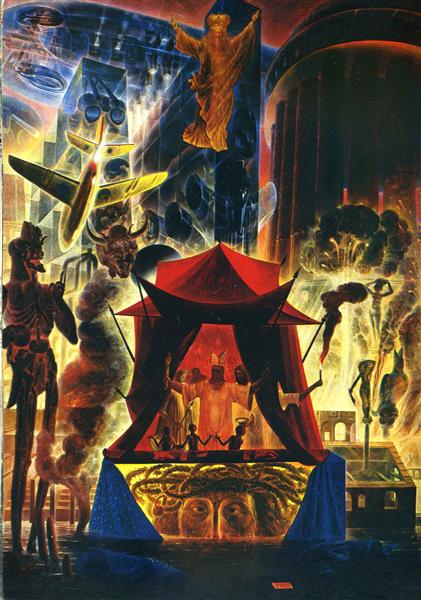
Psalm 69 by Austrian artist Ernst Fuchs, 1960
God will come through in God’s own good time. However, you can still praise the Lord right now, smack in the middle of your dilemma. David, the author of today’s psalm, chose to praise God, even though he did not get an immediate answer to his prayers. Perhaps God is more concerned to change us before changing our circumstances.
We need a solid theology of suffering. And that biblical psalms give it to us. I know of no one who wakes in the morning, sits on the edge of their bed, and says, “Gee, I want to suffer today and feel lots of emotional and spiritual pain.” No, we want happiness and joy, not agony and hardship. Yet suffering has much to teach us and the Lord is rarely quick to snatch us from its lessons. The hardship of personal suffering teaches us faith and dependence upon God, as well as leading us to ask for help from others so that we are lovingly supported.
“The way you look at things is the most powerful force in shaping your life.”
john o’donohue
Tribulations in life are common to all people without exception. The issue is whether we will submit to its hard-knock education, or not – whether we will become better people, or bitter. The Irish teacher and poet, John O’Donohue, penned a poem entitled, “For Suffering,” concerning the blessing of hard things:
May you be blessed in the holy names of those
Who, without knowing it,
Help to carry and lighten your pain.
May you know serenity
When you are called
To enter the house of suffering.
May a window of light always surprise you.
May you be granted the wisdom
To avoid false resistance;
When suffering knocks on the door of your life,
May you glimpse its eventual gifts.
May you be able to receive the fruits of suffering.
May memory bless and protect you
With the hard-earned light of past travail;
To remind you that you have survived before
And though the darkness is now deep,
You will soon see approaching light.
May the grace of time heal your wounds.
May you know that though the storm may rage,
Not a hair of your head will be harmed.
To Bless the Space Between Us: A Book of Blesings (Doubleday, 2008)
We have all likely at times felt the anguish of the psalmist – being so overwhelmed that it feels like we are drowning. The feeling is compounded exponentially when behind the sense of trying to keep our heads above water there are people who do not like us – maybe even hate us, to the point of undermining our work every chance they get. It is in such circumstances we might experience sleepless nights hoping that somehow and someway God will show up.
The typical modus operandi for some within adverse situations is the age-old route of complaining and wishing things were different. Yet neither griping about our problems nor dishing out slander and gossip toward others is a healthy way of dealing with adversity. Just the opposite response is the proper path to the bone-crushing feeling of opposition: to praise God’s name with a song and magnify the Lord with thanksgiving.
The reason the believer can engage in adoring God during trouble is not some Jedi-type mind trick to make us think more positively. Instead, the basis for praise is in knowing God. It is God who ultimately will deal with the wicked; it is the Lord who will bend to listen to our lament when times are hard.
Thanking God for answers to prayer in advance of them being answered is a biblical thing to do. Having a faith robust enough to see ahead toward hope can bring love to a loveless situation, and usher in praise before the divine deed of deliverance is even accomplished.
Saving God, thank you for your deliverance! I give you praise for loving me through sending your Son, the Lord Jesus, to this earthly realm so that I might experience salvation from sin, death, and hell. By Christ’s authority, in the power of the Holy Spirit given to me, I resist the enemy’s attempts to seize control of my life. I belong to you, holy God. Amen.
Then I saw a new heaven and a new earth; for the first heaven and the first earth had passed away, and the sea was no more. And I saw the holy city, the new Jerusalem, coming down out of heaven from God, prepared as a bride adorned for her husband. And I heard a loud voice from the throne saying,
“See, the home of God is among mortals. He will dwell with them; they will be his peoples, and God himself will be with them; he will wipe every tear from their eyes. Death will be no more; mourning and crying and pain will be no more, for the first things have passed away.”
And the one who was seated on the throne said, “See, I am making all things new.” Also, he said, “Write this, for these words are trustworthy and true.” Then he said to me, “It is done! I am the Alpha and the Omega, the beginning, and the end. To the thirsty I will give water as a gift from the spring of the water of life. (NRSV)
The world as we now know it will someday disappear. We have a future hope – it will literally be heaven on earth. The entire planet will be a renewed and God will descend to dwell with us. The Lord will bring us to the original design of the garden with Adam and Eve – an unhindered relationship between divinity and humanity. We shall no longer be dogged by our personal shame, institutional and systemic evil, and the temptations and oppression of Satan. Tears, death, sorrow, and pain will be a thing of the past. Eventually, our struggle with the fallen nature of everything will be completely over.
The message from the Apostle John to the early church was extremely encouraging. The people had faced all kinds of trouble and persecution due to their Christian commitment. To know that suffering only lasts for the night, but joy comes in the morning because of Jesus, changes everything. To the ancient church, as well as us today, this is a comfort and help in our present adversities.
Yet, we are such an impatient people! We want good things to happen, and now! All God’s people throughout history have been looking ahead for the ultimate fulfillment of God’s promises. The Apostle John did not give a brand-new revelation to the church but upheld and anticipated what had been known and true for centuries. God said to the prophet Isaiah:
“See, I will create new heavens and a new earth. The former things will not be remembered, nor will they come to mind. But be glad and rejoice forever in what I will create, for I will create Jerusalem to be a delight and its people a joy. I will rejoice over Jerusalem and take delight in my people; the sound of weeping and of crying will be heard in it no more. (Isaiah 65:17-19, NIV)
Making All Things New by Beth Lighthouse, 2018
In the first Advent of Christ, many of God’s people thought for certain all these promises would finally be realized. Yet, like a young couple in their engagement period, the promises of God had been initiated and promised, but not yet realized or consummated. The Apostle Peter addressed a common question asked throughout the ages:
“What happened to the promise that Jesus is coming again? From before the times of our ancestors, everything has remained the same since the world was first created.” (2 Peter 3:4, NLT)
Peter responded, in part, by reminding Christians:
Do not let it escape your notice, dear friends, that with the Lord a single day is like a thousand years and a thousand years are like a single day. The Lord is not slow to keep his promise, as some think of slowness, but he is patient toward you, not wanting anyone to perish but all to change their hearts and lives. (2 Peter 3:8-9, CEB)
“I am making everything new,” said Jesus. And he wanted John to get that down in writing so not to forget. God is still in the process of moving history to its final stage. Will we be patient in letting God do this work until the final day comes, or will we be impatient?
Although we are awaiting the end of all things, this is no time to be idly sitting by, twiddling our thumbs with nervous anxiety. Nor are we to go all apoplectic with furious activity creating prophecy charts, trying to figure out exactly the day and hour of Christ’s Second Advent. No, rather, we properly anticipate the Second Coming when we let God change our hearts and lives, our neighborhoods and workplaces, our families, and churches, to be just like Christ.
God is presently preparing for Christ’s return by doing away with the old order to make room for the new. The Apostle Paul put it this way to the Corinthian Church:
When anyone is in Christ, it is a whole new world. The old things are gone; suddenly, everything is new! (2 Corinthians 5:17, ERV)
With each transformed life, we are reminded God is not slow in keeping promises but is now vigorously active preparing for the last day.
The Revelation of John helps us to break our fixation with the past and the ways we have always done things. God’s capacity and ability to renew is astounding. Even now, we can walk now in newness of life.
We were buried with him through baptism into death, that just as Christ was raised from the dead by the glory of the Father, even so we also should walk in newness of life. (Romans 6:4, NKJV)
To avoid impatience and to keep persevering, it is helpful to have a big picture view of what God has done, is doing, and will do.
In the Fall of 1991, a car driven by a drunk driver jumped its lane and smashed headfirst into a minivan driven by a man named Jerry Sittser. He and three of his children survived, but Jerry’s wife, four-year-old child, and mother died in the crash. In his book A Grace Revealed Sittser shares the following interaction with one of his surviving children, David, months after the accident:
“Do you think Mom sees us right now?” he suddenly asked.
I paused to ponder. “I don’t know, David. I think maybe she does see us. Why do you ask?”
“I don’t see how she could, Dad. I thought Heaven was full of happiness. How could she bear to see us so sad?”
Could Lynda, my wife, witness our pain in Heaven? How could that be possible? How could she bear it?
“I think she does see us,” I finally said. “But she sees the whole story, including how it all turns out, which is beautiful to her. It’s going to be a good story, David.”
God knows the whole story. When everything dies, all is stripped from our lives, and the world as we know it is done away with, what are we left with? God and the renewal of all things. The troubles of this present evil age will be eradicated forever.
Whenever we seek to do away with the world’s grinding poverty and the starvation of children; whenever we work to end global sex-trafficking and domestic abuse; whenever we tackle epidemics, pandemics, and disease; whenever we help others face and cope with the evil of this world; whenever we come alongside others in their trouble; whenever we extend comfort to the grieving and grace to the wayward; whenever we choose mercy and kindness; then, God is using us to make everything new.
The end is coming. But it is not yet here. God is presently working to make everything new by bringing deliverance from sin, death, and hell to people throughout the world.
Almighty God, in the New Year, at this moment of transition, we understand this is the moment of your intervention. We offer to you, O Lord, everything that makes us sad and upset; everything that makes us desperate; all our unfulfilled plans, and all our unrealized dreams. They are yours. Take them and transform them into something beautiful, magnificent, and new. Let your Holy Spirit make us new creations in Jesus Christ our Lord. Amen.







 Rev. Tim Ehrhardt