Hebrews 6:13-20 – Holding onto Hope

When God made his promise to Abraham, since there was no one greater for him to swear by, he swore by himself, saying, “I will surely bless you and give you many descendants.” And so, after waiting patiently, Abraham received what was promised.

People swear by someone greater than themselves, and the oath confirms what is said and puts an end to all argument.Because God wanted to make the unchanging nature of his purpose very clear to the heirs of what was promised, he confirmed it with an oath. God did this so that, by two unchangeable things in which it is impossible for God to lie, we who have fled to take hold of the hope set before us may be greatly encouraged. We have this hope as an anchor for the soul, firm and secure. It enters the inner sanctuary behind the curtain, where our forerunner, Jesus, has entered on our behalf. He has become a high priest forever, in the order of Melchizedek. (New International Version)

“We must accept finite disappointment, but never lose infinite hope.”

Martin Luther King, Jr.

Humanity needs hope. We all require a confident expectation that things will be different or better. Hope is what our ancestors in faith had in abundance.

How did Abraham receive what was promised by God?

Abraham received what was promised because of hope. He believed God’s promise of having a place to belong. His faith caused him to make a major move from the city where he had always lived. What’s more, Abraham understood that the promises of God don’t end in this life. He looked forward to being a permanent resident in the eternal city.

By faith Abraham obeyed when he was called to go out to a place that he was going to receive as an inheritance. He went out without knowing where he was going. By faith he lived in the land he had been promised as a stranger. He lived in tents along with Isaac and Jacob, who were coheirs of the same promise. He was looking forward to a city that has foundations, whose architect and builder is God. (Hebrews 11:8-10, CEB)

Why did God swear an oath to Abraham?

The Lord wanted to reinforce Abraham’s faith and encourage him. God desired to convincingly show that divine promises are sure.

The Lord spoke to Abram in a vision and said to him, “Do not be afraid, Abram, for I will protect you, and your reward will be great.” But Abram replied, “O Sovereign Lord, what good are all your blessings when I don’t even have a son?…. You have given me no descendants of my own, so one of my servants will be my heir.”

Then the Lord said to him, “No, your servant will not be your heir, for you will have a son of your own who will be your heir.” Then the Lord took Abram outside and said to him, “Look up into the sky and count the stars if you can. That’s how many descendants you will have!” And Abram believed the Lord, and the Lord counted him as righteous because of his faith. (Genesis 15:1-6, NLT)

What are the “two unchangeable things?”

The promise and the oath. God promised to Abraham:

“I will make you into a great nation,
    and I will bless you;
I will make your name great,
    and you will be a blessing.
I will bless those who bless you,
    and whoever curses you I will curse;
and all peoples on earth
    will be blessed through you.”(Genesis 12:2-3, NIV)

God confirmed the promise with an oath:

“I swear by myself, declares the Lord, that because you have done this and have not withheld your son, your only son, I will surely bless you and make your descendants as numerous as the stars in the sky and as the sand on the seashore. Your descendants will take possession of the cities of their enemies, and through your offspring all nations on earth will be blessed, because you have obeyed me.” (Genesis 22:16-18, NIV)

Is there a way to be motivated and encouraged in the Christian life?

Yes. Hope in God’s promises and the confidence that our efforts to live for Christ are being seen and they are not in vain. We need one another. So, it is important to maintain significant relationships with other believers so that we will not lose our spiritual vitality and become discouraged. The author of Hebrews also stated:

We should keep on encouraging each other to be thoughtful and to do helpful things. Some people have gotten out of the habit of meeting for worship, but we must not do that. We should keep on encouraging each other, especially since you know that the day of the Lord’s coming is getting closer. (Hebrews 10:24-25, CEV)

Faith and patience, fueled by an unshakable hope, has always been the way believers have lived their lives. For the Christian, we have a promised inheritance, focused on the person and work of Christ. All of God’s good promises are fulfilled in Jesus.

God of hope, in these times of change, unite us and encourage us with your promise and oath. Help us overcome our fears and enable us to build a future in which all may prosper and share, through Jesus Christ our Lord. Amen.

Luke 16:19-31 – Does God Know Your Name?

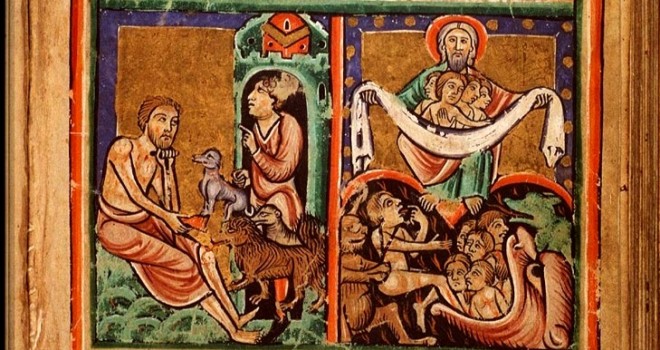
The Rich Man and Lazarus, from a French pictorial Bible, c.1200 C.E.

“There was a rich man who was dressed in purple and fine linen and lived in luxury every day. At his gate was laid a beggar named Lazarus, covered with sores and longing to eat what fell from the rich man’s table. Even the dogs came and licked his sores.

“The time came when the beggar died, and the angels carried him to Abraham’s side. The rich man also died and was buried. In Hades, where he was in torment, he looked up and saw Abraham far away, with Lazarus by his side. So, he called to him, ‘Father Abraham, have pity on me and send Lazarus to dip the tip of his finger in water and cool my tongue, because I am in agony in this fire.’

“But Abraham replied, ‘Son, remember that in your lifetime you received your good things, while Lazarus received bad things, but now he is comforted here, and you are in agony. And besides all this, between us and you a great chasm has been set in place, so that those who want to go from here to you cannot, nor can anyone cross over from there to us.’

“He answered, ‘Then I beg you, father, send Lazarus to my family, or I have five brothers. Let him warn them, so that they will not also come to this place of torment.’

“Abraham replied, ‘They have Moses and the Prophets; let them listen to them.’

“‘No, Father Abraham,’ he said, ‘but if someone from the dead goes to them, they will repent.’

“He said to him, ‘If they do not listen to Moses and the Prophets, they will not be convinced even if someone rises from the dead.’”  (New International Version)

Everyone looks for a miracle at some point in life, especially for family. Whenever we see relatives walking far from God or siblings living without much thought to the words and ways of Jesus, it can be disconcerting. We may reason that if they could just experience or see some great miracle, then they will surely believe and embrace Christ. 

Yet, Jesus’ parable to us of the rich man and Lazarus graphically depicts an important message: God has already revealed divinity to humanity through Moses and the Prophets (the Old Testament). If people are not convinced by what already exists and is, they will not respond when the miraculous slaps them in the face.

Maybe we too often look for the dramatic because the mundane typically rules the day. Perhaps what we are looking for is already present in God’s revelation to us. It could be that the greatest task we have is not to beg for a miracle (even though there is nothing wrong with that!) but first to be quiet and listen to the Spirit of God speak through the Word of God so that our prayers to God arise in God’s way and God’s time.

Today’s Gospel story gets at the heart of where we immediately and reflexively turn when in dire straits. There is nothing wrong with turning to others, consulting trusted resources, or even Google. Yet, Holy Scripture is timeless. It contains everything we need for life and godliness in this present age. And I believe it has the answers to life’s most pressing questions.

Everyone has their trusted sources, as well as sources we don’t trust. If a person has had a pattern of not consulting or trusting the source material of Scripture, then it doesn’t matter who encourages them, even if it is a trusted person who shows up from the grave, to look into the Bible’s contents and believe it’s message.

If we look closely at the story, we are told the poor man’s name: Lazarus. And we are not told the rich man’s name. You see, the poor man, Lazarus, had his name written in the Book of Life. The rich man’s name cannot be spoken because it is not found there.

There are two opposite choices in life. One is to choose pleasure and overlook the great needs of the earth. Like old Jacob Marley in the Christmas Carol, it is to forge a chain, link by link, day after day, which will eventually leave one in bondage and regret.

The other choice is hope. To look ahead by faith and see the eternal things which are coming, then shaping our existence to act in sync with permanent values, is to choose life. Although this may bring deprivation, even suffering, in this present existence, the decision to forego temporary pleasure for eternal glory shall be rewarded. It is to live for future prosperity through present affliction.

So, how shall we then live?

Will we anchor our souls in the good bosom of bettering our fellow humanity?

Is there an acknowledgment that the measure we give to others shall eventually be given to us?

Do we seek to hold faith with a neighbor in his poverty?

Are we trusting so much in our five senses – sight, smell, taste, hearing, touch – that we either cannot or will not trust in the sixth sense of the spirit which tells us to believe Moses and the prophets?

Christ has risen. Christ is coming again. If we align our lives with spiritual truth, we shall find our names written in the Book of Life. Let us actively look for Lazarus in our lives, so that we don’t carelessly step over him day after day while selfishly indulging in the good things of this life.

Mighty God, you have done miraculous things. Help me see what you have already done and teach me to listen so that your revelation becomes alive to me. Holy Spirit, impress the redemptive event of Christ’s resurrection on the hearts of all who do not know you so that they might know your amazing grace. Amen.

Job 8:1-22 – Face the Pain

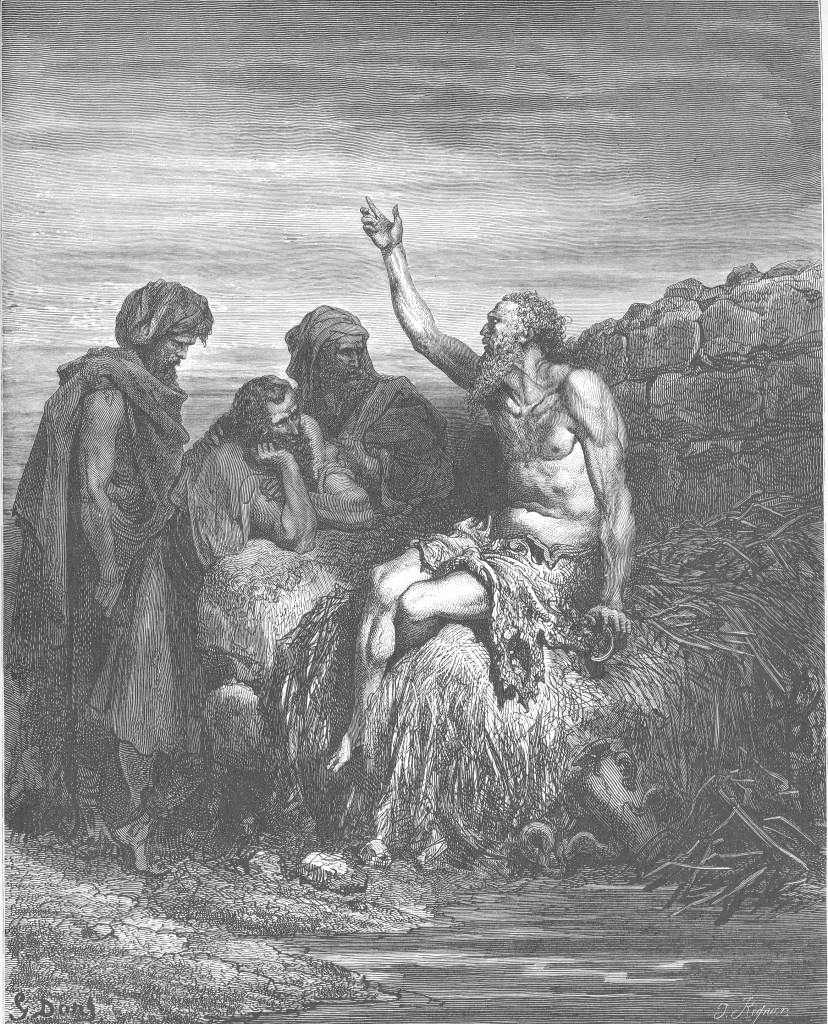
Job Speaks with His Friends by Gustave Doré (1832-1883)

Are you finally through with your windy speech?
God never twists justice;
    he never fails to do what is right.
Your children must have sinned against God,
    and so he punished them as they deserved.
But turn now and plead with Almighty God;
    if you are so honest and pure,
    then God will come and help you
    and restore your household as your reward.
All the wealth you lost will be nothing
    compared with what God will give you then.

Look for a moment at ancient wisdom;
    consider the truths our ancestors learned.
Our life is short; we know nothing at all;
    we pass like shadows across the earth.
But let the ancient wise people teach you;
    listen to what they had to say:

“Reeds can’t grow where there is no water;
    they are never found outside a swamp.
If the water dries up, they are the first to wither,
    while still too small to be cut and used.
Godless people are like those reeds;
    their hope is gone, once God is forgotten.
They trust a thread—a spider’s web.
    If they lean on a web, will it hold them up?
    If they grab for a thread, will it help them stand?”

Evil people sprout like weeds in the sun,
    like weeds that spread all through the garden.
Their roots wrap around the stones
    and hold fast to every rock.
But then pull them up—
    no one will ever know they were there.
Yes, that’s all the joy evil people have;
    others now come and take their places.

But God will never abandon the faithful
    or ever give help to evil people.
He will let you laugh and shout again,
    but he will bring disgrace on those who hate you,
    and the homes of the wicked will vanish. (Good News Translation)

These are the words of Bildad, a “friend” of Job. The guy just couldn’t take it anymore. As Job expressed his deep grief, Bildad grew perturbed. Whereas Job needed to be heard, to tell his story with others who would offer listening ears of empathy, Bildad was uncomfortable with all this grief junk and felt he needed to rebuke Job…. Oy vey.

There are various kinds of suffering, and the biblical character of Job experienced them all. One of the most severe kinds of hurt, and the one that gets far more attention than any other in the book of Job, are the short-sighted rebukes from Job’s “friends.” 

God had a severe mercy for Job. The friends, however, lived in a black and white world of either/or – either you confess your sin, or you don’t – as if all suffering is connected to personal sin. Bildad’s left-brained linear explanation was expressed this way: God will not reject a blameless man.

For Bildad, personal suffering equals personal sin and God’s disfavor. Bildad could only see a sequential connection, a direct line from sin to calamity. It was simply out of his equation to think otherwise. Since Bildad saw suffering as the direct result of sin, his remedy was to exhort toward confession of sin. 

The problem with this view is that we, as the readers, already know this to be a patently false understanding of Job’s suffering. Although Bildad saw the suffering, he did not discern the unseen dimension of good and evil contending behind-the-scenes between God and Satan.

It is only normal to wonder if we have sinned against God whenever finding ourselves in the crucible of suffering. But if we have done patient work to determine there is no personal reason for the pain, perhaps there is something going on that is much bigger than us. 

Our task, like Job’s, is to entrust ourselves to God. We might chafe at such counsel because we like to fix things that hurt. Suffering, however, will not last forever; it will eventually pass. And God’s way will always prevail, in the end. So, we must continually keep in mind that permanent faith transcends temporary pain.

There are four types of pain we experience in this life:

  1. Spiritual pain that arises from within us in our connection, or lack thereof, with the divine.
  2. Emotional pain that arises from our relationship with others.
  3. Physical pain that arises from our bodies and from natural forces on this earth.
  4. Mental pain that arises from cognitive disorders, childhood trauma, and all forms of abuse or neglect.

In all pain, the story we tell ourselves about the reason for the hurt is significant. We have a relationship with our pain. If the story we are telling ourselves is that the pain is all in my head, or that others have it worse than me, we are ignoring or stuffing our pain. If the story is that pain is bad and I must rid myself of it, then we will completely miss what our pain is trying to tell us.

Job was trying to come to grips with his pain. He was facing it, talking about it, expressing his wonderings concerning it, and allowing himself to completely feel all of it.

Conversely, Bildad so tightly held onto his own story about what pain and suffering is that he was unable to be the friend Job needed. And, I might add, at the end of the story, God didn’t look with favor on Bildad’s approach.

So, what will you do with your pain?

What is the story you are telling yourself about your pain?

Who do you trust so that you can talk about your pain?

Where is God in your pain?

How is your current relationship to the pain helping or hindering you?

Where will you turn, in the future, when pain comes upon you?

Loving God, take pity on my life as I seek to embrace you in both good times and bad. I belong to you; therefore, I will not forsake you, no matter how much I do not understand the suffering. Amen.

Hebrews 1:1-4, 2:5-12 – World Communion Sunday

In the past God spoke to our ancestors through the prophets at many times and in various ways, but in these last days he has spoken to us by his Son, whom he appointed heir of all things, and through whom also he made the universe. The Son is the radiance of God’s glory and the exact representation of his being, sustaining all things by his powerful word. After he had provided purification for sins, he sat down at the right hand of the Majesty in heaven. So, he became as much superior to the angels as the name he has inherited is superior to theirs….

It is not to angels that he has subjected the world to come, about which we are speaking. But there is a place where someone has testified:

“What is mankind that you are mindful of them,
    a son of man that you care for him?
You made them a little lower than the angels;
    you crowned them with glory and honor
    and put everything under their feet.” [Psalm 8:4-6]

In putting everything under them, God left nothing that is not subject to them. Yet at present we do not see everything subject to them. But we do see Jesus, who was made lower than the angels for a little while, now crowned with glory and honor because he suffered death, so that by the grace of God he might taste death for everyone.

 In bringing many sons and daughters to glory, it was fitting that God, for whom and through whom everything exists, should make the pioneer of their salvation perfect through what he suffered. Both the one who makes people holy and those who are made holy are of the same family. So, Jesus is not ashamed to call them brothers and sisters.He says,

“I will declare your name to my brothers and sisters;
    in the assembly I will sing your praises.” [Psalm 22:22] (New International Version)

Today is World Communion Sunday. We come to the Lord’s Table with awareness of Christian sisters and brothers throughout the world, in all nations, and in all the various traditions of Christianity. We may not all agree about a lot of things in the church and the Christian life. Yet, every Christian tradition – past and present – has and does observe communion around the Lord’s Table. It is a practice which binds us and reminds us of our unity with another.

And that unity is focused and centered in Jesus Christ our Savior and Lord. Jesus is the person who holds us together. Jesus is the one in whom all the good promises of God are fulfilled. Today we remember Jesus, commune with Jesus, and express our hope in Jesus.

We remember that Jesus was made perfect through suffering – and that we, too, experience spiritual formation through suffering.

We commune with Jesus and one another because the cross of Christ achieved deliverance from spiritual estrangement and relational loneliness and gathered us into the one people of God.

We hope with confident expectation, as we celebrate Jesus at the Table along with all the saints everywhere, that Christ will return and take us to be with him forever in glory. There will be no more suffering, no more pain, no more poverty, no more oppression, no more injustice. There will be complete faith, realized hope, and absolute love for all time and forever. Amen!

Our past, present, and future all belong to Jesus. And we are not alone, for all Christians in everyplace from every race, ethnicity, class, and gender – whether they are Pentecostals in Puerto Rico, Anglicans in Africa, Catholics in Poland, Coptic Egyptians, or Orthodox Russians – the beautiful diversity of Christ’s Body comes together in harmonious unity at the Lord’s Table. It is this sacrament which raises our awareness of both solidarity with Christ and with all believers everywhere.

The purpose of the Lord’s Table is to participate in the blessings of Christ by visually re-creating the story of Jesus. There are three different terms for the Table in the New Testament, and each term is meant to convey a different aspect of the Table’s significance. 

The Lord’s Supper is a focus on remembrance, a memorial of Christ’s death that is deeply reflective and contemplative. 

What you must solemnly realize is that every time you eat this bread and every time you drink this cup, you reenact in your words and actions the death of the Master. You will be drawn back to this meal again and again until the Master returns. You must never let familiarity breed contempt.

Anyone who eats the bread or drinks the cup of the Master irreverently is like part of the crowd that jeered and spit on him at his death. Is that the kind of “remembrance” you want to be part of? Examine your motives, test your heart, come to this meal in holy awe. (1 Corinthians 11:26-28, MSG) 

The Eucharist literally means “thanksgiving.” The Lord’s Table as Eucharist means we celebrate Christ’s victory over sin, death, and hell on our behalf. 

While they were eating, Jesus took a piece of bread, gave a prayer of thanks (Eucharist), broke it, and gave it to his disciples. “Take it,” he said, “this is my body.” Then he took a cup, gave thanks to God (Eucharist), and handed it to them; and they all drank from it. (Mark 14:22-23, GNT) 

Communion means to participate in Christ and with other Christians. This emphasizes that when we partake of the Lord’s Table, we ought to do so with unity and fellowship. We are more than individual Christians. We share in the Lord together as the community of the redeemed.

When we drink from the cup that we ask God to bless, isn’t that sharing in the blood of Christ? When we eat the bread that we break, isn’t that sharing in the body of Christ? By sharing in the same loaf of bread, we become one body, even though there are many of us. (1 Corinthians 10:16-17, CEV) 

As we allow the Table to be a remembrance, celebration, and participation with each other, we engage in a ritual that helps us to know Christ better. And we are better able to realize God’s grace to us.

Participating and sharing in communion is important because we can easily be fragmented and not fellowship with one another in a local church, as well as the world-wide church. The cross of Jesus Christ has ended division. The cross has brought us peace and reconciliation between God and others. 

The suffering of Jesus on the cross has restored a broken relationship between us and God, and also between one another. Therefore, there is to be no more ignoring one another, or brothers and sisters elsewhere, because we are one unified people around the good news of Jesus – enjoying solidarity with each other in both our joys and our sufferings.

One awareness needed as we share in communion together is to be mindful of others. Not everyone is the same. We must avoid coming to the Table expecting people to be the way we want them to be. Instead, we are to come because we have staked our souls on the fact that Christ is the Way, the Truth, and the Life, and the Church is the best place to be while we all struggle to figure out what that means. We come because we’d be hard pressed to say which is the bigger of the two scandals of God: that he loves me—or that he loves everyone else. 

The Lord’s Table is the great leveler, where we all have equal footing and accept one another according to a common confession of Christ. Communion emphasizes participation in the body and blood of Christ, as well as participation with all Christians everywhere. 

Therefore, we are not alone. Communion means God is with us, and that Christ has so closely identified with us that he took our place on the cross. As a result, every believer in Jesus is linked to all the others so that, when one suffers or rejoices, all suffer or rejoice, whether it is a Pastor down the street rejoicing over a newly saved soul, or a suffering Syrian Christian trying to survive in a refugee camp.

Let us live up to what, and whom, we profess. Since we are God’s forgiven people, we are to work at living the Christian life together. This unity is symbolized by partaking together of the same loaf of bread and drinking from a common cup.

One Sunday, a group of missionaries and believers in Papua New Guinea were gathered to observe communion together.  After one young man sat down, one of the missionaries recognized that he seemed to be quite upset. Then, after a while, the young man seemed to be fine. 

The missionary leaned over and whispered to him, “What was it that troubled you?”  The young man replied, “The man who just came in happens to be the man who killed and ate the body of my father.  And now he has come in to observe communion with us. At first I didn’t think I could do that. But it is all right now.  He is washed in the same precious blood as I am.”  And so together they participated in Christian communion.

We have peace because of Jesus. Christ’s suffering and death has brought reconciliation not only between us and God, but between each other. As we approach the Lord’s Table, let us be aware not only of our personal relationship with God, but our relationships with one another in the local church, and our unity with the world-wide church. 

May our lives be shaped and formed around the cross of Jesus Christ, as we remember, celebrate, and participate together.

Almighty and everlasting God, may this time we partake of the body and blood of Jesus unite us in the community of saints who know your love and proclaim your Son with fervor and grace to a broken and hurting world. May your healing hands be the salve for ending hurt and violence in this world, even as we prepare for the next. In the holy Name of Jesus. Amen.