Pentecost


            Just this morning a group of us guys from church had a large grill session of burgers, brats, and hot dogs in preparation for a Sunday celebration.  This time of year is hugely significant when we attune ourselves to Holy Time because it is Pentecost.  Ten days after recognizing Christ’s Ascension, and fifty days after our Lord’s resurrection from death, the Christian Calendar observes the day of Pentecost (which literally means “fifty” in Greek).  The day coincides with an established Jewish festival, the Feast of Weeks.  Back in the day, Jerusalem would be filled with all kinds of different nationalities and ethnicities during the festival.
 
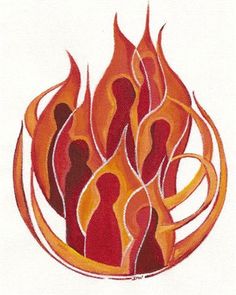
            Pentecost is often known as the birthday of the church.  It marks the time when the Holy Spirit came upon the fledgling believers in power.  The account is found in the New Testament book of Acts:  “On the day of Pentecost all the Lord’s followers [120 believers] were together in one place.  Suddenly there was a noise from heaven like the sound of a mighty wind!  It filled the house where they were meeting.  Then they saw what looked like fiery tongues moving in all directions, and a tongue came and settled on each person there.  The Holy Spirit took control of everyone, and they began speaking whatever languages the Spirit let them speak” (Acts 2:1-4).  The upshot of it all was that Peter, once an up-and-down follower, was filled with the Spirit and spoke the Word of God boldly.  His call to repentance and faith in Jesus led directly to three-thousand persons added to the little band of one-hundred twenty.
 
            But it didn’t stop there.  We live in a tremendous age in which all believers in Jesus have the same Holy Spirit as our spiritual ancestors.  It is an era of the Spirit empowering the church to reach the world with the good news that there is forgiveness and grace through the person and work of Christ.  So, then, the church possesses confidence and security in knowing that the Spirit’s enablement and power is available for the mission of proclaiming Christ to the nations.  It is an immense call, a calling that befits the bigness of God.
 
            There are a wide range of Christian celebrations of Pentecost. Some churches do not recognize the holiday at all. Most churches at least mention it in prayer, song, or sermon. Other churches go all out, with worship focused on remembering the first Pentecost and praying for a similar outpouring of divine power.  Churches that employ liturgical colors generally use red on Pentecost as a symbol of power and fire of the Spirit.
 
            Pentecost reminds us that Christians are meant to live in the presence and in the power of the Holy Spirit, all day, every day, 24/7.  It is a chance to confess our shortcomings and failures because of fear, apathy, and selfishness, and to ask for a fresh infusing and infilling of God’s wonderful Spirit.  Pentecost flings every single believer into a congregational whole, the church, and lets us know that we are not to be rugged individualists acting alone but are part of the Body of Christ.    Thus, we must renew our commitment to the church for whom Christ died and the Spirit is ready to use.  Pentecost throws disparate people together in a unified whole, made up of every kind of language, nationality, ethnicity, gender, and race.  We are all to use the gifts of the Spirit given to us for the benefit of building up one another.
 
            The church is the church because of the Holy Spirit.  We are to do the work of spreading the gospel in passionate outreach using the power of the Spirit, equipping and encouraging each other displaying the fruit of the Spirit, and worshiping the person of the Spirit for always being present with us.


            Pentecost was and is a watershed event.  Worship, community, and outreach are the logical extensions and the collective responsibility of each and every church around the globe.  In solidarity, let the day of Pentecost be recognized and observed with heartfelt thanksgiving and renewed impulses to exercising our spiritual abilities graciously promised by Jesus and given to us by the Holy Spirit.

1 Corinthians 2:1-5

            My late Dad was, I think, one of the smartest guys I have ever known.  That is saying something, since I have three academic degrees and studied under intelligent professors and worked with gifted students.  Yet, he would sometimes say in the course of a cerebral conversation, “But what do I know? I’m just a dumb farmer.”  The self-deprecation came from the fact that he never attended college and did not study formally. 
 
            Today’s New Testament lesson shifts the focus away from any earthly wisdom.  Whether a person has a formal education and much learning; or, has a well-developed common sense; or, possesses a perceptive social intelligence; the Apostle Paul places the onus for Christianity in none of those attributes of the wisdom of humanity, but, rather, in the power of God.
 
            Although I believe Paul was a very gifted individual with every kind of human wisdom available to him, he himself did not ultimately put his trust in any of it.  What was of ultimate importance to Paul was that people would know Jesus Christ and him crucified.  Paul did not want people to be persuaded by his eloquence, or lack thereof, nor did he want to develop people who would follow him personally.  No, Paul wanted people to rest their faith squarely in Jesus Christ.
 
            It is the Spirit of God which uses us to demonstrate the power of God to a needy world.  Therefore, developing our connection with God in the Holy Spirit is of paramount importance.  And this is something everyone can do, not just an elite few.  This is the beauty of Christianity, that the most common of persons, as well as the most extraordinary of people, can both be equally used by God if they maintain a faith relationship with God.  Take time today and every day to foster such a relational experience in Christ.
            All-wise God, all power, glory, and honor belong to you.  My faith and hope rest securely and confidently in you.  Fill me to the full with your Holy Spirit so that the words that come out of my mouth and the actions that I do are a demonstration of God’s power to the glory of Jesus Christ.  Amen.

John 20:19-23

            In the wake of Pentecost, it is necessary and important to live into our calling and mission as believers in Jesus who have been given the Holy Spirit.  Jesus said, “As the Father has sent me, even so I am sending you.”  And when Jesus said this, he breathed on them and said to them, “Receive the Holy Spirit.”  What is more, we are anticipating the celebration of Trinity Sunday upcoming.
 
            Everything comes down to the triune God.  As people created in God’s image and likeness, we are to reflect God in all we say and do.  This includes our service and sense of mission.  What the church is to be all about is what God is all about.  Just as the heavenly Father sent King Jesus to earth in order to bring all creation under the divine reign, so we are being sent by God into the world so that we will bring the message of God’s kingdom rule to every creature.  What is more, we have been given the power source to accomplish the work:  the Holy Spirit, who is the battery of the Christian life.
 
            Every believer in Jesus must wrap his/her head around the spiritual reality that God has called us into his service to reach every race, class, and ethnicity on earth regardless of who they might be because everyone needs the saving work of Jesus Christ.  We are to be preoccupied with the bald fact that Jesus sends us into the world equipped with the Holy Spirit to bring a message of forgiveness of sins in Christ.
 
            If we must rearrange our lives to accommodate God’s call, then so be it.  Eating meals with non-Christians, prayer-walking our neighborhoods, doing our hobbies with new people, taking breaks together with co-workers, volunteering in the community, and tangibly serving our neighbors are all practical ways of developing and deepening relationships with people in order to love them with the love of Jesus Christ who loved us and forgave us of a great debt of sin.
            God of peace, just as you as Father, Son, and Spirit exist in perfect unity, harmony, and love, so help me to be so keenly aware of being united with Jesus Christ that his agenda is my agenda.  Thank you, Holy Spirit, for filling and empowering me for loving service in the church and the world.  Amen.

Warming Up for Pentecost


The Holy Spirit is the distinguishing mark of the believer in Jesus Christ.  Christians do not earn the right to have the Holy Spirit; they are given the Spirit.  Therefore, our main responsibility as Christians is to receive.  Christianity is distinctive in this sense – it is primarily a religion of receiving.  The reason for this is that the Christian life cannot be lived by one’s own strength; it is lived by the power of the Holy Spirit.  The only function of faith is to receive what grace offers.  We are saved by grace alone through faith.  And it is equally true that the Christian life is lived by grace alone through faith.  God lives in and through us by means of his Spirit.  The miraculous and the supernatural cannot, obviously, be done by any human person.  It can, however, be accomplished through the power of the Holy Spirit.
 
            We put a lot of pressure on ourselves, me included, to be a certain way and to do certain things.  The result is that we are tired.  And every time we catch our breath, someone else needs something else.  But what if Christianity were not mostly about giving, but about receiving?  What if the Christian life were really all about putting ourselves in a position to receive what God has for us through prayer and humility?  You see, the opposite of receiving is not giving but pride. 
 
            Maybe this kind of talk makes you feel uncomfortable.  I am not talking here about being passive or lazy, but about receiving grace from God by means of the Holy Spirit and allowing God the Spirit to do what he wants to do in and through us for his own purposes and glory.  Jesus said we would do greater works than even he himself with the advent of the Spirit!  The question then becomes:  Will we let God do this?  Will we participate with God, and allow the Spirit to do his work?  Will we, as individuals and churches, petition God and, in essence, write him a blank check so that he can do whatever he wants to do in and through us?
 
            The Spirit is elsewhere in Scripture described as a gentle presence, an encourager, counselor, and comforter.  But not at Pentecost – the Spirit is portrayed like wind and fire.  Not a gentle breeze, nor a warm campfire but a violent presence.  The Holy Spirit in Acts 2 is not some gentleman caller coming politely into our lives when invited.  Instead, he appears more like a drunken sailor who bursts into the room and causes and big ruckus.  There is nothing subtle about the Spirit at Pentecost.  He is electric and volcanic, causing a huge upheaval.  This is a big God with a big Word looking to expand out into a big world.
 
            Because of Pentecost, true believers are marked and defined by God’s Spirit living within them and being full of the Spirit.  So, what does God want to do?  He wants to pour out his Spirit on all kinds of people.  He wants to fill people to overflowing so that what comes out of them is “prophecy” (Acts 2:14-21).  By “prophecy” Joel and Peter do not mean predicting the future, but inspired speech and words coming from a spiritual heart full of the Spirit.  Just as an inebriated person says and does things he/she would not typically say or do because they are filled with alcohol, so the person filled with God’s Spirit says things and does things that they would not typically say or do because their inspiration and courage do not come from themselves but is a result of God within them.
 
            God transformed this little band of people in Acts 2 from learners, to ones sent out with a mission.  Being on a mission from God is not about feeling adequate; it is about being filled and sent.  First time parents may learn and read and find out all they can about parenting before their child is born, but when that little bundle comes into the world and the hospital puts this kid in your arms and sends you out you feel pretty inadequate for the task.  Parenting becomes a kind of supernatural affair where you learn and pray on the fly, finding out that you need something beyond yourself to get anywhere in raising this screaming, pooping, sleeping person who depends completely on you for everything. 
 
            God has sent us into the world to make disciples and we may feel pretty inadequate for the task.  But this has more to do with receiving the Spirit.  The Spirit comes looking to impact the world not in some small way but with turning the world upside-down with new life in Jesus Christ. 
 
            In light of Pentecost, God’s agenda for his people is not to simply have nice worship services among nice people so we can live nice lives in the world.  The Spirit came to shake things up and do among God’s people what they could never do on their own.  The church in the New Testament was not formed as a country club for people to simply enjoy the perks of membership.  The church in Acts 2 is more like a place where the people seem drunk because they are all talking with inspired speech from the Holy Spirit. 


            It all begins with receiving.  If our hands are continually making fists and fighting other believers then we are not in a position to receive the Spirit.  But if our hands are open, palms up, then we are ready to have the Spirit come and be the Wild Person he came to be, just like a tornado and a blazing fire.  If there is something the Church needs more than anything else today it is someone:  the Holy Spirit.  Come, Holy Spirit, we need you.