
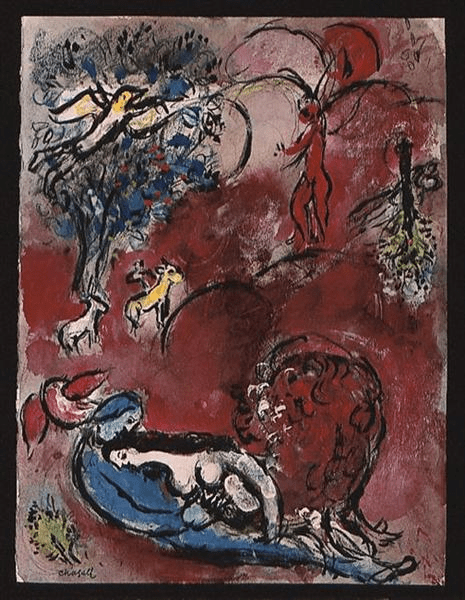
The Beauty of Love (Song of Songs 1:1-17)

Song of Songs I, by Marc Chagall, 1960

The Song of Songs, which is for Solomon.

[Woman]

If only he would give me some of his kisses . . .

Oh, your loving is sweeter than wine!
Your fragrance is sweet;
        your very name is perfume.
        That’s why the young women love you.
Take me along with you; let’s run!

My king has brought me into his chambers, saying,
“Let’s exult and rejoice in you.
Let’s savor your loving more than wine.
        No wonder they all love you!”

Dark am I, and lovely, daughters of Jerusalem—
        like the black tents of the Kedar nomads,
        like the curtains of Solomon’s palace.
Don’t stare at me because I’m darkened
        by the sun’s gaze.
My own brothers were angry with me.
        They made me a caretaker of the vineyards—
        but I couldn’t care for my own vineyard.

Tell me, you whom I love with all my heart—
        where do you pasture your flock,
        where do you rest them at noon?—
            so I don’t wander around with the flocks of your companions.

[Man]

If you don’t know your way,
    most beautiful of women,
        then follow the tracks of the herds
            and graze your little goats
            by the tents of the shepherds.

I picture you, my dearest,
        as a mare among Pharaoh’s chariots!
Lovely are your cheeks, adorned with ear hoops;
        your neck, with beads.
Let’s make hoops of gold beaded with silver for you!

[Woman]

With my king close by,
        my perfume filled the air.
A sachet of myrrh is my love to me,
        lying all night between my breasts.
A cluster of henna flowers is my love to me
        in the desert gardens of En-gedi.

[Man]

Look at you—so beautiful, my dearest!
        Look at you—so beautiful! Your eyes are doves!

[Woman]

Look at you—so beautiful, my love!
        Yes, delightful! Yes, our bed is lush and green!
The ceilings of our chambers are cedars;
        our rafters, cypresses. (Common English Bible)

The Song of Songs is an unabashedly sensuous biblical book. It is, throughout its contents, an erotic paean to love. In eight chapters, a man and a woman pursue each other through verdant fields and lush valleys. The excitement they have, being together, is palpable.

For most of church history, the Song of Songs has been viewed as an allegory, a love poem between Christ and the Church. And in the case of Hebrew Scripture, the covenant love which exists between God and Israel, has been the predominant interpretive lens.

Seen from this perspective, the Song of Songs reflects that we ought to love the Lord with overpowering commitment, as if we were love-sick for our Beloved. Our thoughts are constantly on the object of our love – how we can please our beloved one.

And yet, there still seems to be room to read the Song in the very down-to-earth realness of physical love between two lovers. Since we are embodied people, such love ought to be celebrated, and is anything but base or to be refused. Sex is a gift from the Creator, and encouraged by God.

I think that the Song of Songs is not an either/or; it is a both/and; it’s both literal and allegorical. That’s not a weird thing. On the allegorical level, the Song is a beautiful poem describing the Divine Eros for God’s people, and the faithful’s heartfelt love for the God whose very name is Love.

Concerning a literal view, the Song celebrates the sanctity of human love, seeing within it the symbol of God’s love for us. Our very real bodies are themselves sacred, just as much as our souls.

Yet, however one chooses to look at the Song of Songs, it remains a statement of mutual admiration, of committed love and affection. It is indeed a poetic lifting of love above all else.

Indeed, if love isn’t the answer, we are not asking the right question.

Believe it or not, the Song of Songs was once viewed as an important key, capable of unlocking the entirety of Holy Scripture.

In fact, C.H. Spurgeon, the Prince of Preachers, in the nineteenth century, preached 59 sermons from this book; in Victorian England, no less. Spurgeon discerned the Song as central to the whole of the Bible. Reflecting on Song of Songs 1:7, he said:

“These words express the desire of the believer after Christ, and his longing for present communion with Him…. Tell me where Thou feeds, for wherever Thou stands as the Shepherd, there will I lie down as a sheep; for none but Thyself can supply my need. I cannot be satisfied to be apart from Thee. My soul hungers and thirsts for the refreshment of Thy presence….

“Satan tells me I am unworthy; but I always was unworthy, and yet Thou hast long loved me; and wherefore my unworthiness cannot be a bar to my having fellowship with Thee now. It is true I am weak in faith, and prone to fall, but my very feebleness is the reason why I should always be where Thou feeds Thy flock, that I may be strengthened, and preserved in safety beside the still waters.

“Why should I turn aside? There is no reason why I should, but there are a thousand reasons why I should not, for Jesus beckons me to come. If He withdraw Himself a little, it is but to make me prize His presence more. Now that I am grieved and distressed at being away from Him, He will lead me yet again to that sheltered nook where the lambs of His fold are sheltered from the burning sun.” Charles Haddon Spurgeon

The Song, in history past, once functioned as a beautiful path to deep intimacy with God. Methinks it behooves us to recover this.

The two lovers in the Song see beauty everywhere. They see it in each other, in the fields where the sheep are pastured, in the orchards where love is consummated, in the seasons, in the animals, trees, and hills. Beauty is all around them, and it is they themselves.

All things which God has created are lovely. Nothing is too small or too insignificant when the eyes of love look upon them. Beauty is designed to be noticed, celebrated, and praised. Love is meant to be expressed out loud, with flavor.

Each time love is stated, every exhalation of adoration, and all of the instances when beauty is acknowledged and affirmed, the ones who speak bind themselves more deeply to God and God’s big world. Together, they call all of it good.

Today’s Old Testament lesson is a wondrous reminder that beauty and love will have its way. Regardless of class, race, family, or societal norms, lovers will continue to seek and find one another and claim their relationship.

While the daughters may stare, and the brothers may be angry, the lovers will yet affirm the beauty of their love. And they will find contentment with each other.

You and I are no accident on this earth; we were created by a loving Creator who has an eye for beauty. And no matter how separated we may get from our divine source, God will seek us out; and if we seek the Lord, he will be found.

O God, you have prepared for those who love you such good things as surpass our understanding: Pour into our hearts such love towards you, so that we, loving you in all things and above all things, may obtain your promises, which exceed all that we can desire. Amen.

For the Sake of Beauty (1 Kings 7:1-12)

King Solomon’s throne room, by Edward Poynter, 1890

Solomon’s palace took 13 years to build.

Forest Hall was the largest room in the palace. It was 44 meters long, 22 meters wide, and 13.5 meters high, and was lined with cedar from Lebanon. It had 4 rows of cedar pillars, 15 in a row, and they held up 45 cedar beams. The ceiling was covered with cedar. Three rows of windows on each side faced each other, and there were three doors on each side near the front of the hall.

Pillar Hall was 22 meters long and 13.5 meters wide. A covered porch supported by pillars went all the way across the front of the hall.

Solomon’s throne was in Justice Hall, where he judged cases. This hall was completely lined with cedar.

The section of the palace where Solomon lived was behind Justice Hall and looked exactly like it. He had a similar place built for his wife, the daughter of the king of Egypt.

From the foundation all the way to the top, these buildings and the courtyard were made out of the best stones carefully cut to size, then smoothed on every side with saws. The foundation stones were huge, good stones—some of them four and a half meters long and others three and a half meters long. The cedar beams and other stones that had been cut to size were on top of these foundation stones. The walls around the palace courtyard were made out of three layers of cut stones with one layer of cedar beams, just like the front porch and the inner courtyard of the temple. (Contemporary English Version)

By Bible Art

Having secured the throne after his father’s death, King Solomon set himself to the task of following his father David’s ardent desire to build a temple for the Lord. The work took seven years to complete. (1 Kings 5-6)

Then, Solomon turned to building a royal palace with a complex of buildings (or halls). It seems these had the purpose of being both residences and government structures. This architectural achievement took nearly twice as long as constructing the temple of God.

Some commentators are rather hard on Solomon about this fact of taking so much time to build himself a palace. They interpret him as being distracted, almost self-absorbed – that somehow his heart was more into his own buildings than God’s temple.

I don’t really buy into that line of thinking. It seems to me this reads more into the text than what’s there. They could be right. However, it appears such commentary does an anachronistic reading of the text. Taking a standpoint of Solomon’s later devotion to his many wives, and hence their many other gods, a lack of commitment is then superimposed upon the construction projects. It’s as if Solomon finished the temple stuff in order to get his real architectural passions.

I think there’s a more plausible explanation for King Solomon’s dedication to erecting buildings in addition to the temple. The editor of 1 Kings includes the detail and dedication that went into the temple.

Let’s keep in mind that King David had been stockpiling and preparing materials, and planning for the temple, well before he died. Just because the Lord told David that he would not be the one to build it, that Solomon would, did not mean that David kept his thoughts and his hands off of getting as much ready as he could for his son.

What’s more, once Solomon put together such a marvelous and intricate building as the temple, the experience gave him a desire to work on other projects, as well. Solomon had an expansive vision of his kingdom.

As the wisest person on earth, he put his money where his mouth was, by constructing beautiful structures given to justice, and reflecting the abundance of a goodness and justice which comes through living by God’s covenant code.

Did Solomon go overboard? Yes, and no. It depends on the project, and with whom you talk to. The issue of Solomon’s building projects, as I would frame it, has much more to do with demonstrating a particular theology.

The theology I believe Solomon was trying to reflect was that Israel serves a God who is given to beauty, justice, and abundance. And those qualities are also seen in the New Testament. I think of the story when Mary came to Jesus with her expensive and beautiful perfume:

Mary took a very expensive bottle of perfume and poured it on Jesus’ feet. She wiped them with her hair, and the sweet smell of the perfume filled the house.

A disciple named Judas Iscariot was there. He was the one who was going to betray Jesus, and he asked, “Why wasn’t this perfume sold for 300 silver coins and the money given to the poor?” Judas did not really care about the poor. He asked this because he carried the moneybag and sometimes would steal from it.

Jesus replied, “Leave her alone! She has kept this perfume for the day of my burial. You will always have the poor with you, but you won’t always have me.” (John 12:3-7, CEV)

I would argue that Judas Iscariot was the one distracted – and not Mary. Thus, returning to the story of Solomon’s building the palace complex, I would also argue that perhaps some of the commentators, with an eerily familiar criticism, are actually the ones distracted – and not Solomon.

Anyway, I like my positive reading of today’s Old Testament lesson, rather than the others’ negative reading. What about you?…

O heavenly God, who has filled the world with beauty: Open my eyes to see what is beautiful, to behold your gracious hand in all your works. Open my mind to know what is true. Open my heart to love what is good. May I learn to serve you with gladness, justice, and righteousness. Amen.

The Contrast of Good and Bad (1 Samuel 2:11-17)

Top picture: Eli’s sons commit sacrilege; Bottom picture: Hannah and Elkanah bring the boy Samuel to the tabernacle; by William de Brailes, c.1230 C.E.

Elkanah and Hannah went back home to Ramah, but the boy Samuel stayed to help Eli serve the Lord.

Eli’s sons were priests, but they were dishonest and refused to obey the Lord. So, while people were boiling the meat from their sacrifices, these priests would send over a servant with a large, three-pronged fork. The servant would stick the fork into the cooking pot, and whatever meat came out on the fork was taken back to Eli’s two sons. That was how they treated every Israelite who came to offer sacrifices in Shiloh. Sometimes, when people were offering sacrifices, the servant would come over, even before the fat had been cut off and sacrificed to the Lord.

Then the servant would tell them, “The priest doesn’t want his meat boiled! Give him some raw meat that he can roast!”

Usually the people answered, “Take what you want. But first, let us sacrifice the fat to the Lord.”

“No,” the servant would reply. “If you don’t give it to me now, I’ll take it by force.”

Eli’s sons did not show any respect for the sacrifices that the people offered. This was a terrible sin, and it made the Lord very angry. (Contemporary English Version)

Stories in the Old Testament of the Bible typically have two or more contrasting characters within them. One of the characters is good and the other not so much. The narrative is set up without having to tell us who is good and who is bad because the unfolding story makes it patently obvious.

This method of contrast is meant for us to look at the narrative and say to ourselves that we don’t want to go down the bad path but to walk in the good way of helpful obedient service.

In today’s story, we clearly see that, in the case of Eli’s sons, the apple doesn’t fall far from the tree. Old Eli the priest is a contrast to the boy priest-in-residence Samuel.

Eli had many faults, especially when it came to dealing with his sons, who were also priests. Eli seems to have continually had an issue with not listening very well – which ended in making a mess of things.

His sons took the casualness to an entirely new level of bad. They were not only worthless but also interfered in the people’s sincere worship of God. The sons were more than simply incompetent; they were also downright evil.

The Law made it clear how the priests and their portion of the sacrificial animals was to occur. There were detailed instructions on the importance of what part of the animal the priests received; and that the sacrifice needed to have the fat boiled off before it was given to the priest. (Leviticus 7:30-36)

But Eli’s sons took whatever they wanted, and did whatever they wanted, with calloused impunity. They disregarded divine instructions. If they wanted to roast their meat, they did. If they decided to have a different part of the animal, they took it from the worshiper. The sons did not care about anyone, and especially about God. They were bullies of the worst kind.

When sincere worshipers tried to stop the insanity of the priests’ blatant neglect, the servant of the priests threatened them. Although Eli himself did not do this detestable practice, we are meant to see in the narrative that he is an absent father and grossly negligent as a priest.

That entire incompetent and insensitive situation raised the ire of a holy God. It would not end well for Eli and his sons. That particular branch of the Levite priesthood was completely eradicated by the direct judgment of the Lord.

The contrast between Eli and Samuel – both serving as priests – has an unexpected twist. Whereas one would reasonably expect Eli to be the good mentor because of his age and experience, it turns out that the much younger Samuel is the actual mentor to the good and right life of priesthood. Eli needed to take his cues from a child. But, alas, he did not.

Hannah presenting Samuel to Eli, by John Flaxman, 1783

Many adults seem to think that children have nothing to teach them. We who are the big people believe we’re the teachers, leaders, and mentors. Yet, in the kingdom of God, age hasn’t got much to do with it. In fact, generally speaking, children are closer and wiser to knowing how God’s kingdom works, often better than the adults do.

In many respects, I am more like an eight year old boy than the actual father and grandfather that I am. I consider that a good thing. It serves me well in living the spiritual life. And as a boy in an adult body, I say we need to take children more seriously. How can we do that?

Listen carefully. Listen with the intent to understand and learn. The best way of talking to a child is listening to them. Hear both what they’re saying and not saying. Jesus insisted that we must become like little children before we can enter the kingdom of heaven. (Matthew 18:2-5)

Since we are to become like children, there’s no reason not to do your very best in getting on a child’s level and hearing what they have to say. After all, they’re the experts on being kids. The young Samuel is our model: “Speak, Lord, for your servant is listening.” (1 Samuel 3:10)

Validate a child’s emotions, especially their fears. In truth, kids are some of the bravest souls on the planet. They typically have no real hang-ups on connecting with other people, whereas many adults have a lot of anxieties and fears concerning other people.

So, when a child is afraid of something, it’s wise to take notice. They have a special radar to reality that most adults lost a long time ago. I’ll bet the children of the community knew the score of Eli and his sons well before the adults caught on to it.

Observe children’s artworks. For those interested in learning from a child, their drawings with crayons say a lot; their sand sculptures and garbage art speak loads to us if we observe and take notice. Kids are communicating their worldview and how they make sense of things.

Art is about understanding life and the human spirit, connecting to the past and other cultures, and expressing emotions. Becoming open to what children create is a pathway to the divine and to what is important in this world. Eli’s sons removed the art and craft of priesthood; they made it a mere exchange of goods and services. And God was not happy with this arrangement. It took away something significant about connecting with the Lord.

By contrasting the way of Samuel with the way of Eli and his sons, we begin to see the wide chasm between a one-dimensional bullying approach to being a priest, with a multi-dimensional, beautiful, and authentic expression of priesthood that embodies the conduit between heaven and earth.

How will you go about living your life? What does the way you do things say about God?

Holy God, infuse in us your ability to remain present to your people. Help us to be there for the people who need us – for the young, the old, the needy, and the brokenhearted. Enflame our hearts with a spirit of service and obedience. And enable us to be open and ready to love. Amen.

The Issue of Holy War (Deuteronomy 7:1-11)

Joshua’s military campaign against the five Amorite kings, by Gilliam van der Gouwen, 1728

When the Lord your God brings you into the land you are entering to possess and drives out before you many nations—the Hittites, Girgashites, Amorites, Canaanites, Perizzites, Hivites and Jebusites, seven nations larger and stronger than you—and when the Lord your God has delivered them over to you and you have defeated them, then you must destroy them totally. 

Make no treaty with them, and show them no mercy. Do not intermarry with them. Do not give your daughters to their sons or take their daughters for your sons, for they will turn your children away from following me to serve other gods, and the Lord’s anger will burn against you and will quickly destroy you. 

This is what you are to do to them: Break down their altars, smash their sacred stones, cut down their Asherah poles and burn their idols in the fire. For you are a people holy to the Lord your God. The Lord your God has chosen you out of all the peoples on the face of the earth to be his people, his treasured possession.

The Lord did not set his affection on you and choose you because you were more numerous than other peoples, for you were the fewest of all peoples. But it was because the Lord loved you and kept the oath he swore to your ancestors that he brought you out with a mighty hand and redeemed you from the land of slavery, from the power of Pharaoh king of Egypt. 

Know therefore that the Lord your God is God; he is the faithful God, keeping his covenant of love to a thousand generations of those who love him and keep his commandments. But

those who hate him he will repay to their face by destruction;
    he will not be slow to repay to their face those who hate him.

Therefore, take care to follow the commands, decrees and laws I give you today. (New International  Version)

You may likely identify today’s Scripture as a difficult passage in the Bible. And rightly so. It doesn’t quite square with many people’s concept of a gracious and loving God. Yet, here it is. So, what do we do with this supposed loving God, commanding the new nation of Israel to completely wipe out the Canaanites?

Here are a couple of approaches I believe are completely unhelpful as we consider the text in front of us: 1) Ignore this text and relegate it as some antiquated piece of ancient literature which has nothing to do with us today; or 2) Reinterpret the text so that the killing doesn’t seem so bad, e.g. it’s not murder but a just war that was necessary to do.

However we choose to approach this text of Scripture, there’s no getting around the reality that it is talking about God commanding the Israelites to engage in a holy war of killing Canaanites – even though it was God who commanded, “Thou shalt not kill.” (Exodus 20:13, KJV)

Indeed, let’s face the reality that this is a moral and ethical conundrum for us. Let’s neither ignore it, nor do some interpretive gymnastics to make it say something it isn’t saying. In practical and objective terms, this is about God giving the Promised Land to the Israelites, of occupying and settling the land without any sort of residual contamination from the Canaanite way of life.

The taking of the land involved the exclusive worship of Yahweh. In order for that to effectively happen, the elimination of Canaanite gods needed to occur, according to God. And it was taken to the extreme limit of also eliminating those who worship the other gods.

An explanation is given for the method of holy war: To leave anything Canaanite in the land would end up being a snare to the Israelites because they would be led astray to serve those other gods.

For Israel to make it as a nation, they were to be holy and set apart exclusively for the worship of Yahweh. To have the Canaanites alongside them would be something like leaving a box of donuts on the desk next to you when you’re trying to work and attempting to lose weight.

Gathering, by Yoram Raanan, 2015

Covenant loyalty was highly important to both God and the Israelites. If the people would faithfully follow God’s will, as revealed in God’s Law, they could confidently go into battle against their enemies. Then, the Israelites will know that the Lord is going before them to give them success and victory.

However we try to understand holy war in the Old Testament, this was not really an issue for ancient cultures. Such an approach to taking land and occupying it was almost taken for granted. And in light of the Israelites having just lost an entire generation of people because of disobedience and complaining, they wanted nothing to do with that again – or with being under the slavery of an empire like Egypt.

Yet, here we are, trying to still make sense of the text of Scripture for today. And, it seems to me, every generation of Bible readers will continually grapple with this. There is something, however, that is important to consider: The nature of the ancient pagan worship.

There was a huge difference between the worship of Yahweh and the worship of the seven distinct gods in Canaan such as Molech and Chemosh. The abuse of both women and men in cult prostitution, as well as the practice of child sacrifice, were characteristics of that pagan worship.

Canaanite worship was so offensive to the Lord, that God as the rightful and just Judge, made the judgment to do away with them – not because Israel was so holy, but because Canaan was that immoral. In those circumstances of immoral and unethical ways of worship and life, the danger of Israel becoming morally and religiously corrupt was particularly acute.

So, this is why the Lord demanded that the Canaanite implements of worship be completely destroyed. And this situation was deemed of such high risk, that God commanded everything of the Canaanites – including the Canaanites themselves – be done away with. It was a war not just against people, but against their gods.

None of this necessarily makes a holy war justifiable from a contemporary perspective; but it does bring a needed context and understanding as to the extreme nature of ensuring the Canaanites were snuffed out altogether.

All of us are influenced by others. Bad relationships corrupt good character. No individual, group of people, or even an entire nation, can keep itself on a right, just, and good path if they are continually around others who harm people either verbally and/or physically.

It behooves us to be vigilant as to our relationships and to who we choose to listen to. One of the most significant issues for people today, in my opinion, is how we hear, and who we listen to. The poor choices that so many persons make as to the sort of people and ideas they hear every day significantly impacts our culture and society.

It is my ardent desire to be an agent of healthy religion, sound ethics, personal morality, cultural good, and societal justice. I neither need to be an obnoxious jerk in doing so, nor need to go on a holy war – namely because only God can call for such a thing. And if any person (especially a politician or a pastor) tries to tell you or me that it’s okay to destroy others and harm them, then that person is not speaking from a place of understanding or rationality.

In the end, we can choose to listen or not listen to whomever; yet we will eventually have to listen to the greatest force which exists in the universe.

Almighty God, the Sovereign of the universe who dispenses both judgment and grace: Deliver us from any sort of coldness and hardness of heart, or any kind of unhealthy and deluded thinking, so that we may have thoughts of steadfast love and affections of that which is just and true. Amen.