Why? (Job 18:1-21)

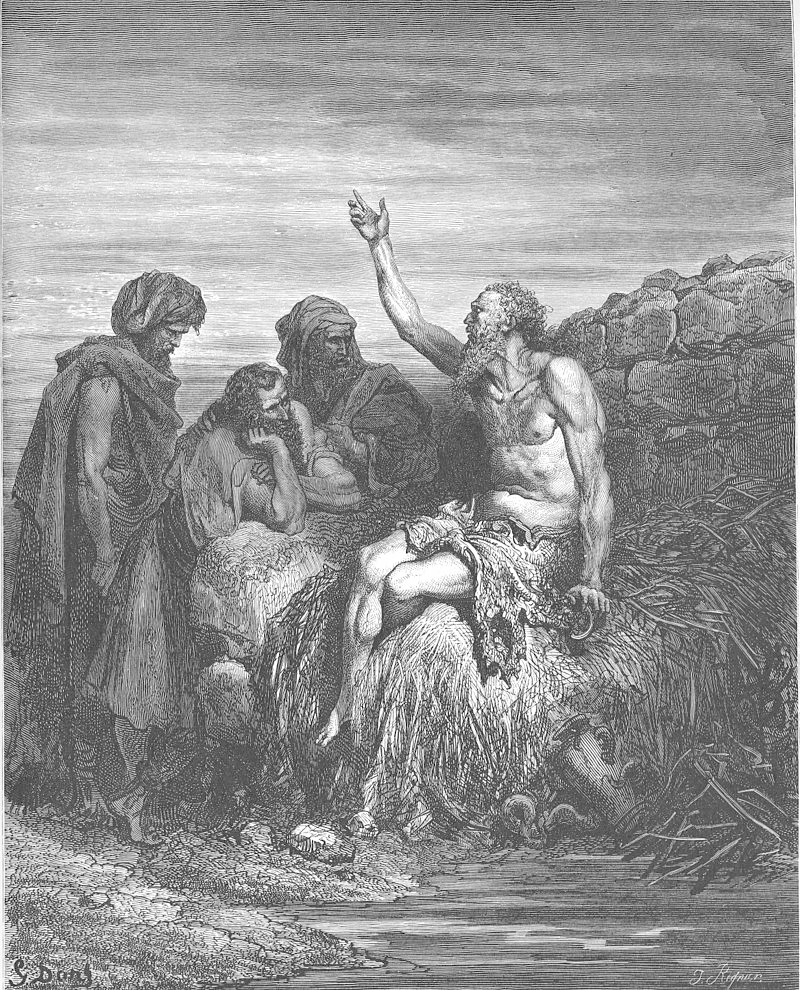
Job speaks with his friends, by Gustave Doré, 1866

Then Bildad the Shuhite replied:

“When will you end these speeches?
    Be sensible, and then we can talk.
Why are we regarded as cattle
    and considered stupid in your sight?
You who tear yourself to pieces in your anger,
    is the earth to be abandoned for your sake?
    Or must the rocks be moved from their place?

“The lamp of a wicked man is snuffed out;
    the flame of his fire stops burning.
The light in his tent becomes dark;
    the lamp beside him goes out.
The vigor of his step is weakened;
    his own schemes throw him down.
His feet thrust him into a net;
    he wanders into its mesh.
A trap seizes him by the heel;
    a snare holds him fast.
A noose is hidden for him on the ground;
    a trap lies in his path.
Terrors startle him on every side
    and dog his every step.
Calamity is hungry for him;
    disaster is ready for him when he falls.
It eats away parts of his skin;
    death’s firstborn devours his limbs.
He is torn from the security of his tent
    and marched off to the king of terrors.
Fire resides in his tent;
    burning sulfur is scattered over his dwelling.
His roots dry up below
    and his branches wither above.
The memory of him perishes from the earth;
    he has no name in the land.
He is driven from light into the realm of darkness
    and is banished from the world.
He has no offspring or descendants among his people,
    no survivor where once he lived.
People of the west are appalled at his fate;
    those of the east are seized with horror.
Surely such is the dwelling of an evil man;
    such is the place of one who does not know God.” (New International Version)

It only makes sense that Bildad was expecting a sensible discussion with Job.

But it was not going to happen.

Why?

Because grief doesn’t make sense; it’s nonsensical, whimsical, and fractal.

If you’ve ever been in a discussion with someone in which the person speaks illogically, it’s likely that you tried to talk sensibly and logically, pointing out the thought process.

And if you have ever done that, it’s also likely that the person did not change one iota of what they said.

Why?

Because people are not primarily thinking creatures who happen to have emotions. Instead, people are emotional creatures who happen to think.

Why do people ask, “Why?”

Because they’re angry. It’s not a cerebral question; it’s an emotional question.

Bildad, a “friend” of Job, was exasperated with his carrying on about being innocent, contending with God, and expressing anger – which is rather funny, because Bildad himself was angry.

Why?

Because supposedly logical and controlled people have illogical and emotional issues, too.

Welcome to the human race, all of you who pride yourselves on your flawless logic and neatly formed theology.

There is a chunk of people in this world who think that everything either works, or ought to work, according to Cartesian coordinates.

A Cartesian coordinate system describes the position of points in space using perpendicular axis lines that meet at a point called the origin. Any given point’s position can be described based on its distance from the origin along each axis. In other words, Cartesian coordinates allow one to specify the location of a point.

So, why am I talking about Cartesian coordinates?

Because that is what Bildad the Shuhite was trying to do with Job, to fix him on a plane that he could understand.

Because in Bildad’s theological world, the wicked are punished by God with bad circumstances and suffering. In the Cartesian world, as the wickedness increases, so does the pain and suffering.

Hence, one is being punished by God… But does the world really operate according to Bildad’s conception of it?

Hell no! (apparently wicked people say that sort of thing when not in the Cartesian world; they should probably get right with God; and, by the way, sarcastic people are wicked, too)

Bildad went so far as to suggest that perhaps Job doesn’t know God at all.

After all, that’s where one goes in a conversation with someone who doesn’t conform to clear and tidy Cartesian-style theology.

They can preach hellfire and damnation to others, yet when another even uses the word “hell” in a phrase, that is where they’re going to go.

It seems that Bildad isn’t really making sense.

Why?

Because he’s stuck. He cannot imagine life outside of his theological bubble.

The difference between Bildad and Job is that Job will admit that he is stuck, confused, messed-up, angry, and has no decent answer to what is going on in his life.

Whereas Bildad would never admit such a thing, even though he is so far stuck in the mud that it would take a divine miracle to get him out.

In fact, it appears we all need a divine miracle.

But God is silent.

Why?

I don’t know. But I do know that it won’t be for long.

Everyone might want to brace themselves for what’s coming.

Why?

Because we will receive precisely what we’re looking for: A word from God. But it’s probably not going to be what we expect.

After all, we aren’t living in a world of Cartesian coordinates.

O Lord God almighty, Creator of heaven and earth: I admit that these people you created drive me nuts! And I’m one of them! I can barely live with myself, let alone others.

In my wondering and confusion and pain, it’s hard to focus on anything. I don’t know why everything is upside-down and topsy-turvy. Yet, somehow I know, and am convinced, that you are present with me, and that you love me.

How in the world could I accept good from you, and not bad? If you love me, and are present with me, then I believe that whatever happens from this point forward, I shall not be forsaken by you.

Contend with those who contend against me. Help me with today, for tomorrow has enough worries of its own. Amen.

Tamar (2 Samuel 13:1-19)

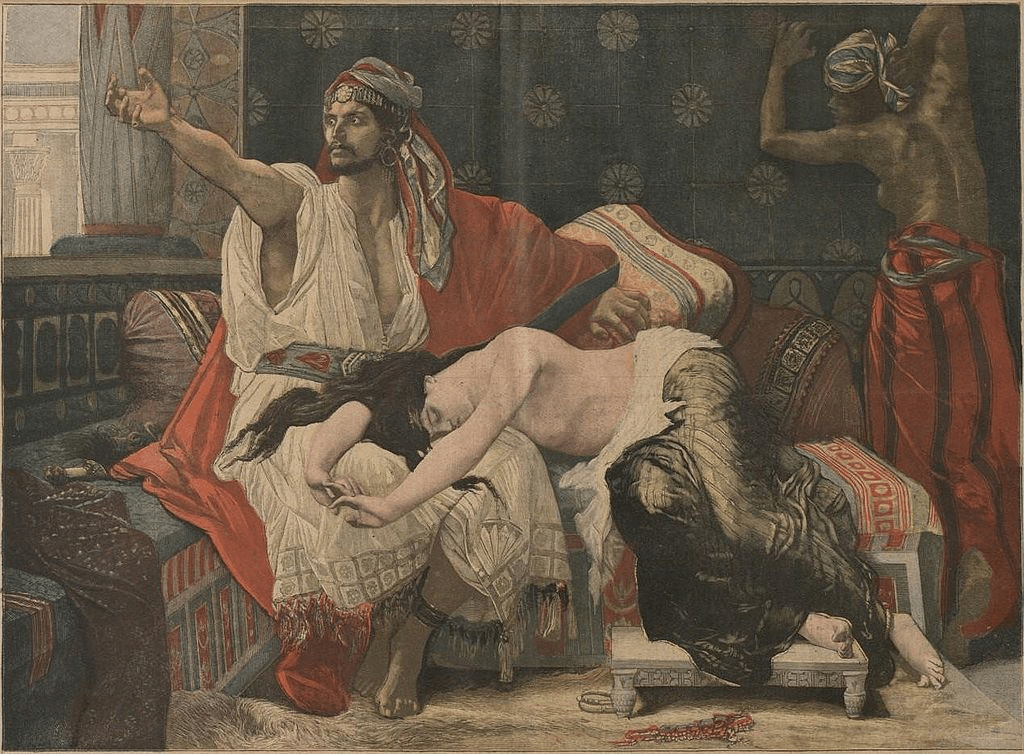
Tamar, by Alexandre Cabanel, 1875

In the course of time, Amnon, son of David fell in love with Tamar, the beautiful sister of Absalom son of David.

Amnon became so obsessed with his sister Tamar that he made himself ill. She was a virgin, and it seemed impossible for him to do anything to her.

Now Amnon had an adviser named Jonadab son of Shimeah, David’s brother. Jonadab was a very shrewd man. He asked Amnon, “Why do you, the king’s son, look so haggard morning after morning? Won’t you tell me?”

Amnon said to him, “I’m in love with Tamar, my brother Absalom’s sister.”

“Go to bed and pretend to be ill,” Jonadab said. “When your father comes to see you, say to him, ‘I would like my sister Tamar to come and give me something to eat. Let her prepare the food in my sight so I may watch her and then eat it from her hand.’”

So Amnon lay down and pretended to be ill. When the king came to see him, Amnon said to him, “I would like my sister Tamar to come and make some special bread in my sight, so I may eat from her hand.”

David sent word to Tamar at the palace: “Go to the house of your brother Amnon and prepare some food for him.” So Tamar went to the house of her brother Amnon, who was lying down. She took some dough, kneaded it, made the bread in his sight and baked it. Then she took the pan and served him the bread, but he refused to eat.

“Send everyone out of here,” Amnon said. So everyone left him. Then Amnon said to Tamar, “Bring the food here into my bedroom so I may eat from your hand.” And Tamar took the bread she had prepared and brought it to her brother Amnon in his bedroom. But when she took it to him to eat, he grabbed her and said, “Come to bed with me, my sister.”

“No, my brother!” she said to him. “Don’t force me! Such a thing should not be done in Israel! Don’t do this wicked thing. What about me? Where could I get rid of my disgrace? And what about you? You would be like one of the wicked fools in Israel. Please speak to the king; he will not keep me from being married to you.” But he refused to listen to her, and since he was stronger than she, he raped her.

Then Amnon hated her with intense hatred. In fact, he hated her more than he had loved her. Amnon said to her, “Get up and get out!”

“No!” she said to him. “Sending me away would be a greater wrong than what you have already done to me.”

But he refused to listen to her. He called his personal servant and said, “Get this woman out of my sight and bolt the door after her.” So his servant put her out and bolted the door after her. She was wearing an ornate robe, for this was the kind of garment the virgin daughters of the king wore. Tamar put ashes on her head and tore the ornate robe she was wearing. She put her hands on her head and went away, weeping aloud as she went. (New International Version)

Tamar, David’s daughter, photo by Dikla Laor

There is a very sad reality that has been pervasive throughout human history. Sexual assault and rape has existed as long as people have been on this earth.

Today’s account of Tamar’s awful experience, of having her life upended and changed forever, and of being dehumanized – treated as an object and not as a person created in the image of likeness of God – is unfortunately a story of far too many women in history, as well as today.

To have this sort of thing happen to just one woman is unacceptable, and ought never to happen again. And yet, countless female lives (not to mention many male lives, as well) have been altered by another (or others) who only viewed them from a place of evil desire.

It isn’t right. It’s not just. It is not good. Downright ungodly is what it truly is. There is nobody who should ever have to go through something like Tamar did.

There are enough of these sorts of stories in history, in literature, and in the news, that it’s hard for past victims not to be re-traumatized all over again – remembering what happened in their own lives, and being triggered yet again with unwanted memories.

That is neither the Bible’s intention, nor mine. Rather, I want to acknowledge Tamar’s experience as having happened, and that it was not her fault in any way, shape, or form. I see Tamar, in the healthy sense of seeing. And I hope, if you in some way relate to Tamar, that you are seen this day by someone who cares, and by a God who understands and grieves along with you.

There’s no need for me, therefore, to rehash the particulars of today’s Old Testament story. This is a scriptural case in which reading it once is sufficient for today. The real question is what we are going to do with it.

For those who are concerned, and wonder how to help someone, a friend or family member, who has been harassed or assaulted, consider the following:

  • Believe them, period. There’s no need to ask a lot of probing questions, as if you’re trying to find the truth. Encourage and support, don’t judge or criticize.
  • Affirm to them that they are not alone. Offer your support and time. Let them know of resources which might help (see below).
  • Let them know this was not their fault. Avoid blaming or trying to find out what they could have done differently.
  • Empower them. It’s their choice to tell their story, or not; or what parts of the story they want to reveal. Do anything you can to let them know they have options, and that they are in control of the conversation.
  • Ask how you can help. “How can I help you?” assumes that the other person knows better than you do about what they need. And keep asking as the days, weeks, and months go on.
  • Tell them your observations. If they look mad or sad, anxious or depressed, or are doing something which seems concerning, offer your observations without judgment. You can always ask them if your own perspective is on, or off.
  • Refer to others who can help. A person in crisis needs more help, not less. Not only might they need a trained therapist, but they may also need other forms of support in order to cope with what happened. Changing a residence, dropping classes, or help with basic daily chores are examples of assistance they may want. They might also need others who can help them with unhealthy ways of coping such as alcohol or risky behaviors.
  • Know your own limits. Steer clear from trying to do the job of people who have the training to do it. Know what you can do and not do. Also, if you do all the problem-solving, they might miss opportunities to learn new ways of coping. For example they might be reluctant to confront important but painful issues in therapy if they have already been discussed with you.

A few resources of help for those affected by sexual assault:

The National Sexual Assault Hotline has confidential 24/7 support either online at online.rainn.org, or by phone at 800-656-4673

End Violence Against Women International (EVAWI) is an organization which is a catalyst for justice and healing, so that every survivor of sexual assault and domestic violence gets the right response, every time. The EVAWI specializes in trauma-informed law enforcement responses. You can find them online at evawintl.org

Rise serves to bring equality to sexual assault survivors across the country and around the world; and seeks to help anyone who has the vision and drive to pen their own rights into existence. They can be found at risenow.us

The National Network to End Domestic Violence (NNEDV), a social change organization, is dedicated to creating a social, political, and economic environment in which violence against women no longer exists. You can find them online at nnedv.org

Gracious heavenly Father: You love and care for all of your children, especially the smallest and most vulnerable. We entrust to you the lives of the many who have been sexually abused, and whose trust and innocence have been destroyed. Help us to hear their cries of pain and to take responsibility for their broken lives.

May they may find understanding and support so that with the help of your grace their wounds may be healed, and they may again know peace. Grant this through our Lord Jesus Christ, your Son, who shared our weakness in all things but sin, and lives and reigns with you in the unity of the Holy Spirit forever and ever. Amen.

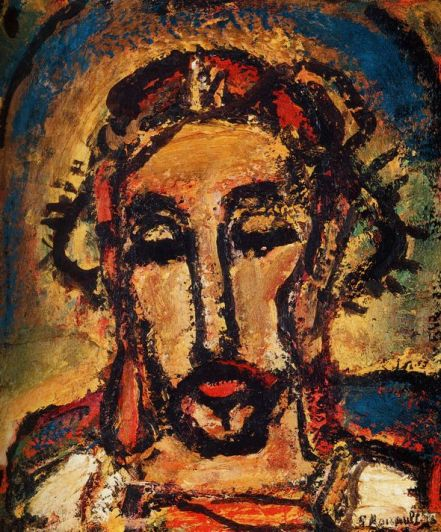
The Wounded Healer (Psalm 18:1-6, 43-50)

By French painter Georges Rouault (1871-1958)

I love you, Lord;
    you are my strength.
The Lord is my rock, my fortress, and my savior;
    my God is my rock, in whom I find protection.
He is my shield, the power that saves me,
    and my place of safety.
I called on the Lord, who is worthy of praise,
    and he saved me from my enemies.

The ropes of death entangled me;
    floods of destruction swept over me.
The grave wrapped its ropes around me;
    death laid a trap in my path.
But in my distress I cried out to the Lord;
    yes, I prayed to my God for help.
He heard me from his sanctuary;
    my cry to him reached his ears…

You gave me victory over my accusers.
    You appointed me ruler over nations;
    people I don’t even know now serve me.
As soon as they hear of me, they submit;
    foreign nations cringe before me.
They all lose their courage
    and come trembling from their strongholds.

The Lord lives! Praise to my Rock!
    May the God of my salvation be exalted!
He is the God who pays back those who harm me;
    he subdues the nations under me
    and rescues me from my enemies.
You hold me safe beyond the reach of my enemies;
    you save me from violent opponents.
For this, O Lord, I will praise you among the nations;
    I will sing praises to your name.
You give great victories to your king;
    you show unfailing love to your anointed,
    to David and all his descendants forever. (New Living Translation)

King David, the psalmist, had no problem with publicly expressing his great feeling of love for God. His desire was to be thoroughly devoted to the Lord; and he confidently discerned God as the source of his strength.

What’s more, David freely recognized God as the One who brought him deliverance. David cried out in distress. In his despair and desperation, he looked to the Lord, and God responded.

This is in contrast to those who complain about God and consider the Lord as distant and uncaring – if existing at all. David’s experience was that of being heard by God. And he wanted everyone to know, so that the faithful may be encouraged.

David didn’t want people becoming discouraged because of the bitterness of others who accuse God of being unconcerned.

The psalmist was not just talking about some mundane request, like asking for parking spot close to the building. David was in a life-and-death situation, stressful beyond imagination. Things were not looking good for him.

It seemed that the insolent, who think God isn’t watching, believed they could act unjustly and do whatever they wanted. Sadly, their lust for power and control blinds them to the larger reality of an invisible God who sees, and who responds at just the right time.

David wanted people to remember and not to forget about the saving actions of God. Because by keeping in mind who God truly is, then we can have confident trust, and will live in a way that is right, just, and good.

“Our service will not be perceived as authentic unless it comes from a heart wounded by the suffering about which we speak.”

Henri Nouwen

A good, right, and just life is always the appropriate response to divine mercy and deliverance. We are saved from evil, so that we might live in the spiritual freedom of purity and peace. And David gave God some due praise, adoration, and thanksgiving for rescuing him from his enemies.

Since David went through all of the adversity, hardship, stress, and suffering of dealing with unjust people, he was in a position to be a wounded healer for us.

A wounded healer is not someone who endorses a victim mentality. Rather, this is a person who has been profoundly hurt – physically, mentally, emotionally, or spiritually – and comes through the experience with an ability to be present with others and help facilitate healing in those who suffer.

Surely he took up our pain
    and bore our suffering,
yet we considered him punished by God,
    stricken by him, and afflicted.
But he was pierced for our transgressions,
    he was crushed for our iniquities;
the punishment that brought us peace was on him,
    and by his wounds we are healed. (Isaiah 53:4-5, NIV)

We all suffer and face various hard circumstances. And we are all changed by the hurtful encounters. But we don’t all respond the same way to that adversity. The difficult experiences of pain lead us to become either bitter or better.

If we have a wounded healer in our life, there is a good chance that we will be able to move through the hardship and come to a place of gratitude for what the Lord has done for us and how God brought us deliverance.

“As followers of Jesus we can also allow our wounds to bring healing to others.”

Henri Nouwen

Deliverance may not end up looking like anything we anticipate. If we are stuck on particular outcomes and have a singular expectation, then we may very well miss the Rescuer when the ship of salvation shows up.

Yet, if we can remain open to and aware of God – as well as of what’s going on inside us – then we shall likely experience healing for our deep wounds of pain. And we will embrace the scars it leaves as a reminder of the Lord’s deliverance.

It could be that things don’t change, at least like we want. In such times, perhaps the greatest healing that can take place is to be healed from the need for healing.

The Lord shows unfailing commitment and steadfast love to the faithful, to those who seek God. We shall find the divine in all circumstances, that is, if we seek God with all our heart.

“You will seek me and find me when you seek me with all your heart.” (Jeremiah 29:13, NIV)

Pain cannot be taken away unless we enter into it. So, it only makes sense to me, that we have a guide like the psalmist to lead us, and a Savior like Jesus to rescue us.

“Wholeness is not achieved by cutting off a portion of one’s being, but by integration of the contraries.”

Carl Jung

May you be patient in suffering, as Christ was in his earthly pain.

May the Lord be near you in your time of weakness and wondering.

May God sustain you by divine grace, and grant you courage not to have a failure of faith.

May you know healing of both body and soul.

And may you always believe that what happens to you in this present life is of little account if you hold Christ in eternal life. Amen.

Dealing with Another’s Evil Intentions (1 Samuel 19:18-24)

David and Saul, by He Qi

When David had fled and made his escape, he went to Samuel at Ramah and told him all that Saul had done to him. Then he and Samuel went to Naioth and stayed there. 

Word came to Saul: “David is in Naioth at Ramah;” so he sent men to capture him. But when they saw a group of prophets prophesying, with Samuel standing there as their leader, the Spirit of God came on Saul’s men, and they also prophesied. 

Saul was told about it, and he sent more men, and they prophesied too. Saul sent men a third time, and they also prophesied. Finally, he himself left for Ramah and went to the great cistern at Seku. And he asked, “Where are Samuel and David?”

“Over in Naioth at Ramah,” they said.

So Saul went to Naioth at Ramah. But the Spirit of God came even on him, and he walked along prophesying until he came to Naioth. He stripped off his garments, and he too prophesied in Samuel’s presence. He lay naked all that day and all that night. This is why people say, “Is Saul also among the prophets?” (New International Version)

King Saul was in the middle of a personal downward spiral of evil. And David was his target. Even though David served Israel and the king with distinction and bravery, his success aroused the jealousy of Saul.

It came to the point that David needed to flee for his life because Saul saw him as a threat and was out to kill him. Instead of trying to go it alone, feeling angry and defeated, David went to the one person he knew was wise, discerning, and could help: Samuel, the priest and prophet of Israel.

David was not looking to kill Saul, as Saul was trying to kill him. He just needed someone to talk to, some empathy and solid help in this very unwanted and awful situation.

As we move through the biblical narratives which tell of Saul and David, we will observe that God is with David and helps him through his travails; but God is not with Saul, who is continually haunted with a bad spirit whenever he descends into the dark path of jealousy, anger, even murder.

It is only human to wonder why people of faith, with good and genuine hearts, must contend with such self-absorbed narcissistic people like Saul. We can only answer it in part: the presence of evil in the world; the place of trials and tribulations in the believer’s life, etc. For the most part, it is a mystery for which we shall not have answers, this side of heaven.

But what we do know is that God is concerned for the godly, for those who seek to do right, have pure hearts, and think of the common good of all the people. And the Lord can deal with evil, while protecting the good, in quite unexpected ways.

We expect prophets to prophesy. We don’t expect anyone else to necessarily do so. Yet, in this story, we see God sending the spirit of prophetic speech not just upon the prophets and the good folk, but upon those who have ill intentions toward the godly ones.

Yes, the Lord sent a spirit upon people who were trying to kill David, and then even upon Saul himself; not to illumine, but to prevent. The power of prophecy in this instance was not a sign of being chosen by God, but a clear sign from God of rejection.

In stripping off his clothes and laying naked in prophetic utterance, Saul was being humbled, abased, and mortified. Decades later, King David would do so willingly as a repentant person. But here, King Saul does so unwillingly, as an unrepentant person who needs to let himself be among the penitent persons. But, alas, Saul did not do so, and was continually moved by other forces other than the Lord.

For the believer who is in the throes of a gaslighting boss, or a narcissistic leader, or a self-centered relative, today’s story is an encouragement: God’s will on this earth shall prevail; and the Lord will take care of those who desire to live a just, right, and good life.

Conflict and trouble must not necessarily result in one’s devastation and discouragement.

Whenever we find ourselves in the crosshairs of an evil person, we do not need to add to the madness with harsh and divisive words.

Instead, we can be sober-minded and good-hearted by handling the adverse situation with gentle words and a wise spirit. We can face the trouble, without wishing it away, by going to a wise person for counsel and help, if need be.

The mark of a truly good person is not whether they have conflict in their life, or not, but by how they handle the trouble when it comes. And as for the troublemakers and chaotic people themselves, the Lord knows how to deal with them.

You may be in an unwanted situation, dealing with a difficult person. Please don’t let that person steal your personal integrity and happiness from you. The one thing you can always control – that nobody can ever take away from you – is your own attitude and ability to respond.

“Everything can be taken from a man but one thing: the last of the human freedoms—to choose one’s attitude in any given set of circumstances, to choose one’s own way.”

Viktor Frankl, Man’s Search for Meaning

You and I really can deal with this. If the hurt was unintentional, then forgive and let it go. If the hurt was intentional, we need not be judge, jury, and/or executioner. That’s God’s job, not ours. Rather, we can choose to forgive and not hold onto bitterness; talk with a wise person to receive wise counsel, and not spread anger and slander; and determine to be joyful and godly, not sullen and irritable.

O Lord God almighty, listen to the prayer of the righteous! Direct the way of your servants in safety under your gracious divine protection, so that through all of the changes of our earthly pilgrimage, we may be guarded by your mighty help and power. Amen.