Show Some Basic Human Kindness and Love (Ruth 3:8-18)

Art by Chanelle Nibbelink

At midnight the man was startled and turned over, and there, lying at his feet, was a woman! He said, “Who are you?” And she answered, “I am Ruth, your servant; spread your cloak over your servant, for you are next-of-kin.”

He said, “May you be blessed by the Lord, my daughter; this last instance of your loyalty is better than the first; you have not gone after young men, whether poor or rich. And now, my daughter, do not be afraid, I will do for you all that you ask, for all the assembly of my people know that you are a worthy woman. But now, though it is true that I am a near kinsman, there is another kinsman more closely related than I. Remain this night, and in the morning, if he will act as next-of-kin for you, good; let him do it. But if he is not willing to act as next-of-kin for you, then, as the Lord lives, I will act as next-of-kin for you. Lie down until the morning.”

So she lay at his feet until morning but got up before one person could recognize another, for he said, “It must not be known that the woman came to the threshing floor.” Then he said, “Bring the cloak you are wearing and hold it out.” So she held it, and he measured out six measures of barley and put it on her back; then he went into the town. 

She came to her mother-in-law, who said, “How did things go with you, my daughter?” Then she told her all that the man had done for her, saying, “He gave me these six measures of barley, for he said, ‘Do not go back to your mother-in-law empty-handed.’” She replied, “Wait, my daughter, until you learn how the matter turns out, for the man will not rest but will settle the matter today.” (New Revised Standard Version)

Boaz was an unmarried wealthy landowner. He was pious and conscientious. Ruth was a widow, a foreigner from Moab. Naomi was Ruth’s mother-in-law, and also a widow. Naomi and Ruth only had each other.

As one in poverty did in those times, Ruth walked behind the harvesters in the fields during the barley harvest, gleaning whatever was left behind. She was gleaning in the field of Boaz. He noticed.

Boaz was kind enough to make sure that Ruth was able to glean for two people. It turns out that Boaz was an in-law to Naomi, through her late husband Elimelech. Naomi sought to play matchmaker, so that Ruth would be well cared for. So, she instructed Ruth in what to do….

A woodcut of Ruth and Boaz on the threshing floor, by Unknown Artist

Harvest time in Judah was also a time of celebration and feasting. Late one night, on the barley wheat threshing floor, Boaz lay down to sleep after a day of bringing in the grain, and an evening of eating and drinking.

Doing exactly as her mother-in-law Naomi instructed, Ruth went to threshing floor, and then quietly laid down at the feet of Boaz. At midnight, Boaz was startled and woke up. There, at his feet, was a woman!

“Who are you? What do you want?” asked Boaz. And Ruth made herself known with the humble response, “I am Ruth, your maidservant.”

Ruth continued to follow Naomi’s guidance, and asked that Boaz spread his cloak over her, because he is the next of kin, the relative who could be responsible for engaging a levirate marriage with her (that is, a legal marriage involving in-law’s).

Although sleepy, and maybe even a bit tipsy, Boaz knew immediately that Ruth was asking him to marry her. Pious man that he was, Boaz would likely have realized the imagery of his situation, as likened to the prophet Ezekiel’s description concerning God’s love toward Jerusalem:

I spread the edge of my cloak over you and covered your nakedness: I pledged myself to you and entered into a covenant with you, says the Lord God, and you became mine. (Ezekiel 16:8, NRSV)

In following Naomi’s advice, Ruth put herself in a very vulnerable situation. Yet, Naomi’s observation of Boaz was spot on. Ruth’s faith in, and love for, her mother-in-law was well-placed.

The man Boaz responded favorably to the asking and overture of Ruth. He praised Ruth for her steadfast love and faithfulness; and her willingness to be with him, instead of a younger man.

Arising organically and sincerely from within Boaz was a prayer for God’s blessing upon Ruth. Not only would Boaz act to marry Ruth, but he also assured her that she belongs to God and God’s people.

The cloak of Boaz being spread over Ruth not only symbolized their upcoming levirate marriage, but it also communicated her marriage to God. Ruth was coming into God’s covenant as one of the people, as well as entering the marriage covenant.

I like that Boaz did not regard the actions and words of Ruth as something impertinent, immoral, or inappropriate. He fully recognized that she was operating consistent with the law of God in honoring a family obligation. And Boaz reciprocated by being honored to have been asked, and honored to comply with Ruth’s wishes.

It seems to me that this is love, as it is intended to be with us. We respect one another’s character, and seek to do whatever we can to meet this person’s need. When I love, I want to go out of my way to act on behalf of this person I admire and adore.

Boaz was not under a legal obligation to marry Ruth. He could have done nothing. But love compelled him – a love for Ruth which was grounded in an abiding love for God.

It wasn’t that Boaz should have, or could have, done something to help meet the needs of Ruth and Naomi. Boaz wanted to do something. He wanted to help Ruth. Boaz wanted to show kindness and steadfast love to Ruth. He wanted to fulfill her asking.

Naomi came up with a plan, because she trusted in the mercy, kindness, and generosity of Boaz. And also because she loved her daughter-in-law Ruth, and wanted her to be loved and cared for.

To show his goodwill and intention to fulfill Ruth’s request, he gave her a significant gift of barley. That is, he loaded her up with groceries to take home. This was a sign that Boaz would indeed make sure that the needs of Ruth and Naomi would be met this day, and into the future.

I am struck with how simple this story really is, at it’s core. It’s just three people, who each care. Caring is something that all of us can do, no matter who we are, where we are, or what situation we find ourselves in.

We really can show basic human kindness to another. We can be merciful, just, and generous. We can ask for what we want and need. We can help one another.

Perhaps, then, the real question for each of us is not whether we can speak and act with love, grace, and kindness; the real question is: Will I speak and act with love and mercy?

If we want to live in a world where there is justice, mercy, and love, then we must demonstrate those very things in our own lives, today and every day.

Live the way that you yourself want to be treated. And if you want mercy, generosity, and love from others, then ask for it.

God of steadfast love, help us each day in the midst of things we don’t understand, To those of us who are afraid, give courage To those who are exhausted, give strength To those in despair, give hope.

Comfort us in our struggles, O Loving God, and meet every need. Grant us safety, security and stability, and help us learn the lessons you are giving us, so that we may all work together to make this world a better place. Amen.


Redeem One Another (Ruth 3:1-7)

Boaz and Ruth, by John August Swanson (1938-2021)

Naomi her mother-in-law said to her, “My daughter, I need to seek some security for you, so that it may be well with you. Now here is our kinsman Boaz, with whose young women you have been working. See, he is winnowing barley tonight at the threshing floor. Now wash and anoint yourself, and put on your best clothes and go down to the threshing floor, but do not make yourself known to the man until he has finished eating and drinking. When he lies down, observe the place where he lies; then go and uncover his feet and lie down, and he will tell you what to do.” She said to her, “All that you say I will do.”

So she went down to the threshing floor and did just as her mother-in-law had instructed her. When Boaz had eaten and drank and was in a contented mood, he went to lie down at the end of the heap of grain. Then she came stealthily and uncovered his feet and lay down. (New Revised Standard Version)

Naomi and Ruth were two widows – a mother-in-law and daughter-in-law – living in an ancient time when women were dependent upon men for survival.

Ruth had been out in the barley fields during harvest, gleaning as much as she could by walking behind the harvesters. It was what people in need did back then.

The owner of the land, Boaz, had heard of Ruth and took notice of her. He was kind and made sure she had enough for herself and Naomi.

So, Naomi, although too old to be out in the fields gleaning barley, could still use her wisdom. She decided to help Ruth have some security for the future. Naomi wanted to help her daughter-in-law,  so she instructed Ruth to make herself available to Boaz.

Boaz was a kinsman, connected to Naomi’s extended family. Naomi intended on using this connection to bring Ruth and Boaz together in marriage, thus settling her daughter-in-law in a good and secure life.

The approach of Naomi underscores her thoughtfulness, creativity, and limited resources. Most of all, however, Naomi’s plan rests entirely on the goodwill and generosity of Boaz. Naomi was observing Boaz, and assessed him as a person she could put her faith into.

Would Boaz be willing to act in Ruth’s favor, as a near kinsman to Naomi? Would he take up the mantle of kinsman-redeemer and enter a levirate marriage with Ruth?

A “levirate” is reference to an ancient marital system which involved in-laws. If a man died without children, the dead man’s name could be perpetuated through the widow’s marriage with a man related to the dead person.

Israel and Judah had a strong sense of community and family solidarity which is evidenced in God’s law. Members of the family and the community had a duty to watch out for each other and care for one another. For example:

“If anyone of your kin falls into difficulty and sells a piece of property, then the next of kin shall come and redeem what the relative has sold. If the person has no one to redeem it but then prospers and finds sufficient means to do so, the years since its sale shall be computed and the difference refunded to the person to whom it was sold, and the property shall be returned. But if there are not sufficient means to recover it, what was sold shall remain with the purchaser until the year of Jubilee; in the Jubilee it shall be released, and the property shall be returned. (Leviticus 25:25-28, NRSV)

Naomi did her best to try and prepare for a marriage to happen. And her best chance was with Boaz on the threshing floor after the barley harvest. Considering that arranged marriages were the norm, none of this was weird at the time.

She wanted to stir up this sense of duty in Boaz, and help him take responsibility for the family, so that Ruth could be properly cared for.

Israelites had a strong theological sense that their God had redeemed them out of Egypt, and therefore, they themselves were to act as redeemers, whenever needed, within their families and communities.

Another way of putting the matter, is that Israel’s covenant with Yahweh their God was to have the wider implication of covenanting to help and care for each other as Israelites. And this was especially true for one’s family.

Boaz was related to Naomi through her late husband Elimelech; and related to Ruth through Elimelech’s son Mahlon, who was Ruth’s late husband.

As you can imagine, not every scenario in Judah which involved redeeming one’s in-law’s actually happened. The question was whether Boaz would do anything. And Naomi was betting on the farm that he would care and help. Hence, Naomi’s advice to Ruth concerning Boaz.

Naomi instructed Ruth to make clear to Boaz that she wanted him to marry her. All of the preparation for the nighttime visit was designed to spark within Boaz that Ruth is asking for a levirate marriage.

Ruth did exactly what her mother-in-law told her. I believe that not only was Naomi looking out for her daughter-in-law, but Ruth was also looking out for her mother-in-law.

Neither one of them had to do what they did. Naomi didn’t have to make arrangements for Ruth to be cared for. But she did. And Ruth, as a foreigner from Moab, didn’t have to succumb to any Jewish covenantal understandings of things. And yet, she did.

Individualistic Western societies reflexively think of personal interest first, and often only think of the personal implications to just about everything – even concerning family. Many persons abandon their families and take up a sort of surrogate family.

They may feel no duty or responsibility to biological family connections. Even more persons move from place to place without much thought to the communities they leave, nor to how they might contribute to the wellbeing of their new community.

A careful reading of the Book of Ruth ought to challenge those types of approaches to family and community. Although none of us are living in the covenant society of Ruth, Naomi, and Boaz, there is an inherent universal ethic of caring for those closest to us, especially family.

Each day is an opportunity to act in redemptive ways which lift up and help others in whatever their need may be. I pray we all to have the sensibilities of persons like Boaz, Ruth, and Naomi.

Gracious God, enable us to understand and care about the needs of others. May your way of love open up for all those who suffer or are in any kind of trouble. Thank you for your steadfast love and abundant mercy. Help us to both accept your love and mercy, and to give it. Amen.

Be Helpful, Not Harmful (Psalm 119:113-128)

I hate two-faced people,
but I love your teachings.
You are my hiding place and my shield.
My hope is based on your word.
Get away from me, you evildoers,
so that I can obey the commandments of my God.
Help me God, as you promised, so that I may live.
Do not turn my hope into disappointment.
Hold me, and I will be safe,
and I will always respect your laws.
You reject all who wander away from your laws,
because their lies mislead them.
You get rid of all wicked people on earth as if they were rubbish.
That is why I love your written instructions.
My body shudders in fear of you,
and I am afraid of your regulations.

I have done what is fair and right.
Do not leave me at the mercy of those who oppress me.
Guarantee my well-being.
Do not let arrogant people oppress me.
My eyes are strained from looking for you to save me
and from looking for the fulfillment of your righteous promise.
Treat me with kindness,
and teach me your laws.
I am your servant.
Help me understand
so that I may come to know your written instructions.
It is time for you to act, O Lord.
Even though people have abolished your teachings,
I love your commandments more than gold, more than pure gold.
I follow the straight paths of your guiding principles.
I hate every pathway that leads to lying. (God’s Word Translation)

I don’t know about you, but disingenuous people drive me nuts. This is the type of person who is nice as pie to your face, but then walks away and talks smack about you to another. They seem to always have an agenda in order to get ahead, gain power, and be in the know, so that they can have leverage against you.

There are other people who try to avoid doing wrong and always try to do right. There are yet others who either bulldoze or sleepwalk through life, doing what they will, with impunity, unaware of how they’re damaging people’s lives. And then there are those who try to steer clear of what they consider the biggie sins, while having no problem indulging in so-called little sins. 

Selfishness, self-centeredness, and unawareness of the self’s impact on this world will create all sorts of problems for others. Indeed, sin is messy business. 

No matter the form or the attempt at dealing with one’s selfish proclivities, the bottom line is that we all engage in such behavior because it benefits us, that is, we like doing it. We might not always like the consequences and the fallout of self-centered living, but it sure feels good while it lasts.

Humanity needs a complete reorientation of the heart. Rather than hating every way that doesn’t benefit me, we must learn to hate every way which is contrary to God’s good commands.

The psalmist proclaims and affirms that all God’s precepts are right. It’s important to hate every false path which deviates from the true self and the common good of all persons. 

If we indulge in self-centered ways because we like them, the road to thinking of others and their needs is learning to hate my false self and false belief systems – to loathe them so much that it’s like a nasty stench in our nostrils. 

Hating sin comes from the acquired taste of loving God’s commandments. When we come around to cherish and desire God’s Word, then selfish sinful desires gradually become so odious to us that we want nothing to do with them.

The reason the psalmist could proclaim such an extended love song to the commands of God, is that he tried them, ate them, and imbibed them. And how good they were! It caused him to forsake every selfish way in trying to achieve human enjoyment. 

I encourage people to have a solid plan for reading (or listening to) Scripture every day – because it really has the power to reorient us from being selfish jerks who harm others to becoming unselfish thinkers who help others.

Scripture changes our taste buds. Sustained, consistent, daily eating of the psalms will teach us to want God and God’s ways – while forsaking the dark path of insolence and oppression in order to satiate our own selfish wants.

The psalmist committed himself to avoiding worthless selfish situations, as well as steering clear of harmful people with the propensity to doing wrong. They are fickle, double-minded, two-faced people, divided in their loyalties.

On one side of their mouth, they talk a good line about faith; and then talk out the other side of their mouth, spewing a bunch of worthless gobbledygook which, at the least, adds no value to anything, and, at worst, wrecks good plans and harms others.

If there are people in authority over us who don’t give a wit about our most cherished values, we will likely find ourselves tasked with doing things which rub against our understanding of Holy Scripture. In this state of moral distress, we are pushed, pulled, and tested in our single-minded devotion by the double-minded selfish person to do what we are uncomfortable with.

In the stress and crucible of trouble, we need the courage to speak up, despite the fear of repercussions. And that strength is only possible if we have a resilient spirit with the capacity to sustain our personal integrity in the face of distress. That is, we need God and God’s Holy Word.

Scripture and fellow believers provide support; we need to care for one another as a community of redeemed persons who seek to live into the words of ways of almighty God.

It can be tricky business, wisely trying to discern between what we to accept and what to pushback against. Yet, with God, God’s Word, and God’s people, we possess all the resources required in living the spiritual life and navigating the selfish world we inhabit.

Almighty God, I pray that you will deal with me according to your steadfast love and teach me your statutes. I am your servant; give me understanding so that I might know and live by your commands and forsake the evil of the world. Amen.

The Lord’s Will Be Done (Acts 21:1-16)

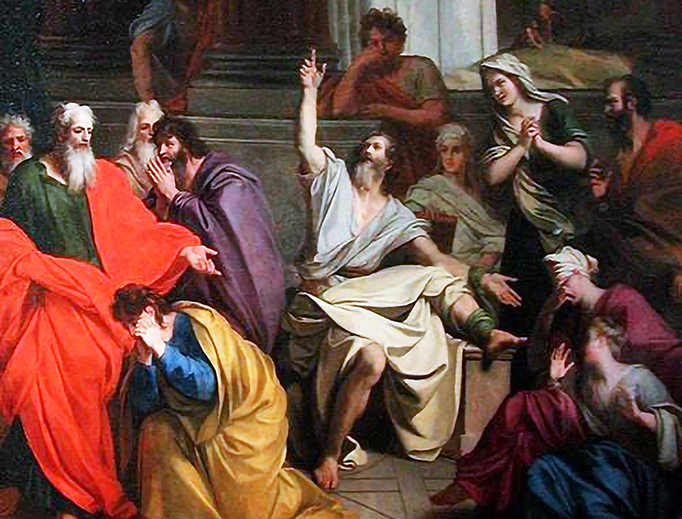
The Prophecy of Agabus, by Louis Chéron, 1687

After we had torn ourselves away from them, we put out to sea and sailed straight to Kos. The next day we went to Rhodes and from there to Patara. We found a ship crossing over to Phoenicia, went on board and set sail. After sighting Cyprus and passing to the south of it, we sailed on to Syria. We landed at Tyre, where our ship was to unload its cargo. 

We sought out the disciples there and stayed with them seven days. Through the Spirit they urged Paul not to go on to Jerusalem. When it was time to leave, we left and continued on our way. All of them, including wives and children, accompanied us out of the city, and there on the beach we knelt to pray. After saying goodbye to each other, we went aboard the ship, and they returned home.

We continued our voyage from Tyre and landed at Ptolemais, where we greeted the brothers and sisters and stayed with them for a day. Leaving the next day, we reached Caesarea and stayed at the house of Philip the evangelist, one of the Seven. He had four unmarried daughters who prophesied.

After we had been there a number of days, a prophet named Agabus came down from Judea. Coming over to us, he took Paul’s belt, tied his own hands and feet with it and said, “The Holy Spirit says, ‘In this way the Jewish leaders in Jerusalem will bind the owner of this belt and will hand him over to the Gentiles.’”

When we heard this, we and the people there pleaded with Paul not to go up to Jerusalem. Then Paul answered, “Why are you weeping and breaking my heart? I am ready not only to be bound, but also to die in Jerusalem for the name of the Lord Jesus.” When he would not be dissuaded, we gave up and said, “The Lord’s will be done.”

After this, we started on our way up to Jerusalem. Some of the disciples from Caesarea accompanied us and brought us to the home of Mnason, where we were to stay. He was a man from Cyprus and one of the early disciples. (New International Version)

The Apostle Paul was on his farewell tour, visiting the believers in churches he planted during his missionary journeys.

The visit to Ephesus was especially heart wrenching; everyone knew this was the last time they would see each other. Paul had spent considerable time in Ephesus establishing the church, and went through a lot with the people. They cared for one another deeply, which is seen in their praying meeting on the beach.

Paul was determined to get back to Jerusalem. Everyone knew that Paul would likely be imprisoned or killed or both by returning there. After the tears were shed, Paul and his coterie of people got on a ship and sailed toward Judea.

Once in Judea, Paul and his companions encountered some characters in the city of Caesarea, including four sisters who had the gift of prophecy, and a man named Agabus who was also a prophet.

The Apostle had been warned several times about going back to Jerusalem. Agabus joined the voices by giving a word by means of the Holy Spirit that Paul would meet persecution if he continued on his journey.

Agabus did some rather dramatic Old Testament prophetic type stuff with Paul. Although others interpreted the message of Agabus as a warning to not go into the lion’s den of inevitable persecution, the prophecy itself is only descriptive of what will happen, and not prescriptive of what should be done.

It’s important to distinguish what the Holy Spirit reveals and commands. We ought only to smush the revelation and the commands together when the Spirit does that. In the case of Agabus and Paul, it was only a revelation. And Paul picked up on that immediately. He knew what he was in for, and was okay with it.

The bottom line for the Apostle Paul was that he felt compelled to head for Jerusalem and face whatever he needed to face there. He was determined to personally bring both spiritual encouragement and economic relief for the people in Judea.

It seems that nobody wanted to see Paul get hurt, arrested, killed, or all three; and that’s more than understandable. Yet, the Apostle himself was convinced of what he should do; and no amount of trying to persuade him otherwise was going to work. So, Paul continued his journey.

The believers came around to saying, “The Lord’s will be done.” And that’s really what we all eventually must come to accept – that participation with what God is doing in the world, in a place, and with us personally, is the thing that counts.

Even Jesus needed to get to that point, so maybe we ought to cut others (and ourselves) some slack when it comes to accepting the situation we are called to be in.

 “Father, if you are willing, take this cup from me; yet not my will, but yours be done.”

Jesus (Luke 22:42, NIV)

No one, especially me, is saying that it’s easy to face adversity and hardship for a certain time and place in your life (or the life of someone you love). In fact, much like Jesus in the garden, it is often agonizing. But moving ahead and doing it we shall, if the Lord’s will is plain to us.

One of the reasons why Paul could be so resolute, and do what he did, was because of the support he continually had around him with his traveling companions.

I often ask people if they are part of a church. Some folks take this as a rebuke and instantly feel guilty that they haven’t attended a worship service for a long while. But the reason I ask is that I’m wondering about their sources of support.

Whenever people are going through hard times, its very helpful to have a faith community who they can rely upon and lean into. Since Paul was rarely alone, he had a consistent supportive presence of people who knew him well, and the circumstance he was enduring.

And I’m hoping that same thing for you – to have a good support system in place for help in following through with the will of God, as you understand it. Because if you are convinced of what you must do, and have people to support you in doing it, no matter what happens, then you can endure a lot, as well as learn a lot.

Lord God almighty, help me grow in discernment and making decisions. Jesus, you know the intensity of our struggle when God’s will conflicts with our desires. Equip and enable me to do your revealed will with a glad and sincere heart. May your will be done, in the power of the Holy Spirit. Amen.