Hebrews 7:23-28 – Jesus Is Better

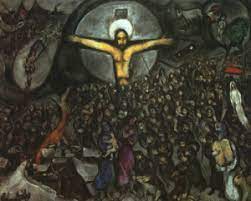
“Exodus” by Marc Chagall, 1952

Now there have been many of those priests, since death prevented them from continuing in office; but because Jesus lives forever, he has a permanent priesthood. Therefore, he is able to save completely those who come to God through him, because he always lives to intercede for them.

Such a high priest truly meets our need—one who is holy, blameless, pure, set apart from sinners, exalted above the heavens. Unlike the other high priests, he does not need to offer sacrifices day after day, first for his own sins, and then for the sins of the people. He sacrificed for their sins once for all when he offered himself. For the law appoints as high priests men in all their weakness; but the oath, which came after the law, appointed the Son, who has been made perfect forever. (New International Version)

Several years ago, I enjoyed serving communion with a retired minister in the church for which I was serving at the time. When we were in the middle of it, I leaned over to him and gave him a bit of instruction on what we were about to do. After I finished, he leaned over to me with a smile and said, “I didn’t hear a thing you just said, but I’ll figure it out!”

When it comes to the Christian life, I think we can learn something from the old Pastor. We are neither always going to hear well everything which is in the Bible, nor are we going to understand everything which is happening around us as Christians. 

The Jewish Christians, for which the book of Hebrews was originally preached, had a difficult transition from Judaism to Christianity. In Judaism, they knew what was happening. The sacrificial system was detailed and meticulously planned. The priesthood was clearly observed with men from the tribe of Levi. Worship was predictable.

However, becoming a Christian changed a lot of things. Being a Christian meant relying on the wild and unpredictable Spirit of God. There was no longer a tangible sacrificial system. Jesus is the high priest, but the believers never see him. 

There was so much living by faith, and so little understanding of what was going to happen, that the Hebrew Christians’ resolve began to break down. They became discouraged and started to lose patience with Christianity.
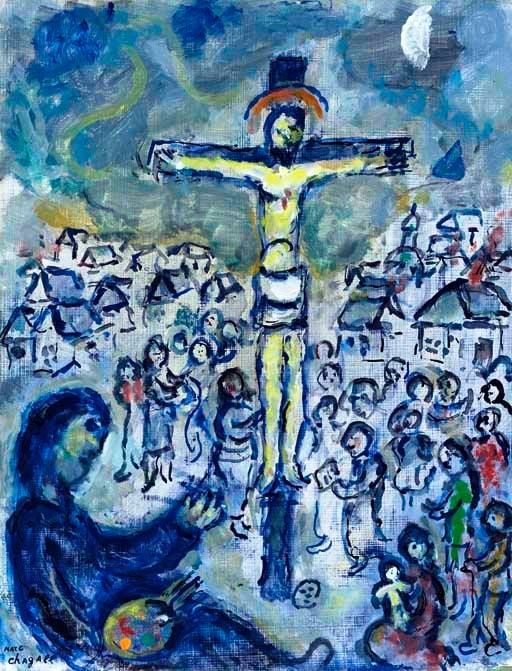
“The Painter and the Christ” by Marc Chagall, 1975

Today’s New Testament lesson is in the middle of an extended discussion by the author of Hebrews about the priesthood and sacrificial system. The Christian Jews were thinking about reneging on their commitment to Jesus and returning to their previous way of life in Judaism. 

So, central to the author’s exhortation is to demonstrate that Jesus is superior to everything in Judaism. Jesus is better than any Old Testament priest. Jesus is the once-for-all sacrifice for sins. Jesus is better because his priesthood is permanent, and his sacrifice is perfect.

In the ancient world, sacrifice was at the center of everyone’s belief system. Every pagan religion had some sort of sacrificial practice to satisfy the god(s) and ensure deliverance and/or prosperity. Jews, of course, had an elaborate sacrificial system of their own with detailed prescriptions of how to go about it.

We need to feel something of the original force of Christianity. It was a radical idea to have one sacrifice to end all sacrifices.

Everyone understood that sacrifices were temporary; you had to keep offering them over and over again. Christianity, however, asked the world to have a new understanding of sacrifice. No longer would there be any sacrifice – no grain sacrifice; no offerings of first-fruits; no animal sacrifices; no physical sacrifices whatsoever. 

In Christianity, Jesus as the once-for-all sacrifice to end all sacrifices was such a crazy notion for so many people that they mocked Christians for it. Both Jews and pagans could barely wrap their minds around such a progressive idea. It would be like saying to us today that there is no longer any need for money because some individual became the underwriter for everything everybody does.
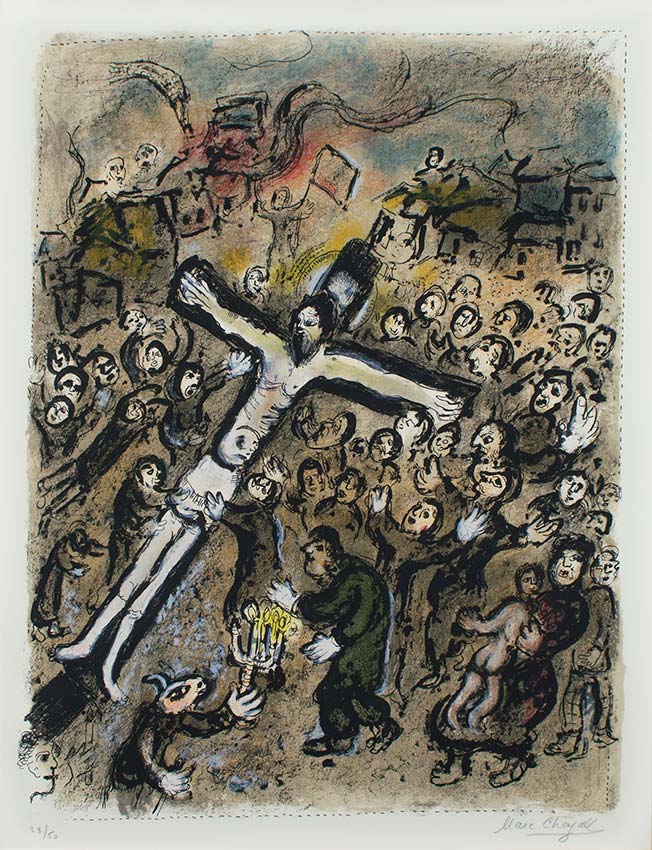
“The Martyr” by Marc Chagall, 1970

All the things the old sacrificial system did for worshipers are now completely fulfilled in the person of Jesus.  Condensed in just a few verses of Scripture, we have a very rich picture of Jesus:

  • Jesus is not a temporary priest, but a permanent priest, the one who is able to intercede continually on our behalf without us having to perform a ritual sacrifice.
  • Jesus lives forever, which enables him to never cease his intercessory work.
  • Jesus saves completely.
  • Jesus meets our need.
  • Jesus has been made perfect forever.

Yet, sometimes Christians go back to the old sacrificial system, not by physically offering animal sacrifices, but treating Christ’s once-for-all finished work as if it were just too good to be true. We reason that we need to do something to help save ourselves. Although Jesus has saved us fully, and therefore, there is no longer any need for sacrifice, yet we still try:

  • To appease God through church attendance or other works, as if the Lord needs to be soothed into not becoming angry at us.
  • To satisfy God through our giving so that the Lord will not have a furrowed brow against us.
  • To assuage our guilty conscience through Christian service, believing this will give us some leverage with God.

In all these kinds of instances, it is going back to an old sacrificial system that is obsolete.

The biblical and theological truth is that Jesus has thoroughly saved us from our sin, and, so, has cleansed us from all guilt, including a guilty conscience.

Jesus meets our need and has completely satisfied God’s wrath against sin. Jesus is our mediator and intercedes for us as we come to God’s throne of grace. That means we do not need to try and get God’s attention with some incredible sacrifice that will somehow obligate him to take notice. 

There is no longer ever a situation where we must run to some spiritual liquor store to pick up a Captain Morgan because the Captain of our souls, Jesus Christ, has already given us everything we need.

Since Jesus has been made perfect forever; is our great high priest; and is the once-for-all sacrifice to end all sacrifices, we have all the grace we need. 

We need not worry anymore about being good enough because Jesus is perfect. Christ’s work is made complete in us. The constant anxiety of feeling we don’t measure-up is not from God. The person and work of Jesus is sufficient to deliver us from guilt and shame.

“Well,” you might say, “if everybody believed that, then nobody would ever do anything.” No, it’s just the opposite. When we feel like we don’t measure up, we do less, not more. A low level discouragement sets in, and we do nothing because we intuitively know it will never be enough. We do just enough to squeak by, never quite knowing if it is doing anything. 
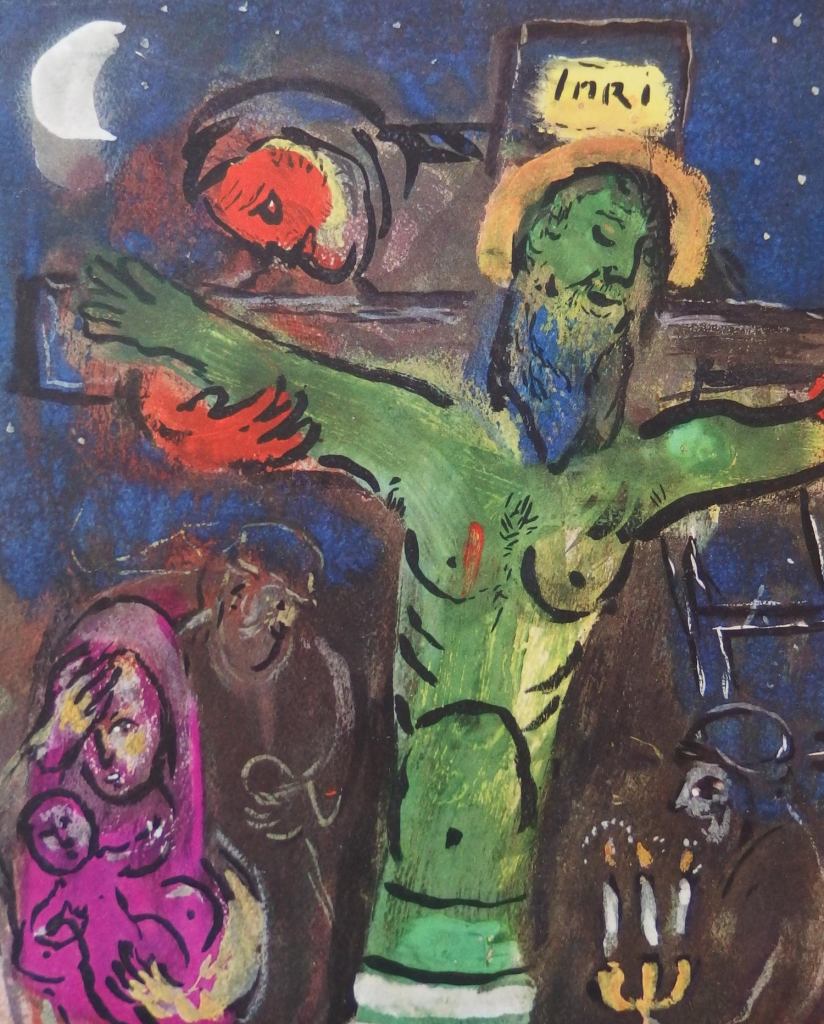
“Crucifixion” by Marc Chagall, 1961

Just like the Hebrew Christians of the first century, we consider giving up because Christianity doesn’t work for us. Yet, when we grasp Christ’s sacrifice to end all sacrifices, and are overwhelmed by grace, then everything we do in the Christian life is a simple desire to say “thank you” with our life and our lips. 

It is the grace, and not the wrath, of God that teaches us to say “no” to ungodliness and worldly passions and to live upright and godly lives (Titus 2:11-12).

The old system wasn’t bad. It served a purpose. Now, however, the old has given way to the new, and there is a better hope by which we draw near to God. The sacrificial system pointed forward to a perfect sacrifice by a permanent priest that would bring us to God forever.

Going back to the old system is like living permanently in a tent, and believing you are home.

Therefore, we must choose what is better. The options are not so much between what is bad and what is good, but between what is good and what is better than good. It is possible to do all kinds of good things and miss the better thing God is doing. 

So, how do we choose the better thing? How do we embrace the new, which is Christ, and not the old, which is the sacrificial system?

  1. Learn to say “no” to the treadmill going nowhere. Since we do not need to impress God, we have the freedom to say “no” to keeping up with the spiritual Jones’s; “no” to cajoling God’s favor, approval, or attention.
  2. Learn to say “yes” to engaging in spiritual practices which remind us of Christ. Say “yes” to the new way of the Spirit, which is by faith and not by sight. This present spiritual age is often intangible, ethereal, and unseen. It requires a new set of spiritual eyes to see.
  3. Let Christianity be about Jesus, and not about us. Resist the allure to rescue others, or have others rescue you. The work of rescue has already been done. Christ saves, we don’t.
  4. Know the better thing over the good thing. Pause before acting or re-acting. Are we expecting someone else to do what Christ has already done? Are we looking to do something we think will make God like us better? Remind yourself of Jesus and his redemption every day in small ways through Scripture reading and prayer, fellowship, and loving service.

Good people can love God, and yet, miss the opportunity to see they are already justified through Christ’s blood. We do not need to justify ourselves. We need to live into the justification we possess by grace through faith.

May it be so to the glory of God.

Hebrews 6:13-20 – Holding onto Hope

When God made his promise to Abraham, since there was no one greater for him to swear by, he swore by himself, saying, “I will surely bless you and give you many descendants.” And so, after waiting patiently, Abraham received what was promised.

People swear by someone greater than themselves, and the oath confirms what is said and puts an end to all argument.Because God wanted to make the unchanging nature of his purpose very clear to the heirs of what was promised, he confirmed it with an oath. God did this so that, by two unchangeable things in which it is impossible for God to lie, we who have fled to take hold of the hope set before us may be greatly encouraged. We have this hope as an anchor for the soul, firm and secure. It enters the inner sanctuary behind the curtain, where our forerunner, Jesus, has entered on our behalf. He has become a high priest forever, in the order of Melchizedek. (New International Version)

“We must accept finite disappointment, but never lose infinite hope.”

Martin Luther King, Jr.

Humanity needs hope. We all require a confident expectation that things will be different or better. Hope is what our ancestors in faith had in abundance.

How did Abraham receive what was promised by God?

Abraham received what was promised because of hope. He believed God’s promise of having a place to belong. His faith caused him to make a major move from the city where he had always lived. What’s more, Abraham understood that the promises of God don’t end in this life. He looked forward to being a permanent resident in the eternal city.

By faith Abraham obeyed when he was called to go out to a place that he was going to receive as an inheritance. He went out without knowing where he was going. By faith he lived in the land he had been promised as a stranger. He lived in tents along with Isaac and Jacob, who were coheirs of the same promise. He was looking forward to a city that has foundations, whose architect and builder is God. (Hebrews 11:8-10, CEB)

Why did God swear an oath to Abraham?

The Lord wanted to reinforce Abraham’s faith and encourage him. God desired to convincingly show that divine promises are sure.

The Lord spoke to Abram in a vision and said to him, “Do not be afraid, Abram, for I will protect you, and your reward will be great.” But Abram replied, “O Sovereign Lord, what good are all your blessings when I don’t even have a son?…. You have given me no descendants of my own, so one of my servants will be my heir.”

Then the Lord said to him, “No, your servant will not be your heir, for you will have a son of your own who will be your heir.” Then the Lord took Abram outside and said to him, “Look up into the sky and count the stars if you can. That’s how many descendants you will have!” And Abram believed the Lord, and the Lord counted him as righteous because of his faith. (Genesis 15:1-6, NLT)

What are the “two unchangeable things?”

The promise and the oath. God promised to Abraham:

“I will make you into a great nation,
    and I will bless you;
I will make your name great,
    and you will be a blessing.
I will bless those who bless you,
    and whoever curses you I will curse;
and all peoples on earth
    will be blessed through you.”(Genesis 12:2-3, NIV)

God confirmed the promise with an oath:

“I swear by myself, declares the Lord, that because you have done this and have not withheld your son, your only son, I will surely bless you and make your descendants as numerous as the stars in the sky and as the sand on the seashore. Your descendants will take possession of the cities of their enemies, and through your offspring all nations on earth will be blessed, because you have obeyed me.” (Genesis 22:16-18, NIV)

Is there a way to be motivated and encouraged in the Christian life?

Yes. Hope in God’s promises and the confidence that our efforts to live for Christ are being seen and they are not in vain. We need one another. So, it is important to maintain significant relationships with other believers so that we will not lose our spiritual vitality and become discouraged. The author of Hebrews also stated:

We should keep on encouraging each other to be thoughtful and to do helpful things. Some people have gotten out of the habit of meeting for worship, but we must not do that. We should keep on encouraging each other, especially since you know that the day of the Lord’s coming is getting closer. (Hebrews 10:24-25, CEV)

Faith and patience, fueled by an unshakable hope, has always been the way believers have lived their lives. For the Christian, we have a promised inheritance, focused on the person and work of Christ. All of God’s good promises are fulfilled in Jesus.

God of hope, in these times of change, unite us and encourage us with your promise and oath. Help us overcome our fears and enable us to build a future in which all may prosper and share, through Jesus Christ our Lord. Amen.

Hebrews 6:1-12 – Don’t Give Up

Therefore, let us move beyond the elementary teachings about Christ and be taken forward to maturity, not laying again the foundation of repentance from acts that lead to death, and of faith in God, instruction about cleansing rites, the laying on of hands, the resurrection of the dead, and eternal judgment. And God permitting, we will do so.

It is impossible for those who have once been enlightened, who have tasted the heavenly gift, who have shared in the Holy Spirit, who have tasted the goodness of the word of God and the powers of the coming age and who have fallen away, to be brought back to repentance. To their loss they are crucifying the Son of God all over again and subjecting him to public disgrace. Land that drinks in the rain often falling on it and that produces a crop useful to those for whom it is farmed receives the blessing of God. But land that produces thorns and thistles is worthless and is in danger of being cursed. In the end it will be burned.

Even though we speak like this, dear friends, we are convinced of better things in your case—the things that have to do with salvation. God is not unjust; he will not forget your work and the love you have shown him as you have helped his people and continue to help them. We want each of you to show this same diligence to the very end, so that what you hope for may be fully realized. We do not want you to become lazy, but to imitate those who through faith and patience inherit what has been promised. (New International Version)

Whenever things get tough and really hard, it is inevitable that there will be people who drop out. It happens in every arena of life, including the Christian life. Sometimes life becomes so overwhelming that we feel like we’re just not making a dent in any of our issues or responsibilities. It is tempting to simply give up and leave it all behind.

Today’s New Testament lesson addresses a group of people who were considering leaving the Christian faith. Some folks had already left, causing confusion with the people still around about how to think about this and what to do going forward.

Who is the author talking about?

He’s talking about those who made a profession of Christ. Are they actual Christians? This gets at the heart of what makes a Christian a Christian. And the answer is that a Christian exhibits both faith and obedience, both trust and perseverance. Real Christians profess the name of Christ with their mouths and demonstrate faith with their actions by obeying the words and ways of Jesus.

What are they in danger of?

Apostasy is a deliberate and intentional renouncing of faith with no intention of ever going back to Christ. An apostate is a person who once professed faith, then rescinded it. This is the author’s point for crafting his message to the struggling Christians. In their hardship, they were seriously toying with the notion of leaving Christianity altogether.

Why would they ever renounce their faith?

Because of hard circumstances, spiritual overwhelm, and grinding tiredness. Adverse situations never leave us the same. They either make us bitter or better, depending upon our response to them. If Christians believe that the Christian life should be an unending journey of victory and glory in this life, disappointment will settle in rather quickly. Missed expectations are typically the manure which fertilizes the field of apostasy.

How can they be restored?

The author of Hebrews makes it clear that they cannot – not because God never gives second chances to people but because the hardness of heart in the apostate is such that they have no intention or desire to live for Jesus. In fact, they now have a hatred of Christ and show contempt for him. We are not talking about flaky or fickle people. We are talking about folks who, with their full faculties intact, put as much energy into resisting, rejecting, and renouncing Christ as they can. This isn’t a momentary lapse in judgment. Rather, it is a calculated decision to hate all that is Christian, after having once loved it.

Where does this happen?

It happens in the heart. When Jesus told his parable of the soils, he was not talking about four different kinds of Christians. The point of Christ’s parable is that there is only one kind of Christian – the other three simply demonstrated they were not the genuine article to begin with. All four professed faith but only one proved it through growth, maturity, and harvest. (Matthew 13:1–23; Mark 4:1–20; Luke 8:4–15)

According to Jesus, there is either no response, a superficial response, a temporary response, or a genuine response. The person who does God’s will is the real deal.

Some people make a dichotomy between faith and obedience, as if they are separate things. Yet, in truth, they are a package deal and cannot be separated. The following all belong together and are not to have any division between them. It is a matter of “and,” not “or.”

Faith and works.

Past and future.

Grace and merit.

Event and process.

People fall away from their faith commitments when they are unable or unwilling to hold the “and’s” together. Whenever the rocks and thorns of life hit them and stick them in ways they don’t like, it is crucial to respond in a way which doesn’t compromise staying on a path of spiritual maturity.

So, where are you on the journey of faith? How do you handle missed expectations and grave disappointments? Are you okay? What do you need? Are there ways others can help?

There are other options besides giving up. Go ahead and explore them.

Grant, O God, that I may never lose the way through self-will, and so end up in the far countries of the soul; that I may never abandon the struggle, but endure to the end; that I may never drop out of the race, but ever press forward to the goal of my calling; that I may never choose cheap and passing things, and embrace the eternal; that I may never take the easy way, and so leave the right way; that I may never forget that sweat is the price of all things, and that without the cross, there cannot be the crown.

So, keep your people and strengthen us by your grace that no disobedience and no weakness and no failure may stop us from entering into the blessedness which awaits those who are faithful in all the changes and chances of life down even to the gates of death, through Jesus Christ our Lord. Amen

Hebrews 5:1-10 – Our Great High Priest

Mosaic of Jesus Christ in the Hagia Sophia, Istanbul, Turkey

Every high priest is selected from among the people and is appointed to represent the people in matters related to God, to offer gifts and sacrifices for sins. He is able to deal gently with those who are ignorant and are going astray, since he himself is subject to weakness. This is why he has to offer sacrifices for his own sins, as well as for the sins of the people. And no one takes this honor on himself, but he receives it when called by God, just as Aaron was.

In the same way, Christ did not take on himself the glory of becoming a high priest. But God said to him,

“You are my Son;
    today I have become your Father.”

And he says in another place,

“You are a priest forever,
    in the order of Melchizedek.”

During the days of Jesus’ life on earth, he offered up prayers and petitions with fervent cries and tears to the one who could save him from death, and he was heard because of his reverent submission. Son though he was, he learned obedience from what he suffered and once made perfect, he became the source of eternal salvation for all who obey him and was designated by God to be high priest in the order of Melchizedek. (New International Version)

The New Testament letter of Hebrews is perhaps the most Christ-centered book in all the Bible. If you like Jesus, or are at all intrigued by him, this is the best place to go, outside the four Gospels.

Hebrews deliberately points out and exalts the supremacy of Jesus Christ over the Old Testament prophets, the angelic realm, and even Moses and the Law. And, as today’s New Testament lesson insists, Jesus is superior to the old Levitical priesthood because Christ is our salvation. His priesthood is from a different and better order.

With all this talk in Hebrews about Christ’s superiority over everything, some might expect a focus on his deity. Yet, it is the humanity of Jesus which gets the most attention. The actual lived experience of Jesus on this earth is the highest qualification there is to intercede between God and us.

Jesus, as a true bona fide human person, had to learn obedience just like the rest of us. He went through all the hardships and sufferings of life, too. Jesus was dependent on prayer, just as we are. And he was heard by God the Father because of his reverent submission.

One of the great deceptions which can befall Christians is that Christianity is all about strength, victory, and glory. That, however, is only part of the story. If Jesus needed to learn and grow by means of suffering, then how much more do we need to be spiritually formed through the adversities, challenges, and heartaches of life?

Jesus Christ proved himself through his obedience to God. Even though he himself was God, he submitted himself to being human with all of it’s limitations, weaknesses, and pains. Through it all, Christ maintained perfect submission and obedience to the will of God.

All of this means that Jesus, the pioneer and perfecter of our faith, is eminently qualified to be our great high priest. Jesus can relate to us. Jesus knows us. Jesus understands what it’s like for us. And Jesus has dealt with the endemic issue of guilt and shame once for all through the cross.

So, what does this mean for you and me? Without a realization of who Jesus is, what he did for us, and continues to do for us, we easily take Christ for granted and slip into spiritual lethargy – and perhaps even spiritual self-loathing – and needlessly suffer in loneliness and despair.

The truth is: Jesus Christ loves us. He has become our high priest, the one who is able to intercede for us – constantly taking our prayers and advocating for us to God the Father.

Let Christians everywhere be reminded that we serve a Trinitarian God – Father, Son, and Spirit – who conspires to do what is best for us, at all times. There is a divine community of three persons, the Holy Trinity, who work seamlessly and with perfect unity to provide deliverance from sin, death, and hell. The God whom we serve is both willing and capable to meet our most pressing needs.

Here are 17 ways we can live into being mature Christian believers who are spiritually growing in the grace of God:

  1. Realize God has called you to be holy and righteous and has given you everything you need to do so. (2 Peter 1:3-4)
  2. Be an integral part of a Christian faith community so that you can be encouraged and encourage others. (Hebrews 10:24-25)
  3. Listen to the counsel of others and discern what is good and what is not. (Philippians 1:9-11)
  4. Stick to a consistent regimen of Bible reading and Scripture study. (Hebrews 4:12-13)
  5. Find good books to read and go through them carefully. (2 Timothy 2:15)
  6. Seek to obey Holy Scripture with all your heart. (Psalm 119:89-96)
  7. Persevere and keep growing spiritually. (Hebrews 10:35-36)
  8. Pray continually, realizing your utter dependence on Christ. (1 Thessalonians 5:16-18)
  9. Always look for ways to praise God and serve Christ. (2 Corinthians 1:1-7)
  10. Consider the consequences of your words and actions before you say and do them. (Galatians 6:7-10)
  11. Enjoy God and God’s people. (Philippians 4:4-9)
  12. Understand that the Christian life is not always easy. (Philippians 1:27-30)
  13. Be patient: Spiritual growth and maturity take time. (Hebrews 6:1-3)
  14. Use the spiritual gifts given to you for the benefit of others. (Romans 12:3-8)
  15. Make plans with other like-minded persons to become spiritually self-disciplined. (Proverbs 27:17)
  16. Pursue genuine and intimate spiritual friendships. (2 Corinthians 7:1-4)
  17. Engage in spiritual conversation and prayer around the Bible’s contents and message. (Colossians 4:2-6)

Gracious Father, we pray for Christ’s Church. Fill it with all truth and peace. Where it is corrupt, purify it; where it is in error, direct it; where in anything it is amiss, reform it. Where it is right, strengthen it; where it is in want, provide for it; where it is divided, reunite it; for the sake of Jesus Christ, your Son, our Savior. Amen.