Hebrews 10:11-25 – Don’t Give Up!

Day after day every priest stands and performs his religious duties; again, and again he offers the same sacrifices, which can never take away sins. But when this priest had offered for all time one sacrifice for sins, he sat down at the right hand of God, and since that time he waits for his enemies to be made his footstool. For by one sacrifice, he has made perfect forever those who are being made holy.

The Holy Spirit also testifies to us about this. First he says:

“This is the covenant I will make with them
    after that time, says the Lord.
I will put my laws in their hearts,
    and I will write them on their minds.”

Then he adds:

“Their sins and lawless acts
    I will remember no more.”

And where these have been forgiven, sacrifice for sin is no longer necessary.

Therefore, brothers and sisters, since we have confidence to enter the Most Holy Place by the blood of Jesus, by a new and living way opened for us through the curtain, that is, his body, and since we have a great priest over the house of God, let us draw near to God with a sincere heart and with the full assurance that faith brings, having our hearts sprinkled to cleanse us from a guilty conscience and having our bodies washed with pure water. Let us hold unswervingly to the hope we profess, for he who promised is faithful. And let us consider how we may spur one another on toward love and good deeds, not giving up meeting together, as some are in the habit of doing, but encouraging one another—and all the more as you see the Day approaching. (New International Version)

The book of Hebrews was originally a sermon preached to a group of struggling Jewish Christians who were discouraged. They were a congregation in decline. The preacher’s approach throughout is to demonstrate that Jesus is better and superior to anything or anyone ever.

With this high view of the person and work of Christ, the preacher comes to the punch line of his sermon. He insists that what the believers need is perseverance to keep going – no matter what adversity they face. For without the ability to endure hardship, the sagging congregation would continue to decline and eventually give up.

Yet, giving up is not an option when it comes to the Christian life. The Christians may not have been going through a Job-like experience, but they needed to get some spiritual spine to them so that they could stand up for Jesus. 

Sometimes, because most of life is lived in the mundane, we can slowly drift from our spiritual moorings and just go through the motions of Christianity without really living for Jesus. Boring and repetitive work; the monotony of caregiving; the tedium of busywork; and the continual grind of it all can be an effective tool in the devil’s workshop. 

When we begin sleepwalking through life, we are in danger of wandering from faith. We then need some stout spiritual stamina. “I didn’t sign up for this!” can be the cry of both the person who is downtrodden with hard circumstances, as well as the person who is simply living a dull life. 

We all have our quitting point – that point where we say, “enough is enough” and we give up and cry uncle. Those times usually come when the pain or inconvenience of what is happening overcomes the resolve to persevere. The devil keeps detailed notes on everyone’s quitting points, and he tries to get us to that point of being ineffective and giving up on the Christian life. 

It easily begins with some minor irritation or complaint against from another. Then moves further along by the loss of someone close. Frustration mounts if financial hardship happens. After a while, if things do not markedly improve, living day in and day out with missed expectations and disappointing situations may lead to bailing out, blowing up, or binging on a sinful desire.

At the quitting point, we throw up our hands, wrongheadedly believing others don’t care and that God is indifferent to our situation.

The preacher of Hebrews knows that the one real measure of a person is the learned ability to push through the quitting points of life. We need endurance and perseverance. But how will we get it?  How can we endure, living for Jesus for the rest of our lives?

There are three indispensable elements of the Christian life, necessary to persevering. Perseverance is a privilege, and not some drudging duty to slog through. Following Jesus for a lifetime comes as we embrace our spiritual privileges.

Faith is the privilege of continually approaching the Lord with confidence

We possess the incredible privilege of approaching the throne of grace with confidence because Jesus has opened the way to God. No longer do we need the elaborate Old Testament sacrificial system in order to approach God. So, let us draw near to God with a sincere heart in full assurance of faith.

We need faith to keep going in the Christian life. Faith is more than doctrinal confession; it is something we experientially live by every day. By faith, we come to God through Jesus – not only soaking in more information but also drawing near to Christ.

Jesus, when on this earth, drew near to the Father. We are to follow Christ in his example. Jesus practiced solitude, silence, and extended times of prayer. Our Lord oriented his teaching and healing ministry around his relationship with the Father by engaging in basic spiritual disciplines that put him in a position to hear and listen so that he could then do the will of God. 

“We can all see God in exceptional things, but it requires the culture of spiritual discipline to see God in every detail.”

Oswald Chambers

A successful student orients her life around certain study disciplines in order to learn and reach graduation day. A winning athlete orients his life around certain daily practices in order to develop the skills needed to face the upcoming competition. Likewise, if we want to follow Christ and draw near to God, we need to reorient our time and commitment in order to take advantage of the privilege of growing and maturing in Jesus. 

The perspective of Hebrews is that we must orient our lives around basic disciplines of faith and put our hands out in order to receive the gift of faith God wants to give us.  Faith is a muscle that must be exercised, or it will atrophy and become useless. And with puny weak faith muscles, it is easy to give up because we have no “umpff” for the Christian life.

Hope is the privilege of living for Jesus with a confident expectation that God keeps divine promises

Perseverance requires hope. Hopelessness happens without the continuing practice of faith expressed in drawing near to God. Hope in Scripture is not wishful thinking; it is a confident expectation that God is good for his promises. 

Hope enables us to bank on the words and ways of Jesus. In those times when we feel hopeless; when there is negativity in the air that brings us to the quitting point; when we sense a season of blessing is not going to come; it is in those very times the preacher of Hebrews says to hold unswervingly to your profession.

We will not always squint our spiritual eyes, looking for the least little hope. Just as young mothers must remember that constant lack of sleep and caring for a needy infant is not always going to be the status quo; just as kids must remember that they will not be in school for the rest of their lives; in the same way, we must remember that God will accomplish everything he sets out to do; that there is an end and a goal to Christianity; and we will be richly rewarded if we keep going and do not give up.

Love is the privilege of encouraging fellow believers

We are to pay thoughtful attention to one another. Believers are to take an interest in each other’s welfare, and put some significant thought into how to spur, incite, cajole, and provoke others into keeping up with Jesus. 

A major opportunity for encouragement is corporate gatherings. Attendance is not an end in itself. Worship services, small group Bible studies, and other ministries of the Church are important because they are moments for us to encourage other people.

Let’s play good response/bad response to this. Bad response: “I feel guilty about what you just said, so I will try harder to love and encourage others.” That’s a prescription for frustration and failure. It ends in reaching the quitting point because we are focusing too much on the strength of our own will, or lack thereof.

Good response: “Wow!  God wants to use me to love other people! I’ll seek to know Jesus better so that I can learn to live and love, just like him. I can’t wait to encourage someone and build them up in the faith.”

Church is not optional equipment for the Christian life. We need each other. We need the Church.

“Love cannot exist in isolation: away from others, love bloats into pride. Grace cannot be received privately: cut off from others, it is perverted into greed. Hope cannot develop in solitude: separated from the community, it goes to seed in the form of fantasies. No gift, no virtue can develop and remain healthy apart from the community of faith. ‘Outside the church there is no salvation’ is not ecclesiastical arrogance but spiritual common sense, confirmed in everyday experience.”

Eugene Peterson

“No one can have God as his Father who does not have the Church as his Mother.”

Cyprian (210-258 C.E.) Bishop of Carthage

“May Christians be guided by the Church’s maternal care until they grow up to maturity and attain the perfection of faith…. To those whom God is a Father, the Church must also be a Mother.”

John Calvin

The Church:

  • Creates a unique presence with God. (Matthew 18:20)
  • Provides the nurture, guidance, and encouragement necessary for spiritual development. (Romans 12:4-5)
  • Helps form our identity as Christians. (Ephesians 2:19-20)
  • Enables endurance through suffering and brings comfort and encouragement in difficult times. (James 5:14-15)
  • Nourishes with the Word in preaching and sacrament. (Acts 2:46-47)
  • Lifts up godly examples to imitate. (1 Corinthians 4:16)
  • Intervenes when sheep go astray. (Colossians 3:16)
  • Fosters spiritual transformation. (Philippians 2:12)
  • Brings maternal care and help. (1 Thessalonians 2:7)

Conclusion

Let’s be encouragers – loving others with the grace of Jesus. The following are six types of encouragers displayed in the book of Hebrews for us to emulate:

  1. The Promoter. Cheering others on to endurance. We are surrounded by a great cloud of witnesses cheering us on and promoting us to push through the quitting points. They did it, and so can we (12:1).
  2. The Professor. Affirming others’ work as valuable and important. God will not forget your work and the love you have shown God’s people and how you continue to help them (6:9-10).
  3. The Preacher. Rebuking and admonishing in love (Proverbs 27:5). We must pay more careful attention to what we have heard, so that we do not drift away.  How shall we escape punishment if we ignore such a great salvation? (2:1-3).
  4. The Prayer Warrior.  Approaching the throne of grace with confidence, so that we may receive mercy and find grace to help us in our time of need (4:16).
  5. The Partner. Coming alongside one another daily so that no one may be hardened by sin’s deceitfulness” (3:13).
  6. The Pastor. Shepherding others through the confusing situations of life. Jesus suffered outside the city gate to make the people holy through his own blood. Together, let’s go to him outside the camp, bearing the disgrace he bore, as we look forward to the heavenly city to come (13:12-14).

It’s our privilege to persevere through the spiritual gifts of faith, hope, and love. Use them for building up one another so that together we can endure for a lifetime.

Hebrews 9:24-28 – Forgiveness Is Real

Photo by Pixabay on Pexels.com

For Christ did not enter a sanctuary made with human hands that was only a copy of the true one; he entered heaven itself, now to appear for us in God’s presence. Nor did he enter heaven to offer himself again and again, the way the high priest enters the Most Holy Place every year with blood that is not his own. Otherwise Christ would have had to suffer many times since the creation of the world. But he has appeared once for all at the culmination of the ages to do away with sin by the sacrifice of himself. Just as people are destined to die once, and after that to face judgment, so Christ was sacrificed once to take away the sins of many; and he will appear a second time, not to bear sin, but to bring salvation to those who are waiting for him. (New International Version)

Jesus is the central figure of the Bible. I could preach on the finished work of Christ every Sunday and never exhaust the immensely rich implications of his death for us. 

Maybe today’s verses seem like a re-hashing of things we already know. Yet, it is important to keep plumbing the depths of Christ’s once for all sacrifice because it is through continually examining Jesus that we will experientially know our forgiveness is real. Having this reality sink deep into our souls enables us to extend forgiveness to others.

The original recipients of Hebrews were experiencing spiritual fatigue due to their difficult circumstances. The believers were so tired from swimming upstream that they considered quitting and giving up on Christianity (or at least the Church). 

The author of Hebrews truly believed that the way to combat this tiredness was through a robust understanding of Christ.  So, he sought to demonstrate that Jesus is superior to the old sacrificial system and has even superseded it. 

There are three main distinctions between the old sacrificial system and the new way of Christ. They are meant to encourage us so that we will know our forgiveness is real. This awareness will help us persevere and live for Jesus in all we say and do, until he returns.

First Distinction: Reality versus a Simulated Copy

The Old Testament sacrificial system, and its worship rituals in dealing with the sin issue, were only a copy and a shadow of the real sacrifice, which is Christ. The Temple sacrifices, in other words, were merely a facsimile of the real thing.

When my girls were small, they always enjoyed going to our local large grocery store. At that store they had a row of mechanical horses that only cost a penny to ride for one minute.  Riding the horses was always the highlight of shopping for them. Their Aunt once came for a visit and brought a coffee can full of pennies and took them to the grocery store just to ride the horses for an afternoon. 

All three of my girls are now grown adult women. They do not ride mechanical horses anymore. They now ride real live horses. My daughters, as excited as they were to ride mechanical horses as small girls, now have no desire to do so because those horses were only a simulation of the real thing.

As Christians, since Christ has come as the true and real sacrifice for sin, we are no longer to be content with simulations and copies of the real deal.  And we are to know the difference between them. Our forgiveness is neither a simulation nor a copy because Christ is the real thing. 

As my girls were growing up, my wife and I had a certain process we went through with them when they did something wrong toward one another. We would talk about the offense, and then they would need to say the words, “I am sorry.” 

However, the matter was never over until they hugged each other and told each other they loved the other. If they could do that, it was the real deal. You see, they could mouth the words to get us off their backs, but to hug and express love was the reality.

“To be a Christian means to forgive the inexcusable because God has forgiven the inexcusable in you.”

C.S. Lewis

Jesus did not just mouth words of forgiveness to us. He secured it through his death on a cross. It is not a cheap imitation kind of forgiveness. It is real. Christ died a violent death. The emphasis in Scripture on blood and sacrifice can be upsetting for many people.

Yet, we need to understand that the brokenness of this world is so bad that it requires drastic action. Christ’s death reflects the horrible sin of humanity. Since Jesus has secured forgiveness for us at such a steep price, we are to receive it with great humility and joy that God loves us that much.

Second Distinction: Once versus Endless Repetition

Jesus Christ came to deal with the sin issue once for all through his blood. He came to do away with sin, not just veneer over it. The old sacrificial system was like whitewashing a barn – it took care of the issue for a while, but it would need to be done over and over again.

We are familiar with temporary arrangements. For example, annual fees need to be paid and renewal stickers have to be put on a car’s license plate every year. Christ’s atonement, however, is no temporary arrangement. The forgiveness Jesus offers is permanent. 

There is no need to keep offering sacrifices over and over because Christ is the sacrifice to end all sacrifices. The forgiveness we possess is not like paying an annual fee and getting a forgiveness sticker for the year. In Jesus Christ, we are forgiven! And this forgiveness was purchased with Christ’s own blood.

Author Henri Nouwen once told a story of a family he knew in Paraguay. The father, a doctor, spoke out against the military regime there and its human rights abuses. Local police took their revenge on him by arresting his teenage son and torturing him to death. Enraged townsfolk wanted to turn the boy’s funeral into a huge protest march, but the doctor chose another means of protest.

At the funeral, the father displayed his son’s body as he had found it in the jail—naked, scarred from electric shocks and cigarette burns, and beatings. All the villagers filed past the corpse, which lay not in a coffin but on the blood-soaked mattress from the prison. It was the strongest protest imaginable, for it put injustice on grotesque display.

“Forgiveness means that I continually am willing to forgive the other person for not being God.”

Henri Nouwen

The cross that held Christ’s naked and marred body exposed the violence and injustice of this world. The cross revealed what kind of world we have and what kind of God we have: a world of gross unfairness, and a God of sacrificial love. Because Jesus was willing to do this on our behalf, we have forgiveness once and for all through his blood.

This world needs forgiveness – not a cheap sentimental forgiving but a real forgiveness that lasts forever. 

Third Distinction: Salvation versus Judgment

A lot of religious energy can be spent trying to figure out how to make ourselves acceptable to God. Part of the good news is that, in Christ, we do not need to fear the future.  We have been made right with God through the death of Jesus. Through Christ’s sacrifice the doors to heaven and earth get flung wide open. The way has been secured, the trail has been blazed, and the road has been made smooth to come to God.

Jesus, unlike any Levitical priest, has entered God’s presence, providing access to the living God. Christ did not need to offer sacrifice for his own sins but offered himself solely on our behalf. Jesus did more than offer the sacrifice; he himself became the sacrifice. It was a sacrifice to bring deliverance to humanity, not judgment.

Either to justify or to judge is God’s business, not ours. Our concern is to believe in the once for all sacrifice of Jesus that brings a permanent forgiveness; and, to share that life-giving message with others so that they, too, can experience deliverance from sin, death, and hell.

We can have such a hard time forgiving others because we struggle with experiencing our own forgiveness. The path to extending grace to others is in deepening our knowledge, understanding, and awareness of God’s grace in Christ.

Conclusion

The author of Hebrews meant for the Christian life to be an exciting and abundant adventure following Jesus, the pioneer of our salvation. And yet, many Christians do not know anything about this kind of life. They only see the Christian life as a duty and a chore, a kind of cross to bear. 

It is important we recognize it is our Lord and Savior, Jesus Christ, the object of our faith, who has delivered us so that we can live a new life of freedom enjoying our forgiveness and inviting others on the journey.

There was once an immigrant that booked passage on a ship with just enough money to buy a ticket, a block of cheese and some crackers for a long voyage. The first few days at sea the crackers and cheese tasted good, but eventually they became stale.

As he watched the porters carry large steaks, lobsters, chicken, beautiful salads and many other delicious foods to the other guests, he became so hungry that he finally stopped one of the porters. “I’II do anything to get one of those steaks,” he said. “I’II wash dishes, clean rooms, even mop the deck.” The porter replied, “You bought a ticket, didn’t you? The meals come with the ticket.”

Too many people today are cheese and cracker Christians—missing out on all of God’s steak dinners. All the resources of God are available to us, yet far too many of us live in self-imposed spiritual poverty. 

For he has rescued us from the dominion of darkness and brought us into the kingdom of the Son he loves, in whom we have redemption, the forgiveness of sins. (Colossians 1:13-14, NIV)

Jesus did not die on the cross and rise from the dead so that we could live ho-hum Christian lives. He has granted us forgiveness so that we will eagerly enjoy the Word of God; enjoy laboring together in the Gospel; and look forward to how the Spirit will transform lives through Christ’s forgiveness. 

Real forgiveness opens our minds, hearts, and our energies to live for Jesus, the pioneer of our salvation.

Hebrews 9:11-14 – A Clear Conscience

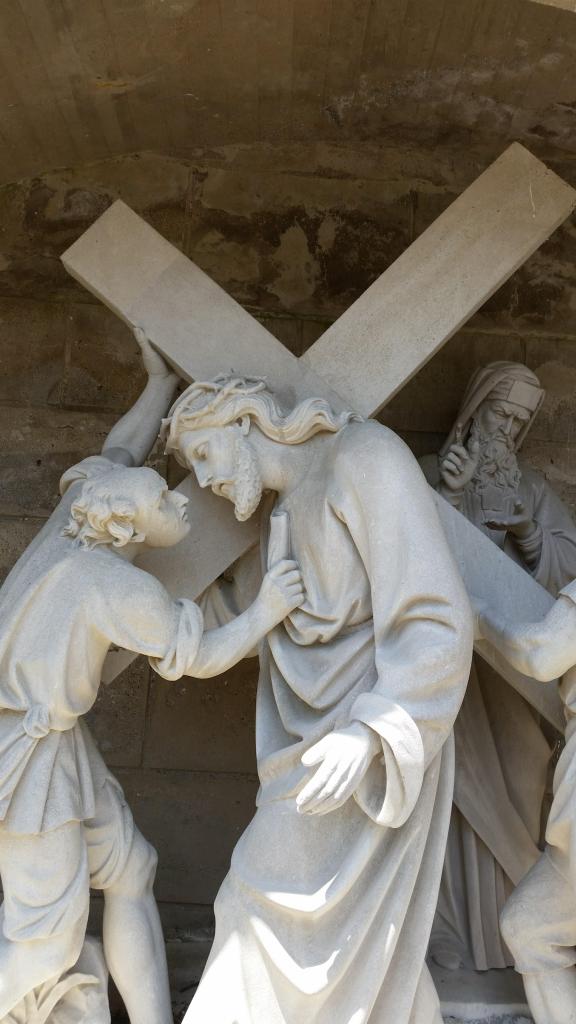
Stations of the Cross at Holy Hill, Hubertus, Wisconsin

When the Messiah arrived, high priest of the superior things of this new covenant, he bypassed the old tent and its trappings in this created world and went straight into heaven’s “tent”—the true Holy Place—once and for all. He also bypassed the sacrifices consisting of goat and calf blood, instead using his own blood as the price to set us free once and for all. If that animal blood and the other rituals of purification were effective in cleaning up certain matters of our religion and behavior, think how much more the blood of Christ cleans up our whole lives, inside and out. Through the Spirit, Christ offered himself as an unblemished sacrifice, freeing us from all those dead-end efforts to make ourselves respectable, so that we can live all out for God. (The Message)

We all have times when we feel guilty. Guilt, in and of itself, is a good thing. Guilt is the response of our conscience telling us we have done something wrong or have not done the good we know we ought to have done. It’s what we do with the guilt that determines the trajectory of our Christian lives. There are several ways we can respond to guilt.

  1. Denial. We can deny and rationalize our guilt by not accepting the truth about what we have done. Using phrases such as, “It’s not my fault,” “It’s only wrong if I get caught,” “I didn’t hurt anybody,” “They deserved it,” and “It’s not that bad,” has the effect of searing our conscience like a hot iron so that we eventually do not feel guilty. The inevitable result of this is hardness of heart.
  2. Shame. Another inappropriate way of dealing with guilt is the opposite of denying guilt; it is to hyper-focus on the guilt by feeling ashamed. Guilt feels bad for actions done or not done. Shame, however, feels bad for who I am, as if I am incapable of being good. Shame believes I do bad things because I am bad and deserve the consequences. In other words, shame is really false guilt.
  3. Inaction. Shame and false guilt may result in despair. We become inactive because of feeling discouraged or defeated. We might reason to ourselves, “What’s the point? I screw up everything I do.” So, we do nothing.
  4. Hyperactive. Some folks become a flurry of activity, working like crazy to feel better in the hope that guilt and shame disappear. It is to impose a penance upon yourself to try and cope with the icky feeling of guilt.

            The good news is that we can experience freedom from guilt and a clear conscience because of Jesus Christ.

  • If we have been victimized in the past, we no longer have to feel ashamed as though we caused or deserved the violence done to us.
  • If we have said or done some truly egregious things that displease God and damage others, we no longer have to live with the regret and the guilt on our consciences. 
  • If we have failed others and God by not living up to who we ought to be, we no longer have to live day after day with our consciences bound with guilt and shame.

            There are three reasons from Hebrews which tell us why we can have freedom from guilt and live with a clear conscience. They all focus on the person and work of Jesus Christ.

Christ has obtained eternal redemption for us by his blood.

Under the old sacrificial system, year after year, the priest offered the same sacrifices which never took away sin. The animal sacrifice was an act of worship in which the worshiper acknowledged guilt before God. The continuous ritual was designed to point forward to a better sacrifice.

The worshiper was purposely led to think, “Wouldn’t it be great if we didn’t have to do this all the time?” The blood of bulls and goats were an annual reminder of sins – such sacrifices never cleansed the conscience of the worshiper. Jesus Christ, however, is the sacrifice to end all sacrifices. Jesus has secured, once and for all, our eternal redemption through his own blood.

The death of Christ, Holy Hill, Hubertus, Wisconsin

Dr. Samuel Weinstein is the chief pediatric cardiac surgeon for a children’s hospital in the New York City. He once traveled to El Salvador to provide life-saving operations for less-fortunate children. Dr. Weinstein and his team operated on an eight year old boy. Twelve hours into the surgery, the procedure took a deadly turn.  

Dr. Weinstein said, “The surgery had been going well, but he was bleeding a lot and there were not many medicines we would use to stop the bleeding. After a while, they said they couldn’t give him blood because they were running out and he had a rare type.” The boy’s blood type was B-negative, which is present in only two percent of the population.

The only other person in the room with a blood type of B-negative was Dr. Weinstein. Immediately knowing what he had to do, he stepped down from the operating table. As his colleagues continued their work, Dr. Weinstein set aside his scalpel, took off his gloves, and began washing his hands and forearm. Then, in the corner of an unfamiliar operating room, the prestigious doctor from one of the most advanced hospitals in the world sat down to give away his own blood. 

When he had given his pint, Dr. Weinstein drank some bottled water and ate a Pop-Tart. Then—twenty minutes after stepping away from the table—he rejoined his colleagues. After watching his own blood circulating into the boy’s small veins, Dr. Weinstein completed the operation that saved the boy’s heart—and his life.

It is the blood of Jesus Christ which saves us from sin, death, and hell. Our condition is so dire that we can do nothing other than let Jesus deliver us. By faith, we trust Jesus to secure a new life for us free from guilt and shame.

Christ cleanses our consciences.

For some, the greatest prison is not tangible or physical – it is the prison of conscience bound and wracked by guilt and shame. Yet, Jesus has taken care of the problem of a guilty conscience once for all through his blood. Forgiveness comes through Jesus. Christ cleanses us from the inside-out and frees us from being slaves to our guilt.

In 1811, the U.S. government began collecting and storing letters like the following note dated from February 6, 1974: “I am sending ten dollars for blankets I stole while in World War II. My mind could not rest. Sorry I’m late.” It was signed by an ex-GI. And there was this postscript: “I want to be ready to meet with God.”  The U.S. government not only collects and stores these letters, but the Treasury Department established a fund and labeled it the “Conscience Fund.” Since its inception, the fund has grown to almost seven million dollars.

A clear conscience is worth a lot. If we try and impose penance upon ourselves, how do we know when it’s enough? In Christ, we are not just outwardly clean, but inwardly clean because of his finished work on the cross. 

Accepting this reality, through God’s eternal Spirit, helps us experience forgiveness and cleansing. The Holy Spirit takes the redemptive events of Jesus and applies them to our consciences so that we are assured of forgiveness.

Christ sanctifies our service.

In the Old Testament sacrificial system, the high priest entered the temple/tabernacle to offer animal sacrifices. Once a year, on the Day of Atonement (Yom Kippur) the priest entered the Most Holy Place. He slaughtered a heifer, took some blood, and sprinkled it on the altar. 

The priest had bells on his ankles when performing this ritual, along with a rope tied to one ankle. In case the judgment of God broke out on the priest and he was killed, then the other priests could reel him out of the Most Holy Place without entering themselves and being killed, as well.

There were several rituals to perform to access God. And, even then, the sprinkling of blood only outwardly took care of cleansing the people. But when Jesus offered himself once for all, the curtain separating the Most Holy Place from the people was torn from top to bottom. The way has been opened for complete purification, inside and out, a cleansing of the guilty conscience so that we might now serve the living God with freedom and confidence.

Since Christ has obtained redemption for us by his blood, cleansed our consciences, and sanctified our service, here’s how we can live into his finished work:

  • Confess and forsake known sin.

Those who hide their sins won’t succeed [shame] but those who confess and give them up will receive mercy. (Proverbs 28:13, CEB)

If we confess our sins, God will forgive us. We can trust God to do this. He always does what is right. He will make us clean from all the wrong things we have done. (1 John 1:9, ERV)

  • Ask forgiveness and be reconciled to anyone you have wronged. 

Jesus said, “So if you are offering your gift at the altar and remember there that another believer has something against you, leave your gift at the altar. First go away and make peace with that person. Then come back and offer your gift. (Matthew 5:23-24, GW)

  • Make restitution to those you have wronged. 

If any of you commit a crime against someone, you have sinned against me [God]. You must confess your guilt and pay the victim in full for whatever damage has been done, plus a fine of twenty percent. (Numbers 5:6-7, CEV)

  • Don’t procrastinate in clearing your wounded conscience.

Paul said he did his best to keep his conscience clear before God and others (Acts 24:16). Some people put off dealing with their guilt, believing their conscience will clear itself in time – but it will not. Procrastination only allows the guilt feelings to fester. Unchecked guilt eventually turns to shame. Today is the day to deal with guilt.

God forgives, not because of the quality of our prayers, but on the basis of Christ’s blood. We can now take advantage of our wonderful situation of freedom to serve the church and the world because God is bigger than a guilty conscience.

Hebrews 9:1-12 – Remembering Christ Together

Photo by Krivec Ales on Pexels.com

Now the first covenant had regulations for worship and also an earthly sanctuary. A tabernacle was set up. In its first room were the lampstand and the table with its consecrated bread; this was called the Holy Place. Behind the second curtain was a room called the Most Holy Place, which had the golden altar of incense and the gold-covered ark of the covenant. This ark contained the gold jar of manna, Aaron’s staff that had budded, and the stone tablets of the covenant. Above the ark were the cherubim of the Glory, overshadowing the atonement cover. But we cannot discuss these things in detail now.

When everything had been arranged like this, the priests entered regularly into the outer room to carry on their ministry. But only the high priest entered the inner room, and that only once a year, and never without blood, which he offered for himself and for the sins the people had committed in ignorance. The Holy Spirit was showing by this that the way into the Most Holy Place had not yet been disclosed as long as the first tabernacle was still functioning. This is an illustration for the present time, indicating that the gifts and sacrifices being offered were not able to clear the conscience of the worshiper. They are only a matter of food and drink and various ceremonial washings—external regulations applying until the time of the new order.

But when Christ came as high priest of the good things that are now already here, he went through the greater and more perfect tabernacle that is not made with human hands, that is to say, is not a part of this creation. He did not enter by means of the blood of goats and calves; but he entered the Most Holy Place once for all by his own blood, thus obtaining eternal redemption. (New International Version)

A healthy approach to looking at the whole of the Bible is to see it as an unfolding drama of redemption in six acts: 

  1. Creation of the world.
  2. Fall of humanity.
  3. Israel and the law.
  4. The earthly ministry of Jesus.
  5. The Church. 
  6. Return of Christ.

We are presently in act five, the church age. The previous four acts were all important in leading up to this act, just as the scenes in a play all build upon one another.

So, then, Israel and the law had their place in this drama of redemption. But we are no longer in that act. This is one reason why we do not hold to all the ceremonial and sacrificial stipulations of the old covenant because it has been superseded by the new covenant.

The previous act of the law had its limitations. It was never designed to completely clear the conscience of the worshiper. Its purpose was to be a reminder of sins that points forward to a better time when the sin issue would be settled once and for all. That time has come. 

The person and work of Jesus has completely cleared the conscience of the worshiper because his sacrifice is the sacrifice to end all sacrifices. Christ’s finished work is both thoroughly pervasive and completely permanent.

Therefore, there is no longer any need to languish in guilt as though we were stuck in act three of God’s redemption drama. 

We do not need to be reminded of our sins anymore. Instead, we are to be reminded of Christ’s finished work on the cross, and that his blood has washed away our sins. We are to remember rightly and have Jesus before us continually. Our redemption is not temporal, but permanent. 

Taking some time each day to remind ourselves of this new reality and enjoy act five of the drama is both sage and necessary in order to live a successful Christian life. Here are some wonderful privileges to remember together of being united with Christ contained within the book of Hebrews:

  • Church connects to other like-minded people who help us live for God.

Encourage each other every day while you have the opportunity. If you do this, none of you will be deceived by sin and become stubborn. (Hebrews 3:13, GW)

  • Church creates a sacred space for us to relate to the divine.

So, whenever we are in need, we should come bravely before the throne of our merciful God. There we will be treated with undeserved kindness, and we will find help. (Hebrews 4:16, CEV)

  • Church enables us to reflect on gratitude.

Since we are receiving a kingdom that cannot be shaken, let us be thankful, and so worship God acceptably with reverence and awe. (Hebrews 12:28, NIV)

  • Church provides opportunities to serve and give to others.

Keep on loving one another as brothers and sisters. Do not forget to show hospitality to strangers, for by so doing some people have shown hospitality to angels without knowing it. Continue to remember those in prison as if you were together with them in prison, and those who are mistreated as if you yourselves were suffering. (Hebrews 13:1-3, NIV)

  • Church teaches us forgiveness.

“I will forgive their sins and will no longer remember their wrongs.” (Hebrews 8:12, GNT)

  • Church gives us purpose and meaning.

Because Jesus lives forever, his priesthood lasts forever. Therefore, he is able, once and forever, to savethose who come to God through him. He lives forever to intercede with God on their behalf. (Hebrews 7:24, NLT)

Saving God, you sent your Son, the Lord Jesus, to take care of the sin issue once for all through his blood. I give you unending thanks for your grace. May your Holy Spirit press this reality of forgiveness and clarity of conscience firmly into my mind and heart so that I will always live for you in all things. Amen.