A Better System (Hebrews 7:11-22)

Mosaic of Melchizedek, in the Church of Sant’Apollinare, Ravenna, Italy, c.5th century, C.E.

If perfection could have been attained through the Levitical priesthood—and indeed the law given to the people established that priesthood—why was there still need for another priest to come, one in the order of Melchizedek, not in the order of Aaron? 

For when the priesthood is changed, the law must be changed also. He of whom these things are said belonged to a different tribe, and no one from that tribe has ever served at the altar. 

For it is clear that our Lord descended from Judah, and in regard to that tribe Moses said nothing about priests. And what we have said is even more clear if another priest like Melchizedek appears, one who has become a priest not on the basis of a regulation as to his ancestry but on the basis of the power of an indestructible life. For it is declared:

“You are a priest forever,
    in the order of Melchizedek.”

The former regulation is set aside because it was weak and useless (for the law made nothing perfect), and a better hope is introduced, by which we draw near to God.

And it was not without an oath! Others became priests without any oath, but he became a priest with an oath when God said to him:

“The Lord has sworn
    and will not change his mind:
    ‘You are a priest forever.’”

Because of this oath, Jesus has become the guarantor of a better covenant. (New International Version)

The author of the Book of Hebrews argued that the old Levitical sacrificial system was temporary; it was never designed to be permanent. And because it was temporary, the system was insufficient in bringing restoration to God and settling the sin issue once and for all.

Only Jesus could bring perfection to worshipers; the Levitical priests could not. The old system is obsolete, because of Christ. Jesus has brought a new and better way.

Before Google, Wikipedia, and the internet, there were actual physical libraries with lots of books. In order to research anything, you needed to go to the library, use the card catalogue to access what book(s) you needed, check them out, and pour over them to find the information you need.

I grew up in an era of typewriters. I learned to use one. All through my high school and college undergraduate years, I would draft all of my papers by writing with a pen on a legal pad of paper (I have to spell out what it actually was, because not everyone knows what it was like back in the day!).

Then, I would manually type my paper draft on a typewriter. If I made a mistake, I would have to use a fluid called “white out” to cover it, and then type the correction over it. As you can either remember, or imagine, this was a painstaking process.

Finally, the paper was physically submitted to the professor, in person. If you lost the document, or spilled something all over it, you would have to type it all over again.

But back then, when I was doing it, I didn’t know any better. There was no other way to get your papers researched, typed, and submitted.

Computers and the internet changed everything. It made library card catalogues with the Dewey Decimal System, and manual typewriters obsolete.

I have “written” thousands of documents since getting my first computer. A lot of my research is now done on a computer, via the internet. I can draft and finalize a document in one place. And when I’m done, I simply attach the virtual document to an email and send it. The entire process of “writing a paper” takes a fraction of the time it took me decades ago – with a lot less hassle.

I still remember some people ridiculing computers when they first came out. They said it was a fad that wouldn’t last; and just a way for electronic companies to fleece money from us in order to pay for one of the newfangled contraptions.

You will now find all the tools I once used to write a college term paper in antique stores and museums. They are obsolete. A better system now helps us all.

The old sacrificial system compared to Christ’s once for all sacrifice is even more pronounced than typewriters and computers, library books and the internet.

The author of Hebrews argued and insisted that the person and work of Jesus Christ is vastly superior and better than the Old Testament sacrificial system handled by the Levitical priesthood. It’s not even close.

The new covenant has replaced the old. We can be close to God and enjoy God because of Jesus, without using a typewriter.

The old way wasn’t bad; it’s just been replaced by a better way. Jesus is the way.

None of this came about haphazardly. It was according to God’s purpose, which is why the author of Hebrews referred to Old Testament passages to reveal that it has always been the divine purpose to have a priest forever in the order of Melchizedek, not Aaron.

God has made an oath and will not change the divine mind about it: Jesus Christ is a priest forever, permanently, eternally. With the permanence of Christ’s person and work, our hope is secure.

You cannot improve on perfection. The work is finished. All there is left to do is exercise faith, hope, and love, according to the system that is now permanently in place.

So, the ancient Jewish Christians were not to be fooled in thinking they could go back to the old Judaism they grew up with. They needed to persevere in faith and patience by sticking with the system of perfection, and with the perfector of our faith, Jesus Christ our Lord.

Let us keep our eyes fixed on Jesus, on whom our faith depends from beginning to end. He did not give up because of the cross! On the contrary, because of the joy that was waiting for him, he thought nothing of the disgrace of dying on the cross, and he is now seated at the right side of God’s throne.

Think of what he went through; how he put up with so much hatred from sinners! So do not let yourselves become discouraged and give up. (Hebrews 12:2-3, GNT)

Almighty God,
all thoughts of truth and peace
proceed from you.
Kindle in the hearts of all people
the true love of peace.
Guide with your pure and peaceable wisdom
those who take counsel
for the nations of the earth;
that in tranquility, your kingdom
may go forward,
till the earth is filled
with the knowledge of your love;
through Jesus Christ our Lord. Amen.

Jesus Is Better (Hebrews 7:1-10)

Abraham meets Melchizedek, 13th century mosaic, Basilica di San Marco, Venice, Italy

This Melchizedek was king of Salem and priest of God Most High. He met Abraham returning from the defeat of the kings and blessed him, and Abraham gave him a tenth of everything. First, the name Melchizedek means “king of righteousness;” then also, “king of Salem” means “king of peace.” Without father or mother, without genealogy, without beginning of days or end of life, resembling the Son of God, he remains a priest forever.

Just think how great he was: Even the patriarch Abraham gave him a tenth of the plunder! Now the law requires the descendants of Levi who become priests to collect a tenth from the people—that is, from their fellow Israelites—even though they also are descended from Abraham. This man, however, did not trace his descent from Levi, yet he collected a tenth from Abraham and blessed him who had the promises. And without doubt the lesser is blessed by the greater. In the one case, the tenth is collected by people who die; but in the other case, by him who is declared to be living. One might even say that Levi, who collects the tenth, paid the tenth through Abraham, because when Melchizedek met Abraham, Levi was still in the body of his ancestor. (New International Version)

We all become discouraged at various times in our lives; it’s part of being human. Chronic discouragement, however, can turn into a resignation to one’s apparent fate. It can cause us to give up.

That is where the Jewish Christians were, both spiritually and emotionally, in the New Testament Book of Hebrews. As Jews, they were living in a pagan Gentile world which did not appreciate their religious and cultural differences. As Christians, they lived with isolation from their Jewish families who did not understand their faith commitment to Christ and the Church.

It’s one thing to become discouraged. It’s another thing altogether to never have your situation change. Day after day, the Jewish Christians faced hardship, even persecution. So, over time, their faith and resolve to serve Jesus began weakening. They were in danger of reneging on their cherished beliefs and way of life.

This is why the author of Hebrews stepped in to address the situation. He wanted to encourage the struggling believers to not give up, to persevere in their faith. In order to do that, the Christians would need to fix their eyes on Jesus.

Instead of returning to Judaism, the Jewish Christians were encouraged to see how Jesus is superior to every important person in history, and better than the legal and sacrificial systems that they came from.

In chapter 7 of Hebrews, the author is continuing an argument that Jesus is better than the high priest Aaron (Hebrews 4:14-10:18). Part of that argument was to highlight the significance of an ancient king, Melchizedek, who was both a king and a priest of the Most High God.

The line of reasoning goes like this:

  • Melchizedek was a king and a priest in the time of Abraham.
  • Abraham acknowledged Melchizedek as such, and recognized his greatness and authority.
  • Therefore, Melchizedek is superior to the founder and patriarch of Jewish faith, Abraham.
  • Jesus is both a king and a priest, like Melchizedek.
  • Aaron is a priest, not a king.
  • Jesus is superior to Aaron; Aaron’s ministry was temporary, and Christ’s reign is permanent.

Specifically, regarding the lesson today, the argument is this:

  • Descendants of Levi were priests in Israel.
  • Levi was the ancestor of Aaron, the original Levitical high priest.
  • Abraham was the great grandfather of Levi.
  • Abraham was patriarch, and therefore, greater than Levi.
  • Melchizedek is greater than Abraham.

And so, the author of Hebrews was making this argument:

Jesus is a priest and king, like Melchizedek. Therefore, Jesus is superior to Abraham, Levi, Aaron, and all of the Levitical priests.

The Book of Hebrews insists that Jesus is greater than all other Jewish persons in history; and is superior to the old Levitical sacrificial system. Every Levitical priest lived and died. Jesus lived and died and rose from death. Therefore, Christ’s priesthood is still in existence. It is permanent.

From the New Testament perspective, Christ’s death and resurrection has replaced the Levitical priesthood as a new and better system of order. It’s new and better because, whereas the Levitical priests offered sacrifices day after day, Christ offered himself, once for all. The Cross of Christ was the sacrifice to end all sacrifices.

This spiritual reality, presented to the Jewish Christians in the ancient world, was meant to encourage them to hold fast in their commitment to Jesus.

We now have the privilege of coming to God without any spiritual hurdles to jump or obstacles to overcome, because Jesus made it possible.

God is available to us at all times, without having to offer a sacrifice in order to enter God’s presence, because the curtain of the temple has been torn in two.

Christ Jesus has finished the sacrificial work, and made it possible for every believer to come to God by faith alone.

So, don’t give up. Be encouraged with Jesus, the Savior and Sovereign of the universe, the Sustainer and Helper in a time of need, and the great King and High Priest who lives even now to intercede for us.

Hebrews is a somewhat long book in the New Testament of the Bible, encompassing thirteen chapters in all. It’s contents may sometimes seem dense and/or confusing. Yet, if you read through it, in one sitting, I believe you will come away encouraged and motivated to persevere and keep going.

Be patient, my friend. The situations which are now discouraging you will not last. And there is a King and High Priest who will last forever, and who has your back through all of the icky sticky circumstances of your life.

Fix your eyes on Jesus, the author and perfector of our faith.

Accept, O Lord, our thanks and praise for all that you have done for us. We thank you for the splendor of the whole creation, for the beauty of this world, for the wonder of life, and for the mystery of love.

Above all, we thank you for your Son Jesus Christ; for the truth of his Word and the example of his life; for his steadfast obedience, by which he overcame temptation; for his dying, through which he overcame death; and for his rising to life again, in which we are raised to the life of your kingdom.

Grant us the gift of your Spirit; that we may know you and make you known; and through your Spirit, at all times and in all places, may give thanks to you in all things. Amen.

Hebrews 7:23-28 – Jesus Is Better

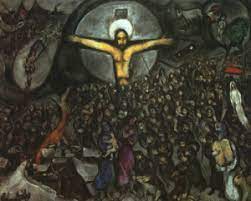
“Exodus” by Marc Chagall, 1952

Now there have been many of those priests, since death prevented them from continuing in office; but because Jesus lives forever, he has a permanent priesthood. Therefore, he is able to save completely those who come to God through him, because he always lives to intercede for them.

Such a high priest truly meets our need—one who is holy, blameless, pure, set apart from sinners, exalted above the heavens. Unlike the other high priests, he does not need to offer sacrifices day after day, first for his own sins, and then for the sins of the people. He sacrificed for their sins once for all when he offered himself. For the law appoints as high priests men in all their weakness; but the oath, which came after the law, appointed the Son, who has been made perfect forever. (New International Version)

Several years ago, I enjoyed serving communion with a retired minister in the church for which I was serving at the time. When we were in the middle of it, I leaned over to him and gave him a bit of instruction on what we were about to do. After I finished, he leaned over to me with a smile and said, “I didn’t hear a thing you just said, but I’ll figure it out!”

When it comes to the Christian life, I think we can learn something from the old Pastor. We are neither always going to hear well everything which is in the Bible, nor are we going to understand everything which is happening around us as Christians. 

The Jewish Christians, for which the book of Hebrews was originally preached, had a difficult transition from Judaism to Christianity. In Judaism, they knew what was happening. The sacrificial system was detailed and meticulously planned. The priesthood was clearly observed with men from the tribe of Levi. Worship was predictable.

However, becoming a Christian changed a lot of things. Being a Christian meant relying on the wild and unpredictable Spirit of God. There was no longer a tangible sacrificial system. Jesus is the high priest, but the believers never see him. 

There was so much living by faith, and so little understanding of what was going to happen, that the Hebrew Christians’ resolve began to break down. They became discouraged and started to lose patience with Christianity.

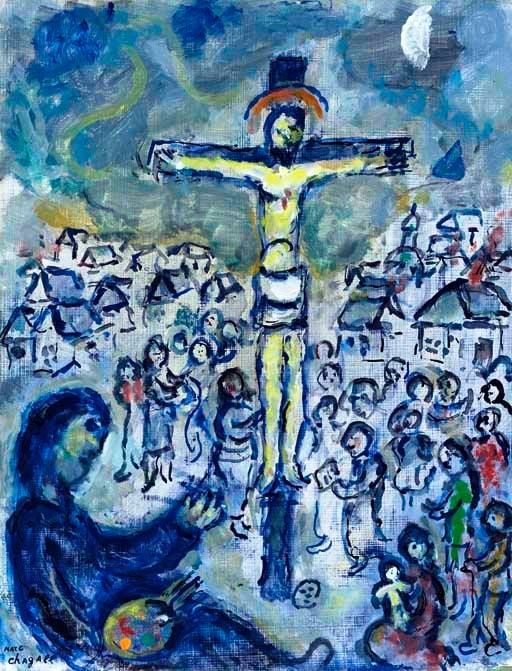
“The Painter and the Christ” by Marc Chagall, 1975

Today’s New Testament lesson is in the middle of an extended discussion by the author of Hebrews about the priesthood and sacrificial system. The Christian Jews were thinking about reneging on their commitment to Jesus and returning to their previous way of life in Judaism. 

So, central to the author’s exhortation is to demonstrate that Jesus is superior to everything in Judaism. Jesus is better than any Old Testament priest. Jesus is the once-for-all sacrifice for sins. Jesus is better because his priesthood is permanent, and his sacrifice is perfect.

In the ancient world, sacrifice was at the center of everyone’s belief system. Every pagan religion had some sort of sacrificial practice to satisfy the god(s) and ensure deliverance and/or prosperity. Jews, of course, had an elaborate sacrificial system of their own with detailed prescriptions of how to go about it.

We need to feel something of the original force of Christianity. It was a radical idea to have one sacrifice to end all sacrifices.

Everyone understood that sacrifices were temporary; you had to keep offering them over and over again. Christianity, however, asked the world to have a new understanding of sacrifice. No longer would there be any sacrifice – no grain sacrifice; no offerings of first-fruits; no animal sacrifices; no physical sacrifices whatsoever. 

In Christianity, Jesus as the once-for-all sacrifice to end all sacrifices was such a crazy notion for so many people that they mocked Christians for it. Both Jews and pagans could barely wrap their minds around such a progressive idea. It would be like saying to us today that there is no longer any need for money because some individual became the underwriter for everything everybody does.

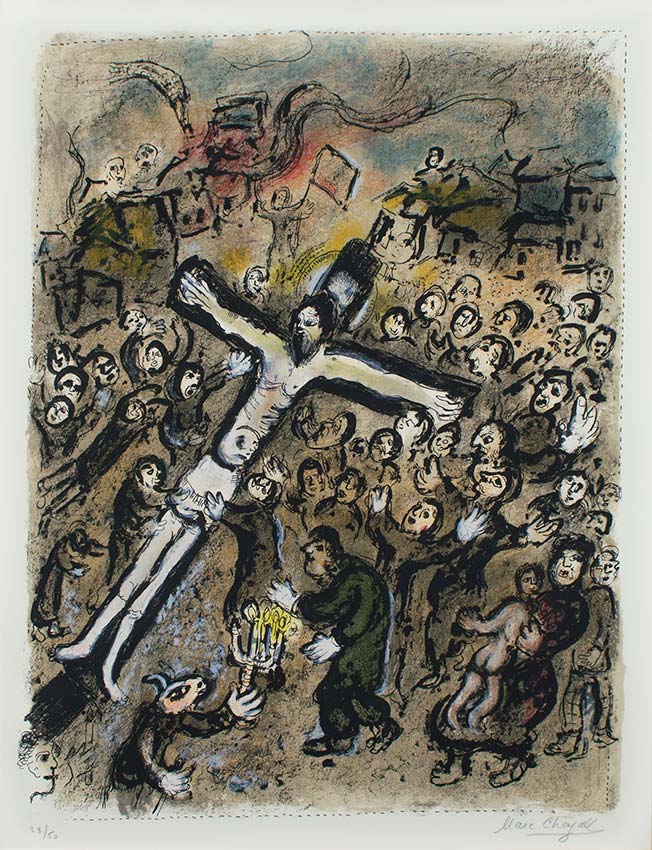
“The Martyr” by Marc Chagall, 1970

All the things the old sacrificial system did for worshipers are now completely fulfilled in the person of Jesus.  Condensed in just a few verses of Scripture, we have a very rich picture of Jesus:

  • Jesus is not a temporary priest, but a permanent priest, the one who is able to intercede continually on our behalf without us having to perform a ritual sacrifice.
  • Jesus lives forever, which enables him to never cease his intercessory work.
  • Jesus saves completely.
  • Jesus meets our need.
  • Jesus has been made perfect forever.

Yet, sometimes Christians go back to the old sacrificial system, not by physically offering animal sacrifices, but treating Christ’s once-for-all finished work as if it were just too good to be true. We reason that we need to do something to help save ourselves. Although Jesus has saved us fully, and therefore, there is no longer any need for sacrifice, yet we still try:

  • To appease God through church attendance or other works, as if the Lord needs to be soothed into not becoming angry at us.
  • To satisfy God through our giving so that the Lord will not have a furrowed brow against us.
  • To assuage our guilty conscience through Christian service, believing this will give us some leverage with God.

In all these kinds of instances, it is going back to an old sacrificial system that is obsolete.

The biblical and theological truth is that Jesus has thoroughly saved us from our sin, and, so, has cleansed us from all guilt, including a guilty conscience.

Jesus meets our need and has completely satisfied God’s wrath against sin. Jesus is our mediator and intercedes for us as we come to God’s throne of grace. That means we do not need to try and get God’s attention with some incredible sacrifice that will somehow obligate him to take notice. 

There is no longer ever a situation where we must run to some spiritual liquor store to pick up a Captain Morgan because the Captain of our souls, Jesus Christ, has already given us everything we need.

Since Jesus has been made perfect forever; is our great high priest; and is the once-for-all sacrifice to end all sacrifices, we have all the grace we need. 

We need not worry anymore about being good enough because Jesus is perfect. Christ’s work is made complete in us. The constant anxiety of feeling we don’t measure-up is not from God. The person and work of Jesus is sufficient to deliver us from guilt and shame.

“Well,” you might say, “if everybody believed that, then nobody would ever do anything.” No, it’s just the opposite. When we feel like we don’t measure up, we do less, not more. A low level discouragement sets in, and we do nothing because we intuitively know it will never be enough. We do just enough to squeak by, never quite knowing if it is doing anything. 

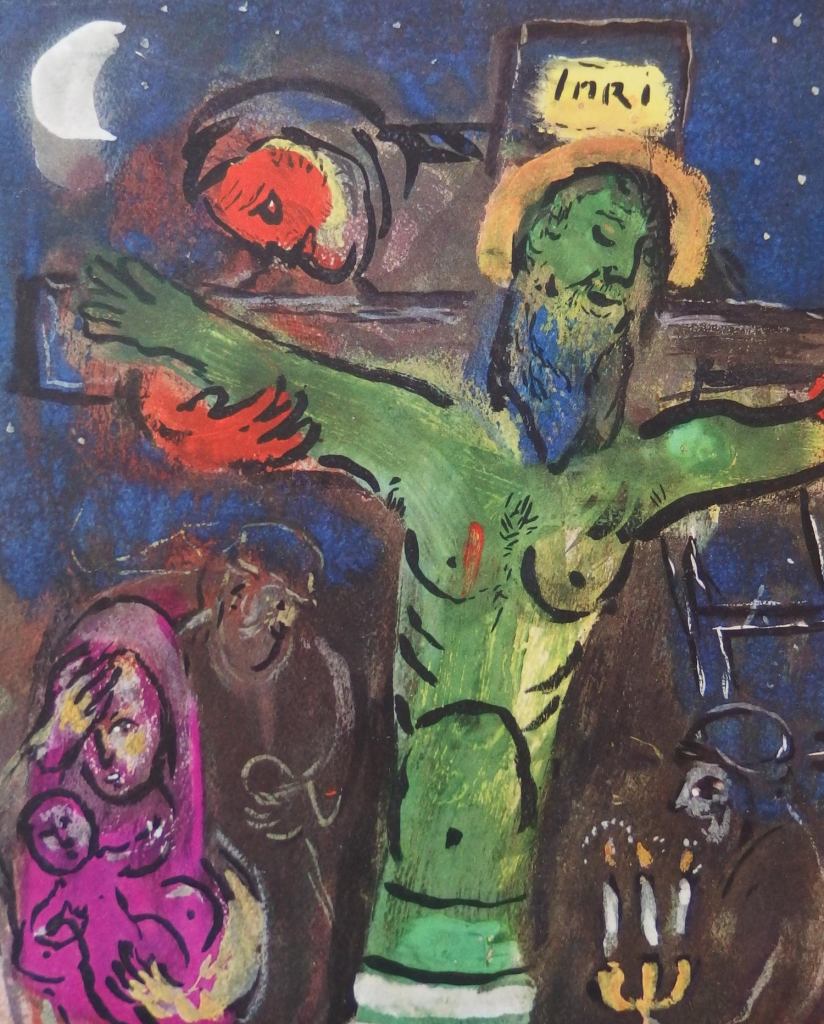
“Crucifixion” by Marc Chagall, 1961

Just like the Hebrew Christians of the first century, we consider giving up because Christianity doesn’t work for us. Yet, when we grasp Christ’s sacrifice to end all sacrifices, and are overwhelmed by grace, then everything we do in the Christian life is a simple desire to say “thank you” with our life and our lips. 

It is the grace, and not the wrath, of God that teaches us to say “no” to ungodliness and worldly passions and to live upright and godly lives (Titus 2:11-12).

The old system wasn’t bad. It served a purpose. Now, however, the old has given way to the new, and there is a better hope by which we draw near to God. The sacrificial system pointed forward to a perfect sacrifice by a permanent priest that would bring us to God forever.

Going back to the old system is like living permanently in a tent, and believing you are home.

Therefore, we must choose what is better. The options are not so much between what is bad and what is good, but between what is good and what is better than good. It is possible to do all kinds of good things and miss the better thing God is doing. 

So, how do we choose the better thing? How do we embrace the new, which is Christ, and not the old, which is the sacrificial system?

  1. Learn to say “no” to the treadmill going nowhere. Since we do not need to impress God, we have the freedom to say “no” to keeping up with the spiritual Jones’s; “no” to cajoling God’s favor, approval, or attention.
  2. Learn to say “yes” to engaging in spiritual practices which remind us of Christ. Say “yes” to the new way of the Spirit, which is by faith and not by sight. This present spiritual age is often intangible, ethereal, and unseen. It requires a new set of spiritual eyes to see.
  3. Let Christianity be about Jesus, and not about us. Resist the allure to rescue others, or have others rescue you. The work of rescue has already been done. Christ saves, we don’t.
  4. Know the better thing over the good thing. Pause before acting or re-acting. Are we expecting someone else to do what Christ has already done? Are we looking to do something we think will make God like us better? Remind yourself of Jesus and his redemption every day in small ways through Scripture reading and prayer, fellowship, and loving service.

Good people can love God, and yet, miss the opportunity to see they are already justified through Christ’s blood. We do not need to justify ourselves. We need to live into the justification we possess by grace through faith.

May it be so to the glory of God.