The Call (Psalm 118:1-2, 19-29)

Call to Worship, by Darrell Black

Confess Yahweh, because he is good,

            because his commitment is permanent.

Yisrael is pleased to say,

            “His commitment is permanent”…

Open the faithful gateways to me;

            when I come through them, I shall confess Yahweh.

This is Yahweh’s gateway;

            faithful people come through it.

I will confess you because you answered me

            and became deliverance for me.

The stone that the builders spurned

            became the head cornerstone.

This came about from Yahweh;

            it’s been extraordinary in our eyes.

This was the day that Yahweh made;

            so that we would celebrate and rejoice in it.

Oh, Yahweh, will you deliver us, please?

            oh, Yahweh enable us to succeed, please.

Blessed be the one who comes in Yahweh’s name;

            we are blessing you from Yahweh’s house.

Yahweh is God; he has shone light to us

– tie the festal offering with cords to the horns of the altar.

You are my God and I will confess you;

            my God, I will exalt you.

Confess Yahweh, because he is good,

            because his commitment is permanent.

(The First Testament, A New Translation by John Goldingay)

This psalm is the last of the Hallel (praise) psalms (Psalms 113-118) used at the Passover meal. It includes a summons for the entire community to praise God; an individual thanksgiving to the Lord; and a communal speech.

The Call to Confession

We are invited and called upon to recognize and confess Yahweh’s enduring steadfast love, which is a lasting and permanent commitment toward God’s people. Why? Because it is through a tenacious love that never gives up that brings healing, wholeness, and health to the community. Our relatedness to God makes all the difference in life.

“The unrelated human being lacks wholeness, for he can achieve wholeness only through the soul, and the soul cannot exist without its other side, which is always found in a ‘You.’ Wholeness is a combination of I and You, and these show themselves to be parts of a transcendent unity.”

Carl Jung, The Psychology of Transference

When it comes to healing – whether it be physical, emotional, or spiritual – love must be involved. The need for healing implies brokenness. And love is relational. Therefore, in order to experience the wholeness of healing, there needs to be another.

Love extended to one who requires mercy creates the opportunity to see light in the other, and to feel it in your own. And that energy brings the healing wholeness of both body and soul.

Every divine/human encounter, and each gracious intervention of God to people, is the chance to bring wholeness through the power of love by means of relationship. Communal worship affords us the opportunity to experience the steadfast love and commitment of God – as well as to steward that love well, for others who need it.

The Call to Thanksgiving

Everyone is on board for thanksgiving, right? Well, not so much. Like most things, it’s complicated. On the one hand, we have those persons who seem to never express gratitude for anything; it appears they are only capable of cynicism and sarcasm. And, on the other hand, are those who are incessantly positive, always thankful, no matter the circumstance; for them, it seems they are never living in the reality of a messed up world.

A reflexive response of gratitude to everything is merely a cheap thanksgiving. And a constant stream of ingratitude is simply taking the easy road of complaint. Thanksgiving ought to be thoughtful and well-placed. Gratitude is really a spiritual discipline that requires constant practice until it becomes a solid life skill.

The psalmist pictures the king, David, leading a procession of worshipers as they approach Yahweh. It’s as if the king is teaching the people how to go about entering God’s presence, and what role thanksgiving has in this relationship between God and humanity.

Central to that relationship are offerings of praise and thanksgiving for divine deliverance. Specifically, it is acknowledging gratitude from the place of a spiritual cornerstone. This is the foundation from which an individual’s and an entire community’s faith is rested upon.

The New Testament locates this vital cornerstone as Christ. Jesus is,

“‘the stone you builders rejected,
    which has become the cornerstone.’

Salvation is found in no one else, for there is no other name under heaven given to mankind by which we must be saved.” (Acts 4:11-12, NIV)

Consequently, you are no longer foreigners and strangers, but fellow citizens with God’s people and also members of his household, built on the foundation of the apostles and prophets, with Christ Jesus himself as the chief cornerstone. (Ephesians 2:19-20, NIV)

The Call to Commitment

The permanence of God’s steadfast love and loyalty toward people demands a response. In Christianity, because of the Lord’s commitment to us – through the person and work of Jesus Christ – there is opportunity for a reciprocal response of commitment to God in Christ through the Spirit.

This response of genuine worship and thanksgiving avoids the crush of the constant critic, on the one hand, and on the other hand, steers clear of ignoring suffering.

As you come to him, the living Stone—rejected by humans but chosen by God and precious to him—you also, like living stones, are being built into a spiritual house to be a holy priesthood, offering spiritual sacrifices acceptable to God through Jesus Christ. For in Scripture it says:

“See, I lay a stone in Zion,
    a chosen and precious cornerstone,
and the one who trusts in him
    will never be put to shame.”

Now to you who believe, this stone is precious. But to those who do not believe,

“The stone the builders rejected
    has become the cornerstone,”

and,

“A stone that causes people to stumble
    and a rock that makes them fall.”

They stumble because they disobey the message—which is also what they were destined for.

But you are a chosen people, a royal priesthood, a holy nation, God’s special possession, that you may declare the praises of him who called you out of darkness into his wonderful light. Once you were not a people, but now you are the people of God; once you had not received mercy, but now you have received mercy. (1 Peter 2:4-10, NIV)

Holy Week is nearly upon us. The celebration and praise of Palm Sunday is coming, along with the suffering and death of Good Friday. This all sets the scene for a victorious resurrection which solidifies the Christian’s faith with the mortar of God’s steadfast love in Christ.

As we enter the Week, let us be open to the full range of thoughts and emotions that arise because of God’s loyal and loving commitment to us, and our reciprocal commitment to Christ. Let us be receptive to the call of love.

God of compassion and love, you know our faults and yet you call us to forgiveness instead of leveling judgment upon us. Keep us in your gracious presence, and give us your wisdom. Open our hearts to gratitude and commitment, and restore to us the joy of our salvation. Amen.


Accept the Situation (Jeremiah 30:12-22)

“This is what the Lord says:

“‘Your wound is incurable,
    your injury beyond healing.
There is no one to plead your cause,
    no remedy for your sore,
    no healing for you.
All your allies have forgotten you;
    they care nothing for you.
I have struck you as an enemy would
    and punished you as would the cruel,
because your guilt is so great
    and your sins so many.
Why do you cry out over your wound,
    your pain that has no cure?
Because of your great guilt and many sins
    I have done these things to you.

“‘But all who devour you will be devoured;
    all your enemies will go into exile.
Those who plunder you will be plundered;
    all who make spoil of you I will despoil.
But I will restore you to health
    and heal your wounds,’
declares the Lord,
‘because you are called an outcast,
    Zion for whom no one cares.’

“This is what the Lord says:

“‘I will restore the fortunes of Jacob’s tents
    and have compassion on his dwellings;
the city will be rebuilt on her ruins,
    and the palace will stand in its proper place.
From them will come songs of thanksgiving
    and the sound of rejoicing.
I will add to their numbers,
    and they will not be decreased;
I will bring them honor,
    and they will not be disdained.
Their children will be as in days of old,
    and their community will be established before me;
    I will punish all who oppress them.
Their leader will be one of their own;
    their ruler will arise from among them.
I will bring him near and he will come close to me—
    for who is he who will devote himself
    to be close to me?’
declares the Lord.
“‘So you will be my people,
    and I will be your God.’” (New International Version)

Jeremiah, by Marc Chagall, 1956

Once in a while, I get a response from a patient in the hospital who was given a poor diagnosis, or a very challenging prognosis, that goes something like this: “These doctors are always focusing on the negative. I’m only going to listen to the positive. I don’t need all that negative talk and energy.”

I believe in things like hope, optimism, and confidence. Yet, those qualities can only be acquired through the purgative force of hard circumstances and suffering. That means, in order to truly embrace the positive and encouraging, we need to first sit with the negative and discouraging realities in front of us.

Bottom line: It hurts to heal. Cuts need peroxide. Serious wounds need to be vacuumed. Severe internal issues require a surgery – being opened up – with a surgical knife, in order to get the body in a position to heal itself.

I find it curious that so many folks who believe in the Bible have never read the Old Testament prophets.

And very few preachers have never even given a sermon from the prophets. “It’s too gloom and doom, too negative. I focus on the positive and build up the church with New Testament truth!”

So, how’s that working for you? If there is a spiritual cancer that needs removal, it’s going to take some pain and hard treatment. And that is a lot of “negative” stuff.

There wouldn’t be a New Testament without an Old. I am suggesting that perhaps one reason why there is so much spiritual immaturity amongst many churches and Christians is that there is a lot of biblical illiteracy, due to the neglect of the prophets.

Without the prophets, we do not get a true feel for the pathos of God; that is, the Lord’s spiritual and emotional energy against injustice and oppression. And, practically speaking, it leaves us with neither resources nor skills to cope with adversity and trouble when it comes.

What do you do when you – or someone you love – hears that they have an incurable disease or condition?

Those without a solid grounding in the biblical prophets will likely want to rush to the places in Scripture that talk of answers to prayer and miracles and resurrections. But little do they realize that one cannot experience life apart from death, that there is no resurrection without a crucifixion, no positive glory without negative suffering.

No healing can take place if there is no pain of a cross.

Conversely, those who have become familiar with the message of the prophets are sure to respond to the incurable situation with expressions of personal grief and public lament, with humility and submission to the will of God.

Prayers will arise from deep within them that are grounded in the justice of God, and rely upon the promises of God. They will look to their inner spirit, without outwardly blaming God and medical staff for being uncaring and negative.

And, most of all, the spiritually and prophetically aware person will lean into their prodigious support system of a loving and gracious God, as well as the many persons who want to help.

The mature believer engages in a combination of submission and subversion – submitting completely to the will and ways of God, while simultaneously praying against the unfairness of disease, disaster, and death.

Healing and restoration will happen. The kicker is that we just don’t know the timing of any of it. We may not realize healing until the next life. Then again, we might experience a dramatic restoration of health and happiness, far beyond what we could ever ask or imagine.

The wise person learns to be patient, and wait for the proper time. They are comfortable with whatever timetable the Lord has for them. For what is most important to them is that they are close to the God who is near to the brokenhearted.

If we are guilty, we admit it, and seek to repair whatever damage may have been done. And if we are innocent, well then, we admit that we are not our own, but belong, both body and soul, to our faithful Creator.

Even in pain, we rest; even though suffering, we are at peace.

Accept the situation as it is, and not as you want it to be.

O God of love, you are the true sun of the world, evermore risen and never going down: We pray you to shine in our hearts and drive away the darkness of sin and the mist of error. We pray that we may, this day and all our lives long, walk without stumbling in the way you have prepared for us, which is Jesus Christ our Lord; who lives and reigns with you and the Holy Spirit, one God in glory everlasting. Amen. – A prayer of Erasmus of Rotterdam (1466-1536)

Why Are We Here? (Matthew 9:2-13)

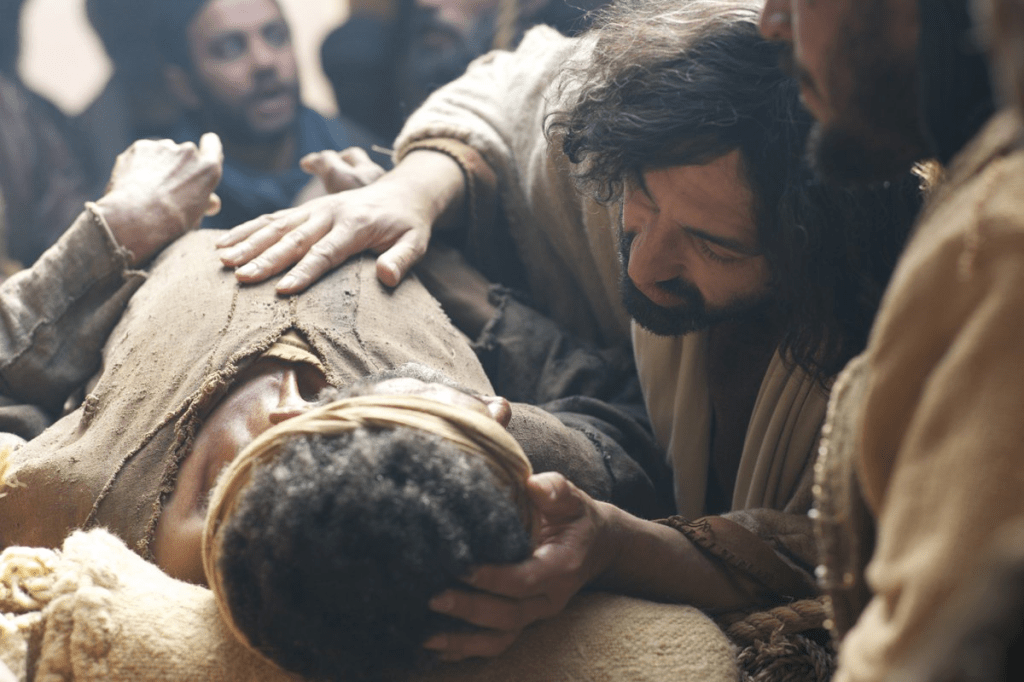
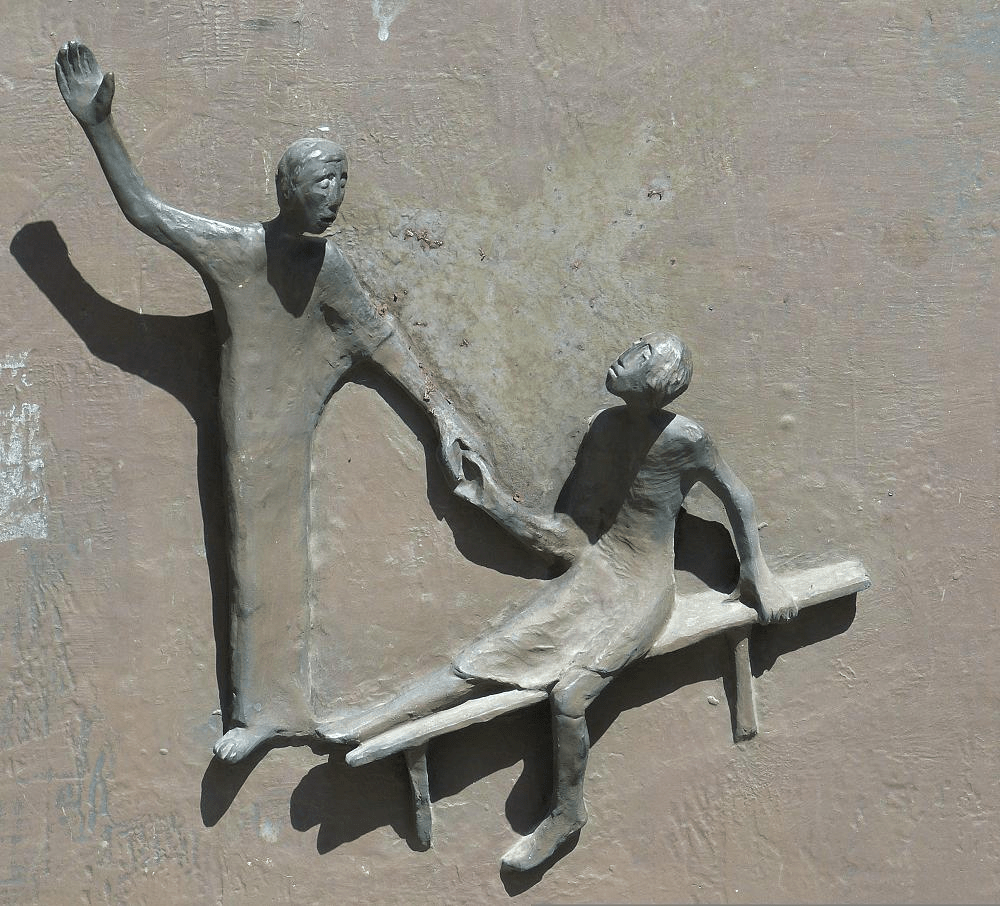
Jesus heals and forgives a paralyzed man

Some men brought to him a paralyzed man, lying on a mat. When Jesus saw their faith, he said to the man, “Take heart, son; your sins are forgiven.”

At this, some of the teachers of the law said to themselves, “This fellow is blaspheming!”

Knowing their thoughts, Jesus said, “Why do you entertain evil thoughts in your hearts? Which is easier: to say, ‘Your sins are forgiven,’ or to say, ‘Get up and walk’? But I want you to know that the Son of Man has authority on earth to forgive sins.” So he said to the paralyzed man, “Get up, take your mat and go home.” Then the man got up and went home. When the crowd saw this, they were filled with awe; and they praised God, who had given such authority to man.

As Jesus went on from there, he saw a man named Matthew sitting at the tax collector’s booth. “Follow me,” he told him, and Matthew got up and followed him.

While Jesus was having dinner at Matthew’s house, many tax collectors and sinners came and ate with him and his disciples. When the Pharisees saw this, they asked his disciples, “Why does your teacher eat with tax collectors and sinners?”

On hearing this, Jesus said, “It is not the healthy who need a doctor, but the sick. But go and learn what this means: ‘I desire mercy, not sacrifice.’ For I have not come to call the righteous, but sinners.” (New International Version)

“The church is a hospital for sinners, not a museum of saints.”

Abigail Van Buren (“Dear Abby”)

Why does the Church exist? Why did Jesus come to this earth? What are we supposed to be doing? Does Christianity make any difference in this world? Why are we here?

The Church is not on this earth solely for the benefit of Christians, any more than a hospital exists for the benefit of the doctors or insurance companies.

Rather, the Church is designed to extend the mission of Jesus through proclamation of good news with the restorative touch of grace. The Church is the community of the redeemed, gathered together for worship and encouragement, and then sent into the world to be the continuing presence of Jesus on this earth.

This mean that the Church’s calling is not to find others who can help them with their tithing and budget, or to keep the pews warm with fresh bottoms.

Some folks are not healthy. Some are sick physically, and others spiritually. Even more are emotionally brokenhearted. And then there are those who are sick-and-tired of being sick-and-tired.

Please know that Jesus came neither to condemn nor heap a pile of unrealistic expectations on us. Christ points us to the source of healing and transformation, and invites us to come to him. 

Conversely, there are many other people today who are healthy, spiritually alive, and have a good well-being. And they possess the opportunity to participate in ways that bring holistic healing to the world as Christians. The mission of Jesus is our mission, as well.

Jesus came to bring forgiveness and transformation. In today’s Gospel healing, it was a case where the person’s paralysis was both physical and spiritual. The paralytic found in Jesus healing of both body and soul.

The religious insiders observed the healing of the paralytic. Yet, they didn’t rejoice over it. Instead, they were hung up on Jesus claiming to be God. Although this may have been a hard truth to accept, Jesus labeled their response as evil – because of an inability to perceive the situation as a divine intervention. Since the religious insiders wrongly discerned who Jesus is, they wrongly interpreted the situation. 

It’s important to see Jesus as the Human One who extends compassion and forgiveness. If we fail to see this about Christ, we will get caught up in all kinds of silly matters concerning personal preferences and power plays, based in how we think things should go, rather than how God is shaking out things.

Jesus came to forgive our guilt and shame. Healing the body is good, but it’s not enough. Christ came to heal both the body and the spirit. At the heart of the human condition is spiritual brokenness, and Jesus wants to remove the obstacle of sin and create a new healthy society. This is a radical vision which seeks to encompass all persons – which means Jesus touched many people overlooked by others.

Jesus came to call the despised people of society, the “sinners.” He called Matthew, a tax collector. Tax collectors were hated. They were corrupt characters who extorted money from innocent people. And furthermore, Jesus had dinner with Matthew, along with all of his unsavory buddies. This kind of behavior by Jesus was deeply offensive to upstanding citizens.

However, Jesus did not back down, saying that it’s not the healthy who need a doctor, but the sick. And he backed up his social actions with Scripture by encouraging offended folks to meditate on what the biblical phrase, “I desire mercy, not sacrifice.” (Hosea 6:6)

It is possible to engage in outward rituals of worship, do all the right things, fulfill duty, yet still miss the heart of what God wants for humanity. Mercy is what God wants. Jesus knew this. So, Christ entangled himself with sinners to bring spiritual healing and restoration.

If we want to see God deliver people from their unhealthy situations, we must entangle ourselves with them, into complicated lives that are not pretty, with persons who have been tainted by sin. 

Lots of people are in awful predicaments. Christians, like their Lord, will need to get their hands dirty and their feet wet to extend Christ’s ministry of mercy and forgiveness.

The gospel was never intended to be proclaimed from afar, but up close and personal. The merciful mission of Jesus requires the following three activities:

  1. Intimacy with Jesus. Engaging in the spiritual disciplines of prayer, giving, fasting, reading, and meditating on Scripture. These practices help us to know Christ better and how to respond with mercy.
  2. Intimacy with fellow believers. We are hard-wired by God for community. Superficial relationships only provide superficial community. Christians need to help one another with spiritual growth, and to hold one another accountable for the mission of Christ.
  3. Intimacy with “sinners.” This world is filled with sick, needy, hurting, and lonely people who are locked in unhealthy patterns of living. They need a merciful change of life that comes from the merciful Jesus acting through merciful Christians. 

Mercy, not judgment, is at the heart of all change. For things to be different, we must be acquainted with mercy.

Most merciful God, we confess we have sinned against you in thought, word, deed, and neglect. We have not held fast to your commandments and have strayed from your teachings. We turn away from self-centered actions and pride. For the sake of your Son, Jesus, have mercy on us and forgive us so that we are released from all sinful obstacles. Empower us with your wisdom, revelation, and discernment so that we might be your merciful hands, feet, and words to one another and those who do not yet know you. Amen.

Are You Looking for Healing? (Mark 3:7-12)

Jesus departed with his disciples to the sea, and a great multitude from Galilee followed him; hearing all that he was doing, they came to him in great numbers from Judea, Jerusalem, Idumea, beyond the Jordan, and the region around Tyre and Sidon. He told his disciples to have a boat ready for him because of the crowd, so that they would not crush him, for he had cured many, so that all who had diseases pressed upon him to touch him. Whenever the unclean spirits saw him, they fell down before him and shouted, “You are the Son of God!” But he sternly ordered them not to make him known. (New Revised Standard Version)

A man’s shriveled hand was restored in full view of all the public. From then on, throngs of people came to check out what was happening. Jesus was well into his earthly ministry and created quite a buzz amongst everyone in Palestine. The ancient paparazzi even started following him around.

There were more fans rushing to see Jesus than Swiftys at a sighting of Taylor Swift. Like having the limousine ready after a concert to get away from the huge crowds, so Jesus instructed his disciples to have a boat ready for him in order to avoid the great crush of people.

Christ’s reputation of curing the sick and infirmed had reached such a critical mass that thousands were determined to at least touch him and experience long-awaited healing. And, really, you can’t really blame them, can you?

Maybe you’ve never experienced debilitating chronic pain – day after day not being able to get away from it’s awful effects in both body and soul. Or perhaps you have no idea what it’s like to live with depression constantly dogging you, just waiting to take a bite out of your life and devour you like some piece of meat.

A lot of people know what it’s like to live with infirmities that they don’t want and didn’t ask for. And they’ve tried everything to either get rid of it, or cope with it, somehow.

In fact, there are so many such persons living on planet earth, that when they had a snowball’s chance at getting to Jesus, they dropped everything and took it – going after him and not caring one bit if they themselves got crushed from all the other people trying to get help.

That, my friend, is how many people there are with great physical, mental, emotional, and spiritual needs on this planet.

We could go the route of playing arm chair observer and criticize the great crowd of people for being nothing but a bunch of fans who wanted to see the latest fad in Jesus. But, if you get up close with boots-on-the-ground, you will see a different picture: thousands of people looking for hope, health, and wholeness, wanting to be “normal” like everyone else.

The problem? Normal is nothing more than a social construct. For the infirmed, it’s likely not going to happen. For those believing they’re normal, in truth, they have a profound lack of awareness to their own great need.

No, we’re all abnormal; all of us are disordered, or diseased, or distressed in some sort of way. It turns out that we all need Jesus; some of us just know it much more profoundly than others.

Jesus was not only about to be crushed from physical bodies pressing in on him; he was going to be crushed by the sheer weight of the world’s tremendous need for healing.

But he was pierced for our transgressions,
    he was crushed for our iniquities;
the punishment that brought us peace was on him,
    and by his wounds we are healed.
We all, like sheep, have gone astray,
    each of us has turned to our own way;
and the Lord has laid on him
    the iniquity of us all. (Isaiah 53:5-6, NIV)

At this point in Christ’s ministry, a significant shift began. Rather than entering a synagogue and speaking only to Jews, Jesus started addressing Gentiles, as well. In fact, the crowds wanting to see him came not only from exclusively Jewish locations, but also from other places.

This ministry of Christ raised the attention of the demonic realm. It was a major threat to the demons’ influence on people. Identifying him as the Son of God and calling Jesus out by that name was a way for the demons to reassert their power and try to get some leverage. Names are actually a big deal. Which is why, for example, Jesus once asked a demoniac in the cemetery what his name is.

That’s one way a name is powerful. Yet, when it comes to you and me, the fact that Jesus knows your name, and my name, is a mighty thing in a very different way. Rather than having demons making the Son of God known, Christ grants us the authority to make the name of Jesus known throughout the world.

Even though the redemptive events of Jesus happened two thousand years ago, great crowds of people still come to Jesus, clamoring for but a touch of his grace. And the forces of darkness are still hanging around, knowing that their time is short.

Yes, there is still healing and wholeness to be found in Jesus, even today. And even though there remain some forces of darkness in opposition to it, the victory has already been achieved.

O God the Father, whose will for us and for all your people is health and salvation,

Have mercy on us.

O God the Son, who came that we might have life and have it in abundance,

Have mercy on us.

O God the Holy Spirit, whose indwelling makes our bodies the temples of your presence,

Have mercy on us.

O Triune God, we pray you to hear us, and that you will grant your grace to all who stand in need of healing both of body and spirit, and lead them to look with confidence in you;

We beseech you to hear us, O Lord.

That you will grant patience and perseverance to all who are disabled by injury or illness, and increase their courage,

We beseech you to hear us, O Lord.

That you will grant peace to all who are troubled by confusion or pain, and set their minds at rest,

We beseech you to hear us, O Lord.

That you will grant relief from suffering to all sick children, and give them a sure sense of your tender love and care,

We beseech you to hear us, O Lord.

That you will grant rest to all whose increasing years bring weariness, distress, or loneliness, and give them the abiding comfort of your presence,

We beseech you to hear us, O Lord.

That you will grant confidence to all about to undergo surgery or difficult procedures, and keep them free from fear,

We beseech you to hear us, O Lord.

That you will grant purpose to the church as it seeks to carry on Christ’s ministry of healing to suffering humanity, and keep it always true to the gospel of Christ,

We beseech you to hear us, O Lord.

That you will grant skill and compassion to doctors, nurses, technicians, aides, and all who are called to  practice medical arts, and make strong their dedication to help others,

We beseech you to hear us, O Lord.

That you will grant to all people the refreshment of quiet sleep and joy of resting in your everlasting arms, that we may rejoice in your care while we are on earth, and in the world to come, have eternal life.

We beseech you to hear us, O Lord.

O God, who in Jesus Christ called us out of darkness into your marvelous light; enable us always to declare your wonderful deeds, thank you for your steadfast love, and praise your with heart, soul, mind, and strength, now and forever.

Amen, and amen.