The Wounded Healer (Psalm 18:1-6, 43-50)

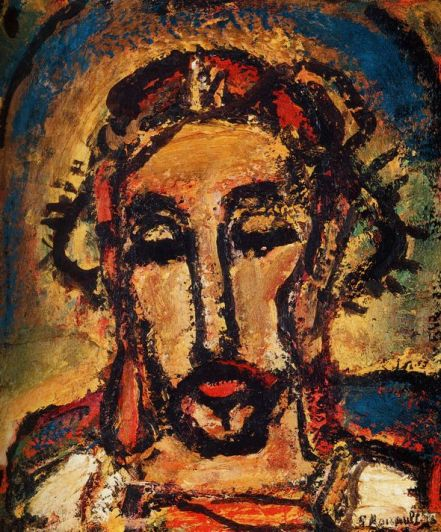
By French painter Georges Rouault (1871-1958)

I love you, Lord;
    you are my strength.
The Lord is my rock, my fortress, and my savior;
    my God is my rock, in whom I find protection.
He is my shield, the power that saves me,
    and my place of safety.
I called on the Lord, who is worthy of praise,
    and he saved me from my enemies.

The ropes of death entangled me;
    floods of destruction swept over me.
The grave wrapped its ropes around me;
    death laid a trap in my path.
But in my distress I cried out to the Lord;
    yes, I prayed to my God for help.
He heard me from his sanctuary;
    my cry to him reached his ears…

You gave me victory over my accusers.
    You appointed me ruler over nations;
    people I don’t even know now serve me.
As soon as they hear of me, they submit;
    foreign nations cringe before me.
They all lose their courage
    and come trembling from their strongholds.

The Lord lives! Praise to my Rock!
    May the God of my salvation be exalted!
He is the God who pays back those who harm me;
    he subdues the nations under me
    and rescues me from my enemies.
You hold me safe beyond the reach of my enemies;
    you save me from violent opponents.
For this, O Lord, I will praise you among the nations;
    I will sing praises to your name.
You give great victories to your king;
    you show unfailing love to your anointed,
    to David and all his descendants forever. (New Living Translation)

King David, the psalmist, had no problem with publicly expressing his great feeling of love for God. His desire was to be thoroughly devoted to the Lord; and he confidently discerned God as the source of his strength.

What’s more, David freely recognized God as the One who brought him deliverance. David cried out in distress. In his despair and desperation, he looked to the Lord, and God responded.

This is in contrast to those who complain about God and consider the Lord as distant and uncaring – if existing at all. David’s experience was that of being heard by God. And he wanted everyone to know, so that the faithful may be encouraged.

David didn’t want people becoming discouraged because of the bitterness of others who accuse God of being unconcerned.

The psalmist was not just talking about some mundane request, like asking for parking spot close to the building. David was in a life-and-death situation, stressful beyond imagination. Things were not looking good for him.

It seemed that the insolent, who think God isn’t watching, believed they could act unjustly and do whatever they wanted. Sadly, their lust for power and control blinds them to the larger reality of an invisible God who sees, and who responds at just the right time.

David wanted people to remember and not to forget about the saving actions of God. Because by keeping in mind who God truly is, then we can have confident trust, and will live in a way that is right, just, and good.

“Our service will not be perceived as authentic unless it comes from a heart wounded by the suffering about which we speak.”

Henri Nouwen

A good, right, and just life is always the appropriate response to divine mercy and deliverance. We are saved from evil, so that we might live in the spiritual freedom of purity and peace. And David gave God some due praise, adoration, and thanksgiving for rescuing him from his enemies.

Since David went through all of the adversity, hardship, stress, and suffering of dealing with unjust people, he was in a position to be a wounded healer for us.

A wounded healer is not someone who endorses a victim mentality. Rather, this is a person who has been profoundly hurt – physically, mentally, emotionally, or spiritually – and comes through the experience with an ability to be present with others and help facilitate healing in those who suffer.

Surely he took up our pain
    and bore our suffering,
yet we considered him punished by God,
    stricken by him, and afflicted.
But he was pierced for our transgressions,
    he was crushed for our iniquities;
the punishment that brought us peace was on him,
    and by his wounds we are healed. (Isaiah 53:4-5, NIV)

We all suffer and face various hard circumstances. And we are all changed by the hurtful encounters. But we don’t all respond the same way to that adversity. The difficult experiences of pain lead us to become either bitter or better.

If we have a wounded healer in our life, there is a good chance that we will be able to move through the hardship and come to a place of gratitude for what the Lord has done for us and how God brought us deliverance.

“As followers of Jesus we can also allow our wounds to bring healing to others.”

Henri Nouwen

Deliverance may not end up looking like anything we anticipate. If we are stuck on particular outcomes and have a singular expectation, then we may very well miss the Rescuer when the ship of salvation shows up.

Yet, if we can remain open to and aware of God – as well as of what’s going on inside us – then we shall likely experience healing for our deep wounds of pain. And we will embrace the scars it leaves as a reminder of the Lord’s deliverance.

It could be that things don’t change, at least like we want. In such times, perhaps the greatest healing that can take place is to be healed from the need for healing.

The Lord shows unfailing commitment and steadfast love to the faithful, to those who seek God. We shall find the divine in all circumstances, that is, if we seek God with all our heart.

“You will seek me and find me when you seek me with all your heart.” (Jeremiah 29:13, NIV)

Pain cannot be taken away unless we enter into it. So, it only makes sense to me, that we have a guide like the psalmist to lead us, and a Savior like Jesus to rescue us.

“Wholeness is not achieved by cutting off a portion of one’s being, but by integration of the contraries.”

Carl Jung

May you be patient in suffering, as Christ was in his earthly pain.

May the Lord be near you in your time of weakness and wondering.

May God sustain you by divine grace, and grant you courage not to have a failure of faith.

May you know healing of both body and soul.

And may you always believe that what happens to you in this present life is of little account if you hold Christ in eternal life. Amen.

Don’t Fear, Believe! (Mark 5:21-43)

Jesus heals the daughter of Jairus, by Hyatt Moore

When Jesus had crossed again in the boat to the other side, a great crowd gathered around him, and he was by the sea. Then one of the leaders of the synagogue, named Jairus, came and, when he saw him, fell at his feet and pleaded with him repeatedly, “My little daughter is at the point of death. Come and lay your hands on her, so that she may be made well and live.” So he went with him.

And a large crowd followed him and pressed in on him. Now there was a woman who had been suffering from a flow of blood for twelve years. She had endured much under many physicians and had spent all that she had, and she was no better but rather grew worse. She had heard about Jesus and came up behind him in the crowd and touched his cloak, for she said, “If I but touch his cloak, I will be made well.” Immediately her flow of blood stopped, and she felt in her body that she was healed of her disease. 

Immediately aware that power had gone forth from him, Jesus turned about in the crowd and said, “Who touched my cloak?” And his disciples said to him, “You see the crowd pressing in on you; how can you say, ‘Who touched me?’ ” He looked all around to see who had done it. But the woman, knowing what had happened to her, came in fear and trembling, fell down before him, and told him the whole truth. He said to her, “Daughter, your faith has made you well; go in peace, and be healed of your disease.”

While he was still speaking, some people came from the synagogue leader’s house to say, “Your daughter is dead. Why trouble the teacher any further?” But overhearing what they said, Jesus said to the synagogue leader, “Do not be afraid; only believe.” He allowed no one to follow him except Peter, James, and John, the brother of James. When they came to the synagogue leader’s house, he saw a commotion, people weeping and wailing loudly. When he had entered, he said to them, “Why do you make a commotion and weep? The child is not dead but sleeping.” And they laughed at him.

Then he put them all outside and took the child’s father and mother and those who were with him and went in where the child was. Taking her by the hand, he said to her, “Talitha koum,” which means, “Little girl, get up!” And immediately the girl stood up and began to walk about (she was twelve years of age). At this they were overcome with amazement. He strictly ordered them that no one should know this and told them to give her something to eat. (New Revised Standard Version)

Christ Healing the Hemorrhaging Woman, by Ivan Rutkovych, 1698

Hopeless. That’s how two people felt in today’s story. One of them a woman, and the other the father of a little girl.

To have a sense of hopelessness is perhaps one of the worst feelings a person could ever have; it is to suffer with the despair that your suffering isn’t going to end.

It was still early in Christ’s earthly ministry. Jesus had already performed amazing exorcisms and healed people. His fame was spreading, and crowds began to form everywhere he went.

The Hemorrhaging Woman

The woman had suffered for 12 years with hemorrhaging. She went through a string of doctors with no answers to her malady. Her condition drained her not only bodily, but also emotionally and financially. Despite everything she tried, not only did things not get better, but they got worse.

She likely didn’t get out much because of her situation. But even if she did, the woman would have to literally remain on the margins of the community because of all the blood. In other words, she was unclean, and anyone who touched her would be, as well.

I see many folks in my line of work who have had an adverse health condition for years. Some of them have had a debilitating illness for so long that the sickness is what now defines them. Their daily schedule is ruled by doctor appointments and therapy sessions. Their health maladies have taken over their identity.

Despair and desperation are close cousins. The woman’s desire to gain back her life aroused the courage to seek out Jesus. And she believed that by resolutely getting through the crowd of people, that even if the edge of his cloak could be touched, restoration would happen.

True faith leads us to act in a way that seems irrational to others.

The woman pushed and wormed her way close enough to Jesus to touch just the edge of his cloak… and the effect was immediate. She felt it in her body. The woman was cured with but a simple touch.

Then the woman became afraid, realizing that Jesus was aware that someone touched him. And a woman, no less, who had a hemorrhaging issue. Christ looked around, trying to find out who did it.

The extreme awareness of Jesus contrasts with the blatant unawareness of his disciples. They dismissed their Teacher’s investigation because of all the people who clamored around him. But Jesus was determined to find the person who touched him.

The woman realized she could not hide what she did, and what happened. With her robust faith in Jesus, she was willing to face any consequence for touching the rabbi. She was so scared that she trembled as she talked to Jesus. The woman revealed her story to him of who she is and what brought her to this point.

Genuine faith and healing always brings light, because grace and redemption will have its way in this fallen dark world.

Whereas we might expect a religious leader to respond with disdain or shock, and likely a firm rebuke, Jesus honored the woman by calling her “daughter.” He truly saw her, and publicly bestowed blessing and peace upon her.

Jesus confirmed and affirmed the woman’s healing in front of everyone. She was hopeless no more.

The Sick Young Girl

Christ continued his journey to young girl’s house. Her faither, Jairus the synagogue ruler, appealed to Jesus to come and heal her. She was at the end of life. As the father of three daughters myself, I can easily imagine the despair and desperation of Jairus concerning his precious little girl’s condition.

Somehow he knew there was only one hope for his daughter; Jairus needed Jesus because there was nothing he could do, or anybody could do, to save her. And once he got to Jesus, his poverty of spirit was evident, his humility palpable.

Jairus fell to his knees and became a spiritual beggar. He pleaded with Jesus to come and lay healing hands on his dear girl.

But his hope morphed into hopelessness; while on the way, Jairus received the devastating news that his daughter had died. All is lost… or is it?

Jesus didn’t think so. He simply gave a hopeful reassurance, “Don’t fear. Believe!” To the unbeliever, those words must seem cruel – giving a father whose child has died false hope. But for God, nothing is impossible. In God’s kingdom, death never has the last say on a person’s life.

It’s hard to have faith and hope whenever everyone else is mourning and crying and grieving. Arriving at the house, Jesus said yet another possibly cruel thing: “The child’s not dead but sleeping.” Christ understood that she was not all dead, just mostly dead.

The nervous and stressed laughing of the people in the house did nothing to deter Jesus. He was supremely confident about what would happen – a future that no one else could yet see.

A simple command, just a few words, was all it took. Taking the girl’s mother and father into the room, I imagine Jesus saying with a combination of authority and compassion, “Little girl, get up!”

Since Christ’s authority knows no bounds, the girl immediately got up. She was alive – so alive that it’s as if nothing ever made her ill to begin with.

Only a Story?

You may think this is only a story. Perhaps you believe there’s nothing to this, other than an ancient follower of Jesus trying to make his Teacher look like a healer, a savior.

For me, the story confirms what I know and believe to be true from my own experience as a church pastor, hospital chaplain, and follower of God: The impossible happens with Jesus. Christ is more powerful than anything life throws at us. Jesus is enough.

Amen. Soli Deo Gloria.

Victory Over the Power of Evil (Luke 4:31-37)

He went down to Capernaum, a village in Galilee. He was teaching the people on the Sabbath. They were surprised and impressed—his teaching was so forthright, so confident, so authoritative, not the quibbling and quoting they were used to.

In the meeting place that day there was a man demonically disturbed. He screamed, “Stop! What business do you have here with us, Jesus? Nazarene! I know what you’re up to. You’re the Holy One of God and you’ve come to destroy us!”

Jesus shut him up: “Quiet! Get out of him!” The demonic spirit threw the man down in front of them all and left. The demon didn’t hurt him.

That knocked the wind out of everyone and got them whispering and wondering, “What’s going on here? Someone whose words make things happen? Someone who orders demonic spirits to get out and they go?” Jesus was the talk of the town. (The Message)

During his earthly life and ministry, Jesus was a Deliverer and a Liberator; he came to save people from their guilt and shame, and to free the world from the clutches of evil.

And so, it was inevitable that Jesus would come into conflict with the forces of darkness.

In today’s story, Jesus had a confrontation with an unclean spirit, that is, a demon who is an ally of the devil. The particular demon was not only speaking for himself, but also for his fellow band of wicked spirits.

Christ’s ministry put him in direct opposition to the hosts of Satan. The nub of the issue for the demon was whether Jesus had come for their immediate destruction. Jesus, however, wasn’t in the habit of answering questions from demons.

So, Christ rebuked the demon, told him to get out of the person he was influencing. And that is exactly what happened. The writer, Luke, pointed out that this demonstrated Christ’s authority, that it even includes the power to command unclean spirits, and out they go.

And that is how the liberating and saving ministry of Jesus began.

In the Gospel of Luke, this account of Jesus being confronted by a demon happens just after Christ’s 40 days of being tempted in the desert, even by Satan himself. So, the entire demonic realm was alert to beginning ministry of Christ. They went after Jesus right away, perhaps trying to trip him up before he could get any ministerial momentum.

Jesus was teaching on the Sabbath in the town of Capernaum. We ought not to be surprised that a demonized man was among those observing the Sabbath. The wise believer will be savvy to this reality.

Furthermore, we aren’t told who the man was or of any symptoms he may have had. Apparently, he presented himself as a normal Jewish villager. So, we ought not to think that anyone being demonized will necessarily demonstrate madness or illness of some sort.

The demon was perhaps more aware of who Jesus was than anyone else there on that Sabbath Day in Capernaum. He acknowledged Christ’s power and mission. Jesus indeed came to destroy the power and influence of evil in the world.

You believe that there is one God. Good! Even the demons believe that—and shudder.

James 2:19, NIV

Since Jesus Christ is the rightful authority over all, that means Satan and his wicked spirits are not; and they must submit to that true and real power.

Truth and doctrine are not only about objective facts and right belief. Even though our thinking is important and critical, there is more to it than that: Orthodoxy (right belief) requires orthopraxy (right actions).

A right truth that is only described is not the whole truth. In reality, a false witness and a liar may state the truth, but not entirely, withholding important information; thus, impairing any sort of right action from taking place.

Gaslighting relatives, oppressive bosses, and tyrannical rulers who tell some truth, and even support some good things, are still gaslighting and oppressing others with their narcissistic brand of leadership.

Truly, believers in and followers of Jesus can sometimes be duped into supporting evil leaders who use all sorts of unjust tactics, just because that leader tells the part of truth I want upheld.

Jesus saves; he is Savior of the world – but that is only part of the truth. We must also ask: What has Christ come to save us from? Not just our mistakes, mess-ups, and sins. Christ came to deliver us from the very power of evil that supports injustice and unrighteous behavior to begin with.

If we merely view Jesus as our personal Savior from hell after we die, then we will likely focus almost exclusively on heaven. But if we see all the freedom we need from unhealthy behaviors and unjust ways, then we view Christ as so much more than a fire insurance policy.

We need a more expansive understanding of Christ’s cross. Yes, Jesus died for our sins. Yet, he also died to conquer evil; Christ made it possible for us to become liberated from the shackles of systemic sin and structural evil, as well as personal guilt. In other words, Christ came to topple all evil, and not just human foibles.

And this was why the dark powers of Satan, and his demons, were so afraid of Jesus. They knew their time was short. There is yet another power that has a hold on us today – and that is the reality that many people no longer believe in demons and devils and dark forces.

Since we are a technically advanced people with great understanding of medical science, we now know all sorts of things which cause physical and mental illness. Ancient people did not know about human hormones and chemicals, and the impact of genetic codes on our health. They had no idea about bacteria and viruses, microbes and hygiene.

Therefore, we can jettison all this mumbo-jumbo about demons, right?… Not so much.

Even with all of our modern (and postmodern) explanations for the body and brain, we are still finding ourselves having to contend with the mystery of evil, and the malevolent suffering it causes us.

We modern folk can certainly provide a lot of insight into the cause and effect of particular symptoms a person has according to their biology. And yet, that doesn’t take away the presence of malevolent forces on this earth.

Even with all of our understanding, evil still resides within organizations, institutions, and even faith communities. The meanness and malevolence, the injustice and the ingratitude, and the profound violence (both verbal and physical) which one human being can exact on another is still here – and some would argue that it’s worse than ever.

Knowing something isn’t the same as doing it. If that were true, then education ought to deliver us from evil. Even some intelligent and objective people, who are fluent in facts and figures, still use their calculations for evil.

No matter our creeds or convictions, whether we are religious or not, all of us seem to have a collective sense that this old world of ours is profoundly broken.

All the research dollars in the world has not produced a solution to fix evil. And even if we could completely understand evil, that isn’t the same as ridding ourselves of it.

What’s more, those who put all their trust in changing things through modern means (which means without God) have been some of the worst offenders of producing wars, political tyranny, and gross injustice.

To put all of this perhaps more succinctly in the form of question: We know and understand a lot in combating disease, disaster, and death; but does all of that insight do away with the evil of it? Are things less tragic now?

I argue that is has not. Evil is still evil. Chronic pain, homelessness, poverty, injustice, and health inequities are still wreaking their evil on people.

I believe that evil really does exist, even if it has different language today than it did in the ancient world.

There is real opposition, conflict, and confrontation from evil today. The victory Christ has achieved over the forces of evil has a 2,000 year track record of helping people experience renewed lives, even when their bodies are wasting away.

In the end, the victory of Jesus Christ shall become evident to all the world. Overcoming evil doesn’t come from us, but from God. We can and we must deal with evil in this world. But we are not the Savior or the Liberator.

We need faith in the Son of God who loved us and gave himself for us. Amen.

What Will You Do with Jesus? (John 5:1-18)

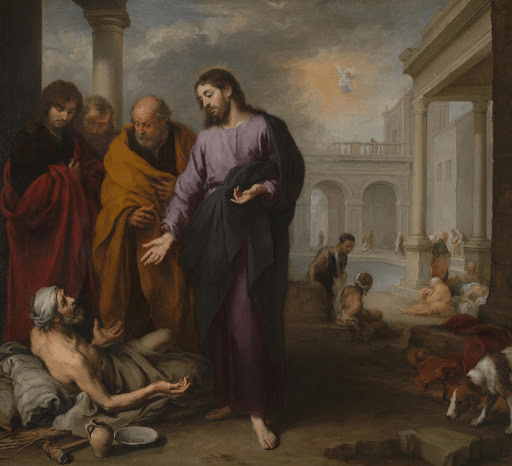
Healing the Paralytic, by Bartolomé Esteban Murillo, 1670

Sometime later, Jesus went up to Jerusalem for one of the Jewish festivals. Now there is in Jerusalem near the Sheep Gate a pool, which in Aramaic is called Bethesda and which is surrounded by five covered colonnades. Here a great number of disabled people used to lie—the blind, the lame, the paralyzed. One who was there had been an invalid for thirty-eight years. When Jesus saw him lying there and learned that he had been in this condition for a long time, he asked him, “Do you want to get well?”

“Sir,” the invalid replied, “I have no one to help me into the pool when the water is stirred. While I am trying to get in, someone else goes down ahead of me.”

Then Jesus said to him, “Get up! Pick up your mat and walk.” At once the man was cured; he picked up his mat and walked.

The day on which this took place was a Sabbath, and so the Jewish leaders said to the man who had been healed, “It is the Sabbath; the law forbids you to carry your mat.”

But he replied, “The man who made me well said to me, ‘Pick up your mat and walk.’ ”

So they asked him, “Who is this fellow who told you to pick it up and walk?”

The man who was healed had no idea who it was, for Jesus had slipped away into the crowd that was there.

Later Jesus found him at the temple and said to him, “See, you are well again. Stop sinning or something worse may happen to you.” The man went away and told the Jewish leaders that it was Jesus who had made him well.

So, because Jesus was doing these things on the Sabbath, the Jewish leaders began to persecute him. In his defense Jesus said to them, “My Father is always at his work to this very day, and I too am working.” For this reason they tried all the more to kill him; not only was he breaking the Sabbath, but he was even calling God his own Father, making himself equal with God. (New International Version)

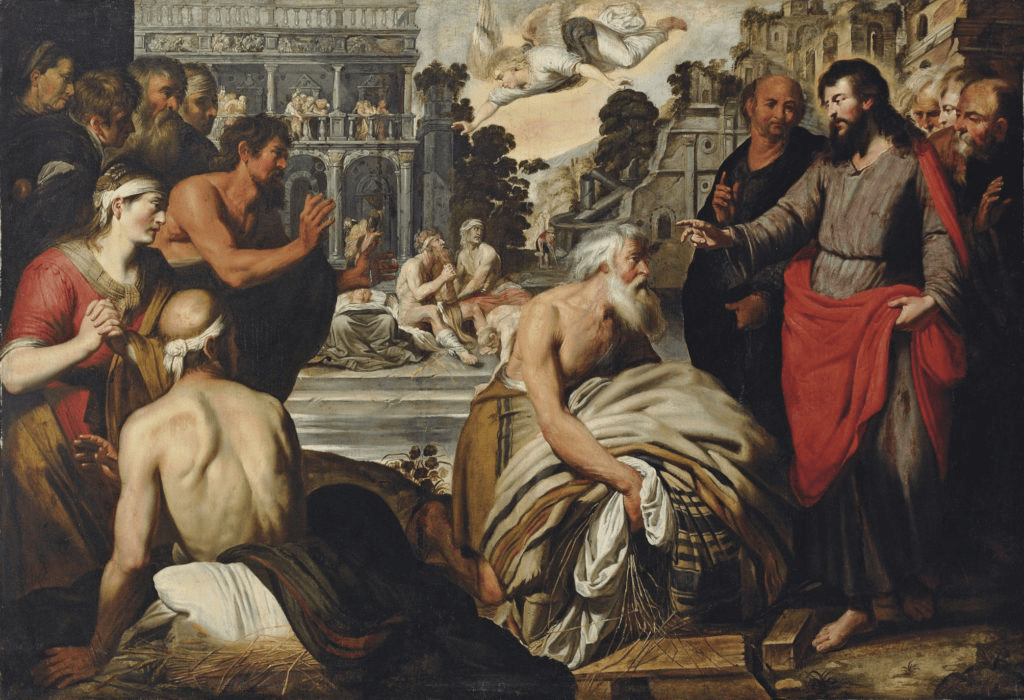
Christ at the Pool of Bethesda, by Artus Wolffort, c. 1625

During one of the yearly Jewish festivals, on a Sabbath day, a miracle happened. Miracles of healing are typically accompanied by celebration and joy. But not so much with this one.

It’s one of those things about living in a messed up world of broken systems, that an invalid can start walking and there are people who have frowns and furrowed brows about it.

Granted, the man who was healed by Jesus may seem a bit hard to like in some ways. We don’t really know what he was into, but when Christ bestows healing on you, then says to stop sinning, it’s probably a significant sin to warrant the Lord’s exhortation.

Regardless of any sort of sin, the man appears to be paraplegic. Especially in the ancient world, this meant all sorts of problems had to be navigated – such as needing others to literally carry you around (no wheelchair or handicapped accessible anything), long periods of social isolation, lack of bodily control over your bowels and bladder, and the continual needs for cleanliness.

This made the man hard to like by many people just because he likely had strong body odors and had to crawl to get around if no one would help. He would not have been pleasant to look at. But he would have to make sure you did because, in the absence of any charity, the guy’s only option was to beg.

I’m glad there are greater forces in the world than indifference and dislike. There is grace – which is an act of bestowing honor and/or forgiveness to another person. It is not dependent upon whether one deserves it. Grace chooses not to hold something over or against another. It is a deep concern for others that comes from within and not from without.

“I do not understand at all the mystery of grace – only that it meets us where we are but does not leave us where it found us.”

Anne Lamott

Another gracious act that Jesus did was to honor the man’s dignity by respecting him with a question. By asking a question, we don’t assume we know what’s best for another. Sincere questions acknowledge another’s basic humanity. “Do you want to get well?” Jesus asked.

In the life of being an invalid and having little control over much of anything, including one’s own body, being asked a question is to receive the gift of autonomy.

There are many times in my work as a hospital chaplain that I speak with patients who don’t have a lot of control in their lives. I go out of my way to ask questions such as, “May I come in?” “Is it alright with you if I pull up a chair and sit down?” “Would you be okay telling me about what is going on?” “May I pray with you?”

This is important, because there are too many other people in this world who would just barge into a room, act like they own the place, and talk at them, and not with them – hence reinforcing to the person that they’re nothing compared to others, that they don’t have any real say.

The man’s response to Jesus was to essentially say that he is alone. He has no one to help him. Even though the man is in a city, surrounded by hundreds and thousands of others, he is lonely.

Not anymore. Jesus saw him, even inquired about him and learned about the man. Jesus Christ, the Lord of all, cared about a non-descript invalid and was sincerely curious about him. In a world of everyone for himself, Jesus championed the lonely and the lost.

A simple command to obey was all. Christ told the man to pick up his mat and walk. That’s it. Just as words created the world, so a few words created a whole new life for the man. So, he got up, and he walked.

It’s interesting that the religious leaders never seemed to notice the man when he was lame, but now that he’s up and walking around, they pay attention to his apparent work on a Sabbath.

The invalid was validated by Jesus, but Jesus, the one validated by the Father, was invalidated by the religious leaders, who are the spiritual invalids.

It was against the (their) rules to carry something around. Apparently, it was okay for people to be lonely, not contribute to society in meaningful and dignifying ways, and to suffer; but it’s not okay to walk and carry a mat.

Even worse, is anyone who would heal on the Sabbath and tell the healed person to walk and carry a mat. It was so bad, apparently, that it warranted persecuting such a person. But that’s what happens when people are forced to serve rules, instead of the rules serving people.

On top of it all, Jesus was working; and he justified it by stating that his Father keeps working. This was dangerously close to blasphemy by likening himself to God. For the religious leaders, not only was Jesus unethical in breaking the law, but he was also theologically immoral; he claimed a special relation with God.

The more that laypeople get to know Jesus, the more compelling he becomes; they want to follow him. But the more that clergy discover Jesus, the more angry they become and want to do away with him.

Ultimately, it is Jesus we must contend with, and not the law and our interpretations of scripture. We need to decide what we are going to do with Jesus… what will you do?…