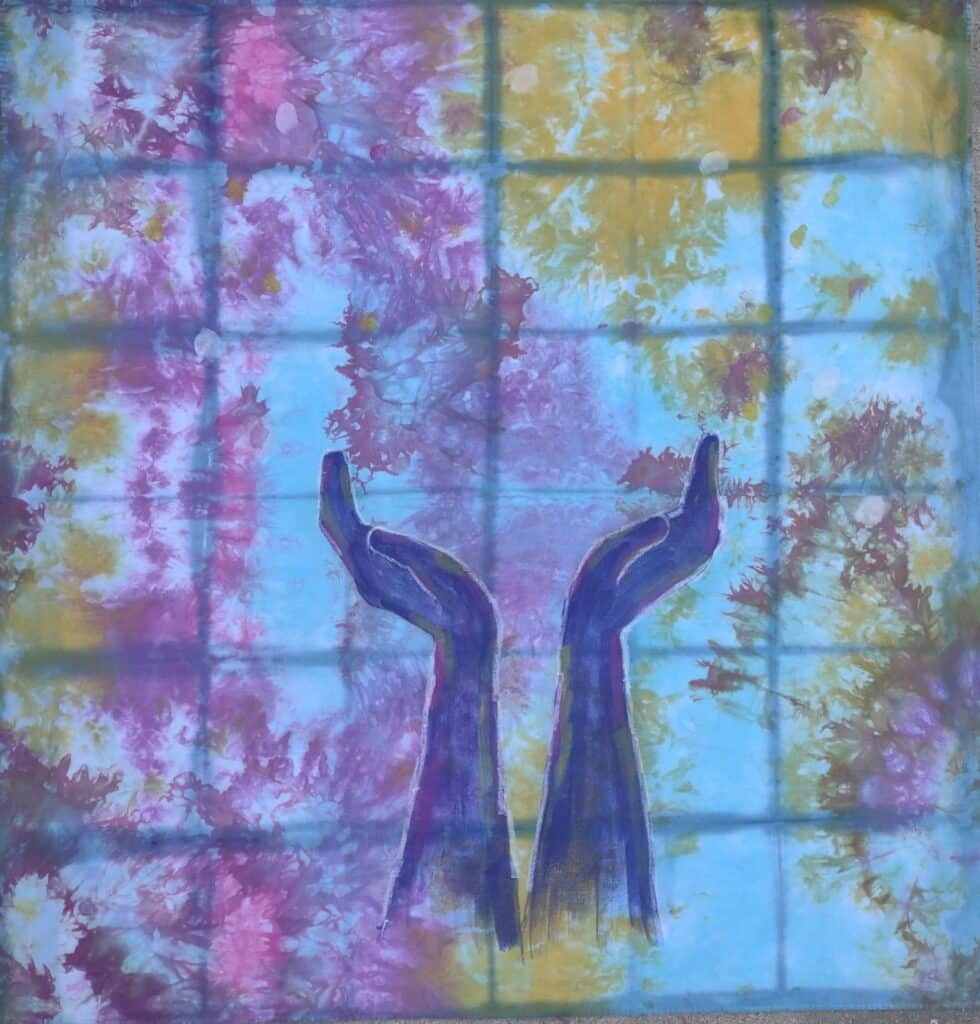
Restoration (Jeremiah 30:1-11a)

This is the word that came to Jeremiah from the Lord: “This is what the Lord, the God of Israel, says: ‘Write in a book all the words I have spoken to you. The days are coming,’ declares the Lord, ‘when I will bring my people Israel and Judah back from captivity and restore them to the land I gave their ancestors to possess,’ says the Lord.”

These are the words the Lord spoke concerning Israel and Judah: 

“This is what the Lord says:

“‘Cries of fear are heard—
    terror, not peace.
Ask and see:
    Can a man bear children?
Then why do I see every strong man
    with his hands on his stomach like a woman in labor,
    every face turned deathly pale?
How awful that day will be!
    No other will be like it.
It will be a time of trouble for Jacob,
    but he will be saved out of it.

“‘In that day,’ declares the Lord Almighty,
    ‘I will break the yoke off their necks
and will tear off their bonds;
    no longer will foreigners enslave them.
Instead, they will serve the Lord their God
    and David their king,
    whom I will raise up for them.

“‘So do not be afraid, Jacob my servant;
    do not be dismayed, Israel,’
declares the Lord.
‘I will surely save you out of a distant place,
    your descendants from the land of their exile.
Jacob will again have peace and security,
    and no one will make him afraid.
I am with you and will save you,’
    declares the Lord.” (New International Version)

The cry of Jeremiah the prophet, by Slovakian artist, 1937

To be restored is a beautiful thing, namely because it presupposes that someone or a group of people were dilapidated and in need of healing. Restoration implies that something was lost, but now is found.

If you have lost things like finances, a home, a car, precious memorial items, a job; or relationships such as a marriage, a friendship, estrangement from family members; or your health to disease or disaster; or even lost your mind or your soul – you can completely understand the longing for restoration and wholeness.

The Jews lost their homeland, their property, their temple, and their dignity to the invading Babylonians. Babylon took everything from Judea. The people became exiled in a strange land. Only some poor folk were left behind in a land that was ravaged.

This was the place that was once referred to as a land of milk and honey, a good home of abundance and blessing. But in the prophet Jeremiah’s day, it was becoming a thing of the past. Would the people ever recover what they had lost? Is restoration even a possibility? Could they learn to hope again?

Into a time of distress and despair, God spoke, and said that yes, it is possible; yes, restoration can and will happen. The people will not be in captivity forever.

Things can get so bad that you become physically sick, emotionally spent, mentally fearful, and spiritually disheartened – as if your life has been ripped from you without mercy and with malice. Yet, what is true of us today is not necessarily going to be true of us tomorrow.

Oppression is a terrible thing. To be constantly harassed by others or by chronic pain or by adverse situations is draining; it sucks the life out of us. Into these sorts of circumstances, God says to us, “I am with you, and I will save you.”

Perhaps tomorrow comes and nothing changes. The pain is still there. The mean-spirited people haven’t gone anywhere. The lost things are not found. And yet, there is something primal and universal which has always been here and shall never go away, no matter the circumstances: God is with us, and God loves us.

If we have the spiritual eyes to see, we will notice that God is alongside us, weeping with us. God knows a thing or two about the sort of suffering and pain that is unimaginable.

“Why does not God do something sooner, if God is so loving and powerful?” you may ask. If you are a parent, you have likely had a child ask you why you are doing something to them that feels awful. You know that emotion of feeling hurt alongside them. You also know that there is sometimes no way you can adequately explain to them what’s going on.

You commit yourself to being there, being present, and assuring the child that you aren’t going anywhere. So, when it comes to us, why is it so hard to understand that God is not a divine Santa or a cosmic Genie granting our every wish? If we want kids to understand, then perhaps we ought to first understand our own relationship as God’s children.

There will be times of trial and tribulation, even divine judgment. Yet there shall also be deliverance from evil, and salvation from sin, death, and hell. The yoke of oppression won’t last because there is the promise of restoration.

No matter how nasty, misguided, or sinful the political leadership and governmental system, none of those rulers or politicians have the last word – God does, not them. Grace has the final say, utilizing a restorative mercy which cannot be undone.

The days are coming when there will be a new future, based in the resolve of God to accomplish it. Fortunes shall be restored. Rehabilitation and renewal are ahead for the faithful. Healing will happen, whether it be in this life, or the next.

Things may seem impossibly hopeless now, but God can and will overrule the present evil machinations of oppressive rulers. Terror may be on every side, yet the Lord will break the bonds of oppression; God will burst the unjust practices. Indeed, God will save.

Therefore, we need not fear, for God is with us; and divine intervention is nearly here.

O God of heavenly powers, by your holy might, be present to us in your goodness and grace; banish all injustice and unrighteousness and restore your people in the strength of faith. Amen.

Learning to Trust (Psalm 4)

Answer me when I cry out, my righteous God!
    Set me free from my troubles!
        Have mercy on me!
        Listen to my prayer!

How long, you people,
    will my reputation be insulted?
How long will you continue
    to love what is worthless
    and go after lies?
Know this: the Lord takes
    personal care of the faithful.
The Lord will hear me
    when I cry out to him.
So be afraid, and don’t sin!
    Think hard about it in your bed
    and weep over it!
Bring righteous offerings,
    and trust the Lord!

Many people say,
    “We can’t find goodness anywhere.
    The light of your face has left us, Lord!”
But you have filled my heart with more joy
    than when their wheat and wine are everywhere!
I will lie down and fall asleep in peace
    because you alone, Lord, let me live in safety. (Common English Bible)

The psalmist, David, was a man after God’s own heart. But that did not mean that he was inoculated from trouble and hardship.

David had a lot of adversity and much difficulty throughout his life. So, it only made sense to him to cry out to the Lord for deliverance and help. God had helped David in the past, and David was confident that the Lord would help him yet again.

We all find ourselves in a tight spot, between a rock and hard place, at times. It’s what we do when we are in that position that is critical. David had a history of looking to God, seeking God’s grace, and soliciting answers to prayer.

David, the psalmist, was a real victim of slander and lies. More than once in his life, he had people out to get him, to actually take his life. Whatever your understanding of stress is, it doesn’t get much more stressful than someone hunting you down like an animal to literally kill you. I’m sure that many times David wondered how long this surreal madness was going to go on.

Whenever we are especially stressed, it can be hard to even breathe. If we aren’t mindful of ourselves, we will take lots of short staccato breaths that only feed anxious signals to the brain. It leaves us in a perpetual state of hypervigilance, almost unable to pray and have thoughts of God.

But we absolutely need to take deep breaths and trust in God’s sustaining presence. We’ll never get to sleep, nor stay at rest, without a sense of the divine presence.

Insomnia happens for a lot of reasons. Many people have diagnosed sleep disorders that are very real medical conditions. Others can’t get a good night’s rest because of poor sleep hygiene by not planning for adequate sleep, drinking too much caffeine during the day, inattention to a healthy diet, or a host of other habits. Some have issues of chronic pain which can make it difficult to sleep well.

And then there are yet others who suffer from racing thoughts, anxiety, and depression. The stress of their waking life is so significant that several hours of deep sleep seems only like some pipe dream. It’s impossible to sleep when the weight of the day is pressing on you. Finding a sense of calm before bed isn’t easy—especially when you can’t unplug from the demands of your day.

I am wondering if many of us will even allow ourselves to unplug and establish some quiet wind-down time. Reading a real book – not one on a backlit tablet device – or talking with a friend or family member are simple ways of easing our anxiety and letting rest come.

The psalmist, David, had a regular practice of meditating on Scripture, recalling the events of God, and expressing gratitude and praise for answered prayer. Each of us has a built-in spiritual rhythm just like we have a circadian rhythm. Always trying to buck those God-given rhythms will inevitably result in being “off,” at the least, and experiencing debilitating depression, at the worst.

Yet, when we learn to move with the unforced rhythms of grace, there is a groove we slip into which serves us well. In other words, what I am trying to say, is that by allowing ourselves to be human, we can discover health.

David neither had delusions, nor illusions, about his enemies, friends, others, and himself. He didn’t try to be somebody he was not. Instead, David had firm and confident convictions about God and the place of prayer.

By taking in a steady diet of David’s psalms, we can learn to hold together both faith and doubt, confidence and confusion, perseverance and perplexity, in ways which strengthens our faith.

Everyone of us who desire God must learn to trust; and it’s in the school of hard knocks where our faith is developed in order to sustain us for a lifetime of service and resilience.

There will always be those who believe ill of us through slander, lies, or outright oppression. In such times, let’s cry out to God for both peace and guidance; and ask the Lord for help in learning to breathe, lie down, and get some rest.

As our trust develops, we may even find the grace and courage to confront our oppressors, so that they can seek their own peace with God.

May Christ be with you, and within you;
May Christ go before you, and linger behind you;
May Christ be on your right, and on your left;
May Christ hover above you, and bring support beneath you;
May the Lord Jesus Christ completely and thoroughly surround you, now and forever. Amen.

Share Your Story (Psalm 107:1-16)

Psalm 107, by Erin Beardemphl

O give thanks to the Lord, for he is good,
    for his steadfast love endures forever.
Let the redeemed of the Lord say so,
    those he redeemed from trouble
and gathered in from the lands,
    from the east and from the west,
    from the north and from the south.

Some wandered in desert wastes,
    finding no way to an inhabited town;
hungry and thirsty,
    their soul fainted within them.
Then they cried to the Lord in their trouble,
    and he delivered them from their distress;
he led them by a straight way,
    until they reached an inhabited town.
Let them thank the Lord for his steadfast love,
    for his wonderful works to humankind.
For he satisfies the thirsty,
    and the hungry he fills with good things.

Some sat in darkness and in gloom,
    prisoners in misery and in irons,
for they had rebelled against the words of God
    and spurned the counsel of the Most High.
Their hearts were bowed down with hard labor;
    they fell down, with no one to help.
Then they cried to the Lord in their trouble,
    and he saved them from their distress;
he brought them out of darkness and gloom,
    and broke their bonds apart.
Let them thank the Lord for his steadfast love,
    for his wonderful works to humankind.
For he shatters the doors of bronze
    and cuts in two the bars of iron. (New Revised Standard Version)

Every person of faith has a story, a testimony of God’s redeeming, saving, and loving deliverance from trouble. And each one of those stories is sacred and special; no one story is better or greater than another. There’s no need, therefore, to act like you’re taking a course in comparative storytelling – as if you don’t have nearly the spiritual testimony of someone else.

The fact of the matter is that there is no trouble like your own personal trouble. Although others can relate to elements of each of our stories, no one else knows what your own experience is like. The old black spiritual is right in saying. “Nobody knows the trouble I’ve seen. Nobody knows but Jesus.”

It’s important to have others empathize with us and help normalize the experience we are going through. It’s necessary to have another validate our emotions and affirm the feelings we’re feeling. And, even after that, there’s nothing quite like a compassionate and caring Being who intimately knows everything about your trouble, how you experience it, and steps-in according to perfect divine timing, to bring uplift, hope, and salvation.

There is such a Being. God. Yahweh. The Lord. Pure Goodness. Redeemer. Savior. And most of all, Lover who is infinite Love with a capital “L.”

Why am I so confident about such a Being as this? Did I take too much methadone? Am I only an old fart who still believes in God? Or perhaps, you think, I’m a weird sort of giddy about God because of the Bible. Well, yes, and no. Scripture – especially the Psalms – just happens to put into words my actual experience and emotions.

But I don’t much care about parsing out whether I’m a deluded metaphysician or a sappy magpie or whatever other label gets affixed to me. It just doesn’t matter – because every epistemic fiber of my lower case being resonates with the upper case Being who bestows steadfast love because that Being’s character is actually made up of Love. It’s as if God is the biggest ultimate Teddy Bear, stuffed with holy love for all creation.

And, what’s more, this God seems to specialize and enjoy paying attention to the least, the lost, and the lowly among us humans. I was once in such a deep, dark, dank, black hole of spiritual nothingness that I knew I could never get out of, that is, on my own. I needed deliverance, or there wouldn’t be any hope whatsoever.

Others have experienced something akin to wandering alone out in a desert spiritual wasteland with no water, no food, no nothing but oppressive heat and loneliness. And others have had the trouble of real flesh and blood people seeking to do them harm, both physically and mentally. Yet others felt like they were bereft of options on a plantation of slavery in which all they could do was work like animals just to survive another day.

What all these persons have in common is that they cried out to the Lord, the maker of heaven and earth. And most of them didn’t just do it once; some cried out until they had no voice and were too weak to even speak anymore.

God showed up. God also showed off. Not only was there deliverance, but there was also an upgrade. For me, it was not like Tim 2.0, but Tim 1,000.0 – a filling of divine grace that goes beyond mere words. Because of God’s grace and love in my own life, it has enabled me to tap into that storehouse of mercy and pray with spiritual confidence.

When my dear wife had a spine surgery several years ago and awoke from it unable to move her legs, I prayed. I asked for mercy. I pleaded for grace. And I did it for hours at the foot of her hospital bed. I remember that I stubbornly would not accept the fact that she could not move her lower body.  And I decided to stand there and pray until I got an answer from God.

Eventually, I prayed myself asleep. My wife woke me up sometime in the early morning the next day. She told me to pull back the covers and look at her right big toe…. She could give it an ever-small twitch. We called the nurse, who was so excited that she called everyone she could get a hold of.

With a dozen hospital staff huddled around the hospital bed, my wife proceeded to give that big toe a hearty move. The staff erupted with clapping, and I am not kidding when I say that we had a party with noise and shouts in a hospital room at 4am. Nobody cared we were going nuts. I certainly did not.

My friend, God is still in the business of answering prayer, of showing up and showing off.

Through the hard times, the good times, and the confusing times, the Lord is our constant ballast for all seasons of life, whether good or bad. And I love God for that abiding presence. I can also give testimony that through all of the adverse situations my wife and I have faced, we have learned to stop, be still, and find that all we ever wanted we already have, even when everything changes.

Psalm 107 lets us know that personal testimony expressed to the community is an important aspect of strengthening everyone’s faith. Our stories are important, and they are meant to be shared. The spiritual and emotional health of us all is at stake.

Accept, O Lord, our thanks and praise for all that you have done for us. We thank you for the splendor of the whole creation, for the beauty of this world, for the wonder of life, and for the mystery of love.

We thank you for the blessing of family and friends, and for the loving care which surrounds us on very side.

We thank you for setting us at tasks which demand our best efforts, and for leading us to accomplishments which satisfy and delight us.

We thank you also for the disappointments and failures that lead us to acknowledge our dependence on you alone.

Above all, we thank you for your Son Jesus Christ; for the truth of his Word and the example of his life; for his steadfast obedience, by which he overcame temptation; for his dying, through which he overcame death; and for his rising to life again, in which we are raised to the life of your kingdom.

Grant us the gift of your Spirit; that we may know you and make you known; and through your Spirit, at all times and in all places, may give thanks to you in all things. Amen.

Accept the Situation (Jeremiah 30:12-22)

“This is what the Lord says:

“‘Your wound is incurable,
    your injury beyond healing.
There is no one to plead your cause,
    no remedy for your sore,
    no healing for you.
All your allies have forgotten you;
    they care nothing for you.
I have struck you as an enemy would
    and punished you as would the cruel,
because your guilt is so great
    and your sins so many.
Why do you cry out over your wound,
    your pain that has no cure?
Because of your great guilt and many sins
    I have done these things to you.

“‘But all who devour you will be devoured;
    all your enemies will go into exile.
Those who plunder you will be plundered;
    all who make spoil of you I will despoil.
But I will restore you to health
    and heal your wounds,’
declares the Lord,
‘because you are called an outcast,
    Zion for whom no one cares.’

“This is what the Lord says:

“‘I will restore the fortunes of Jacob’s tents
    and have compassion on his dwellings;
the city will be rebuilt on her ruins,
    and the palace will stand in its proper place.
From them will come songs of thanksgiving
    and the sound of rejoicing.
I will add to their numbers,
    and they will not be decreased;
I will bring them honor,
    and they will not be disdained.
Their children will be as in days of old,
    and their community will be established before me;
    I will punish all who oppress them.
Their leader will be one of their own;
    their ruler will arise from among them.
I will bring him near and he will come close to me—
    for who is he who will devote himself
    to be close to me?’
declares the Lord.
“‘So you will be my people,
    and I will be your God.’” (New International Version)

Jeremiah, by Marc Chagall, 1956

Once in a while, I get a response from a patient in the hospital who was given a poor diagnosis, or a very challenging prognosis, that goes something like this: “These doctors are always focusing on the negative. I’m only going to listen to the positive. I don’t need all that negative talk and energy.”

I believe in things like hope, optimism, and confidence. Yet, those qualities can only be acquired through the purgative force of hard circumstances and suffering. That means, in order to truly embrace the positive and encouraging, we need to first sit with the negative and discouraging realities in front of us.

Bottom line: It hurts to heal. Cuts need peroxide. Serious wounds need to be vacuumed. Severe internal issues require a surgery – being opened up – with a surgical knife, in order to get the body in a position to heal itself.

I find it curious that so many folks who believe in the Bible have never read the Old Testament prophets.

And very few preachers have never even given a sermon from the prophets. “It’s too gloom and doom, too negative. I focus on the positive and build up the church with New Testament truth!”

So, how’s that working for you? If there is a spiritual cancer that needs removal, it’s going to take some pain and hard treatment. And that is a lot of “negative” stuff.

There wouldn’t be a New Testament without an Old. I am suggesting that perhaps one reason why there is so much spiritual immaturity amongst many churches and Christians is that there is a lot of biblical illiteracy, due to the neglect of the prophets.

Without the prophets, we do not get a true feel for the pathos of God; that is, the Lord’s spiritual and emotional energy against injustice and oppression. And, practically speaking, it leaves us with neither resources nor skills to cope with adversity and trouble when it comes.

What do you do when you – or someone you love – hears that they have an incurable disease or condition?

Those without a solid grounding in the biblical prophets will likely want to rush to the places in Scripture that talk of answers to prayer and miracles and resurrections. But little do they realize that one cannot experience life apart from death, that there is no resurrection without a crucifixion, no positive glory without negative suffering.

No healing can take place if there is no pain of a cross.

Conversely, those who have become familiar with the message of the prophets are sure to respond to the incurable situation with expressions of personal grief and public lament, with humility and submission to the will of God.

Prayers will arise from deep within them that are grounded in the justice of God, and rely upon the promises of God. They will look to their inner spirit, without outwardly blaming God and medical staff for being uncaring and negative.

And, most of all, the spiritually and prophetically aware person will lean into their prodigious support system of a loving and gracious God, as well as the many persons who want to help.

The mature believer engages in a combination of submission and subversion – submitting completely to the will and ways of God, while simultaneously praying against the unfairness of disease, disaster, and death.

Healing and restoration will happen. The kicker is that we just don’t know the timing of any of it. We may not realize healing until the next life. Then again, we might experience a dramatic restoration of health and happiness, far beyond what we could ever ask or imagine.

The wise person learns to be patient, and wait for the proper time. They are comfortable with whatever timetable the Lord has for them. For what is most important to them is that they are close to the God who is near to the brokenhearted.

If we are guilty, we admit it, and seek to repair whatever damage may have been done. And if we are innocent, well then, we admit that we are not our own, but belong, both body and soul, to our faithful Creator.

Even in pain, we rest; even though suffering, we are at peace.

Accept the situation as it is, and not as you want it to be.

O God of love, you are the true sun of the world, evermore risen and never going down: We pray you to shine in our hearts and drive away the darkness of sin and the mist of error. We pray that we may, this day and all our lives long, walk without stumbling in the way you have prepared for us, which is Jesus Christ our Lord; who lives and reigns with you and the Holy Spirit, one God in glory everlasting. Amen. – A prayer of Erasmus of Rotterdam (1466-1536)