Hebrews 12:3-13 – Interpret Your Circumstances Wisely

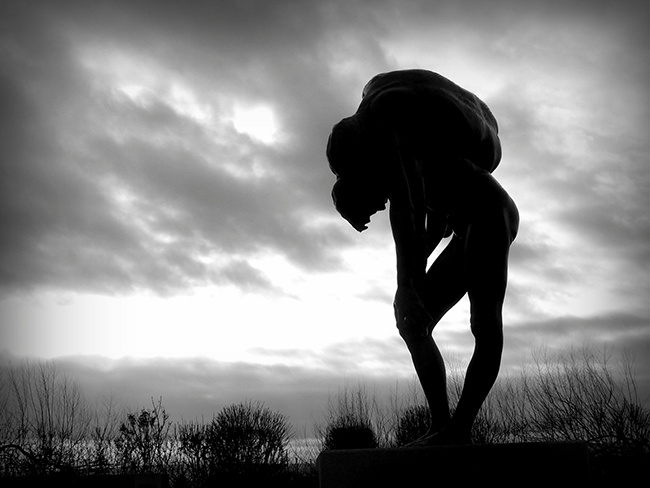
“The Kingdom Comes” by Bangladeshi artist Nikhil Halder, 1978

Consider him who endured such opposition from sinners, so that you will not grow weary and lose heart.

In your struggle against sin, you have not yet resisted to the point of shedding your blood. And have you completely forgotten this word of encouragement that addresses you as a father addresses his son? It says,

“My son, do not make light of the Lord’s discipline,
    and do not lose heart when he rebukes you,
because the Lord disciplines the one he loves,
    and he chastens everyone he accepts as his son.”

Endure hardship as discipline; God is treating you as his children. For what children are not disciplined by their father? If you are not disciplined—and everyone undergoes discipline—then you are not legitimate, not true sons and daughters at all. Moreover, we have all had human fathers who disciplined us, and we respected them for it. How much more should we submit to the Father of spirits and live! They disciplined us for a little while as they thought best; but God disciplines us for our good, in order that we may share in his holiness. No discipline seems pleasant at the time, but painful. Later on, however, it produces a harvest of righteousness and peace for those who have been trained by it.

Therefore, strengthen your feeble arms and weak knees. “Make level paths for your feet,” so that the lame may not be disabled, but rather healed. (New International Version)

Missed expectations often result in discouragement, even depression.

If we expect God to continually bless us with unending positive circumstances, we will, sooner or later, be confused and/or frustrated when life goes sideways.

The ancient Jewish Christians, for whom today’s New Testament lesson was addressed, faced opposition. Not only did they encounter the hardship of being Jews living in a Gentile world, but they also had to experience the difficulty of being Christians in a Jewish community.

Its one thing to put up with adversity for a few days or weeks. It is quite another thing altogether to deal with hard circumstances day after day, week after week, month after month, even year after year.

Where is God in all this negativity? When are the earthly blessings going to come? What the heck is going on here? Why are my prayers bouncing off the church ceiling?

Over time, the believers began to lose their joy. They started getting discouraged. The Jewish Christians, after beginning well in their faith, gradually slid into misinterpreting their circumstances as God being mean to them. Things got so bad, they even entertained the notion of returning to Judaism and leaving Christianity behind.

Their faith was shrinking.

However, their plight was very much seen by God. In fact, God was the One orchestrating the situations, as difficult as they were.

It is not our lack of resources, the disrespect, or the difficult people around us who are the problem. The issue is our interpretation of those events and persons.

The author of Hebrews invited the struggling believers to take a different interpretation of their hardship: They were experiencing divine discipline.

We are all responsible for our own children. As parents, we discipline them (ideally) for their own good. We know it will hurt temporarily. Yet, in the long run, the discipline will work out.

In fact, we understand this with all kinds of things. Everyday, people submit themselves to getting cut open, poked, prodded, and tested by doctors, surgeons, and healthcare workers because we know there needs to be temporary pain for permanent healing to occur.

It is the rare child who grows up without any discipline and becomes a productive citizen of society. It is the exceptional person who knows nothing of medical interventions for health and healing. And so, it is extremely unlikely that a Christian will experience holiness, righteousness, and live wisely in the world apart from some gut-wrenching, heart-breaking, and mind-bending circumstances for which they neither saw coming, nor ever asked for.

So, when the divine baseball bat whacks us upside the head, how will we interpret it?

Discipline is education by correction. God is the Father, treating us as family, as children who need to learn the ways of grace. God is the Divine Coach, exhorting us to work, run the laps, put in the reps, and reach beyond what we think we can do – knowing all along what our true capabilities are.

Godliness comes through discipline, training, and plain old fashioned hard work. Unless there is the suffering which comes through trials to our faith, Christianity is only a theory.

Before I suffered, I took the wrong way,
    but now I do what you say.
You are good and you do good.
    Teach me your statutes!
The arrogant cover me with their lies,
    but I guard your precepts with all my heart.
Their hearts are unfeeling, like blubber,
    but I rejoice in your Instruction.
My suffering was good for me,
    because through it I learned your statutes. (Psalm 119:67-71, CEB)

The appropriate response to difficult and adverse circumstances is to view them as God’s gracious guidance and correction. Rightly interpreting our life events gives us renewed resolve for the Christian marathon.

Endurance and perseverance are needed. Keeping good running form, consistent spiritual exercise, and maintaining liturgical rhythms, all help us face the adversity with energy, focus, and strength.

Christianity isn’t a matter of doing more. It is a way of life – a continuous evaluation of beliefs and thinking, addressing the shadows of the heart, and listening to the compassion deep in our gut.

Don’t give up. Keep going.

Be safe. Be strong. Be smart. Be spiritual. We are all in this together.

Thanks be to you, Lord Jesus Christ, for all the benefits which you have given us; for all the pain and insults you have borne for us. O most merciful redeemer, friend and brother, may we know you more clearly, love you more dearly, and follow you more nearly day by day. Amen.

James 1:1-8 – How to Face Painful Trials

James, a servant of God and of the Lord Jesus Christ,

To the twelve tribes scattered among the nations:

Greetings.

Consider it pure joy, my brothers and sisters, whenever you face trials of many kinds,because you know that the testing of your faith produces perseverance. Let perseverance finish its work so that you may be mature and complete, not lacking anything. If any of you lacks wisdom, you should ask God, who gives generously to all without finding fault, and it will be given to you. But when you ask, you must believe and not doubt, because the one who doubts is like a wave of the sea, blown and tossed by the wind. That person should not expect to receive anything from the Lord. Such a person is double-minded and unstable in all they do. (New International Version)

Where do you turn when unwanted circumstances leave you wondering how to cope?

The Apostle James, no stranger to adversity and stressful situations, likened our position in hard situations as faith being on the witness stand, put to the test. Faith is being examined and cross-examined. And it must stand the test. 

Our attitude toward such trials, in all their varied forms, determines whether we will become upset, hard-hearted, and calloused, or, come through having our faith confirmed with newfound peace and joy.

James wrote to Jewish Christians who felt like fish out of water. They were part of the dispersion of believers from Jerusalem in the persecution against Stephen and the church (Acts 7). The dispersed believers were refugees – poor, in a foreign country, just trying to carve out an existence and live for Jesus the best they could under a lot of adversity. 

James exhorted the Christians to view their situation as an opportunity for their faith in Christ to develop and grow.

Rejoice in the midst of trials.

“Consider the adverse circumstances as joy? Are you smoking something?” we might wonder. Telling someone to consider their tough situation as pure joy is a really hard pill to swallow. 

I’m not sure what the believers were thinking when they first heard this from James, but they might have thought the guy was crazy. These were people experiencing a lot of hard things. To tell hungry families with scant resources, wondering where their next meal is coming from, that they ought to consider their situation as pure joy may seem strange, even downright calloused. 

James, however, was looking to fortify the believers’ faith. Whenever we get a cut or a laceration, the first thing needed is to apply peroxide to the wound so there will be no infection from the injury. It might seem insensitive because peroxide applied to an open wound, frankly, hurts like hell. Yet it must happen. It’s a necessary part of healing. 

The Apostle cared enough about the people to tell them what they needed to hear, up front. Without a positive, godly, and wise perspective on their difficult situation, they would not make it. Infection would set in and destroy the fledgling church.

Suffering, in the form of spiritual peroxide, is necessary. To merely say what itching ears want to hear helps no one. Suffering is a significant part of the Christian life. God never promised that life would be or should be all cupcakes and unicorns. 

In fact, Christ promised just the opposite – that everyone who wants to live for Jesus in this present broken world will have a hard time of it. It’s not a matter if you will face the testing of your faith, but of whenever you face trials.

The good news is that adversity can become our teacher. We can learn patient endurance, which is necessary to the development of our faith. Spiritual growth only matures through the testing of faith through adversity.

Faith is not a neutral or static thing. Faith is active and dynamic. It’s always either developing or degenerating.  Without spiritual peroxide, faith degenerates and becomes rancid. Eventually, gangrene sets in, and an amputation will happen. To avoid this, we need to learn how to experience joy in the middle of hard things.

It seems to me a great tragedy, for many Christians and faith communities, is that we can live a trivial, blasé, and superficial existence as believers in Jesus, and get away with it. Because we have the ability to be independent, self-sufficient, and hold our own, we don’t really need anybody, including God. We say we need God, then turn around and live our lives as if no divine being existed, at all. 

Too many folks are doing everything but exercising spiritual disciplines that would put them in touch with Jesus. To try and keep from getting hurt, church becomes optional; reading and reflecting on Scripture becomes our daily crumb instead of our daily bread; prayer becomes a hail Mary, only for times of desperation, and not as a means of connecting with Jesus; giving and serving becomes ancillary, done only if there is any discretionary time and money left over. 

The Christian life was not meant to be easy! It requires blood, sweat, and tears. Faith is challenging, and often hard. Yet, even within the pain, faith is incredibly invigorating and joyful.

Do not avoid trials.

We need perseverance. If we always bail out when things get hard, we will be immature. Only through endurance does the maturation process occur. Let your hard situation do its necessary work. Immature people avoid hard things and instead put their energy into keeping up appearances.

Conversely, the mature person spends energy standing the test and trial of faith. They understand that there must be pressure for spiritual maturity to occur.

Oyster pearls are valuable and expensive. They result from years of irritation. Natural pearls form when an irritant – usually a parasite – works its way into an oyster. As a defense mechanism, a fluid is used to coat the irritant. Layer upon layer of this coating is deposited until a beautiful pearl is formed.

God is looking to do something beautiful in our lives. So, if we constantly run away and do not deal with our hard situations, there will never be a pearl. It takes about ten years for a pearl to form in an oyster in the ocean.  Observing an oyster every day, you never notice any movement is happening. You only see the irritation.

In the Christian life, the consistent daily choices over a long period of time (perseverance) form the eventual beauty.

No one needs to go looking for trials. And, I might add, you don’t need to take upon yourself being someone else’s trial. There’s no such thing in the New Testament of anyone having the spiritual gift of irritation. The trials come from God, not people. Therefore, we are to let our faith develop and grow through the testing.

Yet, what if I am in the middle of something so hard that I just cannot see God’s perspective on it? What if there is seemingly nothing redemptive from this adversity?

Pray for wisdom in the trials.

Ask God for wisdom to see the situation from a different angle – of its positive good, and for what God is accomplishing in and through it. The truth is, God is developing within people a strong vibrant faith, if we allow it.

Growing up on the farm, we had apple trees on the property. My Dad had a shop in the garage with a big vice on the workbench. Vices and little boys were made for each other. My brother and I used to find all kinds of things to put in that vice and squeeze them until they broke, split, or exploded. 

Putting fresh apples in the vice was one of our favorites. The best were the strong juicy ones because we could get them to splatter everywhere. We hated the wormy apples. They were rotten inside and collapsed with only a little pressure.

God will, at times, put us in the divine vice – not because the Lord is mean or delights in our pain. God places us in situations of extreme pressure for fresh prayers to explode out of us to heaven.

If we are walking with God, we will be strong and juicy. However, if we have neglected God, then just a smidge of pressure will create a collapsing wormy mess. With no meaningful prayers, there is no meaningful wisdom for our circumstances.

Believe God is good no matter the trial.

God is not mean, but generous. The Lord gives with no questions asked, and without giving us a hard time about our situation. Yet, there is a condition….

We must believe – that God is good, answers prayer, and gives wisdom. Doubting God’s generosity and benevolence is a demonstration of a weak wormy faith. We may doubt a lot of things. Yet we are always to be secure in the knowledge that God has our best interests at heart. This is why there can be joy and perseverance, even when everything around us is going to hell.

Grant, O God, that we may never lose our way through stubborn self-will, and never abandon the struggle but endure to the end. Help us never to choose the cheap way of avoiding or circumventing our trials but embrace the Via Dolorosa. May we never forget that sweat is the price of all things, and that without the cross, there cannot be the crown. Amen.

Galatians 6:1-10 – Fulfill the Law of Christ

Brothers and sisters, if someone is caught in a sin, you who live by the Spirit should restore that person gently. But watch yourselves, or you also may be tempted. Carry each other’s burdens, and in this way you will fulfill the law of Christ. If anyone thinks they are something when they are not, they deceive themselves. Each one should test their own actions. Then they can take pride in themselves alone, without comparing themselves to someone else, for each one should carry their own load. Nevertheless, the one who receives instruction in the word should share all good things with their instructor.

Do not be deceived: God cannot be mocked. A man reaps what he sows. Whoever sows to please their flesh, from the flesh will reap destruction; whoever sows to please the Spirit, from the Spirit will reap eternal life. Let us not become weary in doing good, for at the proper time we will reap a harvest if we do not give up. Therefore, as we have opportunity, let us do good to all people, especially to those who belong to the family of believers. (New International Version)

Its all about grace. God’s grace. In Christ, lived by means of the Holy Spirit. Its not about hard black-and-white lists of rules or principles to live by. The Law of Christ is to help each other in our troubles, no matter what.

Overwhelming physical, mental, emotional, and/or spiritual burdens can become even more heavy through failing to live up to someone’s or some group’s or a church’s unwritten list of rules. “Keep a stiff upper lip.” “Everything is possible for those who love God.” “Stay positive.” “Just have faith and trust God.” Or worse, silence…. These and hundred other phrases communicate to people with crushing loads that they will have to carry them alone.

The letter to the Galatian believers spells out what is to truly characterize Christian interactions, and what it means to walk in the Spirit. Believers in Jesus are to emulate the behavior of Christ, the ultimate burden-bearer, who came to restore sinners, not condemn them.

We have a responsibility to rescue, renew, and revitalize persons who have lost their way. We are our brother’s and our sister’s keeper.

Someone caught in the crosshairs of a bad decision, or ensnared by making a wrong step, who is now in over their heads, needs help. In such a case, we are to restore, not punish. The person’s wound needs spiritual cauterizing. The broken spirit needs to be set back into place to heal properly.

The tone and the attitude which we do this important work of restoring people is through gentleness (meekness). We are to have a mindset and heart stance which understands there is no moral superiority with me. I could easily be the person in need of restoration.

When we have a gentle spirit, then we discern we are not above falling into the same trouble. We, too, are ethically and morally vulnerable. So, the church has a corporate responsibility to bear one another’s burdens.

There are other people who, through no fault of their own, find themselves in over their heads, too. Their health and mental health challenges, the emotional weight of hard circumstances, and their broken spirits require others to help shoulder the load so that the weighted-down person is not crushed.

Nobody in any faith community is above doing this work of burden-bearing. And it isn’t appropriate for an individual to boast about the burden-bearing work of others, as if it were theirs. You and I are to take responsibility for our own actions and attitudes without taking credit for someone else’s efforts.

A mature spiritual community of people are able to distinguish those loads which individuals must bear for themselves, and those burdens where help is sorely needed. We are accountable to carry our own backpack. And we are also accountable before Christ to share our load with others when it becomes too heavy for us.

If we choose not to allow others to assist us when we need it, then we will reap what we sow – we’ll feel the full weight and consequences of our silence. The planting and harvesting metaphor isn’t just for those who have engaged in wrongdoing. It is also for those who don’t put any seeds in the ground to begin with. They shouldn’t expect a harvest, at all.

Grace lived out in real experiences knows when to get under a load and help carry it. And grace also knows when to be kind to self and share the heavy burden with others who can help shoulder it for a bit. This is Christianity which relies on the enablement of the Spirit, made possible by Christ, who carried our crushing weight of guilt and shame for us.

Our Christian freedom in Jesus is to be stewarded wisely through carrying one another’s burdens, and so, fulfilling the Law of Christ.

God of all comfort, our help in time of need: We humbly pray to relieve and restore persons in need, people for whom are tired, sick, weary, or unable to continue as they are. Look upon them with the eyes of your mercy; comfort them with a sense of your goodness; preserve them from the temptations of the enemy; and give them patience under their affliction. In your good time, restore them to holistic health, and enable them to live their lives to your glory; and may they dwell with you in life everlasting; through Jesus Christ our Lord. Amen.

Psalm 130 – Believe, Hope, and Love

I cry out to you from the depths, Lord—

my Lord, listen to my voice!
    Let your ears pay close attention to my request for mercy!
If you kept track of sins, Lord—
    my Lord, who would stand a chance?
But forgiveness is with you—
    that’s why you are honored.

I hope, Lord.
My whole being hopes,
    and I wait for God’s promise.
My whole being waits for my Lord—
    more than the night watch waits for morning;
    yes, more than the night watch waits for morning!

Israel, wait for the Lord!
    Because faithful love is with the Lord;
    because great redemption is with our God!
He is the one who will redeem Israel
    from all its sin.
(Common English Bible)

Throughout church history, the book of Psalms has been used and understood as the Church’s prayer book.  Indeed, the psalms are much more than a collection of beautiful poems, words of assurance, and songs of praise – they are designed and meant to have regular and ongoing use as prayers. And I’m not just talking about the psalms being somebody else’s prayers; they are my prayers and your prayers. 

There are times when words fail us – where we find ourselves between a rock and a hard place and want to pray. Our stress and/or anxiety is so high, we can neither think straight, nor form anything coherent with our mouths. It’s in such times that the psalms present themselves to us as the path forward. 

What’s more, psalms are meant to be spoken out loud and more than once. And I’m not talking about saying them with a quiet mumble or a flat monotone.  No! These precious prayers of Holy Scripture are meant to be declared with full voice and a large amount of flavor!  They are to repeatedly roll off our lips with all the emotional and spiritual gusto which resides within us!  Tears and yelling are both appropriate and encouraged. 

For we do not possess a mere heady faith of thoughts and ideas; we also possess a faith that is robustly heartfelt, and dwells down deep in the gut where our bowels of compassion have their abode. 

Even with a cursory reading of today’s psalm, we can easily observe there’s more going on here than beliefs of faith, hope, and love. 

The psalmist is expressive, clinging to faith with a patient longing for God to make good on divine promises. It is chocked full of emotion, a prayer coming from the depths of the gut. The whole being is involved, and rightly so, because our faith affects the entirety of a person and everyone in the community of the redeemed.

If this psalm resonates with you in any way, let your proclamation of it be with the expanse of feeling inside you. After all, as people created in the image of God, we share God’s own deep sense of love – and love is genuinely love when it is outwardly expressed with a sacred combination of words, actions, and feelings.

Waiting, watching, hoping. We as humans do a lot of that. While we anticipate God’s response, we keep up the praying. We keep reminding God to be God. We encourage others to watch and wait and hope, all the while encouraging ourselves, as well.

Whenever we are stressed, more often than not, we thrash about, like a desperate swimmer in the middle of a lake, just trying to keep his head above water. Yet, the psalm tells us to do the counterintuitive: Don’t do something. Just stay there and relax. Why, in heaven’s name, should I do nothing?

Because the Lord will act.

And that action of God will redeem, renew, refresh, and revitalize. It will be new, like the morning dawn. A fresh day, that will not be like any other day before it.

God does his best saving work in the worst and most impossible of circumstances. We need not fear the overwhelming depths of difficulty and trouble. We can trust the Lord.

Perhaps the most awful of deep holes are emotional – deep depression and/or anxiety – a lostness inside oneself because of mental disorder. In such a dark oblivion, and terrible morass, one tries to survive into another hour, not just another day. Like a watchman waiting for the night to dissipate and dawn to break, there is a longing for God.

Deliverance and rescue seem slim. Hopelessness begins to calcify the spirit. Only love can release the hardening situation; the steadfast love of God is a gentle hammer, picking away at the grief.

This is a love which never gives up.

Today’s psalm begins as a desperate cry for help. It ends with an awareness of the need to trust, hope, and wait….

Blessed Jesus, in the comfort of your love, I lay before you the memories that haunt me, the anxieties that perplex me, the despair that frightens me, and my frustration at my inability to think clearly. Help me to discover your forgiveness in my memories and know your peace in my distress. Touch me, O Lord, and fill me with your light and your hope. Amen.

*Above painting of Psalm 130 by Virginia Wieringa