The Effects of Bad Decisions (2 Samuel 12:15-25)

David and Nathan, by Angelika Kauffman (1741-1807)

After Nathan had gone home, the Lord struck the child that Uriah’s wife had borne to David, and he became ill. David pleaded with God for the child. He fasted and spent the nights lying in sackcloth on the ground. The elders of his household stood beside him to get him up from the ground, but he refused, and he would not eat any food with them.

On the seventh day the child died. David’s attendants were afraid to tell him that the child was dead, for they thought, “While the child was still living, he wouldn’t listen to us when we spoke to him. How can we now tell him the child is dead? He may do something desperate.”

David noticed that his attendants were whispering among themselves, and he realized the child was dead. “Is the child dead?” he asked.

“Yes,” they replied, “he is dead.”

Then David got up from the ground. After he had washed, put on lotions and changed his clothes, he went into the house of the Lord and worshiped. Then he went to his own house, and at his request they served him food, and he ate.

His attendants asked him, “Why are you acting this way? While the child was alive, you fasted and wept, but now that the child is dead, you get up and eat!”

He answered, “While the child was still alive, I fasted and wept. I thought, ‘Who knows? The Lord may be gracious to me and let the child live.’ But now that he is dead, why should I go on fasting? Can I bring him back again? I will go to him, but he will not return to me.”

Then David comforted his wife Bathsheba, and he went to her and made love to her. She gave birth to a son, and they named him Solomon. The Lord loved him; and because the Lord loved him, he sent word through Nathan the prophet to name him Jedidiah. (New International Version)

The backstory to today’s Old Testament lesson is that King David not only screwed up, but he also jumped off the diving board into a big nasty pool of immoral excrement.

He saw a woman, Bathsheba, and had to have her. Thinking of only his desire, and not her needs, or that she was a married woman, he used his royal authority to get her. And he slept with her. What’s more, she became pregnant by the king.

At that point, David went to the dark side by covering up his immorality and shame. He eventually went so far as to ensure that Bathsheba’s husband, Uriah (who was both an upright man and an innocent victim) was killed in battle. The king again used his authority to arrange a murder to look like a death in military battle.

With Uriah dead, David brought Bathsheba to his palace as another one of his wives. And no one was the wiser… Except God, who was very displeased with the entire affair. So, the Lord sent Nathan the prophet to David. Through the savvy use of parable, Nathan was successful in helping the king to see his own terrible guilt.

To King David’s credit, he came to the point of recognizing his great faults, and repented of his awful doings. And to God’s credit, David was forgiven.

However, despite the reality of repentance and forgiveness, there are still consequences to our actions. And what is heartbreaking, is that the effects of our bad decisions and bad actions can and do affect others.

As a result of one man’s sin, a woman was violated, a man was murdered, and a baby was conceived, born, and soon died.

Bathsheba attends to her child as David fasts and prays, by W.A. Foster, 1897

King David came to the point of understanding this reality. True repentance, forgiveness, and faith, leads us to a real life which exudes genuineness and authenticity. It won’t undo the past; yet, it will affect the present, and can change the future – that is, if we let mercy and grace have its way.

David’s genuine fatherly love came from his restored place, and was shown by his authentic grieving and mourning. He did not want Bathsheba’s baby son to die. Yet, the child did die. Unfortunately, innocent people often become collateral damage because of another’s unthinking actions.

The king’s behavior, after the child died, shows his pained acceptance of the situation. And his consoling of Bathsheba is the first real evidence we have of David thinking of her instead of himself.

The story reassures us that God loves the next child born from Bathsheba and David. This baby (the future King Solomon) will not pay for his father’s crimes; nor will any other child that David fathers.

The typical trajectory of David’s life was to learn from God’s law and from the experiences God gave him. Yet, in the case of Bathsheba and Uriah, King David ended up learning the hard way that he could not rest on his laurels once he was in a secure and successful place in his life.

Maybe because David spent so much of his adult life facing life-and-death situations, that once he could relax a bit and not have to worry about his life, he let his spiritual and emotional guard down and fell into sin.

After committing adultery, David found himself in a spiritual and emotional place he had never been in before. Yet, instead of confessing his crime to God and making things right with Bathsheba and Uriah, he worked to cover up everything.

Specifically, shame is the place that David had never experienced before, at least to this degree. And when shame gets its poisonous talons into us, it is very hard to be open, real, genuine, and authentic.

In an effort to keep the secrets, the lies morph into more bad decisions, and more bad decisions become ever-increasing bad actions. It becomes a downward spiral of icky guilt which will never be assuaged apart from the divine tools of confession, repentance, faith, and reconciliation.

I trust and hope that it will not take a prophet like Nathan to show you and I how egregious some of our decisions and actions actually are.

Instead, we can make the daily decision to practice our spiritual disciplines, so that when we find ourselves in that good position of no longer having to fight for survival, we will be able to exercise wisdom from the largess of God’s grace which fills us.

Have mercy on me, O God,
    according to your unfailing love;
according to your great compassion
    blot out my transgressions.
Wash away all my iniquity
    and cleanse me from my sin. Amen. (Psalm 51:1-2, NIV)

How To Handle the One Who Grieves (Job 37:1-13)

The Wrath of Elihu, by William Blake, 1805

“At this my heart pounds
    and leaps from its place.
Listen! Listen to the roar of his voice,
    to the rumbling that comes from his mouth.
He unleashes his lightning beneath the whole heaven
    and sends it to the ends of the earth.
After that comes the sound of his roar;
    he thunders with his majestic voice.
When his voice resounds,
    he holds nothing back.
God’s voice thunders in marvelous ways;
    he does great things beyond our understanding.
He says to the snow, ‘Fall on the earth,’
    and to the rain shower, ‘Be a mighty downpour.’
So that everyone he has made may know his work,
    he stops all people from their labor.
The animals take cover;
    they remain in their dens.
The tempest comes out from its chamber,
    the cold from the driving winds.
The breath of God produces ice,
    and the broad waters become frozen.
He loads the clouds with moisture;
    he scatters his lightning through them.
At his direction they swirl around
    over the face of the whole earth
    to do whatever he commands them.
He brings the clouds to punish people,
    or to water his earth and show his love.” (New International Version)

Job’s Despair, by William Blake, 1821

On the one hand, the biblical book of Job needs little introduction. Many people know it has to do with a man’s innocent suffering and tenacious faith. Most folks are familiar with how it feels to suffer for no apparent reason. And everyone understands the struggle when life is broken by pain and loss.

Yet, on the other hand, the book of Job defies simple anecdotes about suffering. And the relationship between Job and God has a lot of complexity to it. Add in Job’s friends with their wordy offerings into his situation, and there becomes a fuller picture of the true wrestling of faith and patience that occurs.

Elihu was a young person who was with the three friends of Job. After listening to everyone speak, he himself went on a long speech, stretching six chapters from Job 32-37. He was angry with Job, and with Job’s three friends.

The young Elihu had picked up that Job thought of himself more righteous than God. And he was also upset that the “friends” offered nothing helpful, and could provide no convincing answers to Job – thus making it appear that God was guilty of Job’s intense suffering and grief.

Job, by French painter Léon Bonnat, 1880

In today’s Old Testament lesson, we are getting an end part of Elihu’s speech in which he sought to defend God’s justice through observing the majesty and order of creation.

The testimony of God’s sovereign governance of the world is found in the rain, the thunder, and the lightning; through the winter storms and the frost. The Lord uses the created order to both judge and sustain people. And through the ecological systems we can see that God is at work, regulating it all, and using it for divine purposes, Elihu points out.

What strikes me about Elihu’s words is that he is not wrong, he’s just not very helpful. As a believer, I look at his speech as more of a Captain Obvious moment; yes, he is stating theological reality, but no, he’s not really breaking any new ground or giving any great insight here.

Both Job and Job’s friends had already expressed a theological perspective in kind. Which makes me curious as to why Elihu felt so compelled to even talk at all. I think he would have been better remembered, and maybe even hailed as spiritual beyond his years, if he would have just kept silent.

I realize not everyone is going to go with me on that observation, and that’s fine. Yet it seems to me that a good many people lob too many words toward the suffering among us, when what is actually needed is a compassionate presence that has learned to be comfortable with the uncomfortable.

There are times when words are not needed, when the situation is so incredibly unique and/or difficult that to offer a speech is like yelling in the woods with no one around; it might make the one yelling feel better but that’s about it.

If anyone needed to feel better it wasn’t Elihu. What’s more, a perceived need of defending God’s reputation or honor perhaps betrays a shortsighted theology to begin with. The Lord is quite big enough to handle any rebuffs or misunderstandings from mouthy humans. God isn’t in Junior High School, requiring a mouthpiece to help him out in a scuffle.

I would personally rather give comfort to a hurting person, instead of theological exhortations and speeches about how we ought to talk to, and about, God. That’s because I observe Jesus bringing genuine comfort and help. And I would much rather take my cues for dealing with grieving people from Christ than from Elihu, or anybody else for that matter.

“God blesses those people who grieve. They will find comfort!” (Matthew 5:4, CEV) Jesus said this in his Sermon on the Mount, as a beatitude of all who desire God’s kingdom. Christ understood well the psalmist’s understanding of God’s role and stance concerning people’s grief: “The Lord is close to the brokenhearted; he saves those whose spirits are crushed.” (Psalm 34:18, CEB)

The Apostle Paul, taking a lesson from both his Jewish learning and his encounter with Christ said, “mourn with those who mourn.” (Romans 12:15, NIV) Comfort because of grief and suffering will be built into the end of time. Methinks, then, that this is important…

“Look! God’s dwelling place is now among the people, and he will dwell with them. They will be his people, and God himself will be with them and be their God. ‘He will wipe every tear from their eyes. There will be no more death’ or mourning or crying or pain, for the old order of things has passed away.” (Revelation 21:3-4, NIV)

In whatever way you choose to look at the book of Job, please don’t miss what is to be our response to another’s pain. There is a time for theological education, and there is a time to put a robust theology into practice through a very real comforting presence of another who is in terrible suffering.

God, the strength of the weak and the comfort of those who suffer: Hear my prayers and grant those who suffer in body, mind, or spirit the power of your grace, that affliction may be turned into health, and sorrow into joy. Amen.

A Warning and a Reassurance (Isaiah 32:9-20)

Prophet Isaiah, by Sefira Lightstone

You women who are so complacent,
    rise up and listen to me;
you daughters who feel secure,
    hear what I have to say!
In little more than a year
    you who feel secure will tremble;
the grape harvest will fail,
    and the harvest of fruit will not come.
Tremble, you complacent women;
    shudder, you daughters who feel secure!
Strip off your fine clothes
    and wrap yourselves in rags.
Beat your breasts for the pleasant fields,
    for the fruitful vines
and for the land of my people,
    a land overgrown with thorns and briers—
yes, mourn for all houses of merriment
    and for this city of revelry.
The fortress will be abandoned,
    the noisy city deserted;
citadel and watchtower will become a wasteland forever,
    the delight of donkeys, a pasture for flocks,
till the Spirit is poured on us from on high,
    and the desert becomes a fertile field,
    and the fertile field seems like a forest.
The Lord’s justice will dwell in the desert,
    his righteousness live in the fertile field.
The fruit of that righteousness will be peace;
    its effect will be quietness and confidence forever.
My people will live in peaceful dwelling places,
    in secure homes,
    in undisturbed places of rest.
Though hail flattens the forest
    and the city is leveled completely,
how blessed you will be,
    sowing your seed by every stream,
    and letting your cattle and donkeys range free. (New International Version)

The biblical prophets spoke their prophecies for a reason, usually because there was some sort of injustice happening. And typically they addressed those with power, authority, and influence within society – who were doing something wrong, or were simply unaware of what was happening around them. In other words, the people ought to know better.

A Warning Against Complacency

The prophet Isaiah was specifically addressing particular folks, in our Old Testament lesson for today. Isaiah was calling out those who were complacent and living a life of ease. There was a chunk of society in Isaiah’s day who were safe, secure, affluent, comfortable, and rested on their laurels and their resources. Such persons didn’t ever think the thought that their lifestyle was temporary.

The warning of Isaiah was directed specifically to the well-off women in society. Concerning the rich and powerful, the biblical prophets had a tendency to address the women, e.g. the prophet Amos went after the women, calling them “the cows of Bashan.” (Amos 4:1)

The tone of Isaiah’s warning here is much more toward preparing the rich for a time when they won’t be able to rely on their wealth and affluence – they will be stripped of what they have. The women, Isaiah warned, need to prepare themselves for a time of grief.

In other words, they need to face up to what is about to occur, and not idle their lives away merrily as if nothing will ever happen to change their way of life.

Realize, Isaiah says, that the land will be emptied of life, and that resources will become scarce. You women will be reduced to near poverty. The once pride and joy of your nice house will quickly become, in no time at all, a turn of pride and joy in at least having a donkey to sit on.

The happy world they presently know will soon become nothing but a memory.

That is, until a new spirit takes over…

A Reassurance of Newness

Lamenting a loss will not happen forever. The grief shall eventually break. Not everything will be doom and gloom, as if it is some sort of new normal. Positive hope is also on the horizon. A spirit will be given, Isaiah insists, that will generate a wonderful restorative newness.

From a New Testament perspective, the spirit which is given is the Comforter. The Holy Spirit of God moves us through our grief and helps us realize a new lease on life.

“But when the Counselor comes, whom I shall send to you from the Father, the Spirit of truth who proceeds from the Father, He will bear witness of Me.”

Jesus (John 15:26, MEV)

The Spirit is the very force of God in the world, given to help us live into grace and truth – thus, turning injustice to justice, fear to faith, complacency to action, foolishness to wisdom. The desert is transformed into a garden, the dry land becomes lush and fruitful. All things are restored to vitality; people flourish and thrive again.

People’s needs, along with their great need for peaceful relational connections, will take their rightful place. Throughout the land there shall be human well-being. In other words, there is real peace – wholesomeness and integrity, with settled trust and rest in the plans and purposes of God.

In this present contemporary world of political instability for so many, instead of running about like Chicken Little believing that the sky is falling, people of faith can exhibit a peaceful confidence and a settled trust that grace and mercy will have the day.

We don’t need to live in fear, continually and anxiously vigilant to the bad thing around the corner. And when something good happens, we don’t have to wonder when the other shoe will drop. A good God has good purposes in store for humanity.

At the same time, those who are complacent and either cannot or will not see beyond the end of their nose, are served a merciful notice: They can become aware of how things really are – and do something about it.

Cycles of violence, pain, and injustice can and will be broken. Yet we must all do our part to become self-aware, acknowledge the arrogance within society, and determine that in faith we will trust in the name of the Lord who made heaven and earth; and that we will work for a better society and a more fruitful culture.

We are truly not far from the kingdom of God.

Almighty Father, who gave your only Son to die for our sins and to rise for our justification, give me grace to put away the leaven of malice and evil – so that I may always serve you in purity of heart and truthfulness of mind; through Jesus Christ your Son, my Lord, who lives and reigns with you and the Holy Spirit, one God, now and forever. Amen.

Holy Saturday (John 19:38-42)

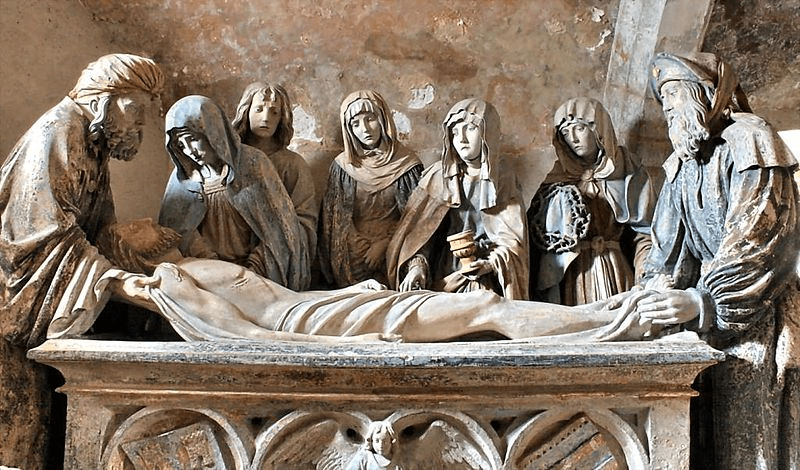
The Entombment, by the French sculptor Maître de Chaource, 16th century

After these things, Joseph of Arimathea, who was a disciple of Jesus, though a secret one because of his fear of the Jews, asked Pilate to let him take away the body of Jesus. Pilate gave him permission, so he came and removed his body. Nicodemus, who had at first come to Jesus by night, also came, bringing a mixture of myrrh and aloes, weighing about a hundred pounds. 

They took the body of Jesus and wrapped it with the spices in linen cloths, according to the burial custom of the Jews. Now there was a garden in the place where he was crucified, and in the garden there was a new tomb in which no one had ever been laid. And so, because it was the Jewish day of Preparation and the tomb was nearby, they laid Jesus there. (New Revised Standard Version)

Today is Holy Saturday – a quiet place sandwiched between the ignominy of the cross and the celebration of resurrection – a day of solitude, silence, and stillness. 

This isn’t a particularly popular day. People don’t rave about Holy Saturday, in fact, many Christians haven’t had a thought that this day could have any significance. Yet, this very day has its place in the scheme of the Christian life.

There cannot be resurrection and new life without a death and dying to self. There must be suffering before there can be glory. Whenever Christians quickly jump to triumphal language about victory and speak little-to-nothing about suffering, then we are left with a cheap grace which has been purchased with the counterfeit currency of velocity. 

This day is meant for us to get out of our heads and wrap our hearts around the important reality that Jesus Christ was truly in the grave – very much dead. 

It was real suffering on Good Friday, and it is a real death in the grave on Holy Saturday. There is no movement.  All is silent and still. Jesus is in the solitude of a dark tomb. 

My friends, there is absolutely no getting around the fact that if we want a Resurrection Day with all its celebration and glory, then we cannot and must not circumvent Holy Saturday. 

On Holy Saturday, Christ’s disciples were experiencing an awful and real grief. Jesus suffered. He was tortured and humiliated. Jesus died. It was surreal for the disciples. They could barely believe there could ever be a day like today. Their Lord was dead and buried in a tomb.

Holy Saturday sits us down and asks some hard questions:

  • Are you ready to follow Jesus and suffer as he did? 
  • Are you willing to stop your striving, manifested through constant movement, and embrace solitude, silence, stillness with its contemplation and embrace of suffering?
  • Will you have sense enough to pray? 
  • Will you practice a Christian counter-cultural shift and face the ridicule of friends so that you might take some much-needed time to be with Jesus in the tomb?
  • Are you so antsy and anxious that you just want to leap into Easter with no solidarity with your Lord who is in the grave?

You may think that I’m being a bit too hard, or harsh, or cold…. That’s because Jesus is cold. He has a bonified cold dead body. It’s no fake death. There’s no “swoon theory” here, as if Christ only passed-out and did a weird divine fainting spell. No, he is dead. And if you and I want to live with Jesus, we must die with Jesus. 

Anyone who tries to promise a new life apart from journeying with Jesus into the grave is a spiritual charlatan. 

Only through death can there be life. 

On this Holy Saturday, let us intentionally slow down, do less, give ourselves a large chunk of unstructured time, and put aside routine things for a while. In its place, fill the time with unfettered access to God in Christ.

O God, Creator of heaven and earth: Grant that, as the crucified body of your dear Son was laid in the tomb and rested on this holy Sabbath, so may we await with him the coming of the third day, and rise with him to newness of life; who now lives and reigns with you and the Holy Spirit, one God, for ever and ever. Amen.