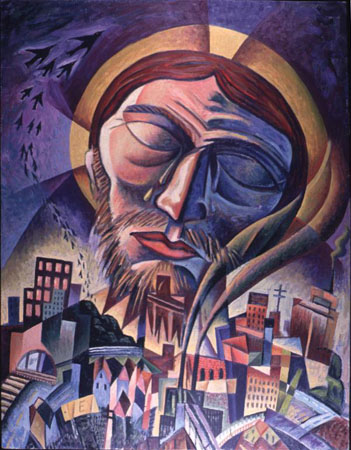
Luke 19:41-44 – The Place of Tears

Man of Sorrows by James B. Janknegt, 1990

“As Jesus came to the city and observed it, he wept over it.  He said, ‘If only you knew on this of all days the things that lead to peace. But now they are hidden from your eyes.  The time will come when your enemies will build fortifications around you, encircle you, and attack you from all sides.  They will crush you completely, you and the people within you. They won’t leave one stone on top of another within you, because you didn’t recognize the time of your gracious visit from God.’” (CEB)

There are Christians who believe in as much withdrawal from the world – its earthly political and cultural realm – as is humanly possible this side of heaven. There are yet others who believe in as much accommodation as possible to the world, its structures and society. And there are others who believe that the world and the church are simply two distinct realms which Christians simply move back and forth within, like taking one hat off and doffing another.

Let us leave that all aside for a moment and just observe the pathos of Jesus. He came to the city of Jerusalem, a city which was both deeply religious and very worldly. Jesus stood and looked affectionately and longingly at the city… and he wept. This was not a quiet shedding of a tear. No, the word “wept” means that Jesus openly cried aloud over the city. Think of the kind of crying which takes place when a person is in the throes of grief.  These were great heaves of loud weeping.

The reason Jesus was lamenting with so much feeling was that the city did not recognize they had a gracious visit from God. The Lord looked at the city and saw all the future disaster which was coming. He knew it could be different, and he was emotionally undone by the city’s inability to see God, right in front of their own face.

Now let us return to our view of the world and our involvement in it. Taking some cues from our Lord Jesus, the first and foremost posture we are to take toward the worldly city is not separation, accommodation, or dual citizenship – it is, rather, to grieve and lament.

The longing Jesus had in his heart was to see the city of Jerusalem annexed and incorporated into the kingdom of God. The way of peace, of shalom on this earth, is to bring all things and all the world under the benevolent reign of God. It is as if there are Twin Cities, like Minneapolis and St. Paul, which exist side-by-side but have different municipal structures. 

The kingdom of this world and the kingdom of God exist next to each other. Jesus wanted to bring the earthly kingdom into the peaceful and gracious realm of God’s kingdom. But the people would have nothing to do with it. Both the religious establishment and the secular authorities of the city wanted their own municipal conceptions of how things should go – and they both rejected the Christ who could bring them all true harmony.

We are about to enter the season of Lent. It is a time set aside in the Christian Year for repentance and preparation to receive King Jesus as our rightful benevolent ruler. Let us lament the world full of both religious and secular people who do not recognize the time of God’s visitation. Let it be a time to journey with Jesus and follow him in his Passion for this world and all its inhabitants.

Blessed Father, Son, and Holy Spirit, the holy Trinity whom I serve – the world and even sometimes the church is estranged from grace – they have not recognized your gracious coming and presence. I lament such a state of things, and ask you, blessed Spirit may draw all people to the Savior, Jesus Christ, in whose name I pray.  Amen.

Job 6:1-13 – A Response to Suffering

Job by French painter Léon Bonnat, 1880

Oh, that my grief was weighed,
    all of it were lifted in scales;
    for now it is heavier than the sands of the sea;
        therefore, my words are rash.
The Almighty’s arrows are in me;
    my spirit drinks their poison,
    and God’s terrors are arrayed against me.
Does a donkey bray over grass
    or an ox bellow over its fodder?
Is tasteless food eaten without salt,
    or does egg white have taste?
I refuse to touch them;
    they resemble food for the sick.

Oh, that what I’ve requested would come
        and God grant my hope;
    that God be willing to crush me,
    release his hand and cut me off.
I’d still take comfort,
    relieved even though in persistent pain;
        for I’ve not denied the words of the holy one.
What is my strength, that I should hope;
    my end, that my life should drag on?
Is my strength that of rocks,
    my flesh bronze?
I don’t have a helper for myself;
    success has been taken from me. (CEB)

The Old Testament character of Job is famous as the poster boy for suffering, grief, and sorrow. A divine and devilish drama was taking place behind the curtain of this world, of which Job had absolutely no clue about.  All he knew was that he lost everything – his family, his wealth, and his standing before others.  The only thing left was his own life – and he was in such physical pain and emotional agony that he was ready to die.

Yet, the greatest pain of all seems to be the silence of God. Job has no idea, nothing to grab ahold of no earthly sense of why he was going through such intense and terrible suffering. His cries, tears, pleas, and expressions of deep hurt seemingly go un-noticed. Job felt truly alone in his horrible pain of body and spirit.

“We must learn to regard people less in the light of what they do or omit to do, and more in the light of what they suffer.”

Dietrich Bonhoeffer

Job’s story is as old as time – probably having taken place 4,000 years ago. And here we are, all these millennia later, knowing the story of why Job suffered, as well as the end of the story. But Job himself never knew why he suffered, even when God spoke and restored his health and wealth.

It is so extremely easy and normal to ask the question, “Why!?”  When we are in the throes of emotional pain and our prayers seem to bounce off the ceiling, there is only trust left for us. We do what is unthinkable to others who have never known God – place our complete reliance and hope on the God for whom we know is not really sleeping or off on a vacation. We believe, even know, God is there. For whatever reasons which we might never know this side of heaven, God chooses to remain silent.

The genuineness of faith is not determined by giving the right answers to a theology questionnaire. Genuine faith is made strong through the trials, sufferings, pain, and lack of understanding in this life. We all suffer in some way. How we choose to respond to that suffering, either by cursing God and becoming bitter, or holding to God even tighter and becoming better, is totally up to you and me.

God of all creation, you see and survey all your creatures here on this earth. Sometimes I just do not understand what in the world you are doing or not doing. Yet today I choose to put my faith, hope, and love in you.  I may not know what the heck I am doing, but you always work to accomplish your good purposes, through Jesus Christ, my Savior, along with the Holy Spirit.  Amen.

Jeremiah 20:14-18 – Overwhelmed with Grief

By Unknown artist

Cursed be the day I was born!
    May the day my mother bore me not be blessed!
Cursed be the man who brought my father the news,
    who made him very glad, saying,
    “A child is born to you—a son!”
May that man be like the towns
    the Lord overthrew without pity.
May he hear wailing in the morning,
    a battle cry at noon.
For he did not kill me in the womb,
    with my mother as my grave,
    her womb enlarged forever.
Why did I ever come out of the womb
    to see trouble and sorrow
    and to end my days in shame? (NIV)

Perhaps you feel as though you must put on a good face, a decent front for others to see. You don’t like other people seeing you upset or cry because it can be embarrassing. Maybe you believe others don’t need to be burdened with your sadness. The last thing you want is to be a killjoy.

Sometimes you might even put up a front with God.  Maybe you think God wants everyone to be perpetually happy and always sing with the birds in blissful joy and gladness, or whistle while you work. However, that would not be an accurate view of God.

One of the most faithful people in Holy Scripture, Jeremiah, freely and unabashedly lamented before God – to the point of wishing he were dead. Jeremiah, the incredible prophet of God, closer to the Lord than anyone of his generation, was so despondent and ashamed that he wished he were never even born. The suffering and the shame were just too overwhelming.

To say that Jeremiah had a difficult ministry is a gross understatement. He literally had the ministry from hell, prophesying to people who neither liked him, nor his message to them. In the middle of it all, Jeremiah threw up his hands and let out his complaint to God. Jeremiah was in such ministerial misery that he wished he had been a stillborn baby.

Lest you think Jeremiah was sinfully depressed or just cuckoo, he is far from alone in the Bible. King David had no scruples about letting God know how he felt about his dire circumstances. Job, likely the most famous sufferer of all, spent time doing nothing but lamenting his terrible losses for months. What all three of them have in common is that they openly grieved with great tears, yet neither cursed God nor forsook the Lord.

Lamentation is the sacred space between intense grieving to God without blaming the Lord for our significant changes and losses in life. I would even argue that lamenting and grieving before God is a necessary spiritual practice which needs full recognition in the Body of Christ. Please sit with that last statement for a bit and consider how it might become a reality in your own life and context.

Grief can and does attach itself to any change or loss. It is the normal emotional, spiritual, physical, and relational reaction to that injury of the heart. There is only one way through grief. We must tell our story to another. It is both biblical and quite necessary.

Share each other’s burdens, and in this way obey the law of Christ.”

galatians 6:2, NLT

We need our spirituality to support us in such times – not drive us away through a misguided theology of believing you must keep a stiff upper lip. It is critical to have safe and supportive people in our lives when going through overwhelming circumstances.

“Spirituality is recognizing and celebrating that we are all inextricably connected to each other by a power greater than all of us, and that our connection to that power and to one another is grounded in love and compassion.”

Brené Brown

Our tears are holy. They are not the mark of weakness, but of power. The prophet Jeremiah was doing a very godly thing in expressing his grief. And Jeremiah’s lament is what helped steel him for the several attempts on his life that he faced.

Let the tears do their intended work in your life.

God of all, you feel deeply about a great many things.  As your people, we also feel a great depth of emotion when our lives go horribly awry from our dreams and expectations.  Hear our lament as we pour out our grief before you, through Jesus, our Savior, with the presence of the Holy Spirit.  Amen.

Psalm 79 – Unbearable Pain

The nations have come into your inheritance, God!
    They’ve defiled your holy temple.
    They’ve made Jerusalem a bunch of ruins.
They’ve left your servants’ bodies
    as food for the birds;
    they’ve left the flesh of your faithful
    to the wild animals of the earth.
They’ve poured out the blood of the faithful
    like water all around Jerusalem,
    and there’s no one left to bury them.
We’ve become a joke to our neighbors,
    nothing but objects of ridicule
    and disapproval to those around us.

How long will you rage, Lord? Forever?
    How long will your anger burn like fire?
Pour out your wrath on the nations
        who don’t know you,
    on the kingdoms
        that haven’t called on your name.
They’ve devoured Jacob
    and demolished his pasture.
Don’t remember the iniquities of past generations;
    let your compassion hurry to meet us
    because we’ve been brought so low.
God of our salvation, help us
    for the glory of your name!
Deliver us and cover our sins
    for the sake of your name!
Why should the nations say,
    “Where’s their God now?”
Let vengeance for the spilled blood of your servants
    be known among the nations before our very eyes!
    Let the prisoners’ groaning reach you.
With your powerful arm
    spare those who are destined to die.
Pay back our neighbors seven times over,
    right where it hurts,
    for the insults they used on you, Lord.
We are, after all, your people
    and the sheep of your very own pasture.
We will give you thanks forever;
    we will proclaim your praises
    from one generation to the next. (CEB)

The setting behind today’s Psalm is the destruction of the temple and a conquering army who proudly gloats over their victory. This is a prayer, an angry cry for God to step in and act on behalf of the humiliated people. The psalm is more than a simple plea for help; it is a deeply passionate appeal. As a child of the 1960’s, my phrase for the psalmist’s entreaty is, “God, stick it to the man!”

There is no polite knock at the side door of God’s house in the face of such evil. This is a pounding on the front door with the demand for God to do something about this terrible trouble. For the psalmist, the incongruence between who God is and what has happened to God’s people is inconceivable and unacceptable. To profane God’s temple is to profane God; and to kill and maim God’s people is to flip the middle finger at God. The psalmist is beside himself and overwhelmed with emotion.

There is something very instructive here that we ought not miss. When we have been brutalized, victimized, and/or demoralized, we just want someone, especially the Lord we serve, to take notice and feel what we are feeling. Never underestimate the power of empathy and solidarity. To feel alone and bereft of help is an awful feeling.

Perhaps the psalmist’s prayer offends some sensibilities. I wonder, for those who find the language difficult, have ever had a daughter raped or a house destroyed by fire or seen a person killed without mercy in front of their own eyes. Methinks they have not. The feelings of helpless despair and sheer anger defy human words. These are not casual affronts but malicious destructions of property and people.

We need someone to affirm the raw ruthlessness of it all, to have some understanding of the impossible place we are in with such wanton cruelty. When our very support is ripped from our lives, the madness within is too much to bear. Who will rescue us from this body of death?

God is big enough to handle our rage and our hurt. The Lord is available and hears our desperate voice of prayer. Yet, God is not always going to directly and immediately answer on the terms we stipulate. God acts out of God’s own providence and justice, and not from our expectations. And that is a good thing, not a bad thing.

God sees, knows, and feels with us. The realization of this enables us to recenter and reorient ourselves around faith, hope, and love. New life is never a gift in a vacuum; it comes out of agonizing struggle in reckoning with the existing evil.

So, when someone goes through a hellish experience, we are to exercise our capacity to listen and witness the horrible spiritual pain of the person. Healing hurts: it is not a pleasant affair. We are to hang in there and walk alongside another in their hour of need, even when their vitriol seems over the top to us. For only in telling our story to another will any of us find relief and renewed hope.

The psalms permit us to use language appropriate to what has happened to us. They also allow us to move beyond the venom to the God who restores broken lives.

Lord Jesus Christ, by your patience in suffering you hallowed earthly pain and gave us the example of obedience to your Father’ will: Be near me in my time of weakness and pain; sustain me by your grace, that my strength and courage may not fail; heal me according to you will; and help me always to believe that what happens to me here is of little account if you hold me in eternal life, my Lord and my God. As the Lord Jesus cried out on the cross, I cry out to you in pain, O God my Creator. Do not forsake me. Grant me relief from this suffering and preserve me in peace, through Jesus Christ my Savior, in the power of the Holy Spirit. Amen.