
A Spiritual Pilgrimage

b9793-palm2bsunday

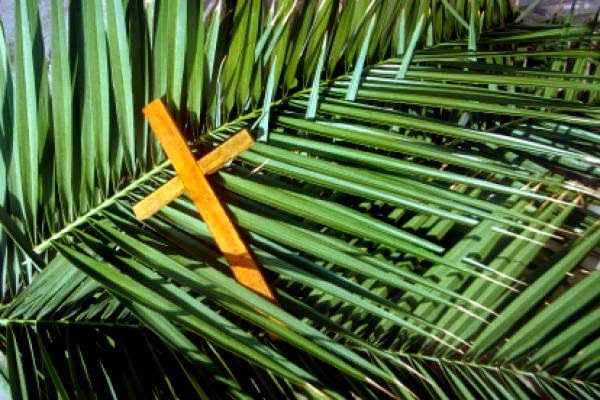
It seems strange sitting here in my home with no anticipation of being around children waving palm leaves.  It feels awkward facing the beginning of Holy Week with the prospect of no physical gatherings of Christian believers.  Perhaps with the exception of this year, every year on Palm Sunday thousands of Christians, from all over the world, gather in the small town of Bethphage, located just two miles outside of Jerusalem – to walk to Jerusalem like Jesus did in his triumphal entry on a donkey.  Many of those pilgrims carry palm and olive branches.  All the people sing hymns as they walk up the Mount of Olives, down into the Kidron Valley, and then up Mount Moriah into the Old City of Jerusalem. It is a worship experience filled with gratitude. “Give thanks to the Lord, for he is good; his steadfast love endures forever!” (Psalm 118:1)

Every year there are others along the pilgrim path appearing out of place for such a joyous journey.  Spread out along the way are Israeli military soldiers wearing full combat gear, carrying automatic weapons over their shoulders and gazing on the spectacle of worshiping Christians before them. Other Israeli Jews look on with a mix of indifference or concern.  Maybe we can imagine that Jesus encountered a similar experience with people laying palm branches along his path; Roman soldiers all around; and, Jews looking on with curiosity.  It might have been easy for Jesus to avoid Jerusalem and not face the cross that he knew was coming at the end of the week.  It might be easy for us to avoid adversity and suffering. Yet, Jesus continued his journey into Jerusalem because of joy and gratitude. Psalm 118 ends like it begins: “O give thanks to the Lord, for he is good, for his love endures forever.”

Joy and gratitude can be our strength in times of adversity.  Yet, it will only come as we join the spiritual pilgrimage.

Psalm 118 is a liturgy for worshipers coming to Jerusalem and the temple from all parts of Israel in order to celebrate Passover.  Like the Christian pilgrims on Palm Sunday, the ancient Jewish worshipers ascended Jerusalem with great anticipation.  They sing of God’s love and remember the deliverance from Egypt and slavery into the freedom of the Promised Land.

The word for “love” throughout Psalm 118 is my favorite word in the Old Testament.  It is a rich word which is difficult to translate in English because the term is so dense with meaning.  The Hebrew word is chesed and the New International Version translates it in various ways:  grace, covenant loyalty, mercy, compassion, kindness, and consistently translated in Psalm 118 as “love.”  It is the kind of love that is graciously given despite whether a person deserves it or not.  It is a steadfast love that holds on and does not let go.

God is a God who consistently gives grace when we fall short; shows unflagging commitment where we are fickle; gives unbounded mercy when we are broken; provides constant compassion when we have been hurt; provides kindness even when we are unkind; and, dispenses enduring love which, for the Christian, finds its ultimate expression in the person of Jesus Christ, our Savior, who embodied “chesed for us so that we might experience life to the full.  Give thanks to the LORD, for he is good; his love endures forever.

We may be under directives to stay at home, yet, we have the gracious opportunity to walk on a spiritual pilgrimage every day to the very heart of God and meet love face to face. How might you and I do that?

Labyrinth

One way is through walking a Labyrinth.  This is an ancient practice of the Church meant for spiritual centering, contemplation, and prayer. Entering the serpentine path of a labyrinth, one walks slowly while quieting the mind and focusing on a spiritual question or prayer.  A labyrinth is not a maze. It has only one winding path to the center and back out.  The wisdom of the Labyrinth is that it reflects life, that is, our lives are not about the destination – life is about the long circuitous journey.  The Christian life is consistently described in the New Testament as a road or a way.  We walk with Jesus.

Although many Labyrinths are typically found within churches, church grounds, or in park spaces (and many or most of these are currently closed) we can utilize “finger” Labyrinths.  Rather than physically walking, you can slowly trace the path with your finger.  You might also get creative and make your own homemade Labyrinth in a space of your home or yard.  Click The Labyrinth Society to get free printable Labyrinths, as well as take a virtual Labyrinth walk.

ChartresLabyrinth

The Labyrinth is not meant to be a race to the center; it only “works” if we move at a pace which enables us to meditatively pray, paying attention to what God is doing within us.  Generally, there are four stages to the walk:

  • Releasing on the way toward the center – letting go of all that weighs us down in the Christian life.  “Let’s throw off any extra baggage, get rid of the sin that trips us up, and fix our eyes on Jesus, faith’s pioneer and perfecter.” (Hebrews 12:1-2, CEB)
  • Receiving in the center – accepting the love God has for you.  Jesus said, “Ask and you will receive, so that your joy may be complete.” (John 16:24, NRSV)
  • Returning through following the path back out – integrating what you have received for the life of the world.  “I will give them a heart to know me, God. They will be my people and I will be their God, for they will have returned to me with all their hearts.” (Jeremiah 24:7, The Message)
  • Responding to the love of God through gratitude – thus finding joy, even in the most troubling of circumstances.  “O give thanks to the Lord, for he is good; his steadfast love endures forever!” (Psalm 118:1, NRSV)

The penitent heart will resonate deeply with the psalms as worship liturgy.  This is because liturgical practices impress the spirit and bring spiritual freedom.  We will only find this odd if we have nothing to repent of.  Turning from sinful liturgies of life and turning to a new liturgy of following Jesus is like walking through a gate into a new reality and rejoicing with all the other redeemed pilgrims who are walking the road to Jerusalem to be with Jesus.  Our Lord himself said,

“I am the gate; whoever enters through me will be saved.  He will come in and go out and find pasture.  The thief comes only to steal and kill and destroy; I have come that they may have life and have it to the full” (John 10:9-10, NIV).

In this time of virtual presence and electronic communication, I take comfort in the reality that we do not need to text or email God and hope he answers – we have the joyous opportunity of walking the pilgrim way and crawling into the lap of God.

Just like everything else, what you put into something is going to affect what you get out of it. If we go into the Labyrinth half-hearted, we will leave half-hearted. If we go into prayer or worship thinking only of the obligation, we will only fulfill the obligation. Yet, if we come ready to meet God, if we come ready to receive his grace, if we come expectantly – Who knows what God can do?

So, let us enter prayer, reading of Scripture, virtual fellowship, and the worship of God each day with the heart of a pilgrim. Let us enter with a song on our lips and joy in our hearts. Let us enter knowing that worship is the place where we connect with the love of God through the Son of God. Let us enter expecting to come out of worship changed, carrying in our hearts the anticipation of great things to happen.

The Power of Gratitude


Thank God no matter what happens. This is the way God wants you who belong to Christ Jesus to live (1 Thessalonians 5:18, The Message).
 
            Gratitude has the power to change our lives and our churches.  That is, if we let it.  If we want to live happy contented lives, then we will obey the Scripture’s exhortation to give thanks in any kind of circumstance in any kind of context.  It can be a challenge to give thanks during hard times.  But that might be the most important time to do it.  The biblical character David had the where-with-all to acknowledge his desperate condition, yet chose to praise God in the middle of it.  In Psalm 57 he said, “I am in the midst of lions; I lie among ravenous beasts – men whose teeth are spears and arrows, whose tongues are sharp swords… They spread a net for my feet – I am bowed down in distress… But my heart is steadfast, O God, my heart is steadfast; I will sing and make music… I will praise you, O Lord, among the nations; I will sing of you among the peoples.”
 
            If you are in between a rock and a hard place, for what can you express praise and thanksgiving to God?  Our spiritual ancestors, the pilgrims, came to this country.  The original colonial pilgrims of America numbered over a hundred when they came, and, after the first winter, less than fifty of them remained.  It does not get much bleaker than that.  Yet, instead of retreating into bitterness, resentment, and envy, they decided to set aside a particular day to give thanks for what they had, and not be constantly upset about what they did nothave.
 
            We are to give thanks in all kinds of circumstances, whether good or bad, whether big or small.  In her book, The Hiding Place, Corrie ten Boom tells about an incident that taught her the principle of giving thanks in all things. It was during World War II. Corrie and her sister, Betsy, had been harboring Jewish people in their home, so they were arrested and imprisoned at Ravensbruck Concentration Camp.  The barracks was extremely crowded and infested with fleas. One morning they read in their tattered Bible from 1 Thessalonians the reminder to give thanks in all things.  Betsy said, “Corrie, we’ve got to give thanks for this barracks and even for these fleas.”  Corrie replied, “No way am I going to thank God for fleas.” But Betsy was persistent and persuasive, and they did thank God even for the fleas.  During the months that followed, they found that their barracks was left relatively free, and they could do Bible study, talk openly, and even pray in the barracks. It was their only place of refuge. Several months later they learned that the reason the guards never entered their barracks was because of those blasted fleas.
 
            Sometimes we do not understand what God is doing.  Sometimes we just don’t perceive that the Lord is up to anything.  You may feel as if you are sitting still right now, yet, planet Earth is spinning around its axis at a speed of 1,000 miles per hour.  We are also hurtling through space at an average velocity of 67,108 miles per hour. So even on a day when you feel like you did not get much done, do not forget that you traveled 1,599,793 miles through space! To top things off, the Milky Way is spinning like a galactic pinwheel at the dizzying rate of 483,000 mph.
 
That is amazing. But we don’t feel it, so it’s off our radars.  When was the last time you thanked God for keeping us in orbit? I’m guessing you have never prayed, “Lord, I wasn’t sure we’d make the full rotation today, but you did it again!” We just don’t pray that way.  But we are to learn to thank God in every circumstance, both big and small.  If we can trust God to keep our feet on the ground with a big thing like gravity, then we can trust him in any and every situation we experience.


            Gratitude has healing power.  It is easy to complain about church.  Any common fool will go on and belly-ache about how bad things are and play arm-chair Deity about how to fix all the ills of the church and the world.  But it takes a wise person to find gratitude and choose to give thanks for all the good things God has done and is doing, being careful to give thanks in all circumstances for this is God’s will in Christ Jesus.

Psalm 118:1-2, 19-29

            Show me a spiritual sourpuss, and I’ll show you a person who lives without daily gratitude toward God and others.  But show me a gracious person who liberally gives thanks, and I will show you a person profoundly in touch with God’s steadfast love.
 
            The psalmist chose to give thanks to the LORD, for he is good; for his steadfast love endures forever!  I wonder how much different each day would be if we began it with the psalmist’s great call to worship:  “This is the day the LORD has made; let us rejoice and be glad in it.” 
 
            There is a misguided notion that only certain people have the attitude of gratitude; some folks are just naturally ornery, and some are just born happy.  But the truth is that gratitude and giving thanks is a practice that must be carefully cultivated.  As it grows and develops, gratitude bears the fruit of joy.  Yes, thankfulness is a daily decision of faith that we need to make in order to have the kind of attitude that pleases God and blesses others.
            Loving God, this is the day you have made; I rejoice in it, and am glad that your steadfast love covers all things.  Help me to connect every good thing with your gracious hand upon me so that I will not look and act like I was baptized in pickle juice.  To the glory of Jesus Christ, I pray.  Amen.

Psalm 69:1-5, 30-36

            We have all likely at times felt the anguish of the psalmist:  being so overwhelmed that it feels like we are drowning.  The feeling is compounded exponentially when behind the sense of trying to keep our heads above water there are people who do not like us – maybe even hate us, to the point of undermining our work every chance they get.  It is in such circumstances that we can experience sleepless nights hoping that somehow and someway God will show up.
 
            The typical modus operandi for such a situation is the age old route of complaining and wishing things were different.  But neither griping about our adversity nor dishing out slander and gossip toward others is a godly way of dealing with problems.  Just the opposite response is the proper path to the bone-crushing feeling of opposition:  praising God’s name with a song, and magnifying him with thanksgiving.  The reason the believer can engage in adoring God in the midst of trouble is not some Jedi-type mind trick to make us think more positively.  Instead, the basis for praise is in knowing God.  It is God who ultimately will deal with the wicked; it is the Lord who will bend his ear to listen to our lament when times are hard. 
 
            Thanking God for answers to prayer in advance of them actually being answered is a biblical thing to do.  Having a faith robust enough to see ahead toward hope can bring love to a loveless situation, and usher in praise before the divine deed of deliverance is even accomplished.
            Saving God, thank you for your deliverance!  I give you praise for loving me through sending your Son, the Lord Jesus, to this realm so that I might experience salvation from sin, death, and hell.  By Christ’s authority, in the power of the Holy Spirit given to me, I resist the enemy’s attempts to seize control of my life.  I belong to you, God.  Amen.