We Are All In the Same Boat (Romans 3:9-20)

What shall we conclude then? Do we have any advantage? Not at all! For we have already made the charge that Jews and Gentiles alike are all under the power of sin. As it is written:

“There is no one righteous, not even one;
    there is no one who understands;
    there is no one who seeks God.
All have turned away,
    they have together become worthless;
there is no one who does good,
    not even one.”
“Their throats are open graves;
    their tongues practice deceit.”
“The poison of vipers is on their lips.”
    “Their mouths are full of cursing and bitterness.”
“Their feet are swift to shed blood;
    ruin and misery mark their ways,
and the way of peace they do not know.”
    “There is no fear of God before their eyes.”

Now we know that whatever the law says, it says to those who are under the law, so that every mouth may be silenced and the whole world held accountable to God. Therefore no one will be declared righteous in God’s sight by the works of the law; rather, through the law we become conscious of our sin. (New International Version)

Whenever there is division, separation, and polarization between two groups of people, it’s important that someone has the ability to come back to what is true and common to all of us.

And that is what the Apostle Paul did in addressing the two differing groups of people in the ancient Roman Church of both Jewish and Gentile believers in Jesus.

The Jewish Christians, Paul argued, did not have a leg up on the Gentiles, just because of their long history with God. They tended to see themselves as better than their Gentile brothers and sisters in Christ. After all, the Jewish believers reasoned, we don’t have such a background of sinful pagan practices and estrangement from God.

Well, actually they do, however the Apostle did not rehearse his own people’s long history of stubborn rebellion and waywardness from God. Instead, he went back to the scriptures, and reminded the Jewish Christians of something they seemed to have lost sight of:

To be a human being is to be intimately familiar with sin and godlessness, guilt and shame, no matter the group nor the individual. We are all in the same boat.

In saying this, the Apostle Paul was not implying there is not anything good in anyone. Quite the contrary. For what is also true of humanity is that every individual person is a good creature, created from a good Creator, with the divine stamp of God’s image and likeness. There are no exceptions to this.

With all the mudslinging within the church, Paul simply pointed out that there is more than enough blame to go around. All the things that one group accuses another of is also true about they themselves.

And when it comes to sin – all those actions, words, and attitudes we have done and failed to do in loving our fellow humanity, and God – every one of us is in the same boat of guilt before God. There are no exceptions to this.

The power and ubiquity of sin is everywhere. Sin is like a nasty weight which continually burdens the world, and like an acrid fog that is always hanging in the air. We all feel the heaviness; we all breathe the same air.

All of our puny attempts at dividing one another into star-bellied Sneetches, and Sneetches without stars upon thars, is only proof positive of our sinful predilections to acquiesce to sin’s power on this earth.

This means that none of us can claim to take the moral and spiritual high ground. Nobody has an advantage on another. Therefore, it is ridiculous to ever try and implement policies of favoritism, cronyism, or prejudice. Such thinking itself is sinful, and ought to be jettisoned at the first awareness of it.

Whether we know what is right, or not; and whether we have the law and a covenant code, or not, isn’t really the issue. Obeying the law and doing what is right and just, with a good heart, is the real issue for all of us.

But it’s rather difficult to truly embrace justice and righteousness if the heart is no good. In truth, all of us have some rather dark places in our hearts. And until these are addressed, we will keep having all of our humanly contrived divisions and separations based upon a supposed superiority of the other.

The very fact that it is so easy to point out the sin in another, and label them as sinner, ought to tell us that “It takes one to know one.”

All Jews and Gentiles are under the accusation of God’s law, without exception. Everyone is accountable to God and the law. Proper observance of the law is to love God and neighbor – and thus, condemnation under the law is to ignore and disobey God, and to ignore and hate one’s fellow humanity.

What’s more, neither Jew nor Gentile can be justified by the law. Not a one of us can undo our guilt by ourselves.

No amount of work can satisfy the breadth and depth of that guilt. Pledges of perfectionism cannot help us, namely because we don’t even have the ability to follow through on them. Sheer hard work will not do the trick, because it would be like trying to empty the ocean with a kid’s sand toy bucket.

Only grace can reverse things. We need a pardon, and a new heart, which can sync and beat with the holy rhythms of divine love and justice. We need Jesus.

The Apostle Paul eventually got to that point later in his letter. Yet, here, he needed to establish everyone’s commonality of sin, so that they would embrace Jesus together as the one people of God who are in desperate need of his saving work, and the Spirit’s sanctifying work.

Therefore, the proper place to begin in being at peace with God and the world is to confess our own complicity in sin. Let us, then, offer this prayer of confession:

Lord Jesus, we have sinned times without number, and been guilty of pride and unbelief, and of neglect to seek you in our daily lives. Our sins and shortcomings present us with a list of accusations, but we thank you that they will not stand against us, for all have been laid on Christ. Deliver us from every evil habit, every interest of former sins, everything that dims the brightness of your grace in us, everything that prevents us taking delight in you. Amen.

Wisdom for Life (Proverbs 11:1-31)

The Lord detests dishonest scales,
    but delights in an accurate weight.
When pride comes, so does shame,
    but wisdom brings humility.
Integrity guides the virtuous,
    but dishonesty ruins the treacherous.
Riches don’t help in the day of wrath,
    but righteousness rescues from death.
The righteousness of the innocent makes their path straight,
    but the wicked fall in their wickedness.
Those who do right are saved by their righteousness,
    but the untrustworthy are caught by their own desires.
When the wicked die, their hope perishes.
    Yes, any hope based on money perishes.
The righteous are saved from distress,
    and the wicked take their place.
The godless destroy their neighbors by their words,
    but the righteous are saved by their knowledge.
When the righteous succeed, a city rejoices;
    when the wicked perish, there are shouts of joy.
A city is honored by the blessing of the virtuous;
    it is destroyed by the words of the wicked.
Whoever despises their neighbor lacks sense;
    a sensible person keeps quiet.
A slanderer walks around revealing secrets,
    but a trustworthy person keeps a confidence.
Without guidance, a people will fall,
    but there is victory with many counselors.
Guaranteeing the debt of a stranger brings big trouble,
    but the one who refuses to shake hands will be secure.
A gracious woman gains honor;
    violent men gain only wealth.
Kind persons benefit themselves,
    but cruel people harm themselves.
The wicked earn false wages,
    but those who sow righteousness receive a true reward.
The righteous are headed toward life,
    but those who pursue evil, toward death.
The Lord detests a crooked heart,
    but he favors those whose path is innocent.
The evil person will surely not go unpunished,
    but the children of the righteous will escape.
Like a gold ring in a pig’s nose
    is a beautiful woman who lacks discretion.
The desires of the righteous end up well,
    but the expectations of the wicked bring wrath.
Those who give generously receive more,
    but those who are stingy with what is appropriate will grow needy.
Generous persons will prosper;
    those who refresh others will themselves be refreshed.
People curse those who hoard grain,
    but they bless those who sell it.
Those who look for good find favor,
    but those who seek evil—it will come to them.
Those who trust in their wealth will wither,
    but the righteous will thrive like leafy trees.
Those who trouble their family will inherit the wind.
    The fool will be servant to the wise.
The fruit of the righteous is a tree of life,
    and the wise gather lives.
If the righteous receive their due on earth,
    how much more the wicked and sinners? (Common English Bible)

The good and the bad, the wise and the foolish, the righteous and the wicked. When it comes to proverbial wisdom, there are two kinds of people: Those who take a right, just, and good path of life; and those who take the wrong exit, practice injustice, and embrace being bad.

We are all, of course, a strange amalgam of sinner and saint. Everyone has some altruism, along with a devious bent. So, life really comes down to our choices. Will our decision-making be wise, or foolish?

This is where the Book of Proverbs helps us. It lays out a prudent course of action for us, so that we can gain a perspective on the consequences of those actions, whether good or bad.

We have to carefully weigh our decisions and consider the likely outcomes of the choices we make.

As we decide, keep in mind that honesty is the best policy (11:1-4); choices have consequences (11:5-6); certain choices lead to rewards (11:7-10); good brings good, and bad brings bad (11:11-31).

Honesty Is the Best Policy

Making the decision to be honest in all things is what builds our capacity to resist evil. Poor choices often come from simply giving in, because we don’t have our resistance to saying “no” built up yet.

Humility enables us to keep our minds on the task at hand, rather than compromise on our integrity in order to achieve something we believe we need or want. The humble person understands that all things are a gift from God – and that the Lord can give, and the Lord can take away. Humility teaches us to say, “Blessed be the name of the Lord.”

When we are emptied of self-promotion, and filled with honest humility, righteousness results. And the righteous person automatically and reflexively denies all evil and wickedness.

Choices Have Consequences

Just because no one sees it, doesn’t mean there won’t be consequences. And just because there was no lightning strike from God immediately after a transgression, doesn’t mean that God’s judgment isn’t coming later.

I talk to far too many people, in my line of work as a hospital chaplain, who are filled with regret about some decision they made earlier in their life. Because now they are experiencing the physical consequences of that choice (and the emotional and relational consequences, as well).

A set of choices made earlier in life not only have real consequences later that one can see and feel; those decisions also erode the ability to make sound decisions in the present. It is a tough uphill struggle to gain some spiritual and emotional health, whenever any reserve of righteousness was not properly developed and maintained.

Certain Choices Lead to Rewards

Conversely, however, consistently good decisions, made over a stretch of time, provide solid spiritual and emotional dividends from which we can draw from in difficult times.

The chief reward for the righteous is that they have a robust life of faith and goodness because of their relationship to the Lord and a good supportive community of persons.

Foolish living leads to punishment; wise living leads to reward. A good life is really a reward itself. That’s because we are meant to live this way, to be merciful and just in all we do, walking humbly with our God. (Micah 6:8)

When the wicked die, that’s it. But when the righteous die, they leave a profound legacy in the form of others who have been encouraged, helped, and loved by their righteousness. They carry on the legacy of good. It makes a big difference.

I cannot imagine any greater reward than to know that I have been faithful to my God, and good to my fellow humanity. Such persons become like a great cloud of witnesses, testifying to the worth of investing in wisdom and humility.

Good Brings Good, Bad Brings Bad

A just and good life inspires others, invigorates groups of people, and leads to holistic health of individuals. Purity of heart is beneficial to the individual, and is contagious to the community.

A foolish life trusts in their own bad attitudes and personal opinions – and then they will wonder why they don’t get anywhere in life, and nobody wants to be around them.

King Solomon himself, gatherer of the biblical proverbs, knew all too well about both the good and the bad, and their eventual outcomes.

Solomon was quite humble and wise at the beginning of his reign. He did everything his father David asked of him, and more. But his wild success as king gradually brought him to acquire more stuff, more wives, and to fudge on the responsibilities and requirements of being king.

If a guy like King Solomon, who was the wisest person who ever lived, can ignore his own nation’s God and Holy Scripture to get whatever he wanted, then how much more do we, who have less wisdom, need the grace of loving people speaking truth to our hearts?

The people we surround ourselves with, no matter who we are, is vitally important. Everyone needs loving persons around them who will tell them what they need to hear in a spirit of love and grace. 

None of us do well with success unless we have humble and wise persons close to us who have the gumption and the grace to speak into our lives to help us, not hurt us. When we don’t have that, things go sideways.

I encourage you to go back and read Proverbs chapter 11 again, slowly, letting its wisdom seep into you. Also, a good practice is to read a chapter of Proverbs each day for the next month; and to occasionally, in the future, come back to this practice.

May the proverbial biblical wisdom fill your heart and your mind, so that you are able to make sage decisions in all of the various circumstances you encounter in this life. Amen.

The Evil Within (Mark 7:1-8, 14-15, 21-23)

Now when the Pharisees and some of the scribes who had come from Jerusalem gathered around him, they noticed that some of his disciples were eating with defiled hands, that is, without washing them. (For the Pharisees, and all the Jews, do not eat unless they wash their hands, thus observing the tradition of the elders, and they do not eat anything from the market unless they wash, and there are also many other traditions that they observe: the washing of cups and pots and bronze kettles and beds.)So the Pharisees and the scribes asked him, “Why do your disciples not walk according to the tradition of the elders but eat with defiled hands?” He said to them, “Isaiah prophesied rightly about you hypocrites, as it is written,

‘This people honors me with their lips,
    but their hearts are far from me;
in vain do they worship me,
    teaching human precepts as doctrines.’

“You abandon the commandment of God and hold to human tradition…”

Then he called the crowd again and said to them, “Listen to me, all of you, and understand: there is nothing outside a person that by going in can defile, but the things that come out are what defile…”

For it is from within, from the human heart, that evil intentions come: sexual immorality, theft, murder, adultery, avarice, wickedness, deceit, debauchery, envy, slander, pride, folly. All these evil things come from within, and they defile a person.” (New Revised Standard Version)

There are many people who believe that evil resides out there, but not in here.

“Out there” is usually in places where people don’t live like me, think like me, and act like me. Rarely does anyone, when asked where evil is, points to their own heart.

The religious establishment of Christ’s day saw evil as something which existed “out there” where the sinners are; but not “in here” where I am.

Jesus had something to say on that subject. The exchange between the religious leaders and Christ began with a query toward Jesus about Jewish traditions and interpretations of the Mosaic law.

The leaders observed that Christ’s disciples were not holding to traditional purity practices. They were not washing their hands in a certain way prior to eating. This was less of a criticism on the followers of Jesus, and much more an indictment on Jesus as their rabbi.

It was believed that there are customs which properly trained disciples ought to know and follow. And Christ’s followers were not, it was assumed, trained well.

The religious establishment understood the words and ways of Jesus as an affront to the teaching of the elders, and of proper scriptural and legal interpretation.

Jesus, however, made a distinction between traditions of the elders and God’s commands. The former are human precepts, whereas the latter are to be obeyed. In no way did Christ demean Mosaic law, or any commandments of God.

Instead, Jesus rejected how particular interpretations – along with practices which arose from those interpretations – end up obscuring the spirit and intent of the law. In other words, purity does not come from hand washing, because neither purity nor impurity originates from the hands.

Christ reached back into the prophecy of Isaiah to show that there is a contrast between what the mouth utters and what is within the heart. The incongruence between the words spoken and the heart’s true state puts the issue of where impurity and evil really come from: The heart, not the mouth.

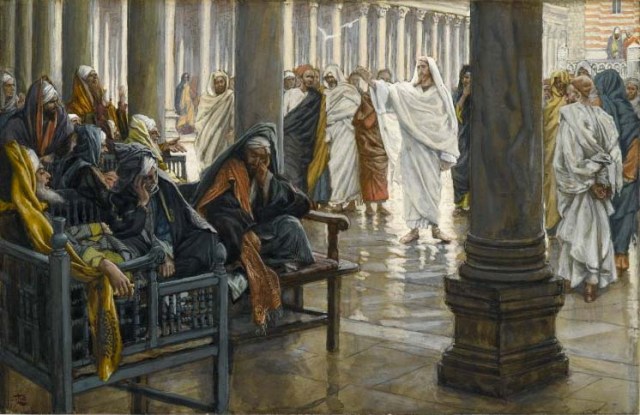
Jesus and the Pharisees, by French painter James Tissot (1836-1902)

Evil intentions originate within. Evil actions are animated by the heart. Evil attitudes are born in the heart. The human heart is the place which needs attention because, for ancient people, this is where a person’s rational will is located. It is where moral pollution dwells, deep within.

Let’s keep in mind that, in the verbal kerfuffle between Christ and the religious leaders, there is no evidence that Jesus disregarded Jewish dietary laws. He instead took the religious establishment to task on elevating outward human traditions, while simultaneously ignoring the inward human heart.

Food and hand-washing are not the chief concern, when it comes to purity and impurity. At issue is the source of defilement, that is, where the pollution is sourced. Jesus insisted that it’s more about who you are, and what is in your heart, than it is about the food you eat or avoid.

In truth, the problem of defilement is important. And keeping the Mosaic law is significant. Yet, Jesus was looking at these issues from a different angle. He affirmed the law’s purpose in restraining evil and avoiding impurity, along with the religious leaders. However, Christ disagreed with them on how the law is practically observed and obeyed.

Jesus did not come up with something new or strange in talking about evil emanating from the heart. Judaism is a religion of the heart, just as much as Christianity or any other religion.

The heart is devious above all else;
    it is perverse—
    who can understand it?
I the Lord test the mind
    and search the heart,
to give to all according to their ways,
    according to the fruit of their doings. (Jeremiah 17:9-10, NRSV)

So, what’s up with the conflict between Jesus and the religious leaders? Over time, many located evil outside, out there, with evildoers and law-breakers, with those disobedient to the law. Christ came along and reaffirmed where the problem originates, scripturally.

One isn’t defiled by improper handling of ritual; one is defiled because being unaware of, or not acknowledging, the dark shadows which reside within every human heart.

Therefore, the discussion of evil and impurity is useless, if we only talk about influences from outside. Deal, instead, with the influences from within.

The heart is not all bad; there’s a lot of good there. But there are spaces within the heart which are camouflaged in darkness. Those places need attention, before we launch into evil which exists elsewhere.

Everyone must come to the point of understanding that they are capable of both great good and great evil. A Pharisee is not all good. And a lawbreaker is not all bad. Until we can see the commonality between ourselves and those we separate ourselves from, we will continually miss the heart of true religion.

Whether a Jew, Christian, Muslim, or any other religious tradition, we must deal with our own collective house, and our own personal heart. Hate speech toward another group has no warrant from Jesus. Injustice has no place in Christianity or anywhere else.

Furthermore, not a one of us can rationalize any unjust words and/or inactions. If that happens, a terrible blindness has occurred in which someone or some group of people refuse to see their own culpability in evil, and project it outward onto another person or group.

If we keep the light of the gospel in our own hearts, then it is much less likely that we will demean or attack others, either verbally, physically, or both.

Using a self-constructed and janky flashlight to shine on another’s heart does nothing but keep the attention off of our own heart. That sort of dubious searching of splinters helps no one, especially ourselves, who already have nasty logs in our own eyes.

Evil is deeper than mere selfishness, bigger than a personal error in judgment, and greater than some individual bad decisions. That’s because there is also a collective heart in every organization, institution, corporation, and faith community. Injustice and unrighteousness resides in those hearts, as well. This makes all of us – personally and communally – both victims of evil, as well as perpetrators of wickedness.

This is why grace and mercy are the real answers to the evil in this world’s systems, and in the human heart. Jesus is trying to pave the way toward a solution of the problem of evil.

Let’s give him an honest look and hearing.

Most merciful God, we confess that we have sinned against you in thought, word, and deed, by what we have done, and by what we have left undone. We have not loved you with our whole heart; we have not loved our neighbors as ourselves. We are truly sorry and we humbly repent. For the sake of your Son Jesus Christ, have mercy on us and forgive us; that we may delight in your will, and walk in your ways, to the glory of your Name. Amen.

Spiritual Growth (2 Peter 3:14-18)

So then, dear friends, since you are looking forward to this [a new heaven and a new earth] make every effort to be found spotless, blameless and at peace with him. Bear in mind that our Lord’s patience means salvation, just as our dear brother Paul also wrote you with the wisdom that God gave him. He writes the same way in all his letters, speaking in them of these matters. His letters contain some things that are hard to understand, which ignorant and unstable people distort, as they do the other Scriptures, to their own destruction.

Therefore, dear friends, since you have been forewarned, be on your guard so that you may not be carried away by the error of the lawless and fall from your secure position. But grow in the grace and knowledge of our Lord and Savior Jesus Christ. To him be glory both now and forever! Amen. (New International Version)

When it comes to Christianity – the Christian life and church ministry – the value and necessity of spiritual growth within individual believers and local churches is of vital importance. 

We were created by God, who made us in the divine image and likeness. That is, we were formed as spiritual people. Every one of us carries within ourselves a God-given spirit; it is a vital part of who we are.

Therefore, we must recognize that the area of our greatest value, potential, fruitfulness, and life fulfillment will be in the realm of the spiritual. 

If we deny our inherent spirituality, whether in thought or in practice, we will inevitably become confused. This then, sets us up for failure, because our basic nature is one of being spiritual persons.

Nothing is more valuable for us than spiritual growth, and the provision God has made for us to experience this growth.

There is a verse tucked away at the end of Peter’s second epistle that states for us to grow in the grace and knowledge of our Lord and Savior Jesus Christ. Grace and knowledge are important words that both point to Jesus. 

“Grace” refers to all the benefits of redemption for us through the person and work of Christ.

“Knowledge” denotes all the benefits of God’s revelation to us in Jesus Christ.

Here is a simple, yet profound, observation of the text: The word “grow” is a command; it is not optional. It’s not something to maybe think about doing when we get around to it. God insists that we spiritually grow.

God has made every provision for our spiritual growth. What’s more, we have been given the ability as a redeemed believer, and as a redeemed community, to grow spiritually. 

So then, each and every believer in Jesus Christ, as well as every local church, must face their own personal responsibility to obey this scriptural exhortation. To do otherwise is to live outside of God’s will.

Sticking with the Apostle Peter’s words, here is another verse of importance which relates to our spiritual growth: 

Like newborn babies, crave pure spiritual milk, so that by it you may grow up in your salvation. (1 Peter 2:2, NIV) 

We are to seek the Word of God with the same kind of intensity that a newly born baby will seek for food. As babies, my kids were barracudas when it came to feeding time; they took their eating seriously, and with a lot of gusto. That same desire for feeding must be present with us as Christians and churches. When the command of Peter is obeyed, and made a priority in our life, then we will grow.

Like any good thing in our lives, there are potential problems, along with the benefits. A significant downside, when pursuing spiritual growth, is that we all have a disease-like force in our lives. There exists within us a destructive tendency of lethargy and passivity toward spiritual things.

It’s rather ironic that people who confess Jesus as Lord, and are convinced about their Christianity, can be so doggone nit-picky about trivial matters which don’t really contribute much of anything to their spiritual growth.

And the trivial things only distract us from feeding upon the Word of God, and consuming the Bread of Life. We cannot – we must not – go on living like this and expect to be successful in the Christian life.

If we are going to grow spiritually, we must be about the business of speaking the truth in love – which results in us growing up into people who embody the words and ways of Jesus. (Ephesians 4:15) 

We are to have an aggressive application of the truth in our speech and our actions, which then impacts our daily faith walk with Jesus. 

The way we grow up spiritually, whether personally or corporately, is through practicing the truth of Holy Scripture – which requires reading it, learning it, and knowing it better than we know our own back door.

Our priorities, goals, and values need to reflect a solid commitment to fulfill scriptural truth in daily life. In that vein, let us ask ourselves some penetrating questions:

  • Have we humbled ourselves before God and confessed the things we have done, and the things we have left undone, when it comes to God’s revealed will?
  • Have we humbled ourselves before one another as believers, and in the church, asking for prayer?
  • Have we read the Bible on the subject of spiritual growth, and followed its teachings, so that we can know the joy and love God has for us?
  • Would we be lethargic and passive about treating a physical cancer in our lives?

God the Father and God the Son have conspired together to give believers God the Holy Spirit for our spiritual growth. The blessed Holy Trinity – the God whom Christians serve – has gifted us the Spirit, so that we might come into close fellowship with the Lord Jesus. 

Once we begin to obey the Scripture in this area of practicing biblical truth, we will experience spiritual growth and the joy of the Lord. 

However, if we allow ourselves to remain lethargic and apathetic concerning spirituality, we will not become our true selves. We must choose to make a biblical response to God, to one another, and to ourself. 

Spiritual growth is not a matter of personal willpower that can be achieved by our own efforts. Instead, we must face our spiritual condition, and seek help within the community of the redeemed, the church. Then, spiritual growth will become a reality.

Gracious heavenly Father, the God of all mercy, thank you for adding another day to my life. I dedicate both my soul and my body to serving you with a right spirit and a holy life. Strengthen me in this life, so that I may grow in grace, and in the knowledge of your Son, my Savior, Jesus Christ, who with you and the Holy Spirit are one God, now and forever. Amen.