Amos 9:7-15 – A Promise of Restoration

“Are you Israelites more important to me
    than the Ethiopians?” asks the Lord.
“I brought Israel out of Egypt,
    but I also brought the Philistines from Crete
    and led the Arameans out of Kir.

“I, the Sovereign Lord,
    am watching this sinful nation of Israel.
I will destroy it
    from the face of the earth.
But I will never completely destroy the family of Israel,”
    says the Lord.
“For I will give the command
    and will shake Israel along with the other nations
as grain is shaken in a sieve,
    yet not one true kernel will be lost.
But all the sinners will die by the sword—
    all those who say, ‘Nothing bad will happen to us.’

“In that day I will restore the fallen house of David.
    I will repair its damaged walls.
From the ruins I will rebuild it
    and restore its former glory.
And Israel will possess what is left of Edom
    and all the nations I have called to be mine.”
The Lord has spoken,
    and he will do these things.

“The time will come,” says the Lord,
“when the grain and grapes will grow faster
    than they can be harvested.
Then the terraced vineyards on the hills of Israel
    will drip with sweet wine!
I will bring my exiled people of Israel
    back from distant lands,
and they will rebuild their ruined cities
    and live in them again.
They will plant vineyards and gardens;
    they will eat their crops and drink their wine.
I will firmly plant them there
    in their own land.
They will never again be uprooted
    from the land I have given them,”
    says the Lord your God.
(New Living Translation)

Guilt

Doom and hope, judgment and grace, suffering and glory. These are the movements and rhythms of the Old Testament prophets. The great sin of Israel which warranted divine wrath was not only that they trampled on the poor and needy. On top of it all, they saw nothing wrong with their way of life. 

This profound lack of awareness, rooted in the spiritual blindness of greed, is what led to judgment. It would take the form of having the Assyrian Empire come, seize the land, and take the people away to a place where they would have no chance to oppress others. Sadly, death would come to many.

“The work of restoration cannot begin until a problem is fully faced.”

Dan Allender

The sin of oppressing others and believing there’s nothing wrong with it comes with severe consequences. The people relied too much on their ethnicity. The ancient Israelites wrongly assumed that because they were the people of the covenant, this somehow inoculated them from disaster. Their belief in Jewish exceptionalism was their downfall.

Grace

Yet, all would not be an endless gloom. The Lord will not destroy completely. God’s anger lasts for a moment. However, God’s grace lasts forever. Restoration, renewal, and fruitful times will come because of God’s mercy. 

Yes, God pronounces judgment when it is warranted. But God also makes and keeps promises to people. In our lesson for today, the Lord promises to restore the fortunes of the people through rebuilding ruined cities and letting them inhabit them once again.

God steps in and graciously acts on behalf of all people because that is what God does. We might get the notion in our heads that God executes judgment to teach people a lesson or to make a point. In my line of work, it is common to hear people express the idea they are under divine punishment because of personal illness or hard circumstances. 

God, however, acts independently out of a vast storehouse of righteousness and mercy. The Lord maintains holy decrees while showing grace to the undeserving. The nation of Israel, in the days of the prophet Amos, deserved only judgment, not grace. 

It seems to me God would have been completely justified to never restore or renew a recalcitrant people. Yet, God’s grace overwhelms and swallows human sin. Try as you might to understand grace, you will end up befuddled. That’s because grace is wildly illogical, nonsensical, and unconditionally free. Grace shows radical acceptance where there ought to be only the punishing fire of hell.

Gratitude

The height of grace and the pinnacle of restoring the fortunes of Israel (from a Christian perspective) came through a baby and a humble birth in the small village of Bethlehem. Jesus came to save the people from their sins. God acted by entering humanity with divine free love so that there could be new life and fresh hope. 

So, let grace wash you clean. Allow mercy to renew your life. Receive the gift of gracious forgiveness, merciful love, and divine peace. Look ahead and see there is hope on the horizon. Give thanks for God’s indescribable kindness.

Merciful God, although you are careful to uphold your great holiness, your mercy extends from everlasting to everlasting. May the gospel of grace form all my words and actions so that true righteousness reigns in my life through Jesus, my Lord, in the power of the Holy Spirit. Amen.

Mark 14:26-31 – Pride Comes Before the Fall

Peter Disowns Jesus by Ethiopian artist Nebiyu Assefa

When they had sung a hymn, they went out to the Mount of Olives.

“You will all fall away,” Jesus told them, “for it is written:

“‘I will strike the shepherd,
    and the sheep will be scattered.’

But after I have risen, I will go ahead of you into Galilee.”

Peter declared, “Even if all fall away, I will not.”

“Truly I tell you,” Jesus answered, “today—yes, tonight—before the rooster crows twice you yourself will disown me three times.”

But Peter insisted emphatically, “Even if I have to die with you, I will never disown you.” And all the others said the same. (New International Version)

Learning to Trust

I have two sisters-in-law who were lifeguards when they were teenagers. One day I watched one of them handle a group of kids experiencing their first swim lesson. She went to each child and told them to put their ears in the water and their belly buttons in the air while she was holding them up. “When I count to three, you won’t feel my hands underneath you, but they’re there,” she said. Most of the kids frantically jerked their knees toward their chins and flailed their arms. Truth is, almost all people float when they assume a posture of rest. But people who think they will sink don’t keep their posture for long. 

The disciples had a hard time trusting Jesus. They just couldn’t seem to rest and relax with Jesus holding them up. After all, Jesus said and did things they were not expecting him to say and do. Jesus preached the necessity of humility and loving one’s enemies. He focused ministry on the least and the lost. 

Different Agendas

The disciples had not yet really bought into Christ’s kingdom agenda. They kept pulling their knees up, thinking Jesus was going to lead a rebellion against the Romans and put Israel back on the map. Bless their hearts, the disciples mistakenly believed Jesus was there to immediately restore the glory days of Jewish dominance in the land.

Despite Christ’s teaching and ministry, some folks believe God’s agenda ought to be restoring prayer in public schools and The Ten Commandments back in courthouses. But Jesus has a different agenda. Christ goes to the heart of the matter. New life is what he is after. Transformation leads to observance of God’s will so the least and the lost persons among us will be reached. 

Jesus turned the world upside-down by insisting not that people come to the temple but that the temple worshipers go to the people. It was not a popular teaching with the disciples, let alone everyone else. The disciples had greater (or so they thought) ideas about how things ought to go.  

Christ followers might neglect the upside-down teaching ministry of Jesus because we believe ourselves to be good people. We already assume we know what God wants. And we would never betray Jesus, right!?  O, sure, we sin occasionally, but not like murderers and child molesters. Our sins are respectable – a little resentment here, a little prejudice there, or a smidge of gossip just to make sure outsiders know and respect their place.

However, we must first hear the bad news before we can hear the good news. And once we hear the bad news and accept it, we need to receive God’s remedy for it. The disciples Peter and Judas are contrasting figures in grasping Christ’s message and responding to it.

Peter and Judas

Peter and Judas had similar ideas about how the future should look – seeing Israel restored to its previous glorious prominence. Judas was a religious and political Zealot. And Peter had no problem picking up a sword when it seemed the time was ripe for a political rebellion and takeover.

Peter insisted he would never turn on Jesus. Yet, Jesus flat-out told him that would happen. Sure enough, Peter did a big belly flop in the pool of denial by disowning Jesus three times.

Then there was Judas. He caught on quicker than Peter that Jesus wasn’t going to lead a military coup. Talking about wasting time on marginal people who couldn’t help usher-in a glorious revolution was the last straw for him.  After Judas clearly saw Jesus had no intention of fulfilling what he thought should happen, he actively sought an opportunity to betray him.

In fact, none of the disciples wanted to take a step of commitment into the world of suffering as the means of reaching others. They wanted glory, not suffering. But Jesus chose the cup of suffering.

Both Judas and Peter realized, after denying Jesus, they had made a terrible mistake. However, that is where the similarities end. Judas responded to his guilt by completing suicide.  Rather than throw himself upon the mercy of God, Judas handled the guilt himself. It was a refusal of grace.

Peter, instead, wept bitterly. He realized his poverty of spirit. He mourned over his sin. Later, Peter became a genuinely meek person with God’s righteousness taking root within him. Having received grace, Peter became a preacher of truth and grace.

Stubborn Pride

Renewal comes from spiritual transformation. It requires a brutally honest assessment of self and others. “I will never fall” comes from a heart that believes “I’m not so bad.” Our failures of faith stem ultimately from pride and a lack of trust. We keep pulling our knees up because we are too anxious to let the agenda of Jesus control our lives. 

Proud people have little need for prayer because they are self-sufficient. However, humble people pray a lot! They don’t want to fall into temptation and defame the name of the Lord. They pray because apart from Jesus Christ they know they’ll act like a cockeye little dog who thinks he is a big dog. Even Jesus himself felt the need to watch and pray so that he could face his hour of pain and suffering on behalf of humanity.

When Jesus was arrested, Peter followed him at a distance. That describes too much of our own following of Christ. We want to see how everything will shake-out before we commit. Jesus invites us to trust him, to commit, to make and keep promises before we even know what it all means. 

It could be that we need to acknowledge we’ve made a mess of our lives through being stubborn. Perhaps we have willfully held to our own ideas of how things ought to go, for far too long.

If you find yourself in a mess, whether it is of your own making or of somebody else’s, grace is the thing that can handle it. That is, coming to God with honesty and humility. Being willing to rest and relax when Jesus is telling you to. It’s okay to let your knees go down and stick the belly button out – to rest in Jesus.

Give us honest hearts, O God, and send your kindly Spirit to help us confess our sins and bring us the peace of your forgiveness, in Jesus Christ our Lord. Amen.

Mark 6:30-34 – The Ethics of Rest and Work

The apostles gathered around Jesus and reported to him all they had done and taught. Then, because so many people were coming and going that they did not even have a chance to eat, he said to them, “Come with me by yourselves to a quiet place and get some rest.”

So, they went away by themselves in a boat to a solitary place. But many who saw them leaving recognized them and ran on foot from all the towns and got there ahead of them. When Jesus landed and saw a large crowd, he had compassion on them, because they were like sheep without a shepherd. So, he began teaching them many things. (NIV)

The Protestant work ethic is a real thing.

Although the German sociologist, Max Weber, coined the term, the idea has been around since the Reformation. Since I’m an old white Protestant minister with Northern European heritage, I can testify firsthand that phrases like “quiet place,” “get some rest,” and “solitary place” aren’t in my tribe’s vocabulary.

The typical understanding of sin in the Protestant work ethic is laziness, sloth, procrastination, and disorder. Heck, even sleeping and eating are viewed more as necessary evils than healthy practices. Hard industrious work is considered a high value. All other activities fall underneath it.

So, it is not surprising that today’s Gospel lesson rarely gets attention from anybody, especially with people who share my heritage. Yet, there it is in Holy Scripture for all to read. And I can’t think of any better or sage advice to give my fellow Protestant Christians as “get some rest.”

Having heard my share of folks, after me insisting they practice some self-care, say goofy things like, “I’ll have plenty of time to rest when I die,” I now go full-frontal retort with my own words that go something like, “And that death will happen a lot sooner than you think, if you don’t obey the Lord through solitude and rest.”

Moving from guilt to grace.

Although I know better, I often find myself burning the candle at both ends. Its far too easy for me to forget eating lunch because of work. And I sometimes catch myself wanting to justify to others the reason for putting my feet up for a few minutes. Make no mistake about it: The Protestant work ethic is mostly motivated by guilt, not grace.

Perhaps we need to say the phrase of Jesus out loud, using several different versions of the Bible. Go ahead. Say the following, slowly… gently… as if Christ himself were speaking directly to you….

“Come with me by yourselves to a quiet place and get some rest.” (NIV)

“Come, let’s take a break and find a secluded place where you can rest a while.” (TPT)

“Come away to a deserted place all by yourselves and rest a while.” (NRSV)

“Come with me privately to an isolated place and rest a while.” (NET)

“Let’s go off by ourselves to a quiet place and rest awhile.” (NLT)

“Let’s go to a place where we can be alone and get some rest.”

Jesus (Mark 6:31, CEV)

I want us to see what a gracious invitation we are being extended by our Lord. This is the same Lord who said:

“Come to me, all you who are struggling hard and carrying heavy loads, and I will give you rest. Put on my yoke and learn from me. I’m gentle and humble. And you will find rest for yourselves. My yoke is easy to bear, and my burden is light.” (Matthew 11:28-30, CEB)

At odds with Christian discipleship.

It is high time we see that much of the Protestant work ethic is at odds with Christian discipleship. Although the ethic rightly lifts the need for faith to be expressed in diligence, discipline, and frugality, it elevates hard work as a visible sign of God’s grace. So, ironically, people end up working their tails off to prove the grace in their lives. And it has created a false self for many who are fearful of being seen by others as slothful and irreligious.

For example, I once had an elderly parishioner who often told me how little sleep she got, the part-time job she held, and the many volunteer opportunities she regularly engaged. I thought it odd that an older person could truly do so much without much rest. And my hunch proved spot on. Turns out she fudged on how many hours she really worked and slept, sometimes outright lying to me.

This lady felt compelled to prove to me, her Pastor, that she was on the straight and narrow, doing the things a good Protestant Christian does. What is sad about this is that the stories are multiplied with many other dear people obsessively relating to me untrue facts about themselves so that I will accept and affirm their superior religiosity expressed in hard work.

However, the axis of the world does not spin on effort and working harder but on grace and love. Behind all the posturing and continually striving for an almost superhuman work ethic are terribly insecure folk who need to rest in the grace of God in Christ.

Embracing both work and rest.

None of this is to say that work is somehow bad. No, work is inherently good. Adam and Eve were placed in the Garden of Eden to work it and tend to it. We need not denigrate work to emphasize rest. Whereas you might doth protest that younger generations today have no idea what hard work is, I will pushback by saying they intuitively see the foolishness of the Protestant work ethic and want to steer clear of it.

Millennials, I argue, are ready to roll up their sleeves and work hard. They just need a bit of direction from us older generations. And that guidance cannot be in the form of disparaging them. Rather it needs to be gracious, forging real mentoring relationships which are helpful.

So, let’s get a hold of what Jesus did: He worked, yes, worked, to get his disciples to a place of rest and refreshment. Christ wanted nothing to do with compulsively working without proper care of body and soul. Rest must come before work. We do well to follow his example.

Be present, O merciful God, and give us refreshment through the anxieties of the day and the silent hours of the night so that we who are wearied by the changes and chances of this fleeting world may rest upon your eternal changelessness, through Jesus Christ our Lord. Amen.

Luke 22:24-30 – Just Shadow Jesus

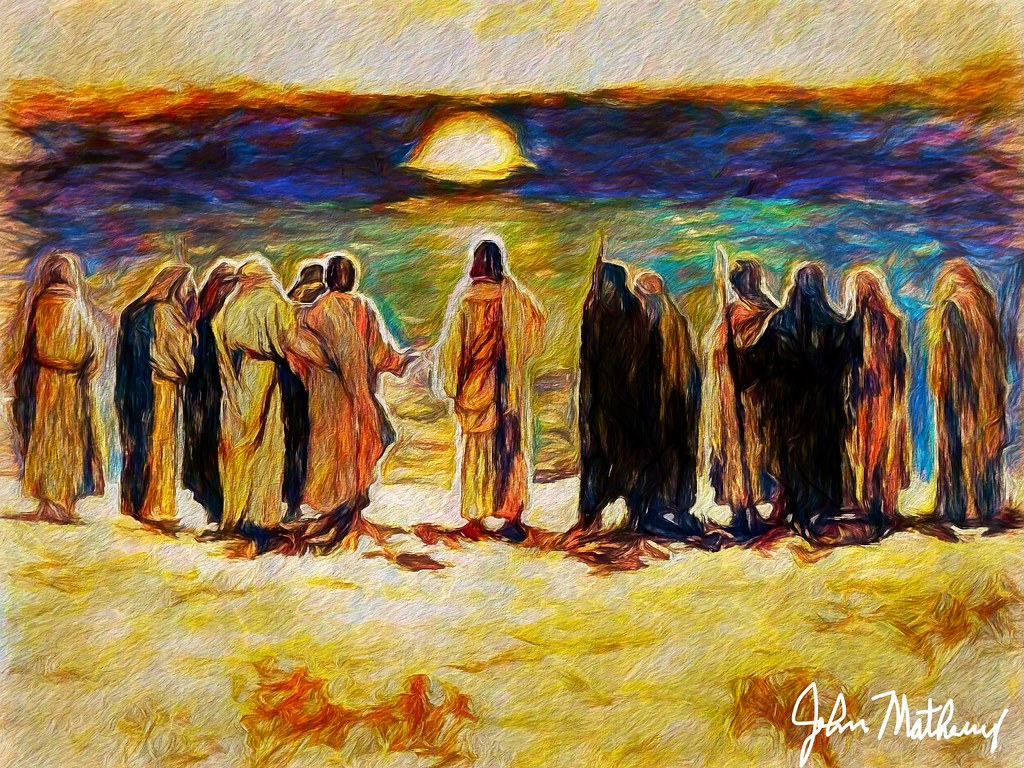
Digital painting of Jesus and the disciples by John Mathews

A dispute also arose among them as to which of them was considered to be greatest. Jesus said to them, “The kings of the Gentiles lord it over them; and those who exercise authority over them call themselves Benefactors. But you are not to be like that. Instead, the greatest among you should be like the youngest, and the one who rules like the one who serves. For who is greater, the one who is at the table or the one who serves? Is it not the one who is at the table? But I am among you as one who serves. You are those who have stood by me in my trials. And I confer on you a kingdom, just as my Father conferred one on me, so that you may eat and drink at my table in my kingdom and sit on thrones, judging the twelve tribes of Israel. (NIV)

Jesus is a different sort of leader.

While the kings of his day were concerned with power and using their authority to ensure even more power and privilege, Jesus went about things differently. In a world of patronage where it was necessary for the lower classes to connect with and suck-up to the higher classes, Jesus operated by a different system.

Jesus, Lord of the universe, King of creation, absolute Leader of the Church, and Ruler over God’s realm was and is a servant of the people.

“Follow my example: Even the Son of Man did not come for people to serve him. He came to serve others and to give his life to save many people.”

mark 10:45, erv

On the surface, striving to be the best might seem noble and good. Yes, working toward being the greatest might motivate us to do all things with excellence. It can solve a lot of problems and issues. On the other hand, it may also result in attitudes and behavior which fosters unhealthy competition and an inordinate focus on becoming the greatest.

Think about it. Not everyone can be the greatest. If everyone is, nobody is. This results in lower self-esteem for nearly everybody. And it creates ripe conditions for leadership paranoia in which the greatest is always looking over their shoulder worrying about being toppled from their lofty position. At the least, all this ballyhoo about greatness only takes away from caring for the people who most need our efforts – family members get the shaft from someone with an imbalanced life who is laser-focused on getting to the top and staying there.

It’s as if a person is living a one-dimensional existence in a three-dimensional world. It won’t work. Fortunately, we don’t have to live like that.

Jesus shows us a better way.

Jesus was present to his disciples. He is present to us in the person of the Holy Spirit. Christ encouraged relational connections and using one’s gifts, talents, and abilities for the common good of all people. For Jesus Christ, the dynamics of power and authority are not to be leveraged for personal greatness but for collective uplift. Authority is to be carefully applied for everyone’s benefit, including those we think don’t deserve it.

The disciples understood far too little about the community their leader was trying to build. Judas Iscariot is likely the one disciple who first realized what Jesus was truly up to. The greatest are the least and the least are the greatest. It wasn’t what Judas signed up for, so he cut his losses and betrayed Jesus.

True exaltation is a gift of grace. The kingdom of God turns on mercy and operates on the economy of grace. It is those who faithfully serve who will sit with Jesus, the ultimate Servant, at the table. Peacocks and pretenders will never realize their dream to be the center of attention.

In a great twist of irony, those who wish to compete and occupy a high standing will discover they have worked to obtain the lowest rung on the ladder leaning against the wall of Satan’s kingdom.

Jesus consistently, patiently, and carefully established the kingdom of God on earth. He went about his task in a manner none of us would even consider. He focused on character, not skills; willing hearts, not intelligent brains; new life, not reformed habits. On the job orientation involved following Jesus around everywhere.

Just shadow Jesus.

Here I am washing your feet. Do the same. Here I am being present to and serving the poor, the lonely, the outcast, the moral failure, and the lowest of society. Do the same. Here I am showing sacrificial self-emptying unconditional love. Do the same. Just shadow me. Do what I do, period.

An obsession with greatness will inevitably lead to petty kingdom building enterprises. Instead, we are to love the neighbor next to us. We make room at the committee table for somebody who looks, acts, and talks different than me. We freely let Jesus live through us, thus, giving the gift of him to those we encounter. We purposely look for ways to serve underprivileged communities rather than use the people living there in ways to make us look better.

Indeed, this following Jesus thing is subversive – even for many professing Christians.

What will you do?

Go in peace to love and serve the Lord, in the name of Christ. Amen.