
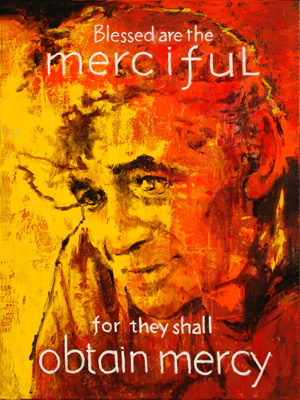
Matthew 5:7 – Blessed are the Merciful

“Blessed are the merciful,
    for they will be shown mercy.” (NIV)

“Mercy” is one of the most rich and important words in all of the Holy Bible. Randomly turn to any page of Scripture and you will most likely find the word “mercy.” Mercy is highly significant because God is merciful.

King David was known as a man after God’s own heart (1 Samuel 13:14). This is first and foremost about mercy. In the ancient world, when a new king came to power who was from a different lineage than the previous ruler, it was a common practice to kill all the male heirs from the former king because they posed a grave threat to the throne. David, however, did not do that; he did just the opposite. David ascended the throne and said:

“Is there anyone still left of the house of Saul to whom I can show kindness?” (2 Samuel 9:1, NIV)

Indeed, there was. His name was Mephibosheth. He happened to be lame in both feet. That meant, literally, he was not able to run away when David became king. I am sure Mephibosheth believed he was being summoned by King David to his death. But when he arrived, David said to him:

“Don’t be afraid, for I will surely show you kindness…. I will restore to you all the land that belonged to your grandfather Saul, and you will always eat at my table.” (2 Samuel 9:7, NIV)

That, my friend, is the very definition of mercy. And that is precisely the character quality Jesus was talking about in his Beatitudes.

Just as David used his power to extend mercy and kindness to potential rivals instead of exterminating them to consolidate his power, so the true follower of Jesus will identify with the powerless and give them a seat at the table.

If we are wondering, at all, whether this is really what Jesus is talking about with mercy, his words in the Gospel of Luke make it crystal clear:

“If you love those who love you, what credit is that to you? Even sinners love those who love them. And if you do good to those who are good to you, what credit is that to you? Even sinners do that. And if you lend to those from whom you expect repayment, what credit is that to you? Even sinners lend to sinners, expecting to be repaid in full. But love your enemies, do good to them, and lend to them without expecting to get anything back. Then your reward will be great, and you will be children of the Most High, because he is kind to the ungrateful and wicked. Be merciful, just as your Father is merciful.” (Luke 6:32-36, NIV)

Merciful folks are gracious, kind, and accept others, especially an unworthy person, because they know that they themselves are unworthy of God’s great mercy and grace. The merciful person’s mantra is: “God has shown me mercy; therefore, I will show mercy to others.”

Those who are merciful will be shown mercy. If anyone treats another harshly and without mercy, they should not expect to receive blessing from God. This raises an important question which needs to be asked: Are we kind and merciful, or do we have a bent toward wanting to see others judged and punished? I share a hypothetical story….

My dear middle daughter was a remarkably busy girl. Whenever we were in public, it was my standing rule that she always holds my hand. The reason for this was that she always ran instead of walked. Holding her hand was the only way I could keep her safe and not literally run into harm’s way.

Here comes the hypothetical part: One day we are walking down the street holding hands. She gets away from my grip and runs… right into oncoming traffic… and is struck by a car. I run up to her, bend over her bleeding and broken body and say, “Well, that’s what you get for disobeying me. After all, you reap what you sow!”

Oh, my, no!… My daughter is now a Mom. And, lo and behold, she has a son just like her. I need to hold his hand, too! If an accident were ever to happen in reality, I can guarantee my response would be to run to him, bend over his bleeding and broken body, cry uncontrollably, and determine to do everything in my grandfatherly power to save his life and see him healed from his injuries.

So, then, my sisters and brothers, why in the world would we ever tell a broken hearted person – perhaps in the throes of depression or riddled with anxiety from hardship – emotionally and spiritually bleeding on the inside: “Get over it!” “Just stop worrying!” or “You need to be strong!”

God, forbid! No! Mercy! I insist, mercy! The world does not revolve on the axis of judgment, criticism, or giving someone what they deserve. God’s great big world spins because of mercy, grace, and basic human kindness that comes from the hand of a good benevolent Lord who cares about all humanity. Perhaps I must be even more specific…

  • The one filled with God’s righteousness will go out of their way to show kindness, love, and compassion to the LGBTQ+ community, becoming familiar with their needs, struggles, and heartaches as they listen without judgment and full of mercy.
  • The person touched by the mercy of God will intentionally seek to give people of color a seat at the table and the freedom to speak freely while listening with ears of mercy.
  • The human being who follows Jesus will see the image of God in our Native American sisters and brothers and will mercifully do everything within their power to advocate for them when it comes to things like inequities of poverty, disease, addiction, and death.
  • The person filled with the righteousness of God will respect all other religious people, regardless of their spirituality. They will be merciful to Buddhists, Muslims, Hindus, and even Wiccans, not because they see them as potential converts, but just because they need mercy, like the rest of us.

Consider what others have to say about mercy….

“God tolerates even our stammering and pardons our ignorance whenever something inadvertently escapes us – as, indeed, without this mercy there would be no freedom to pray.”

John Calvin

“Darkness cannot drive out darkness; only light can do that. Hate cannot drive out hate; only love can do that.”

Martin Luther King, Jr.

“It is mercy, not justice or courage or even heroism, that alone can defeat evil.”

Peter Kreeft

Consider what Holy Scripture has to say about mercy…

Some Pharisees asked Jesus’ disciples, “Why does your teacher eat with tax collectors and other sinners?” Jesus heard them and answered, “Healthy people don’t need a doctor, but sick people do. Go and learn what the Scriptures mean when they say, ‘Instead of offering sacrifices to me, I want you to be merciful to others.’ I didn’t come to invite good people to be my followers. I came to invite sinners.” (Matthew 9:11-13, CEV)

The Lord’s kindness never fails!
If he had not been merciful,
    we would have been destroyed.
The Lord can always be trusted
    to show mercy each morning.
Deep in my heart I say,
“The Lord is all I need;
    I can depend on him!” (Lamentations 3:22-24, CEV)

May we not succumb to thoughts of violence and revenge today, but rather to thoughts of mercy and compassion. We are to love our enemies and be merciful to all so that we might reverse the curse on humanity and restore them, by God’s grace, to their right mind, heart, and spirit.

*Above painting by Hyatt Moore

2 Samuel 6:16-23 – Shameless Worship

As the Ark of the Lord came into the city, Saul’s daughter Michal looked out the window. When she saw David jumping and dancing in the presence of the Lord, she hated him.

David put up a tent for the Ark of the Lord, and then the Israelites put it in its place inside the tent. David offered whole burnt offerings and fellowship offerings before the Lord. When David finished offering the whole burnt offerings and the fellowship offerings, he blessed the people in the name of the Lord All-Powerful. David gave a loaf of bread, a cake of dates, and a cake of raisins to every Israelite, both men and women. Then all the people went home.

David went back to bless the people in his home, but Saul’s daughter Michal came out to meet him. She said, “With what honor the king of Israel acted today! You took off your clothes in front of the servant girls of your officers like one who takes off his clothes without shame!”

Then David said to Michal, “I did it in the presence of the Lord. The Lord chose me, not your father or anyone from Saul’s family. The Lord appointed me to be over Israel. So, I will celebrate in the presence of the Lord. Maybe I will lose even more honor, and maybe I will be brought down in my own opinion, but the girls you talk about will honor me!”

And Saul’s daughter Michal had no children to the day she died. (New Century Version)

“God wants worshipers before workers; indeed the only acceptable workers are those who have learned the lost art of worship.”

A.W. Tozer

A true celebration of God was underway, enjoying the blessing of God. The sacrifices before God were sweet smelling because they were done in a spirit of obedience and humility, and according to the specifications of worship with the Ark of God’s Covenant.

However, David’s wife, Michal, the daughter of the former king, Saul, did not worship. She critically observed David and the others and evaluated the worship service by how it appeared to her. Michal was not with everyone else giving herself to the true worship of God. She did not like how her husband went about worship. 

The acceptable worship of God was not acceptable to her, and she gave David an earful about it. Yet, David was undaunted. He had his focus where it ought to be.

We get a cryptic last note on Michal, describing that she was barren to the day of her death – it is a note on her meant to convey both a physical reality of her body, and a spiritual reality of her soul.

So, how are we to worship God? In the New Testament Gospels, Jesus said about worship: 

“Indeed, the time is coming, and it is now here, when the true worshipers will worship the Father in spirit and truth. The Father is looking for people like that to worship him. God is a spirit. Those who worship him must worship in spirit and truth.” (John 4:4:23-24, GW) 

Neither good intentions alone (in spirit) nor appropriate actions alone (in truth) constitute acceptable worship.  We must possess both. The worship Jesus talked about was literally “to prostrate oneself before God.”  In other words, it is to embrace both the disposition and the attitude of submission and humility toward God, seeking to obey the Lord as rightful Ruler, rather than superimpose our desires on him. 

Furthermore, God is both near to us and far away from us, all at the same time. God is close to us through the person and work of Jesus Christ, and now in the person of the Holy Spirit. God exists supreme and far above us, calling the shots of how we ought to be living our lives.

We must appreciate both divine transcendence and divine immanence.

The presence of God is both comforting and dangerous. God’s holiness is like a fire, giving us light and warmth – get too close to the flame and you will get burned, even destroyed. We do not get to tell God what we are to be doing and how to go about it. We have collective promises and blessings given to us as God’s people. Yet, at the same time, we have a responsibility to know God’s will and to do it in God’s way.

God cares about worship. If we worship any old way we want without consideration of how God wants it done, or if we just critically watch worship without engaging in it, then we ought not to expect blessing. However, if pay attention to God and are careful to do what God wants in God’s way, then we will enjoy God’s approval.

The Church is first and foremost a worshiping community of redeemed persons through the blood of Christ, which are given to the world in order to glorify God:

Everyone on this earth,
    sing praises to the Lord.
Day after day announce,
    “The Lord has saved us!”
Tell every nation on earth,
“The Lord is wonderful
    and does marvelous things!
The Lord is great and deserves
    our greatest praise!
He is the only God
    worthy of our worship.
Other nations worship idols,
but the Lord created
    the heavens.
Give honor and praise
    to the Lord,
whose power and beauty
    fill his holy temple.”

Tell everyone of every nation,
“Praise the glorious power
    of the Lord.
He is wonderful! Praise him
and bring an offering
    into his temple.
Worship the Lord,
    majestic and holy. (1 Chronicles 16:23-29, CEV)

The text in 1 Chronicles, a restatement of our Old Testament lesson for today, goes on to say:

David left Asaph and his coworkers with the Chest of the Covenant of God and in charge of the work of worship; they were responsible for the needs of worship around the clock.

He also assigned Obed-Edom and his sixty-eight relatives to help them. Obed-Edom son of Jeduthun and Hosah were in charge of the security guards. The priest Zadok and his family of priests were assigned to the Tent of God at the sacred mound at Gibeon to make sure that the services of morning and evening worship were conducted daily, complete with Whole-Burnt-Offerings offered on the Altar of Burnt Offering, as ordered in the Law of God, which was the norm for Israel.

With them were Heman, Jeduthun, and others specifically named, with the job description: “Give thanks to God, for his love never quits!” Heman and Jeduthun were also well equipped with trumpets, cymbals, and other instruments for accompanying sacred songs. The sons of Jeduthun formed the security guard. (1 Chronicles 16:37-42, MSG)

David exerted his kingly authority by instituting that in Israel the worship of God was to take place every day – not just one day a week. He hired hundreds of musicians, singers, and worship leaders to minister before the Lord every single day, twice a day. 

“I must take time to worship the One whose name I bear.”

Oswald Chambers

Many believers bemoan the morality and lack of spirituality in our world. Yet, if God’s people are not first and foremost a worshiping community, then we have nowhere else to look to institute the change which is needed.

In addition, every conceivable instrument and voice was used to praise God in worship. New songs were written continually by David, and arranged by Asaph, the worship leader. 

While we make plans and conceive of ideas for our lives, God is waiting for us to worship. It would be good to spend some time each morning when we arise, and each evening at bedtime, in worship following the example of David: remembering God, and who we are; singing to the Lord; confessing sin; claiming forgiveness; reading Scripture; and, praying. 

If we all devoted ourselves to worship without shame, then we might begin to imagine God opening to us blessing upon blessing.

*Above sketches of King David dancing before the Lord, by Rebecca Brogan

Mark 6:45-52 – Facing Fear

Immediately Jesus made his disciples get into the boat and go on ahead of him to Bethsaida, while he dismissed the crowd. After leaving them, he went up on a mountainside to pray.

Later that night, the boat was in the middle of the lake, and he was alone on land. He saw the disciples straining at the oars because the wind was against them. Shortly before dawn he went out to them, walking on the lake. He was about to pass by them, but when they saw him walking on the lake, they thought he was a ghost. They cried out because they all saw him and were terrified.

Immediately he spoke to them and said, “Take courage! It is I. Don’t be afraid.” Then he climbed into the boat with them, and the wind died down. They were completely amazed, for they had not understood about the loaves; their hearts were hardened. (New International Version)

Sometimes, we are afraid – even terrified. And Christians aren’t immune to the feeling of fear and terror.

The truth of the Christian life is that it is a herky-jerky process of three-steps-forward, two-steps-backward, not always knowing with certainty everything we encounter.  

The expectation that we will have a consistent upward trajectory of spiritual development with no scary experiences is wrongheaded and misguided. Throw into the mix that our self-awareness is often skewed, and that we have difficulty assessing ourselves with any accuracy, and voila! we have a recipe for the true human condition.

Doubt, fear, failure, and stubbornness aren’t just endemic to other people – it also characterizes many Christians, as well. We will face severe storms in life. They will be harsh. We will wonder if we’ll even make it out alive, or not. And it may very well seem like Jesus is nowhere to be found. Then, when he does show up, we don’t recognize him, and it scares the bejabbers out of us.

This was the experience of Christ’s disciples, who too often reflect our own stories of faith and fear all rolled up in one person. Today’s Gospel lesson is this: Our fears and foibles do not need to define us because Jesus is Lord over the water, the weather, the wondering, the waiting, the wildness, and our own whimsical natures of seeing miracles accomplished in others, then not believing it can happen in our own lives.

So, what are we really afraid of? Failure? Fear itself? Death? Irrelevance? Loss? Change? Perhaps, everything? Yes, all of life is a risky scary business. There are no guarantees, except one: Christ is present with us, whether we are aware of it, or not.

If the worst scenario you worry about in your head would actually come to pass, it will still never change the reality that God loves you and is with you.  And it will not stop Jesus from assuring us of his presence and climbing into the boat to be with us.

We don’t have any accounts of Jesus freaking out in fear, or when other people flip out in their own fear. Jesus was a person of prayer, completely grounded in his relationship with the Father.   

Jesus made his disciples get into a boat and go out on the lake – all the while knowing what they were about to face with the weather. Even though the disciples were doing God’s will by going out on the lake, they were not spared from adversity. In fact, Jesus wanted them to experience the storm because it is through the storm that we really learn faith and to face down our fears. 

There is no shame in being afraid. We all experience it. And there is no shame in admitting we’re scared. Where shame exists, our instinct is to run away like our ancestors Adam and Eve and hide, thus hiding ourselves from the grace that could be ours.

Being out on the middle of a lake during a storm did not prevent Jesus from being present with the disciples – he just walked on the water to be with them. Even though the disciples had just seen and participated in the miracle of Jesus feeding the five thousand, they were not looking for another miracle – which is why they did not recognize Jesus and were afraid when they saw him.

Jesus never chided his disciples for their fear, or their hard hearts. He simply invited them, with the tone of grace and mercy, to not be afraid. And the Scripture is replete with continual encouragements to not be afraid because of God’s presence. Along with psalmist, we can say:

But when I am afraid,
    I will put my trust in you.
I praise God for what he has promised.
    I trust in God, so why should I be afraid?
    What can mere mortals do to me? (Psalm 56:3-4, NLT)

I sleep and wake up refreshed
    because you, Lord,
    protect me.
Ten thousand enemies attack
from every side,
    but I am not afraid. (Psalm 3:5-6, CEV)

When I called, you answered me.
You made me bold by strengthening my soul. (Psalm 138:3, GW)

Ultimately, fear has to do with disconnection. It is to feel powerless, separated from any resources, unable to do anything about what is presently staring us in the face and scaring us.

Yet, when we have an awareness and a sense of connection with Jesus, there are unlimited resources of grace to accept, cope, and transcend any and every storm we find ourselves in the middle of.

May the risen and ascended Christ, mightier than the hordes of hell, more glorious than the heavenly hosts,
be with you in all your ways. 

May the cross of the Son of God protect you by day and by night, at morning and at evening, at all times and in all places.

May Christ Jesus guard and deliver you from the snares of the devil, from the assaults of evil spirits, from the wrath of the wicked, from all base passions, and from the fear of the known and unknown. 

And may the blessing of God almighty – Father, Son, and Spirit – be upon you and remain with you always. Amen.

*Above painting of Jesus walking on water by Brian Whelan

**Above Orthodox icon of Christ walking on water

***Above painting: Christ walking on the sea, by French artist Amédée Varint (1818-1883)

Galatians 6:11-18 – What Counts is the New Creation

See what large letters I use as I write to you with my own hand!

Those who want to impress people by means of the flesh are trying to compel you to be circumcised. The only reason they do this is to avoid being persecuted for the cross of Christ. Not even those who are circumcised keep the law, yet they want you to be circumcised that they may boast about your circumcision in the flesh. May I never boast except in the cross of our Lord Jesus Christ, through which the world has been crucified to me, and I to the world. Neither circumcision nor uncircumcision means anything; what counts is the new creation. Peace and mercy to all who follow this rule—to the Israel of God.

From now on, let no one cause me trouble, for I bear on my body the marks of Jesus.

The grace of our Lord Jesus Christ be with your spirit, brothers and sisters. Amen. (New International Version)

Motives matter. The interior life of a person is important. Life is neither a mere getting things done nor doing what is needed on the exterior. A house may be beautiful and orderly on the outside, with careful landscaping, a manicured lawn, and attractive appearance – yet on the inside it might be disorderly, full of relational discord, and completely discombobulated.

The exterior life of a person is also important. But it’s only half the person. And, unlike God who sees the heart, we aren’t always privy to what’s going on inside someone.

Folks who are enamored with outward displays of spirituality and righteousness tend to be compulsive about maintaining appearances – for both themselves, and everyone else.

Policing outward forms of righteousness through clear identifiable means is really nothing more than old fashioned judging of one another. It’s antithetical to grace. And it smacks of the snooty superiority of Star-Bellied Sneetches.

Rather than a star on the belly, in the Apostle Paul’s day it was circumcision. Those who had it were “in” and those without it were “out.” Never mind the interior life. A hard outward boundary of righteousness was established by false teachers who made the Christian life easy by simply holding to readily observable forms, like circumcision.

It wasn’t that circumcision was a bad thing. The issue was making it a necessary part of the Christian life. Not circumcised? Not a Christian, insisted the false teachers. In other words, one had to become Jewish before becoming a Christian. I can picture the Apostle Paul doing a hand to the forehead, saying, “Oy vey.”

For the Christian, one must be vigilant not to exaggerate baptism. On the one hand, I would argue far too many believers underestimate the significance and importance of baptism. Flippantly making it a personal choice, as if the individual is in complete control of one’s own salvation, is not only wrongheaded – it’s downright blasphemous.

Yet, on the other hand, a preoccupation with getting a person, especially a child, baptized, as if the world might end if it doesn’t happen, betrays the same problem as Paul faced with circumcision in the first century.

The proper approach, it seems to me, is to embrace the full spectrum of Christianity – both outward and inward – the whole person. And Paul addresses this by anticipating a question of the Galatian congregation: What, then, is of central importance?

The answer is: a new creation. To be transformed by the power of the Spirit is what really counts. The grace of God in Christ, applied to a person, brings a change to inner motives and attitudes, as well as outer behavior through loving actions.

We must always keep in mind that the sign points to the substance. It would be weird if I were traveling to Milwaukee on I-94 and pulled over on the interstate next to the sign marking the city is ahead, crawl all over it, and say, “I’m here!”

The overall thrust of Paul’s letter to the Galatians is that they were debasing the true worship of God into an outward show, honoring Christ with their lips but not holding him in their hearts.

Christianity is fundamentally not about what we do for God but what God has done for us in Jesus Christ. It is divine grace which saves people. We belong to God. Just as we neither chose our own parents nor the time when we were born, so akin to this is, before we chose God, God chose us. We don’t “born again” ourselves; God does the rebirthing.

And since it is solely the work of God in us, there is zero reason to boast about the circumstances of our new birth and becoming a new creation in Christ. We didn’t save ourselves. It would be something like getting a COVID-19 vaccine and then bragging about how we stopped the pandemic.

Instead, we are to bear the spiritual marks of Christ’s crucifixion on our inner selves. No one is saved because they deserve it but simply because they need saving.

Lord Jesus Christ, Son of God, grant us the faith to accept your saving work in the cross and to be so transformed by it that we will not be without excuse on Judgment Day. Help us not merely walk at your side, with mere words to offer. Convert us and give us new life in you so that in the end we will not be dry wood, but living branches in you, the true vine, bearing fruit for eternal life. Amen.
