Matthew 5:27-36 – Lusting, Liquidating, and Lying

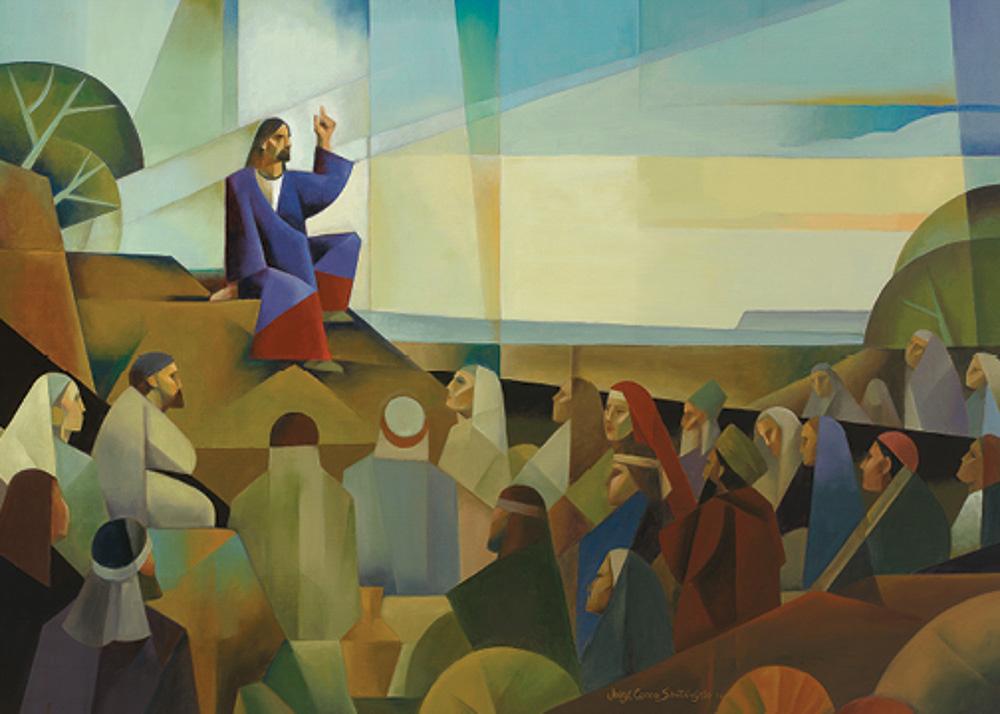
Sermon on the Mount by Argentine artist Jorge Cocco Santángelo

“You have heard that it was said, ‘You shall not commit adultery.’But I tell you that anyone who looks at a woman lustfully has already committed adultery with her in his heart. If your right eye causes you to stumble, gouge it out and throw it away. It is better for you to lose one part of your body than for your whole body to be thrown into hell. And if your right hand causes you to stumble, cut it off and throw it away. It is better for you to lose one part of your body than for your whole body to go into hell.

“It has been said, ‘Anyone who divorces his wife must give her a certificate of divorce. ’But I tell you that anyone who divorces his wife, except for sexual immorality, makes her the victim of adultery, and anyone who marries a divorced woman commits adultery.

“Again, you have heard that it was said to the people long ago, ‘Do not break your oath, but fulfill to the Lord the vows you have made.’ But I tell you, do not swear an oath at all: either by heaven, for it is God’s throne; or by the earth, for it is his footstool; or by Jerusalem, for it is the city of the Great King. And do not swear by your head, for you cannot make even one hair white or black. (New International Version)

Adultery. Divorce. Oaths. Jesus chose these topics from the Ten Commandments (7, 9, and 10) to uphold the ethical law of God.

In Christ’s Sermon on the Mount, Jesus gets to the heart of immorality and unethical behavior. The physical act of adultery arises from mental adultery. Divorce results from hardness of heart. Breaking oaths as a form of lying.

Adultery

Pornography is a 60 billion dollar a year industry, worldwide. It is the church’s problem, as well:

  • 53% of Christian men consume pornography.
  • 51% of pastors say porn is a temptation.
  • 69% of pastors started looking at porn out of curiosity.
  • 37% of pastors say it’s currently a struggle.
  • 35% of men have used pornography in the past month.
  • 4 in 10 of pastors looked at porn today.
  • There are 100,000 websites that offer illegal child pornography.
  • 90% of 8-16 year old’s have viewed porn online (most while doing homework).
  • 20% of men, and 13% of women, admit to viewing pornography at work.
  • 70 percent of all internet porn traffic occurs during the 9-to-5 workday.

Adultery initially occurs when someone feeds on mental sexual activity with another person. As with most of Christ’s solutions, he lays out a radical means of overcoming it.

Jesus is not condemning normal gender attraction, nor sex itself (which is a gift of God). Rather, Jesus condemns the leering upon another with sexual fantasy. All adulterous relationships and inappropriate sexual relations start with the “look.”

“Lust” is to intensely desire and burn for something, to seek mastery over another. The reason people stare, and lust, is not because of the other person’s manner or dress; it’s because they already have an adulterous heart. 

Whenever we are caught in physical or mental adultery, decisive and drastic action is needed. Jesus used hyperbole to drive his point home about the need of dealing with adultery. The approach is not applying a band aid; it is amputation.

The reason many men and women are snared by adultery, and seem unable to stop, is that they deal with it on their own. The radical action needed is accountability; confession must be offered.

Trying to manage lust on our own is like one individual attempting to contain a nuclear meltdown.

Jesus leaves no room to think it is okay to lust in the heart because I am not hurting anybody. Pornography enslaves its users and degrades women.

As powerful and addictive lust is, God’s grace is bigger and more powerful. There’s no need to be burdened with shame and guilt when the cross of Christ has already taken care of it.

There would not be a multi-billion dollar industry if there were not places in our hearts that are black. Now is the time for forgiveness, grace, and healing.

Sermon on the Mount by American artist Bill Bell

Divorce

Today in America more than one-third of all adults have experienced divorce.

Unfortunately, many divorced persons feel their faith community provided rejection rather than support and healing. There is a lot of room for improvement when to help families, and those having experienced divorce.

Please know Jesus condemns the cavalier divorce, and not all divorce. Anybody who doesn’t like their spouse doesn’t have ground for divorce. They entertain the thought of having a better spouse, even though there is no marital unfaithfulness. 

This is yet another form of mental adultery (and idolatry) which believes someone else can better meet my needs. 

Jesus clearly makes provision for divorce to occur in certain circumstances. Yet, he will not bend to liquidating a marriage over unhappiness with what God has joined together.

The intent of Old Testament legislation on divorce is to avoid a casual stance toward marriage (Deuteronomy 24:1-4). Over the centuries, people found creative ways of getting around the law. Although a divorce may be legal, it might not be ethical. Jesus wanted divorce practiced with concern for the woman, so that her rights and needs were considered.

Many took a loose view of divorce and focused solely on “indecency” as grounds for divorce. They did not interpret the term solely as sexual infidelity, as Jesus did, but had a broad understanding of indecency.

For example, if a husband did not like his wife, or, in the words of one rabbi, she continually burns the supper, he may “put her away” (divorce her). Jesus, however, insisted divorce must not happen because of a hard time getting along; or don’t love your spouse anymore; or that your spouse keeps irritating you. 

Being frustrated or unhappy are not biblical grounds for divorce. The answer to most marital problems does not lie in a new spouse, but in the hard work of identifying the idols of our hearts, overthrowing them, and re-connecting. Sin is crouching at the door, but you and I must master it.

Jesus said the ground for divorce is marital unfaithfulness, that is, any sexual activity outside the bounds of the marriage relationship. And, even in this case, divorce need not be an option, if the two people can reconcile.

Christ sought to defend women who are genuine victims. In biblical times, if a wife was given a certificate of divorce, she had four options: 1) Return to her family of origin; 2) Become a beggar; or 3) Become a prostitute to make ends meet; or, 4) Marry again, thus committing adultery if she was divorced because her husband didn’t like her. 

Jesus doesn’t take sides between spouses. Instead, he lifts the original intent of marriage: oneness. Divorce was never meant to be. Separating two people is damaging. However, it obviously occurs. (Matthew 19:1-12)

Divorce exists because of the heart’s hardness in one or both of the marriage partners. Divorce, really, is a legal testimony verifying that a separation has already occurred. It’s a recognition that disunity and non-oneness is already present. Legal divorce affirms that a terrible break already happened, damaging the people involved.

Just as God is one, two marital partners are to be one. Oneness is the primary goal of any marriage relationship. God did not institute marriage for people to live as roommates, but to be a new entity operating as one.

If God found it necessary to divorce his own covenant people, then it is inevitable divorce will occur among people (Jeremiah 3:1-8).  Therefore, let’s be discerning in how we handle each individual situation of marital difficulty.

Sermon on the Mount by Janice Elizabeth Steward

Oaths

“I swear on a stack of Bibles I won’t…” “I will, if I get around to it….” These are a few of the caveats we give when making a promise or oath. Oaths communicate our level or ability of getting it done, or not.

That’s fine. What isn’t fine is making excuses or false promises with no intention of doing what you say you will do. So, Jesus wants all the extraneous language out. Say “yes” or “no” and then follow through. And if you don’t, you’re a liar.

We often lie because we don’t want to do something to begin with. “Yes” and “no” are clear boundary words. Boundaries are needed so there is no oath-breaking.

Boundaries define where I end and someone else begins, leading me to a sense of ownership. Knowing what I am to take and not take responsibility for gives me freedom.

  • Boundaries keep the good in and the bad out. Setting boundaries involves taking responsibility for your choice of “yes” and “no” and living with the consequences.
  • Boundaries protect us from “gaslighting.” Gaslighting is a form of emotional abuse. The abuser manipulates another into doubting their thoughts, feelings, judgments, perceptions, and/or memories.
  • Boundaries hold people accountable for their words and actions. Without boundaries, we can easily feel used and mistreated.

Jesus wants us to clarify our values and live them out; make wise decisions; identify what we will accept and reject; and follow through on what we say we will do.

Conclusion

Adultery, divorce, and oaths are related. Boundaries – making and keeping promises – deals with outside forces trying to compromise our values. Accountability in naming our struggles mitigates covetousness.

Dissolved marriages and broken promises still happen. Yet, Jesus is there offering grace, not judgment. We may become emotionally damaged, however, there is healing available through the mercy of Christ. Amen.

Job 4:1-21 – Where Is God?

Eliphaz and the other friends of Job, speaking down to him in his suffering, from a fresco in the Cathedral of the Annunciation in Moscow

Job, will you be annoyed if I speak?
    I can’t keep quiet any longer.
You have taught many people
    and given strength to feeble hands.
When someone stumbled, weak and tired,
    your words encouraged him to stand.
Now it’s your turn to be in trouble,
    and you are too stunned to face it.
You worshiped God, and your life was blameless;
    and so you should have confidence and hope.
Think back now. Name a single case
    where someone righteous met with disaster.
I have seen people plow fields of evil
    and plant wickedness like seed;
    now they harvest wickedness and evil.
Like a storm, God destroys them in his anger.
The wicked roar and growl like lions,
    but God silences them and breaks their teeth.
Like lions with nothing to kill and eat,
    they die, and all their children are scattered.

Once a message came quietly,
    so quietly I could hardly hear it.
Like a nightmare it disturbed my sleep.
    I trembled and shuddered;
    my whole body shook with fear.
A light breeze touched my face,
    and my skin crawled with fright.
I could see something standing there;
    I stared, but couldn’t tell what it was.
Then I heard a voice out of the silence:
“Can anyone be righteous in the sight of God
    or be pure before his Creator?
God does not trust his heavenly servants;
    he finds fault even with his angels.
Do you think he will trust a creature of clay,
    a thing of dust that can be crushed like a moth?
We may be alive in the morning,
    but die unnoticed before evening comes.
All that we have is taken away;
    we die, still lacking wisdom.” (Good News Translation)

The Christian spiritual classic, The Dark Night of the Soul, was written nearly five hundred years ago by St. John of the Cross. The gist of John’s observation is that God sometimes takes the Christian through dry times of hiding himself from the believer. 

The pain of wondering where God is and if he will even show up; experiencing unanswered prayer; enduring uncaring and misdirected comments from well-meaning people; all these and more are inevitably part of the Christian spiritual experience. 

The dark night of the soul is not to be confused with personal sinfulness. Its origin is not in self, but God. 

“Silence is God’s first language.”

St. John of the Cross

Whenever one knows with a settled confidence that personal integrity is intact, but trouble abounds, we need not immediately rush to the conclusion that something is wrong with us. It may be the Spirit of God thrusting us into a desert experience to test and approve our faith.

Job’s “friend” Eliphaz offered one of those tired age-old arguments that bad things only happen to bad people. He comes at Job with the inexperience and absurdity of making misguided assumptions. He rhetorically asks: Who that was innocent ever perished?  Where were the upright cut off? 

The conclusion of Eliphaz, therefore, was bound to be off the mark – believing secret sin must surely be the culprit behind Job’s awful misfortune. Certainly, Eliphaz thinks, Job cannot possibly go through such terrible suffering without having done something to anger God.

Times change; the basic nature of people, not so much. In today’s church and world, the same notions still endure. If I had a quarter for every time I heard crazy comments, like the following, I would be a rich man: 

“He’s poor because he is lazy and doesn’t want to work.”

“She keeps having chronic health issues. God is punishing her.”

“The pandemic is God’s judgment on us for not having the Ten Commandments in our courthouses.”

“If you just confess your sin and have faith, you’ll be healed.”

“They’re in big trouble. They obviously did something evil.”

On and on the wrong-headed statements continue, ad nauseum.

The Apostle Peter understood how to view trouble in a healthy way. He said we all suffer – both the good person and the wicked. It’s just a matter of whether we will suffer for doing good and the right thing, or suffer because of saying shallow, illogical, and stupid comments that offend God and hurt others. (1 Peter 3:17-18)

Even Christ suffered. And it wasn’t because of his own sin. It was because of ours. Jesus suffered once for sins, the righteous for the unrighteous, that he might bring us to God. 

Jesus suffered; so, the follower of Jesus will suffer. There is a big picture only God sees. Whenever we suffer, there is something going on behind the spiritual scene. We must allow God to do divine work, and then, trust that the Lord bends all human suffering for good and redemptive purposes.

“Where there is no love, pour love in, and you will draw love out.”

St. John of the Cross

So, let’s change the rhetoric. Instead of jumping to judgment, reflexively hop to grace with comments like these:

  • “He has poverty of spirit. He’s blessed and will inherit the kingdom of God.”
  • “She’s in chronic pain. God has allowed her the privilege of suffering in solidarity with her Lord.”
  • “We’re in a pandemic. Here’s a chance for us to live out of the Ten Commandments.”
  • “If we confess the world’s sins of pride, hate, and injustice, perhaps God’s mercy will deliver us.”
  • “We’re in a big pickle. No better time than now to grow in grace.”

Where is God? Beside you, quietly and confidently holding you up in your suffering.

Lord God, I entrust myself to you because you know what you are doing. Thank you for the trials of life which humbles my heart to pray. Do your work in me so that my faith is fortified for a lifetime of service in the church and the world, through Jesus Christ, my Lord. Amen.

Acts 12:20-25 – Don’t Be Worm Food

Herod had been furious with the people of Tyre and Sidon for some time. They made a pact to approach him together, since their region depended on the king’s realm for its food supply. They persuaded Blastus, the king’s personal attendant, to join their cause, then appealed for an end to hostilities. On the scheduled day Herod dressed himself in royal attire, seated himself on the throne, and gave a speech to the people. Those assembled kept shouting, over and over, “This is a god’s voice, not the voice of a mere human!” Immediately an angel from the Lord struck Herod down, because he didn’t give the honor to God. He was eaten by worms and died.

God’s word continued to grow and increase. Barnabas and Saul returned to Antioch from Jerusalem after completing their mission, bringing with them John, who was also known as Mark. (Common English Bible)

Accountability is important. People need to be held to a clear, right, and just standard of attitude and behavior – especially when they mess with the food supply.

Herod Agrippa Is Worm Food

The King Herod in our New Testament story today, known as Herod Agrippa, was a grandson to Herod the Great. Simply put, King Herod Agrippa was a self-absorbed jerk. Although he only reigned four years, he was something like a modern day evangelical huckster. Herod knew how to turn a phrase and play on the emotions of people to get what he wanted while keeping up appearances with both the Empire and the Jewish people.

Yet, despite or because of his eloquence and power, Herod was vain and ruled for self – and neither for God nor country. So, he was stricken by God and died an unpleasant death. The connection is clear: Herod used the food people depended upon as a means of controlling the politics of the region, so God hit him directly in his intestines with a complete lack of control over his own body.

Just as Herod was an unwanted agent manipulating the food supply for his own ends, so the king received some unwanted guests in the form of worms. In the ancient world, when any ruler used food to control the people, there were individuals and families who ended up starving to death. For Herod, the worm turned, it was he who died.

Jesus Is Gospel Food

The swift judgment from God was both a rebuke to Herod’s personal kingdom building, as well as a means of protecting the fledgling church from severe persecution. With Herod Agrippa off the scene, the Apostles could freely move with regularity (pun intended) and proclaim the good news of Jesus Christ.

Paul, Barnabas, and Mark were able to go on a missionary journey. Nothing can thwart God’s good news and sovereign intentions for humanity – especially not an upstart demigod king who, as a Jew, knew better than to go rogue and mess with people’s food.

The church is to give literal and spiritual food – following the footsteps of their Lord Jesus who said:

“The bread of God is the one who comes down from heaven and gives life to the world…. I am the bread of life. Whoever comes to me will never go hungry, and whoever believes in me will never be thirsty…. I am the bread of life. Your ancestors ate manna in the wilderness, and they died. This is the bread that comes down from heaven so that whoever eats from it will never die. I am the living bread that came down from heaven. Whoever eats this bread will live forever, and the bread that I will give for the life of the world is my flesh…. I assure you, unless you eat the flesh of the Human One and drink his blood, you have no life in you. Whoever eats my flesh and drinks my blood has eternal life, and I will raise them up at the last day. My flesh is true food, and my blood is true drink. Whoever eats my flesh and drinks my blood remains in me and I in them. As the living Father sent me, and I live because of the Father, so whoever eats me lives because of me. This is the bread that came down from heaven. It isn’t like the bread your ancestors ate, and then they died. Whoever eats this bread will live forever.” (John 6:33-58, CEB)

God’s purpose and intent is to provide sustenance. Divine retribution is likely to happen when puny humans try and play their power games, putting entire people groups at risk for starvation. Jesus came to this earth for the provision of food that will nourish to eternal life.

The Lord will provide. God shall ultimately topple all systems of repression which deny people basic life needs. Almighty God seeks to eat away, like an intestinal worm, at contemporary political regimes and oppressive governments which put people in impossible situations of trying to fend for themselves.

Jesus is both Bread and Judge. Christ came in his first advent bringing food for the hungry. There is a time coming when he shall return in his second advent to bring the worm – good news to the suffering, and bad news for the ones who create the suffering.

Be encouraged with the spiritual reality that Christ brings spiritual sustenance and eternal life. And be assured that he knows the condition of all people and will extend grace or judgment with sage wisdom.

Grant, O God, that your holy and life-giving Spirit may so move every human heart, especially the hearts of political authorities, that barriers which divide us may crumble, suspicions disappear, and hatreds cease; that our divisions being healed, we may live in justice and peace so that everyone’s need for food is met, through Jesus Christ our Lord. Amen.

James 3:13-4:3, 7-8a – A Spiritual Diagnosis and Treatment Plan

Byzantine icon of the Apostle James, the brother of Jesus

Who is wise and understanding among you? Let them show it by their good life, by deeds done in the humility that comes from wisdom. But if you harbor bitter envy and selfish ambition in your hearts, do not boast about it or deny the truth. Such “wisdom” does not come down from heaven but is earthly, unspiritual, demonic. For where you have envy and selfish ambition, there you find disorder and every evil practice.

But the wisdom that comes from heaven is first of all pure; then peace-loving, considerate, submissive, full of mercy and good fruit, impartial and sincere. Peacemakers who sow in peace reap a harvest of righteousness.

What causes fights and quarrels among you? Don’t they come from your desires that battle within you? You desire but do not have, so you kill. You covet but you cannot get what you want, so you quarrel and fight. You do not have because you do not ask God. When you ask, you do not receive, because you ask with wrong motives, that you may spend what you get on your pleasures….

Submit yourselves, then, to God. Resist the devil, and he will flee from you. Come near to God and he will come near to you. Wash your hands, you sinners, and purify your hearts, you double-minded.

The Apostle James wrote to a church facing all kinds of challenging adversity in their daily lives. Some of the believers responded wisely to their troublesome circumstances. Yet others dealt with their trials and tribulations by being troublesome people themselves. 

It was this breakdown in the church fellowship which spurred James to write his letter. The surface problem was infighting. But James wanted to get down to the root issues below the surface. Like a doctor understanding the pathology of the body, James diagnosed the real problems, and gave a clear treatment plan on how to proceed together in the Christian life. 

His prescription for spiritual health in the Body of Christ was not medication but a lifestyle change. Today’s New Testament lesson answers three diagnostic questions which ailed this ancient church.

First diagnostic question:  Who is wise and understanding among you?

Wise persons live a good life, demonstrated by their humble actions. They have trained themselves in the ways of God through the Scriptures.

Wisdom in the Bible is much like driving a car. You try to keep your eyes on the road and drive defensively while often making quick decisions on the road. You don’t fret about why there is a tight curve or an upcoming stop sign. You don’t try and determine the philosophy behind the mechanics of a stop light. You just try to do what needs to be done on the road to get where you need to go. And as you drive you respond to the road conditions and pay attention to the other drivers. 

Wisdom in the Christian life is more than knowledge; it is also being attentive to the other people around us as we seek to live for God. We respond to every adverse road condition that comes along with a mind dependent on God and a humble heart willing to be directed and re-directed by God’s Holy Spirit.

The unwise person sits and harbors selfish resentment in his heart when he has to wait ten minutes on a train to slowly rumble by on the tracks. The same person then desires to take off like a bat out of hell, freely expressing his road rage at another slow driver in his way.

In his lack of wisdom, the person justifies himself as wise because he believes his destination warrants his way of driving. He has convinced himself that he must drive the way he does. And if pulled over by a police officer, he deludes himself in thinking the officer has a problem for standing in the way of him getting where he wants to go.

Conversely, wise people are characterized by a different set of motivations and practices:

  • Humility and attentive consideration of another’s need.
  • Moral purity and being set apart for Christian service.
  • Peace and harmony, championing the common good of all. 
  • Empathy and an understanding spirit that does not retreat into judgmental criticism or attacking others – putting themselves in another’s shoes and to first understand before trying to be understood. 
  • Submissive to the truth with a teachable spirit and deliberately implement necessary changes to their lives. 
  • Merciful, seeking compassion in action. 
  • Impartial, steady and consistent, with a predictable godly character. Adverse road conditions and selfish drivers do not throw them off. 
  • Sincere, genuine, and vulnerable with a willingness to face their own dark shadows and have no ulterior motives.

God cares as much about why we do what we do and how we go about it, as he does the actual action and its end result. God desires true wisdom, not false wisdom. In diagnosing false wisdom, there is jealous bitter envy and plain old selfishness. The source of the problem is the devil. And if the problem goes unchecked and no lifestyle changes are made, the body will breakdown into disorder and evil destructive behavior.

In diagnosing true wisdom, there is evidence of good deeds done from a good heart devoted to God. The source of the good actions is humility. This results in the good spiritual health of righteousness (right relationships with both God and others) and peace (harmonious relations with both God and others).

Second diagnostic question:  What causes fights and quarrels among you?

After examination, the problem comes from certain desires that act like a disease.  The presenting symptoms are verbal battles and animosities. The cause is “desire” or “pleasure” (Greek: ἡδονῶν) from which we get our English word “hedonism.” 

Hedonism is the belief and practice that pleasure is the chief good in life. It is a consuming passion to satisfy personal wants, and the willingness to do whatever it takes to obtain those wants. The cause of all the in-fighting was hedonism. Certain people wanted what they wanted, and they would do whatever it took to get it.

Hedonism twists our perspective. It skews our judgment. Hedonism calls 911 from the drive through at McDonalds when they run out of chicken nuggets (true story!). Hedonism is a cancer in the Body of Christ. It makes small things big and big things small. Hedonistic desires will do anything it takes to gain satisfaction. A passage in the Screwtape Letters by C.S. Lewis has the Senior Devil giving his understudy, Wormwood, some advice: 

“Never forget that when we are dealing with any pleasure in its healthy and normal and satisfying form, we are, in a sense, on the Enemy’s [God’s] ground.  I know we have won many a soul through pleasure.  All the same, it is God’s invention, not ours.  He made the desires; all our research so far has not enabled us to produce one.  All we can do is to encourage the humans to take the pleasures which our Enemy has produced and get them to go after them in ways in which He has forbidden.  An ever increasing craving for an ever diminishing pleasure is the formula.”

C.S. Lewis, Screwtape Letters

There is an alternative to the no-holds-bar pursuit of hedonism: You do not have because you do not ask God…. And even then, if still holding onto the hedonistic stance through prayer, there will be no answer because of asking with wrong motives. 

Prayer as a cloak for seeking hedonistic pleasure is nothing but spiritual adultery; it is talking to God with a spiritual mistress on the side to meet the needs that God does not seem to care about.

Third diagnostic question:  What does God want?

God wants prayer from a humble heart that seeks to engage the real enemy. Our fight is with our own pride, not with each other. If we have good and godly desires for prayer but find that we do not seek God as we ought; and come to the Scriptures discovering there is a sickness in our soul; then, the prescription is humble submission to God, resistance to evil ways, and drawing near to God.

God wants people to turn from the pride of radical independence and clandestine desires to openly and humbly seeking divine help.

The Apostle James was not trying to be a killjoy when he said to grieve, mourn, and wail; and to change your joy to gloom. He was speaking directly toward the propensity for people to slide into hedonistic attitudes and practices. He was directly accessing the Beatitudes of our Lord Jesus.  Blessed are the poor in spirit for theirs is the kingdom of God.  Blessed are those who mourn for they shall be comforted. 

In other words, true joy and happiness comes through humility. When we realize our great need for God and humbly approach as a spiritual beggar, cut to the heart over our own hedonistic pleasure-seeking, as well as all the filth existing around us, then we discover the prayer that God longs to hear.

God’s prescription for us is:

  • Learn and rely on divine promises in daily life.
  • Do the work of peacemaking and expect a harvest of righteousness.
  • Be humble and let grace and lift us up.
  • Put significant effort into resisting the devil so that he will flee from us.
  • Draw near to God; God will come near to you.

So, let us maintain our therapy appointments for developing humility. Let us admit our wrongs and ask for forgiveness. Let go of bitter envy and selfish ambition. Obey the Scriptures. Bank on God’s promises. For in doing so, we will discover the life that is truly life.

O Lamb of God, by both your example and teaching you instructed us to be meek and humble. Give us grace so that in every thought, word, and deed, we will imitate your meekness and humility. Put to death in us all pride. Keep us from falling prey to the many temptations in our path. Teach us your ways and show us how to clothe ourselves in godly humility. Thank you for your Word and help us to see the beautiful truth about humility. Do the good work of making us more and more like your Son, our Lord, Jesus Christ. Amen.