Celebration and Lament (Matthew 2:13-18)

Coptic Church depiction of the holy family in Egypt

Now after they had left, an angel of the Lord appeared to Joseph in a dream and said, “Get up, take the child and his mother, and flee to Egypt, and remain there until I tell you, for Herod is about to search for the child, to destroy him.” Then Joseph got up, took the child and his mother by night, and went to Egypt and remained there until the death of Herod. This was to fulfill what had been spoken by the Lord through the prophet, “Out of Egypt I have called my son.”

When Herod saw that he had been tricked by the magi, he was infuriated, and he sent and killed all the children in and around Bethlehem who were two years old or under, according to the time that he had learned from the magi.Then what had been spoken through the prophet Jeremiah was fulfilled:

“A voice was heard in Ramah,
    wailing and loud lamentation,
Rachel weeping for her children;
    she refused to be consoled, because they are no more.” (New Revised Standard Version)

Smack in the middle of the great celebration of Christ’s birth is a great lament. That’s because not everyone views the birth of Jesus with joy; there are others who see it as a threat and want to stamp it out.

We are humans, with two ears, two eyes, two hands, two feet, two lungs, and two kidneys. Our paired organs exist because we need the two of them in order to function properly. Joy and sadness, celebration and lament, are emotionally paired so that our soul may serve us as it is intended to. We hold them both together – at the same time, all the time – in order to have a well-rounded and healthy way of life.

In this time of year, it can be easy to gravitate towards either one or the other. We might become engrossed in all the shiny things of the season; or we may get lost by all the sorrows which the season stirs up for us.

I invite you to approach the mundane and simple manger. Although it might seem dull and unattractive – the last place you may find wholeness and peace – it is truly the place where we find God. It is here that both our joys and our sorrows meet, because among the stinky animals and the lower class life we shall actually discover the real longing of our hearts.

The gracious and almighty God preserved and protected the child Jesus. Christ’s early life retraced the life of ancient Israel. Like the Jewish patriarchs, Jesus went down to Egypt (and would eventually go down and face hell for us in his crucifixion); and, like the ancient Israelites, Jesus was brought up out of Egypt (and would rise from the dead bringing freedom from sin and death once for all) in a New Exodus.

It is as if the disciple Matthew means to connect the two Testaments as a unified whole by saying, “Look, here is the Messiah, the coming King, the promised One of Israel and of all the nations. Jesus is our salvation, the fulfillment of all that we have hoped for.”

Jesus is the New Exodus

In the second of three dreams, Joseph is told to take Jesus to Egypt. Joseph obeyed the Lord and took responsibility for the role of protecting Jesus, as contrasted with Herod’s role in attempting to murder Jesus.

Yet, there is more to this story than Christ’s protection; this is the fulfillment of a biblical pattern, an identification of Jesus with the people of God. Matthew pulled forward the prophet Hosea to say that just as God brought the Israelites out of Egypt through a great deliverance, God brought up Jesus, the Great Deliverer, out of Egypt as the unique Son of God.
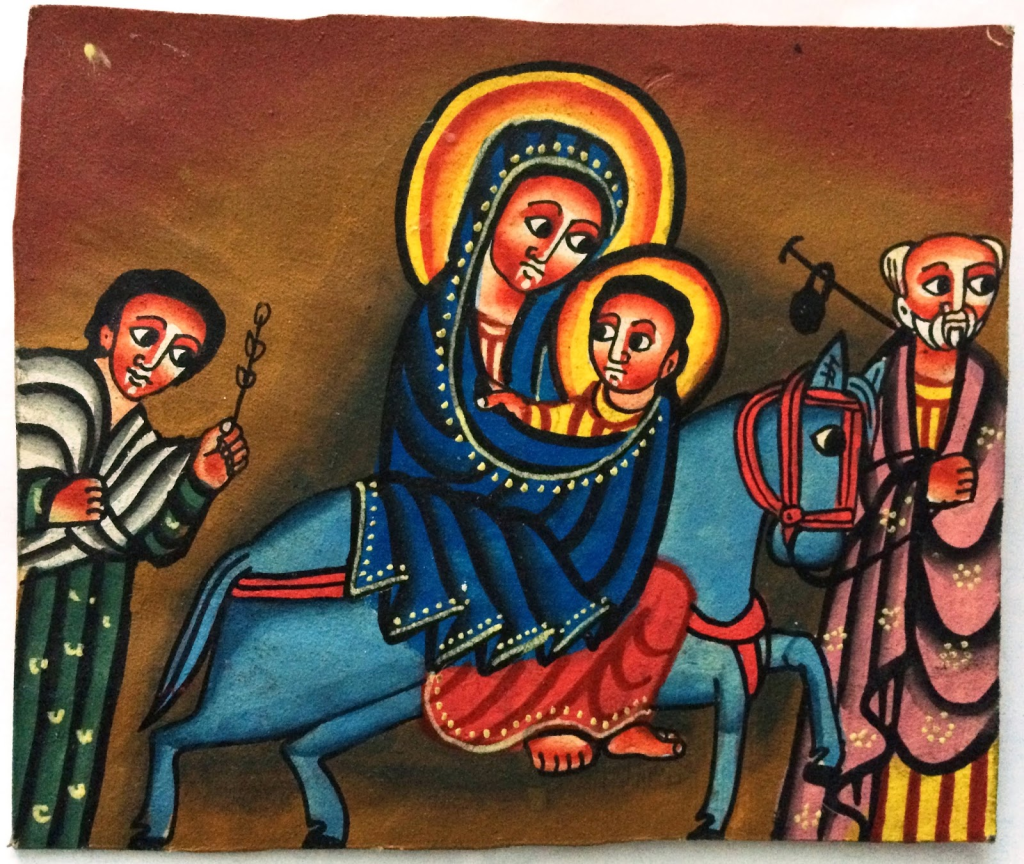
Ethiopian Orthodox icon of the holy family fleeing to Egypt

When we hold the pair of Testaments together in both hands, we feel the weight of Jesus as God’s divine Son; so therefore, Christ is the rightful Ruler in God’s kingdom.

Just as God preserved Israel from Pharaoh’s wrath, the Lord protected Jesus from Herod’s wrath. God’s kindness and loyalty extends to us as covenant people and preserves us from the wrath of the devil who seeks to keep as many people as possible in the realm of darkness.

Our hope is in the Lord Jesus, who conquered the devil by establishing a beachhead on this earth through an incarnation as the Son of God.

Jesus Brought Us Out of Exile

The scoundrel King Herod massacred innocent toddlers to ensure the destruction of Jesus. Behind his atrocity was the devil himself, who knew Jesus was the coming king who would one day bring salvation. Reflecting on a vision of Christ’s birth, the Apostle John identified the sinister plan and the divine deliverance:

The dragon stood in front of the woman who was about to give birth so that when she gave birth, he might devour her child. She gave birth to a son, a male child who is to rule all the nations with an iron rod. Her child was snatched up to God and his throne. (Revelation 12:4-5, CEB)

Satan wars against God’s Son and God’s people, whose roots go all the way back to the first prophecy of Christ after the Fall of humanity. God declared to Satan:

“And I will cause hostility between you and the woman,
    and between your offspring and her offspring.
He will strike your head,
    and you will strike his heel.” (Genesis 3:15, NLT)

There has been continual enmity ever since, between the serpent and the seed of the woman. It manifests itself with the Israelites constantly being threatened with extermination and tempted to conform to pagan ways.

King Herod was just another in a long line of demonically animated persons trying to perpetuate the kingdom of darkness. We must take this threat seriously because the devil knows that his time is short. A second Advent is coming which will be the final judgment.

Satan’s most powerful weapon, death, has lost its sting because of Jesus. Christmas is a hard time of year for many people, filled with depression instead of joy, grieving over lost loved ones for whom we will not spend another Christmas with.

Yet there is a reunion coming, the hope of a bodily resurrection in which we will be with Jesus and God’s people forever. Be encouraged to understand that there is no time in heaven; it will be only a moment and the people who have gone before us will turn around and see us; we will one day join them.

Matthew also used the prophet Jeremiah to communicate hope. Jeremiah’s prophecy dealt with children who were lost in war to the invading Babylonians. The prophecy is a lament with the hope that captivity will not be forever.

The disciple Matthew wanted us to see that the exile is over for us; Jesus has arrived, and the tears which were shed will shortly dry up. There may be a time of suffering we must endure, but there will be glory. Jesus is the Great Deliverer who brings us out of sin’s captivity and into the promises of God. He is our hope.

Jesus is the promised One who will deliver us from the tyranny of the devil. Christ is the hope of the nations, the Savior of the world. So, let us come back to the first Christmas which was the beginning of the end for evil on the earth.

Believers in Jesus are part of God’s victory, and they overcome the evil one by the blood of the lamb, acknowledging that Christ’s incarnation was essential for us. 

Just as Jesus made a radical break with his former life in heaven through the incarnation, we, too, must break with our old way of life.

God will save the people through this child Jesus. The greatest gift we can give in this season and throughout the coming year is the gift of grace, the presentation of the Christ child.

Loving God, help us remember the birth of Jesus so that we may share in the song of the angels, the gladness of the shepherds, and the wisdom of the wise men.

Close the door of hate and open the door of love across the world.

Let kindness come with every gift and good desires with every greeting.

Deliver us from evil through the blessing of the Christ child.

Teach us to be happy with pure hearts.

Grant us grateful thoughts, devoted hearts, and gracious hands, through Jesus our Savior in the might of the Holy Spirit. Amen.

Mary’s Magnificat (Luke 1:46b-55)

The Magnificat, a woodcut by Sr. Mary Grace Thul

Mary said,

“With all my heart I glorify the Lord!
    In the depths of who I am I rejoice in God my savior.
He has looked with favor on the low status of his servant.
    Look! From now on, everyone will consider me highly favored
        because the mighty one has done great things for me.
Holy is his name.
    He shows mercy to everyone,
        from one generation to the next,
        who honors him as God.
He has shown strength with his arm.
    He has scattered those with arrogant thoughts and proud inclinations.
    He has pulled the powerful down from their thrones
        and lifted up the lowly.
He has filled the hungry with good things
    and sent the rich away empty-handed.
He has come to the aid of his servant Israel,
        remembering his mercy,
    just as he promised to our ancestors,
        to Abraham and to Abraham’s descendants forever.” (Common English Bible)

Mary, the mother of Jesus, was able to wrap both her head and heart around an incredible reality – that God had done great things for her. And it was enough for her to erupt into a great song of praise. Indeed, the Lord shows mercy to everyone who worships and adores the mighty acts of God.

It strikes me that Mary, instead of being full of worry and afraid of the future, and as an unmarried teen with child, is full of the Spirit and faith. Mary neither complained nor fretted for the nine months of her pregnancy; she praised God and was clear-headed about the grace shown to her.

Mary’s canticle gives us insight into the mystery of the incarnation: God chooses the weak, those of low esteem, and the powerless. Mary was quite ordinary for her day. She had no wealth and nothing which would cause anyone to pick her out of a crowd.

Yet, Mary is the one chosen by God. And her wonderful response to grace demonstrated that there is so much more to any person than what we can see with our eyes and perceive through our earthly glasses of high positions and strength of personalities.

What’s more, Mary had the wisdom to discern that her situation typified the Lord’s egalitarian work of leveling the field so that all persons have what they need. Her son, the Messiah, would carry this into his own life and ministry – declaring good news to the poor, comforting the brokenhearted, proclaiming freedom for captives, telling those who mourn that the time of the Lord’s favor has come.

We may tend to think that the work of God is surprising, only because we might often experience so little of grace and mercy in this old world. But God is always full of grace, mercy, and power to those who are powerless and in need of help. The Lord has our backs. 

Perhaps if we all, both individually and corporately, continually used our words to identify and declare the great things God has done, we would then realize the consistent blessing of the Lord. 

I encourage you to take some time today and either journal and/or speak with another about the ways in which God has been good to you in this Advent season, and like Mary, offer praise for each act of mercy. Mary exhibited no helplessness but had her heart calibrated to detect the grace of God when it was present.

May the joy of the angels, the eagerness of the shepherds, the perseverance of the wise, the obedience of Joseph and Mary, and the peace of the Christ child be yours this Christmas. And may the blessing of God almighty – Father, Son, and Spirit – be among you and remain with you always. Amen.

You Have Found Favor with God (Luke 1:26-38)

The Annunciation, by Liviu Dumitrescu

Six months after Elizabeth had become pregnant, God sent the angel Gabriel to Nazareth, a city in Galilee. The angel went to a virgin promised in marriage to a descendant of David named Joseph. The virgin’s name was Mary.

When the angel entered her home, he greeted her and said, “You are favored by the Lord! The Lord is with you.”

She was startled by what the angel said and tried to figure out what this greeting meant.

The angel told her,

“Don’t be afraid, Mary. You have found favor  with God.

You will become pregnant, give birth to a son,
and name him Jesus.

He will be a great man
and will be called the Son of the Most High.
The Lord God will give him
the throne of his ancestor David.
Your son will be king of Jacob’s people forever,
and his kingdom will never end.”

Mary asked the angel, “How can this be? I’m a virgin.”

The angel answered her, “The Holy Spirit will come to you, and the power of the Most High will overshadow you. Therefore, the holy child developing inside you will be called the Son of God.

“Elizabeth, your relative, is six months pregnant with a son in her old age. People said she couldn’t have a child. But nothing is impossible for God.”

Mary answered, “I am the Lord’s servant. Let everything you’ve said happen to me.”

Then the angel left her. (God’s Word Translation)

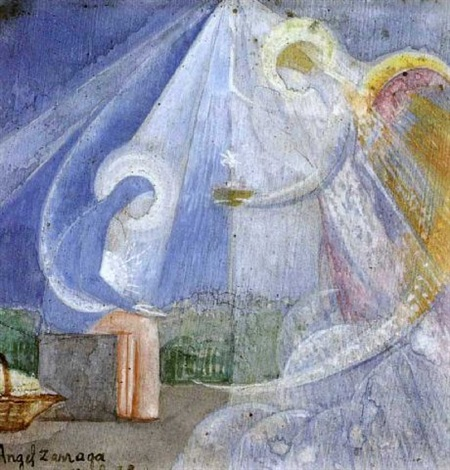
The Annunciation, by Angel Zárraga

Most of life is lived in the mundane. For the most part, we go about our business and deal with the daily grind.  That’s because we are common ordinary people.

So, we can especially relate to Mary. She is rather plain. Mary is of junior high age. If she were living in our day and age, Mary would likely be wearing clothes from the local Goodwill. She cannot read, because girls of her day rarely did.

Mary’s parents make all the decisions that affect her life, including the one that she should be married to an older man named Joseph. We don’t know if she even liked him. She lives in a small town that most people can’t even point to on a map. 

One night, this young girl is visited by the brightly beaming divine messenger Gabriel, whose name means, “God has shown himself mighty.” Mary stands there in her flannel nightgown; her life very quickly moving from the ordinary to extraordinary. The juxtaposition could not be more pronounced:

  • a mighty angel and a plain teen-ager
  • a messenger of the Most High God and a girl barely past puberty
  • holy angelic light in a simple candlelit bedroom
  • awesome power and complete vulnerability

Mary, compared to Gabriel, is defenseless, fragile, and overwhelmed. She’s in over her head. And that’s why we can relate to her. We can get our human arms around Mary. She’s like us. She has faced life with little power to make it turn out the way she planned. Forces beyond her control have rearranged her life and altered it forever. Mary is the Matron Saint of the Ordinary. We can totally understand why she responds the way she does.

Young Mary’s initial reaction was to be greatly troubled. She was disturbed, and was shaking in her ratty old slippers. The angel confidently told Mary that she had found favor with God. In other words Mary was quite literally “graced” by God. 

The situation was not that Mary had some extreme spirituality; but rather that God simply chose her to be the mother of Jesus. 

And Mary needed to come to grips with what was happening to her. This was not what she was looking for.  Becoming pregnant with the Savior of the world was not an answer to prayer for Mary. This was not on her agenda. 

Mary immediately sensed the crazy disconnect between what was being told to her and who she was. After all, she was a plain ordinary girl from the hick town of Nazareth, and she was being told that she would raise a king.  Maybe somebody in heaven screwed up. It could very well be that Gabriel got the wrong girl. Perhaps the angel’s Google map popped up the wrong town to visit. 

Relating to Mary, we can totally understand that she would question how in the world all this was going to happen. Not only is Mary ordinary, and far from royalty, but she is also very much a virgin. None of this made any sense whatsoever.

But the angel lets Mary know that God specializes in the impossible. I understand why many English translators chose to phrase the original rendering as “for nothing is impossible with God.” But I rather like a more literal translation which is “for there is nothing outside of God’s power.” 

There is nowhere we can go, no place on earth, no situation whatsoever that is beyond God’s ability, reach, and power to effect the divine will.

We do not always get straightforward answers to our questions about God. Yet, Mary asked a question and got a straight answer. She really can be pregnant with Jesus because the Holy Spirit will come upon her and overshadow her with power. 

If the story were to end here it would be a great story.  But to me the most astonishing part of this narrative is Mary’s response to what was happening to her.

Mary believed the message and took Gabriel’s words at face value. And so, having believed, she then submitted herself completely to God’s will for her life. 

I think we might totally understand if Mary simply said in her ordinary way that she was not prepared for this.  We would completely “get it” if Mary pushed back on what the angel said to her.

We could relate if Mary just dismissed it all, like Scrooge in the Christmas Carol, with the angel and his message being all humbug as if it were just “an undigested bit of beef, a blot of mustard, a crumb of cheese, a fragment of an underdone potato.  There’s more of gravy than of grave about you, whatever you are!”

And yet, Mary not only believed, but she also humbly submitted herself to what was happening. And, to me, this is what we need to relate to most about Mary – not her being just a plain ordinary person in a non-descript village, but stepping up to the calling she received. 

We, too, have received a calling in our lives. We, too, have been given the power of the Holy Spirit. And we, too, are ordinary people who have been given a very extraordinary task. 

It seems to me that our response today can and ought to be the same as Mary: “I am the Lord’s servant; may it be to me as you have said.” 

The Church is pregnant with possibilities because of the Holy Spirit. We know the end of Mary’s story. She gave birth to Jesus. She raised him in her plain ordinary way. She watched him grow up. She saw him embark on his ministry to proclaim that the kingdom of God has come near. 

Mary did not always understand what Jesus said or what he was doing. And she experienced every mother’s nightmare: seeing her beloved son killed in a terribly gruesome manner right in front of her eyes. 

Yet, just as the Holy Spirit was with the birth of Jesus, so the Spirit was with Jesus at his resurrection from the dead. Jesus, like his earthly mother, lived an ordinary life in a very extraordinary way. And today Jesus invites us to do the same. 

Because Jesus accomplished his mission of saving people from their sins and establishing a kingdom that will never end, he has given us the same Holy Spirit to follow him forever and call other people to follow him, too. 

The Christian life may often be difficult; but it is really not complicated. It’s rather simple, just like Mary. 

Mary responded to God’s revelation with faith, choosing to fully participate in what God was doing. “I am the Lord’s servant” is to be our confession, as well. “May it be to me as you have said” is to be our cry, along with Mary. 

The message Christians proclaim is that Jesus saves – he delivers from sin and Satan and will restore all things.

May you know the presence and the power of God today and always, through knowing Christ Jesus the Lord of all. Amen.

Mercy, Not Sacrifice (Hosea 6:1-6)

“Come, let us return to the Lord,
    for it is he who has torn, and he will heal us;
    he has struck down, and he will bind us up.
After two days he will revive us;
    on the third day he will raise us up,
    that we may live before him.
Let us know, let us press on to know the Lord;
    his appearing is as sure as the dawn;
he will come to us like the showers,
    like the spring rains that water the earth.”

What shall I do with you, O Ephraim?
    What shall I do with you, O Judah?
Your love is like a morning cloud,
    like the dew that goes away early.
Therefore I have hewn them by the prophets;
    I have killed them by the words of my mouth,
    and my judgment goes forth as the light.
For I desire steadfast love and not sacrifice,
    the knowledge of God rather than burnt offerings. (New Revised Standard Version)

My favorite word in all of Holy Scripture is the Hebrew word chesed (חֶסֶד pronounced “hes-ed” with a guttural sound on the “h”). It’s such a rich word that no single English word can capture its depth. 

So, chesed is translated in various ways across the English translations of the Bible as “mercy,” “grace,” “steadfast love,” “covenant loyalty,” “kindness,” “compassion,” and more. It’s no wonder, then, that since chesed marks the character and activity of God, the Lord very much desires people to reflect this same stance toward others. 

In today’s Old Testament lesson, God was calling and wooing wayward people to return to a divine life of closeness with the Lord. God demonstrated chesed by not putting the people away, like a spouse outright divorcing an unfaithful partner. But instead, God committed to loving the Israelites even when they were unlovely.

At all times, the response God wants is not simply going through the motions of outward worship. Ritual practices mean little if there is no heart behind them. The Lord longs for people to demonstrate both fidelity and fealty through mercy and a steadfast love to God and neighbor. Both our work and our worship are to be infused with divine mercy. 

God deeply desires a close relationship with humanity and is profoundly pained when people seek after other gods to meet their needs and to love them. Hosea’s prophecy is an impassioned plea for all persons to find their true fulfillment and enjoyment in a committed loving divine/human union, just like a marriage.

In Christian readings of Hosea’s prophecy, repentance means accepting God’s chesed through Jesus Christ. The believer is to allow the character of God to rule and reign in their heart so that commitment comes flowing out in loving words, actions, thoughts, and dispositions. Mercy finds its highest expression in the person and work of Jesus. Thus, Advent is a season of anticipating the great love and mercy of God through the incarnation of Christ.

It, therefore, ought to be no surprise that Jesus lifted Hosea’s prophecy as a treasured principle of operation when asked why he deliberately made connections with “questionable” people:

While Jesus was having dinner at Matthew’s house, many tax collectors and sinners came and ate with him and his disciples. When the Pharisees saw this, they asked his disciples, “Why does your teacher eat with tax collectors and sinners?” On hearing this, Jesus said, “It is not the healthy who need a doctor, but the sick. But go and learn what this means: ‘I desire mercy, not sacrifice.’ For I have not come to call the righteous, but sinners.” (Matthew 9:10-12, NIV)

And when confronted about “questionable” activities Jesus appealed to the same source of Hosea’s prophecy:

“Look! Your disciples are doing what is unlawful on the Sabbath.” Jesus answered, “Haven’t you read what David did when he and his companions were hungry? He entered the house of God, and he and his companions ate the consecrated bread—which was not lawful for them to do, but only for the priests. Or haven’t you read in the Law that the priests on Sabbath duty in the temple desecrate the Sabbath and yet are innocent? I tell you that something greater than the temple is here. If you had known what these words mean, ‘I desire mercy, not sacrifice,’ you would not have condemned the innocent.” (Matthew 12:2-7, NIV)

One can never go wrong with mercy and grace. If in doubt between whether to judge another or show mercy, the Christian’s choice is clear. Grace and love create connections – reconnecting the disconnected. The heart of true Christian spirituality is a deep kinship with the divine. Whenever that relation is broken or severed, it is vital to restore it. The means of doing so is not judgment but mercy.

Chesed is more than a word; it is a way of life. God wants mercy. Grace is the Lord’s divine will.

So, let us today receive the forgiveness of Jesus and devote ourselves to prayer and works of love which come from a heart profoundly touched by grace. May the result be healing of that which has been broken, and reconciled relationships with others.

Merciful and loving God, the One who shows amazing grace, forgive us for our wanderings away from the divine life. Return us, again, to the grace of Jesus Christ our Savior so that our hearts will be renewed and aflame with love for others. In the Name of the Father, Son, and Spirit, the Great Three in One. Amen.