Pray and Give Thanks (1 Timothy 2:1-7)

First of all, then, I urge that supplications, prayers, intercessions, and thanksgivings be made for everyone, for kings and all who are in high positions, so that we may lead a quiet and peaceable life in all godliness and dignity. This is right and acceptable before God our Savior, who desires everyone to be saved and to come to the knowledge of the truth. For

there is one God;
    there is also one mediator between God and humankind,
Christ Jesus, himself human,
    who gave himself a ransom for all

—this was attested at the right time. For this I was appointed a herald and an apostle (I am telling the truth; I am not lying), a teacher of the gentiles in faith and truth. (New Revised Standard Version)

In our extreme busyness, do any of us stop long enough to consider what is of upmost importance in our lives? Or do we scurry about, not considering why we fill every minute of the day with constant motion and activities which – if we are honest – only frustrate us?

Whether we know anything about William Shakespeare’s tragic play, Hamlet, or not, many a person lives out his centuries old words:

Life’s but a walking shadow, a poor player,

That struts and frets his hour upon the stage,

And then is heard no more. It is a tale

Told by an idiot, full of sound and fury,

Signifying nothing.

Writing to Timothy, a new and young pastoral leader of the Ephesian Church, the Apostle Paul made it clear what is, above all, the activity which the church and all believers in Jesus are to engage in: prayer.

Perhaps that sounds too trite or simple. Yet, there is really nothing easy about prayer. To pray is more like heading out on a wrestling mat with the Incredible Hulk. This is going to take some serious work.

The most important activity we can do is to keep persevering in prayer, never giving up, but continually getting back out there on the wrestling mat of prayer and putting all of your energy into it.

Everyone in leadership must be prayed for. Yes, each person who leads needs our prayers, without exception.

Christians are to be, first and foremost, people of prayer. And those prayers are to be for all sorts of various situations, and for all sorts of persons.

We are to pray for specific needs; general circumstances and situations; urgent and emergent requests; and, as the capstone to all prayer, expressions of thanksgiving and gratitude are most needed.

A weak and ineffective prayer is one that gives no thanks to God, nor offers gratitude to God for anyone.

Conversely, however, prayer filled with power and effectiveness is stuffed with thanksgiving to God, and liberally offers thanks to God for everyone, including the ones we don’t much care about.

Specifically, whenever we fail to pray for, and give thanks for, the very people we don’t much like, and would rather not pray for, at all, then we ought not expect any of our prayers to be heard nor answered by the God who is concerned for every human being on the face of this planet.

For the Christian, prayer is never optional nor merely occasional; prayer is necessary and vital, all the time. And prayer is a close relative to thanksgiving.

Pray in the Spirit at all times in every prayer and supplication. To that end, keep alert and always persevere in supplication for all the saints.

Ephesians 6:18, NRSV

Do not be anxious about anything, but in everything by prayer and supplication with thanksgiving let your requests be made known to God. (Philippians 4:6, NRSV)

In the ancient world of Paul and Timothy, much like our present contemporary world, prayers are needed so that we can live peaceably, with godliness and dignity.

We need religious tolerance and political stability, guaranteed by people in leadership positions. We need God’s sovereign and gracious enablement and direction of world leaders, so that God’s benevolent kingdom will come, and God’s ethical will be done, here on this earth, as it is always done in God’s heaven.

Christians recognize one God. The ancient Romans acknowledged many gods. In fact, veneration of the Roman Emperor as a god began after the assassination of Julius Ceasar in 27 B.C.E. He was proclaimed as divine, and added to the official pantheon of state gods in the Empire. Praying to divinized Ceasars became a real thing in the Roman world.

Paul clearly instructed Timothy to pray for Kings and Caesars, and not to them. Just like everyone else, rulers are dependent upon the mercy of God. Leaders are mortal, not divine; and ought never to be treated like gods.

So, when the Apostle stated that there is one God and one Mediator between God and humanity, he was clearly saying that Christ is King, and Ceasar is not. This was subversive language, at the time, and could get a Christian into some serious trouble.

For us today, it may seem silly to worship a ruler. Yet, we in our contemporary culture have a definite bent toward divinizing particular celebrities, politicians, sports icons, and music and movie stars. Some of what folks do certainly looks like worship of famous persons.

All of the celebrities of this world need God, and need our prayers for them (and not to them!) as people, like us, requiring deliverance from guilt and shame, just like we do.

I am a Calvinist, a person who holds to a Christian tradition from the Reformer John Calvin. I have encountered many people who believe that Calvinism is determinism, as if people are wholly bad, and cannot make choices because everything is already predetermined.

A Reformed Christian tradition simply places emphasis where (we believe) emphasis is due: upon God, and God’s sovereign decrees, commands, will, and decisions. Because ultimately, everything comes down to God, not us.

We worship God, not our choices, or anyone else’s. Before we ever chose God, God chose us.

Everyone needs deliverance, but not everyone receives it. The Reformed concept of “limited atonement” simply recognizes that not everyone will be redeemed. The atonement of Christ is unlimited in its scope for all people, but limited in its application to some persons.

The heart of God is that everyone would be saved and come to a knowledge of the truth. Yet, not everyone experiences this.

This, in no way, flies in the face of a Christian theological tradition like Calvinism. A human judge may pronounce a severe sentence upon the accused; but that does not necessarily mean that the judge desires it, or enjoys putting someone away.

Jesus, the Son of God, and Son of Humanity, gave himself as a ransom for all. This assumes we all carry a significant debt that cannot simply be canceled; it must be reckoned with and redeemed.

Statue of Christ the Redeemer, Rio de Janeiro, Brazil

Spiritual captives need freedom. Spiritual debtors need redemption. The spiritually oppressed need a champion, a warrior. Spiritual slaves need someone to pay for their release from bondage.

The death of Christ is the atoning act which provides new life for humanity. An existential exchange happened, in which Jesus vicariously took our place, and released us from the power of sin, death, and hell.

This is the good news which Christianity proclaims: In Jesus Christ, we are forgiven, and are now free to live a good, right, and just life. There is now nothing hindering our prayers. We have full access to God through Christ.

Thus, we are to use this incredible privilege of accessibility by praying to God on behalf of everyone; and giving thanks for all things, especially the deliverance which has been secured for us.

There are quite enough grumpy curmudgeons in this world. We don’t need any more of them. What we do need, and can never get enough of, are people who have heartfelt thanksgiving – and are grateful for both the good and the bad; those they don’t like, as well as the people they do like; those in an opposing political party, along with their own; their enemies, and their friends.

The good news of Jesus changes us to be people who exist in the world for good; and not for ill. And those who insist on hate speech and hateful actions, are evidencing that they are not people of prayer, and are ingrates who do not know God.

They shall find out the hard way that there is no unlimited atonement.

The Gospel is not a tale told by an idiot.

Lord Jesus Christ, Son of God, have mercy on me, a sinner.

Christ, have mercy, and grant me your peace. Amen.

Whoever Believes (John 3:14-21)

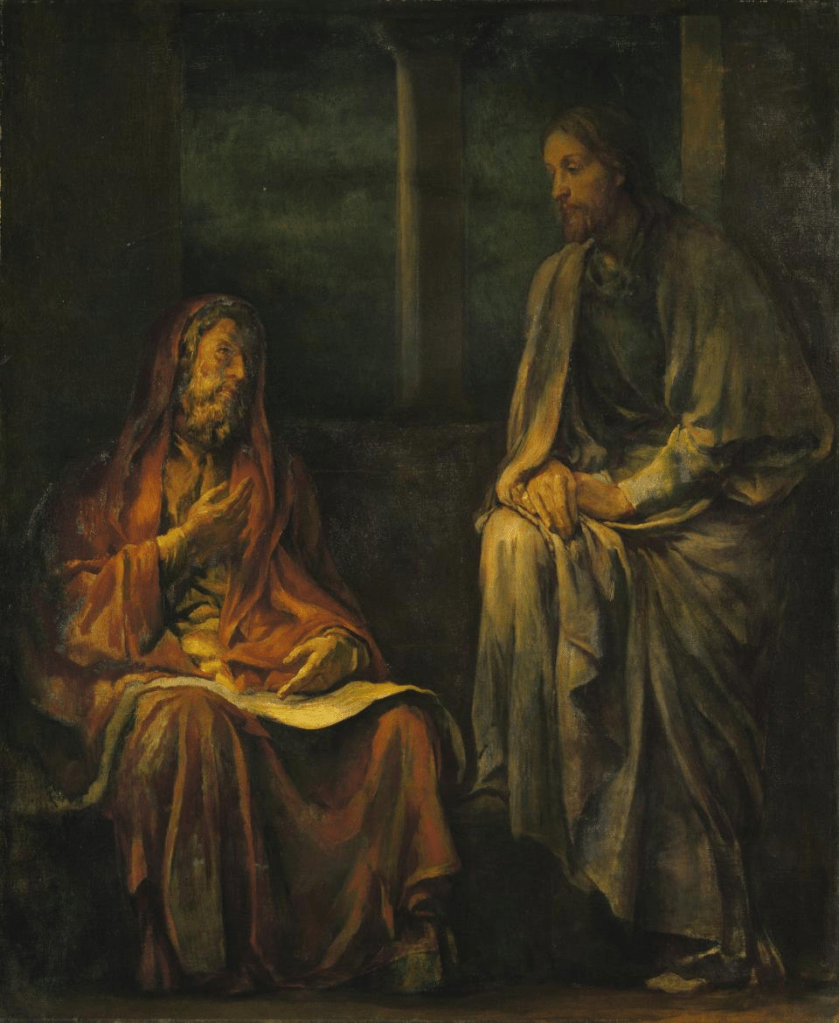
Interview Between Jesus and Nicodemus, by James Tissot (1836-1902)

Just as Moses lifted up the snake in the wilderness, so the Son of Man must be lifted up,that everyone who believes may have eternal life in him.”

For God so loved the world that he gave his one and only Son, that whoever believes in him shall not perish but have eternal life. For God did not send his Son into the world to condemn the world, but to save the world through him. Whoever believes in him is not condemned, but whoever does not believe stands condemned already because they have not believed in the name of God’s one and only Son. 

This is the verdict: Light has come into the world, but people loved darkness instead of light because their deeds were evil. Everyone who does evil hates the light, and will not come into the light for fear that their deeds will be exposed. But whoever lives by the truth comes into the light, so that it may be seen plainly that what they have done has been done in the sight of God. (New International Version)

For many, the truth about God’s purposes in Christ is confusing, even troubling. It was for Nicodemus. And even though there many today who simplify the exchange between Jesus and Nicodemus with a single Bible verse of John 3:16, taking a good look at the Gospel of John puts most of us with Nicodemus.

Nicodemus, a learned Jewish scholar, a Pharisee, found Christ’s words both confusing and troubling because it required him to let go of everything he understood – to let go and become like a newborn baby, receiving and discovering the world on new and different terms. In other words, Nicodemus had to unlearn some things before he could learn truth.

There are some things that are hard to grasp, not because they are so intellectually challenging, but because those things ask a lot of us, demanding our very lives. And so, we don’t so much want to understand; it would require a radical change.

But why would anyone not want to understand the good news that God so loved the world that gave the Son so that we may believe and have eternal life? Because we would then have to contend with the ways Jesus describes himself.

Jesus likened himself to the serpent that Moses lifted up in the desert (John 3:14; Numbers 21:4-9). In that story of Moses in the Old Testament book of Numbers, God sent poisonous snakes into the Israelite camp as punishment for the people’s incessant complaining against God.

Then, when the people repented, God told Moses to make a bronze snake, put it on a pole, and lift it up, so that anyone bitten by one of the poisonous snakes could see it and live. Jesus likened himself to the story. In the same way the bronze snake was lifted on a pole, Jesus explained that so must the Son of Man be lifted up, or exalted high above the people.

Visit of Nicodemus to Christ, by John La Farge, 1880

In the typical language of the Apostle John, using double meanings to a single concept, he meant to communicate that Jesus would be physically lifted onto the cross, above the people; and also that Jesus would be lifted up by God as the exalted One above all creation. (John 8:28; 12:32)

Just as the ancient Israelites were facing death because of their sin, and deliverance because of God’s action through Moses, so people everywhere in every age face the consequences of their sinful complaining; yet through the action of God through Christ’s crucifixion, resurrection and ascension, they can look up to the exalted and glorified Lord and receive deliverance from sin, death, and hell.

There is more to looking up at the lifted One than a mere incline of the head and eyes. In modern terms, we would refer to the sheer action of looking as an intellectual assent to faith. The Apostle John, however, means to have us believe, not simply acknowledge.

Jesus did not tell Nicodemus to simply acknowledge him as Savior, to accept him into the heart, and so, be saved. No, this was an encounter that left an intelligent man and an accomplished scholar scratching his head in bewilderment as he went back out into the darkness.

Today’s Gospel lesson is a story about how any one of us might reject the light offered to us because of the way it exposes what is dark within us. Therefore, to believe requires ultimate trust in another. It isn’t to acknowledge that Jesus was real and had an actual ministry on earth; it’s more than believing something happened in history in the ancient world of the first century.

To believe is to let our own lives be transformed by the Jesus we encounter in this story. And here is what that means:

  1. Realizing and becoming aware of the ways we are complicit in and benefit from having our loyalties elsewhere, other than Jesus. To believe demands us answering the question: Whom shall you serve?
  2. Placing our ultimate trust, allegiance, and loyalty in Jesus Christ. To believe begs the question: To whom will you commit all that you have, and all that you are?
  3. Forsaking all other competing loyalties and “gods,” including both secular and religious deities. To believe means a single-minded devotion, which asks of us all: To whom and to what will you forsake in order to embrace Jesus?
  4. Confronting inconvenient truths of our own personal values which clash with Christ’s ideals of righteousness. To believe presses us to answer the question: To whom and for what are you truly living for?
  5. Willing to die to self and to anything that would hinder knowing Jesus and him crucified, risen, ascended, and coming again. To believe forces us to ask ourselves: Am I willing to die for Jesus?

While there is nothing in this world worth killing for, there are things worth dying for. The lifting up of Jesus lets us know that the true life God has promised us is not the life that we can secure for ourselves through self-interest, caution, and theological debate.

Most merciful God,
we confess that we have sinned against you
in thought, word, and deed,
by what we have done,
and by what we have left undone.
We have not loved you with our whole heart;
we have not loved our neighbors as ourselves.
We are truly sorry and we humbly repent.
For the sake of your Son Jesus Christ,
have mercy on us and forgive us;
that we may delight in your will,
and walk in your ways,
to the glory of your Name. Amen.

Speak the Good Word (2 Timothy 4:1-5)

St. Paul the Apostle, Unknown artist

I’m giving you this commission in the presence of God and of Christ Jesus, who is coming to judge the living and the dead, and by his appearance and his kingdom. Preach the word. Be ready to do it whether it is convenient or inconvenient. Correct, confront, and encourage with patience and instruction. 

There will come a time when people will not tolerate sound teaching. They will collect teachers who say what they want to hear because they are self-centered. They will turn their back on the truth and turn to myths. But you must keep control of yourself in all circumstances. Endure suffering, do the work of a preacher of the good news, and carry out your service fully. (Common English Bible)

This letter from the Apostle Paul to Pastor Timothy was the last writing he ever crafted. Soon after sending this, according to historical tradition, Paul was martyred for his faith in the city of Rome, having been imprisoned there for two years. The letter contains some final words the Apostle wanted his young protégé to know that were important to him.

Paul left Timothy with a sacred charge to proclaim the gracious message of God – no matter the time nor circumstance – with all the divine patience and spiritual exhortation that the Lord gives.

A Word of Christ

The simple commission of Paul was to preach the word, proclaim the message, spread the good news. Paul called on Timothy to speak the word that God has spoken – the word passed on to him, first through his devout mother, then from his mentor, and finally from all the apostles. It’s a unified message of sound teaching concerning the person and work of Jesus Christ – God-breathed and committed to all God’s people who respond to the message in faith.

The responsibility is to not only hear the message, obey it, and guard it’s truth; the charge is to speak, to lift one’s voice and proclaim the message with confidence and without fear – because it is always open season on the proclamation of the gospel.

I don’t know what sort of picture this evokes for you to “preach the word.” Maybe you envision a preacher behind a pulpit in a church; or a guy with a bullhorn on a street corner; or an obnoxious coworker who takes any opportunity to puke the gospel onto another person; or some other picture which may be foreign to you.

Paul preaches in Athens, Unknown artist, 19th century

Please let me assure you that the Apostle Paul was not talking about any of those sorts of scenarios. The image is one of letting out something which is already inside of you, burning to come out and be heard.

It is to be so full of the life of Christ, that the words which come out of you are filled with that very life – a message of grace, redemption, hope, forgiveness, and love. And communicated in a way that also reflects the person of Jesus – an affect, gestures, posture, and tone of voice that resonates with another and is winsome, not annoying.

A Relevant Word

The person who proclaims the message of Christ does so in order to convince, encourage, rebuke, inform, and love. The messenger tells what another needs to hear, and not necessarily what they want to hear. This is a word that speaks to anyone in any situation within any sort of context or culture.

To speak with relevance in no way waters down the message of Christ. Rather, it means that the speaker takes great pains to talk in such a way as to help another in their own circumstance. Utilizing the mind and emotions, as well as the spirit, the preacher presents ideas, ethics, and feelings in order to announce good news.

And we are to always be patient with others. One must never resort to pressurized sales tactics to force another into the kingdom of God. The Word of God is a gracious message that provides life; and is not a big thick Bible that is used to smack somebody upside the head with condemnation.

Our responsibility is to be faithful in handling the message and proclaiming it with mercy. It is the Holy Spirit’s job to woo people to Jesus and purify them.

Don’t throw all over somebody a bucket of judgment, as if you are acting for God. Impatience, impertinence, impoliteness, and being impetuous, all belong to the devil’s imps, and have nothing to do with announcing good news of great joy for all the people.

An Uncompromising Word

Timothy lived in a society that was difficult in proclaiming the message of Jesus Christ. He lived in a city that had a grand temple to the goddess Artemis. He walked around seeing unethical practices and dubious living. Any of us would likely understand if Timothy shrunk back from having a bold proclamation of Christianity.

Paul speaking in the synagogue, a 12th century Byzantine mosaic

But the Apostle Paul was calling Timothy to preach good news without shrinking or shirking the message. One might be tempted to simply tell others what they’d like to hear and not stir the pot and cause any sort of conflict. Not everyone wants to hear the truth. For everyone who genuinely responds to a truthful and merciful message, there are four more persons who want none of it. They want what they want, and if someone says different, they’ll make their life hell.

These are the conspiracy theorists who would rather entertain spicy nuggets of opinion and speculation, than listen to evidence-based research and professionally peer reviewed material. They ground their ideas according to subjective taste and forsake objective documentation and witness.

Paul did not want Timothy coddling such persons or giving into them in any form whatsoever, because they have a severe hearing problem. People who won’t listen, constantly interrupt others, and believe they are always right, need a good dose of the uncompromising word of Christ.

In the face of those who refuse to listen and use their ears for good, Timothy was exhorted by Paul to be a steady teacher who keeps presenting the truth in intellectually and emotionally responsible ways. Timothy may have to endure suffering and put up with a bunch of simpletons giving him a hard time, but he was never to back down from sound and solid apostolic teaching.

It’s important that we all maintain a sense of emotional calm and intellectual soundness amidst all the crud within a given society. The believer is to avoid a discouragement that leads to abject silence.

Let us not be deterred from saying and doing what is right, just, and good. And let’s make sure that in the words we say and the behavior we display, there is the very life of Jesus Christ oozing out of us.

There are more than enough bad words being spoken every day; let’s instead speak the good word, full of grace and truth.

Soli Deo Gloria

Epiphany of the Lord (Isaiah 60:1-6)

Adoration of the Magi, Basilica of the National Shrine of the Immaculate Conception, Washington D.C.

“Arise, shine, for your light has come,
    and the glory of the Lord rises upon you.
See, darkness covers the earth
    and thick darkness is over the peoples,
but the Lord rises upon you
    and his glory appears over you.
Nations will come to your light,
    and kings to the brightness of your dawn.

“Lift up your eyes and look about you:
    All assemble and come to you;
your sons come from afar,
    and your daughters are carried on the hip.
Then you will look and be radiant,
    your heart will throb and swell with joy;
the wealth on the seas will be brought to you,
    to you the riches of the nations will come.
Herds of camels will cover your land,
    young camels of Midian and Ephah.
And all from Sheba will come,
    bearing gold and incense
    and proclaiming the praise of the Lord. (New International Version)

We are drawn to light. I don’t know if you have ever been in a situation with complete darkness surrounding you. When things are totally dark, we begin to fear and panic.

I grew up in a rural area in which there were no lights at night, other than the moon and the stars. More than once, I got myself into a situation, when the sky was overcast, in which I didn’t have a flashlight and could not see my hand in front of my face. I was groping to discern any little bit of light that I could see. Without the light, I was lost.

Our souls are also drawn to light. We no longer want to have darkness enveloping us; we cannot live with the darkness residing within our hearts. This is one reason why the Magi were attentive to the bright star over Bethlehem, and traveled toward it. We have a need for light because nobody can abide in darkness for too long.

The glory of the Lord is associated with bright light. Spiritually, we can find ourselves in such darkness that it’s impossible to discover light, unless God shows up displaying divine mercy and glory.

The Christian season of Epiphany has to do with this divine light. Each year on January 6, on the Church Calendar, and after the twelve days of Christmas, is the celebration of Epiphany. 

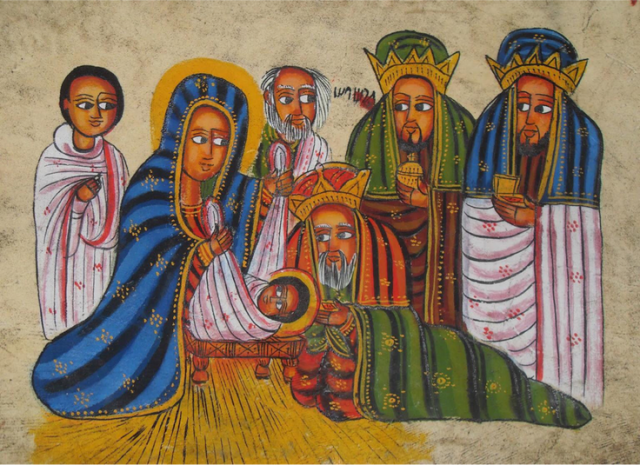
The Three Kings, Ethiopian Orthodox Church

It is a celebration of light – that Christ came to this earth as a child and became like us. Epiphany helps to bring a vision and understanding of God’s glory to all kinds of people in the world.

“Epiphany” literally means “manifestation” or “appearance.” The event most closely associated with this season is the visit of the Magi to Jesus. Included in this time of the year between the seasons of Christmas and Lent is a special emphasis on the teaching and healing ministry of Jesus. 

The people walking in darkness
    have seen a great light;
on those living in the land of deep darkness
    a light has dawned. (Isaiah 9:2; Matthew 4:16, NIV)

The great celebration and focus of these weeks is that salvation is not limited to Israel but extends to the Gentiles, as well.

“I will also make you a light for the Gentiles, that my salvation may reach to the ends of the earth.” (Isaiah 49:6; Luke 2:32; Acts 13:47, NIV)

In this season of Epiphany, the manifestation of God’s grace is one of the most scandalous truths of Christianity: God graces common ordinary people, who seem far from God, with the gift of Jesus. 

God grants repentance that leads to life for all kinds of people, no matter what their race, ethnicity, class, or background. It is a wondrous and astounding spiritual truth that God’s merciful concern is not limited to a certain type of person or a particular group of people.

Grace is (and ought to be) the guiding factor in how we interact with people. 

Losing sight of grace leads to being critical and defensive. Like King Herod of old, a graceless person becomes enamored with earthly power and control. But embracing grace, leads to humility, so that we see the image of God in people very different from ourselves. 

Like the Apostle Peter, who learned in a vision to bring the gospel to non-Jews, old legalisms begin to wear away so that people from all walks of life can have access to Jesus and his gracious saving and healing ministry. 

Grace brings down barriers and causes us to do away with unnecessary distinctions between others. And so, the appropriate response to such a grace is to glorify God for this marvelous and amazing work.

It is a gracious and merciful reality that the Magi, or Wise Men, who were really pagan astrologers, were directed to the Messiah. A light was provided to lead them to Jesus. Apart from God’s care and intervention they would have remained in darkness. 

And it is no less true for people today. This old broken world has a lot of shadowy places to it; there is darkness all around.  All kinds of people have no light at the end of the tunnel of their lives for hope and new life. But the gospel of Jesus Christ brings that light to those walking around with no ability to see. And Jesus exhorted his followers to be the reflectors of divine light for the world.

“Let your light shine before others, that they may see your good deeds and glorify your Father in heaven.”

Jesus (Matthew 5:16, NIV)

Sometimes, maybe oftentimes, the best way to bring resolution to our own troubles and problems is through helping others make sense of their lives through the gracious light of Christ so that they can see an appearance, an epiphany, of what their lives can be in the gracious rule of the kingdom of God. 

As we celebrate Epiphany and journey with Jesus through his earthly upbringing and into his gracious ministry to people, let us keep vigilance to not let our light grow dim. Instead, let us hunger and thirst after Christ’s righteousness so that our joy is full and our light is bright.

God of radiant light, your love illumines our hopes before we know them, and our needs before we ask. Kindle your flame within us, that in our prayers and service, we may know your transforming presence at work in the world around us. All this we ask through Jesus Christ, our Lord. Amen.