Keep On Praying For What’s Important (Romans 15:22-33)

Together We Pray, by Jerome White

This is why I have often been hindered from coming to you.

But now that there is no more place for me to work in these regions, and since I have been longing for many years to visit you, I plan to do so when I go to Spain. I hope to see you while passing through and to have you assist me on my journey there, after I have enjoyed your company for a while. 

Now, however, I am on my way to Jerusalem in the service of the Lord’s people there. For Macedonia and Achaia were pleased to make a contribution for the poor among the Lord’s people in Jerusalem. They were pleased to do it, and indeed they owe it to them. For if the Gentiles have shared in the Jews’ spiritual blessings, they owe it to the Jews to share with them their material blessings. 

So after I have completed this task and have made sure that they have received this contribution, I will go to Spain and visit you on the way. I know that when I come to you, I will come in the full measure of the blessing of Christ.

I urge you, brothers and sisters, by our Lord Jesus Christ and by the love of the Spirit, to join me in my struggle by praying to God for me. Pray that I may be kept safe from the unbelievers in Judea and that the contribution I take to Jerusalem may be favorably received by the Lord’s people there, so that I may come to you with joy, by God’s will, and in your company be refreshed. The God of peace be with you all. Amen. (New International Version)

Paul’s Intentions

It always had been the Apostle Paul’s intention to preach Christ in places where the name of Jesus was not known. He wanted all people everywhere to hear the good news of grace, forgiveness, and new life in Jesus Christ as the fulfillment of all God’s good promises.

Paul wrote a rather complicated historical and theological letter to the Roman Church. He specifically addressed their situation of both Jew and Gentile Christians worshiping together in one church. They were often divided and critical of one another.

Throughout his letter, the Apostle provided a solid apologetic for staying together on clear biblical and theological grounds. Paul also wanted them to work side-by-side in practical matters of ministry, which would help them learn to appreciate each other.

So, Paul intended on visiting them – hopefully sooner than later – to encourage them in the faith, and as a stop on the way to Spain. He longed to get to the farthest geographic point of the continent and make Christ known.

To that end, Paul made a concluding personal statement and emotional appeal to the entire Roman Church – Jew and Gentile alike – for their abiding prayerful support of his ministry and intentions.

Paul’s Prayer

For Paul, and from a New Testament perspective, prayer is the most necessary activity a believer can do. Prayer connects the divine and the human in meaningful dialogue, as well as connecting people to each other in a common purpose of seeking the Lord and knowing Christ.

The Apostle practiced what he preached. Paul continually prayed for the Roman Church and wrestled in prayer for all the believers. (Romans 1:9-12)

He specifically asked the believers to pray that he be rescued from unbelievers; and that his ministry in Jerusalem might be good and acceptable to the believers in that place. Paul took great pains to gather a collection throughout many of the churches he established, so that he could bless the needy persons in Judea.

Paul’s Longing

The Apostle Paul constantly sought and worked toward solidarity between the Christian Jews and converted Christian Gentiles. They were ancient enemies, and at the time of Paul’s writing the Roman Empire and their occupation created even more animosity between the two groups of people.

Paul longed for the world to see an alternative to such enmity. The Church is to be the one place on earth where there are no walls, no separations, no divisions. The Body of Christ is to be a place of unity, mutual encouragement, and sincere love for one another, without prejudice or favoritism.

Unity and the ability to work together in a shared purpose of gospel proclamation was a high value to the Apostle Paul. That’s because it was important to Jesus.

Christ’s Prayer of Unity

Stained glass of Jesus praying

My hope is that Christians will never lose sight of their Lord’s high priestly prayer, as recorded by the Apostle John:

“Holy Father, protect them by the power of your name, the name you gave me, so that they may be one as we are one…My prayer is not for them alone. I pray also for those who will believe in me through their message, that all of them may be one, Father, just as you are in me and I am in you. May they also be in us so that the world may believe that you have sent me. I have given them the glory that you gave me, that they may be one as we are one—I in them and you in me—so that they may be brought to complete unity. Then the world will know that you sent me and have loved them even as you have loved me.” (John 17:11, 20-23, NIV)

If this is the heartbeat of Jesus, then I submit that Christians everywhere ought to also pray this prayer, and work toward that which is important to Christ himself.

I am also keeping in mind that there is nothing automatic about prayer. Paul did not get all of his prayers answered the way he wanted. In fact, so far, neither has Jesus. Two-thousand years later, we are living in a fragmented and polarized world more than ever, even in Christianity between all sorts of different Christian traditions.

On the one hand, we can and ought to bemoan the situation of disunity and even outright animosity between people who confess the name of Christ. This needs to impel us forward by embracing the values of both Jesus and Paul.

On the other hand, there is reason to hope, knowing that the good news can and is making a difference throughout the world. We can be encouraged to keep on praying and to continue persevering in prayer.

The Apostle Paul envisioned a new society in which old enemies would become friends and co-workers around building a community of persons who are redeemed by Jesus and seek to live into his words and ways.

May it be so, to the glory of God. Amen.

Accomplishing the Mission, No Matter What (Acts 25:1-12)

Saint Paul before Festus and Agrippa, by Philip Galle (1537-1612)

Three days after arriving in the province, Festus went up from Caesarea to Jerusalem, where the chief priests and the Jewish leaders appeared before him and presented the charges against Paul. They requested Festus, as a favor to them, to have Paul transferred to Jerusalem, for they were preparing an ambush to kill him along the way. Festus answered, “Paul is being held at Caesarea, and I myself am going there soon. Let some of your leaders come with me, and if the man has done anything wrong, they can press charges against him there.”

After spending eight or ten days with them, Festus went down to Caesarea. The next day he convened the court and ordered that Paul be brought before him. When Paul came in, the Jews who had come down from Jerusalem stood around him. They brought many serious charges against him, but they could not prove them.

Then Paul made his defense: “I have done nothing wrong against the Jewish law or against the temple or against Caesar.”

Festus, wishing to do the Jews a favor, said to Paul, “Are you willing to go up to Jerusalem and stand trial before me there on these charges?”

Paul answered: “I am now standing before Caesar’s court, where I ought to be tried. I have not done any wrong to the Jews, as you yourself know very well. If, however, I am guilty of doing anything deserving death, I do not refuse to die. But if the charges brought against me by these Jews are not true, no one has the right to hand me over to them. I appeal to Caesar!”

After Festus had conferred with his council, he declared: “You have appealed to Caesar. To Caesar you will go!” (New International Version)

The Story Up to Now

Paul was in a pickle. Earlier in his life, as an up and coming star amongst the Jewish Pharisees, he had a life-changing encounter with the risen Christ. Paul did a complete 180 degree turn from opposing and persecuting Christians to becoming a Christian himself.

As you might imagine, this did not go over well with the Jewish establishment, and especially the Pharisees. From the event of Paul’s conversion and onward, he was a marked man. And he knew it.

But Paul didn’t care. He embraced his new life and calling with as much or more zeal than his old life. Paul dedicated himself to missionary journeys, proving that Jesus is the Christ, and establishing churches. Some of the Jews (by no means all) hated him for it. As a result, the Apostle Paul was whipped, stoned, and left for dead more than once. Finally, the upset Jews were able to get Paul arrested and jailed.

And that is where we pick up Paul’s story. And it’s also likely why he appealed to Ceasar instead of staying in Palestine; he knew he wouldn’t survive for too long surrounded by the same sort of people whom he used to run with in trying to stamp out the Christians.

The Present Story

Paul originally dealt with Felix (Acts 24) but then with a change in administration, he faced Festus. The Jews who opposed Paul wanted him transferred to Jerusalem from Caesarea. But Festus was no dummy; he knew this was an age old trick to try and ambush the Roman guards on the way and assassinate Paul. So, Festus went and saw Paul in Caesarea.

Things went as one might expect: Unsubstantiated charges are leveled against Paul in court; Paul maintains his innocence; Festus asks Paul if he wishes to go to Jerusalem for trial, or not; and Paul refuses. But the thing that no one expected is that Paul took the further step of appealing directly to the emperor himself.

We aren’t told why Paul made this appeal – although it certainly appeared as if he may not get a fair trial in Palestine. Yet, we do know that Paul had a desire to fulfill his calling of bearing witness to the gospel of Christ in the West, and to Rome.

It seems to me that, at this point, Festus saw an opportunity to rid himself of all this Jewish weirdness (as he saw it) and send Paul off and out of his own jurisdiction. One less difficult Jewish problem to have to deal with in this far off Roman outpost in the Middle East.

The Story to Come

As Bible readers, we know what is upcoming for Paul – all of the dramatic events and twist and turns of his life getting to Rome and under house arrest in the city. Yet, even though none of us really know what another day will bring, the Apostle Paul was driven by his purpose of gospel proclamation and bringing the message of Christ to the farthest western reaches of the Roman Empire. And to that end, he was not going to be dissuaded or deterred, even when he had little to no control over his life as a prisoner.

A person with meaning and purpose is a person with faith and hope. And when love is the thing animating the purpose, then it doesn’t much matter what the outward circumstances are. Perseverance and resiliency always find a way where there seems to be none.

Half of life is spent discovering, learning, and developing our skills, gifts, and abilities. The other half is applying and honing those skills in new and different contexts. As long as we know what we’re about, and we keep putting in the hard work and practice it takes for continued and sustained excellence, then each situation we encounter becomes an opportunity to extend my purpose in a new experience.

And that is what the Apostle Paul did. It wasn’t about changing or manipulating situations or people; rather, it was about finding pathways to accomplishing his mission on this earth with the calling he received from God. I would say that Paul did a pretty dang good job at that.

I also believe that you and I can do it, too.

Holy God, you search us out and know us better than we know ourselves. Help us to discern your voice and your calling. We seek to listen and learn from the wisdom of Christ. Raise up faithful people who will speak words of life with clarity and grace, with justice and true compassion; in the strength of the Holy Spirit. Amen.

Dealing with a Clash of Belief (Acts 3:17-4:4)

“And now, friends, I know you had no idea what you were doing when you killed Jesus, and neither did your leaders. But God, who through the preaching of all the prophets had said all along that his Messiah would be killed, knew exactly what you were doing and used it to fulfill his plans.

“Now it’s time to change your ways! Turn to face God so he can wipe away your sins, pour out showers of blessing to refresh you, and send you the Messiah he prepared for you, namely, Jesus. For the time being he must remain out of sight in heaven until everything is restored to order again just the way God, through the preaching of his holy prophets of old, said it would be. Moses, for instance, said, ‘Your God will raise up for you a prophet just like me from your family. Listen to every word he speaks to you. Every last living soul who refuses to listen to that prophet will be wiped out from the people.’

“All the prophets from Samuel on down said the same thing, said most emphatically that these days would come. These prophets, along with the covenant God made with your ancestors, are your family tree. God’s covenant-word to Abraham provides the text: ‘By your offspring all the families of the earth will be blessed.’ But you are first in line: God, having raised up his Son, sent him to bless you as you turn, one by one, from your evil ways.”

While Peter and John were addressing the people, the priests, the chief of the Temple police, and some Sadducees came up, indignant that these upstart apostles were instructing the people and proclaiming that the resurrection from the dead had taken place in Jesus. They arrested them and threw them in jail until morning, for by now it was late in the evening. But many of those who listened had already believed the Message—in round numbers about five thousand! (The Message)

I believe a lack of self-awareness is at the middle of a great many sins in this world. A lot of folks just simply do not realize how they come across to others; what impact their words and actions have upon others; and their illogical and nonsensical forms of thinking.

It’s frustrating and maddening for those who can see the blind spots in another’s life. And, keep in mind, it’s the same for others concerning some area of thought or dogmatic belief we may hold to, as well.

Recently, I had one of those surreal conversations. I had made a statement, quoting a verse from one of the New Testament Gospels about what Jesus said. Later in the day, a person who heard me say it, approached me and emphatically stated, “Jesus never said that.”

Even though I went directly to the verse and read it, the person then stated, “But that’s not from the King James or New King James Version.” So, I went to the New King James and read it. “You have to go to the King James because that’s the most reliable.” And then, after reading it there, the person dogmatically stated, “Well, that was added by a scribe. Jesus didn’t really say that.”

Even after all this, and pointing the person toward the field of textual criticism and how languages get translated, they still refused to consider the evidence right in front of their face. Yes, indeed, it is maddening! (Note: The person went so far as to begin attacking my biblical hermeneutic and my faith, because well, if you cannot accept the evidence, then you must go the ad hominem route of discrediting the person. *Sigh*)

People generally do not like their beliefs challenged nor upended. And some persons will do just about anything to maintain those beliefs – including verbal attacks against someone’s very personhood.

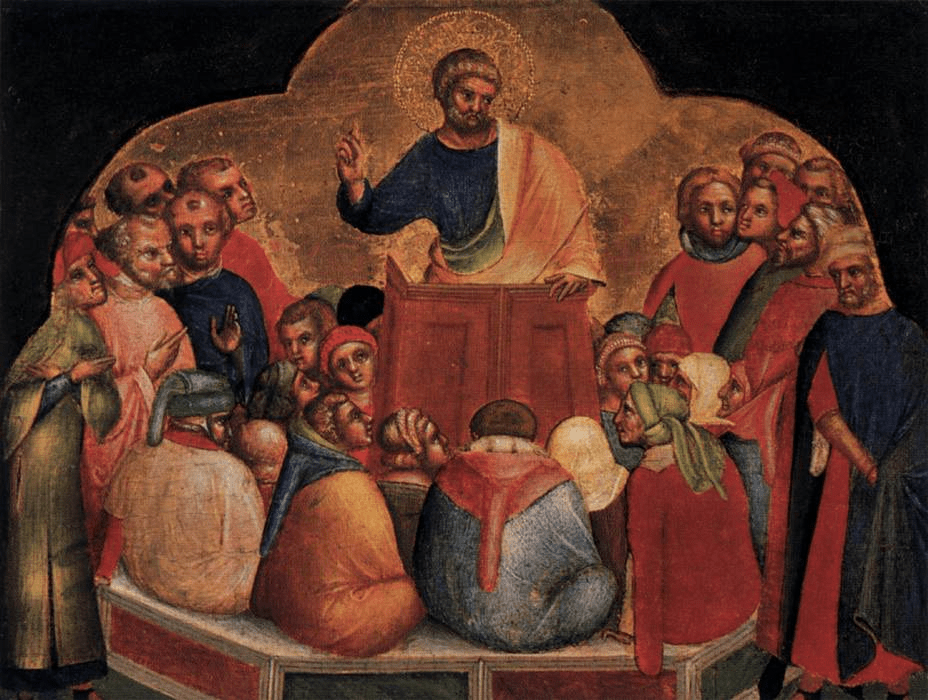
Apostle Peter preaching, by Lorenzo Veneziano, c.1370

And that is exactly what happened with the Apostles Peter and John. Their proclamation of Christ and his resurrection struck a nerve with the Jewish Sadducees who were the keepers of proper worship and liturgy amongst the temple. The Apostles’ teaching was so scandalous and threatening to their own beliefs, that they used their authority to throw Peter and John in jail – just for proclaiming a message the Sadducees didn’t like.

It never feels good getting toasted by those who claim insight and knowledge but are, in reality, a bunch of ignorant simpletons who don’t want to change and will hold onto their sense of power and superiority at all costs.

Yet, the consolation to all of this, is that there are others who are open-minded enough to listen well and adjust their belief systems to match the truthful evidence given to them. And so, despite the efforts of the Sadducees to suppress apostolic preaching, the fledgling group of Christ followers were being added by the thousands.

It turns out that nobody can resist the Holy Spirit of God, no matter how much earthly pull and power they possess.

Today’s New Testament lesson reminds us and teaches us that:

  • Self-awareness of why we hold to our particular beliefs, matters. We ought to hold our dogmatism very loosely.
  • Proclamation of the gospel, that is, the good news of Christ’s crucifixion and resurrection, makes a difference in lot of people’s lives.
  • Opposition is to be expected. There are some who view the good news of grace as the bad news of judgment against themselves; they will oppose it by any means possible.
  • Humility will always serve us well in the spiritual life, whereas condescending arrogance will never help anybody. For God’s sake, please have enough humility to listen and learn, even if (and especially) you don’t like what you’re hearing – no matter which end of the discussion you are on.

If we want the world to be different, then the change begins with you and me. Christians have the opportunity, if they will take up the mantle, of being the most calm, humble, and attentive people in the room. In this time of the year, no other stance and skill can be more important amongst family, friends, and others during the holidays.

O Lord, you have told us what is good, and what you require of us: To do what is right, to love mercy, and to walk humbly. Help us walk together in love and compassion towards the cross, humbly with you and one another. Let your Holy Spirit guide us on the right path to truth and reconciliation with humility; and enable us to hear each other, for we do not want to walk by pride or self-sufficiency, through Jesus Christ our Lord. Amen.

A Great Number of People Believe (Acts 11:19-26)

Now those who had been scattered by the persecution that broke out when Stephen was killed traveled as far as Phoenicia, Cyprus and Antioch, spreading the word only among Jews. Some of them, however, men from Cyprus and Cyrene, went to Antioch and began to speak to Greeks also, telling them the good news about the Lord Jesus. The Lord’s hand was with them, and a great number of people believed and turned to the Lord.

News of this reached the church in Jerusalem, and they sent Barnabas to Antioch. When he arrived and saw what the grace of God had done, he was glad and encouraged them all to remain true to the Lord with all their hearts. He was a good man, full of the Holy Spirit and faith, and a great number of people were brought to the Lord.

Then Barnabas went to Tarsus to look for Saul, and when he found him, he brought him to Antioch. So for a whole year Barnabas and Saul met with the church and taught great numbers of people. The disciples were called Christians first at Antioch. (New International Version)

The earliest of believers in Jesus Christ were Jews. Jewish converts to Christianity were not typically received well amongst their families, communities, and culture. So, when Stephen, one of those converts, retold Jewish history emphasizing a stubborn lack of awareness amongst their ancestors – and then connected it with present day attitudes – a full fledged persecution of Christians broke out.

As a result, the Church – located almost exclusively in Jerusalem – was scattered throughout Judea and across the Roman Empire in a Christian diaspora. In Christ’s ascension, he told the disciples that they would be witnesses beginning at Jerusalem, and then to Judea and outside the Middle East. Little did the small band of believers know, at the time, how that plan would come about.

As it turns out, although life was hard being a Christian refugee in a strange location, the believers spread the good news of Jesus wherever they went. Thus, gospel seeds were planted all across the land.

There is no place we can go where God is not already there.

And so, the displaced Christians discovered God was with them in their sojourning. Their faithful proclamation of good news was the impetus to bringing about many more converts to Jesus Christ.

What was happening in Judea and the Empire came back to the church leaders in Jerusalem. They then, smartly, sent one of their own, Barnabas, to Antioch in order to check out the scene and bring the new believers some encouragement. Since Barnabas was the consummate encourager, the church was emboldened, with even more converts entering into faith in Christ.

Barnabas, as an encourager, had the knack for knowing what he could do and not do; he also knew someone who could supply what he couldn’t do. He was so sure that Saul (Paul) was the right person for the job that he went to Tarsus – which was about 400 miles from Antioch – in order to find him and get him to the new believers as soon as possible. The result was an explosion of fresh converts coming to faith and into the church.

It’s no coincidence that the man with the biggest heart in the church is described in today’s text as a good man who was filled with the Holy Spirit. The Spirit is the One who makes all the difference with the growth of Christianity and the establishment of the Church.

Barnabas could see the evidence of God’s grace in the city of Antioch because he was filled to the full, with God’s own Spirit. He observed people with changed lives; an incredibly diverse and connected international community of believers; and so, encouraged them all in this good work brought about by the Spirit of God.

More and more people were added to the fellowship because of the robust spiritual dynamic that took place. This was not a matter of people using slick marketing strategies to make the name of Jesus Christ known; instead, the adding was all God. The Lord added to the Lord, and not people adding people to the Church. In other words, God is both the subject and the object, the source and the goal, of all good Christian ministry.

Then, when the Lord connected Barnabas together with Saul (Paul) who was also filled with the Holy Spirit and many spiritual gifts from God, the result was nothing less than large numbers of persons coming to faith in Christ and being added to the Church.

The believers in Antioch were so chatty about their faith that the first reference of being called “Christians” were to these converted Jewish believers in Jesus. Even though the moniker of “Christian” was probably a term of derision and meant to mock the Antiochene Church, it stuck, and was held up proudly by the believers. They were completely okay with being called “little Christ’s.”

After all, since they were truly Christ-centered in all they did, it was a fitting title for the fledging and growing Church. It clearly identified them as the people who serve and follow Christ. We, too, these many centuries later, have the very same Spirit of God that they did – and therefore, the same opportunity to speak of Jesus and see the Holy Spirit do the work of adding to the Church.

We pray, almighty God, that all who confess your Name may
be united in your truth, live together in your love, and reveal
your glory in the world.

Guide people everywhere, and of all the nations, in the
ways of justice and peace; that we may honor one another
and serve the common good.

Give us all a reverence for the earth as your own creation,
that we may use its resources rightly in the service of others
and to your honor and glory.

Bless all whose lives are closely linked with ours, and grant
that we may serve Christ in them, and love one another as he
loves us.

Comfort and heal all those who suffer in body, mind, or
spirit; give them courage and hope in their troubles, and
bring them the joy of your salvation.

Lord, in your mercy, hear our prayer. Amen.