Matthew 5:9 – Blessed Are the Peacemakers

Blessed are the peacemakers,
    for they will be called children of God. (NIV)

Why peace?

A lot of people just want some peace… peace of mind, peace in their families and at their workplaces, and peace in their nation and in the world. Racing thoughts, disharmony at home, conflict on the job, constant national disturbances, and the wars, takeovers, coups, assassinations, and oppressive regimes of the world sometimes might lead us to believe there might never be peace – either in our personal lives or on this earth.

What is peace?

Peace is not merely the absence of conflict. It is harmony with God, others, and self. To be at peace involves more than simply getting along with others or being able to sleep at night. Peace involves wholeness and integrity, having unity of mind and purpose, so that people can live beyond surviving to thriving and flourishing in settled peaceful relationships.

How does peace happen?

For peace to be truly realized, there needs to be a peacemaker. Jesus was the ultimate peacemaker. He achieved peace by provoking and challenging the establishment. Jesus brought on conflict in order to bring real and lasting peace.

The cross of Christ became an act of subversion to the existing religious system. Jesus championed the common good of all through his death. The violence of the cross brought the serenity of peace. Christ has abolished all barriers and divisions so that people can come to God and come together.

So, remember that once you were Gentiles by physical descent, who were called “uncircumcised” by Jews who are physically circumcised. At that time, you were without Christ. You were aliens rather than citizens of Israel, and strangers to the covenants of God’s promise. In this world you had no hope and no God. But now, thanks to Christ Jesus, you who once were so far away have been brought near by the blood of Christ.

Christ is our peace. He made both Jews and Gentiles into one group. With his body, he broke down the barrier of hatred that divided us. He canceled the detailed rules of the Law so that he could create one new person out of the two groups, making peace. He reconciled them both as one body to God by the cross, which ended the hostility to God.

When he came, he announced the good news of peace to you who were far away from God and to those who were near. We both have access to the Father through Christ by the one Spirit. So now you are no longer strangers and aliens. Rather, you are fellow citizens with God’s people, and you belong to God’s household. As God’s household, you are built on the foundation of the apostles and prophets with Christ Jesus himself as the cornerstone. The whole building is joined together in him, and it grows up into a temple that is dedicated to the Lord. Christ is building you into a place where God lives through the Spirit. (Ephesians 2:11-22, CEB)

Peace has been accomplished through Christ. We now are to live into that peace by being peacemakers. So, how do we do that?

What characterizes a peacemaker?

Peacemakers demonstrate and show how to relate to God and others because they know the process of being humbled before God and being filled with righteousness. Peace doesn’t just happen. It must be attended to and cultivated.

  • Peacemakers don’t merely try to smooth things over but actively promote and put energy into unity and harmony.

Make every effort to keep the unity of the Spirit through the bond of peace. There is one body and one Spirit, just as you were called to one hope when you were called; one Lord, one faith, one baptism; one God and Father of all, who is over all and through all and in all. (Ephesians 4:3-6, NIV)

“It isn’t enough to talk about peace. One must believe in it. And it isn’t enough to believe in it. One must work at it.”

Eleanor Roosevelt
  • Peacemakers are careful to not use their speech for gossip or slander but help others with forgiveness issues.

Make a clean break with all cutting, backbiting, profane talk. Be gentle with one another, sensitive. Forgive one another as quickly and thoroughly as God in Christ forgave you. (Ephesians 4:31-32, MSG)

  • Peacemakers do not create problems but purposefully facilitate all around good relations by seeking to listen and understand, then gently applying truth.

Now, discipline always seems painful rather than pleasant at the time, but later it yields the peaceful fruit of righteousness to those who have been trained by it. (Hebrews 12:11, NRSV)

  • Peacemakers do not avoid conflict but seek reconciliation.

God’s kingdom isn’t about eating and drinking. It is about pleasing God, about living in peace, and about true happiness. All this comes from the Holy Spirit.If you serve Christ in this way, you will please God and be respected by people. We should try to live at peace and help each other have a strong faith. (Romans 14:17-19, CEV)

  • Peacemakers do not keep quiet but spread the gospel because they know that through Jesus there is true harmony between God and people.

Therefore, since we have been justified through faith, we have peace with God through our Lord Jesus Christ. (Romans 5:1, NIV)

  • Peacemakers will be called “children of God” because their character reflects the character of God.

Jesus said, “I’m leaving you well and whole. That’s my parting gift to you. Peace. I don’t leave you the way you’re used to being left—feeling abandoned, bereft. So don’t be upset. Don’t be distraught.” (John 14:27, MSG)

  • Peacemakers do not encourage divisions between people but promote and enable relational connections which foster everyone getting their needs met.

When peacemakers plant seeds of peace, they will harvest justice. (James 3:18, CEV)

  • Peacemakers don’t give up but continually keep making peace.

Stop doing what is wrong and do good. Look for peace and do all you can to help people live peacefully. (1 Peter 3:11, ERV)

Conclusion

Peacemakers are people who occupy a middle space between persons or groups at odds with each other. They desire to live righteously with the mercy and purity God has provided for them. 

People dedicated to peacemaking understand there is so little peace in this world because there are so few peacemakers. There are so few peacemakers because so many people in this world have not availed themselves of God’s justice and righteousness.

And precious few people have availed themselves of God’s righteousness because there are so few truly humble people. There are so few humble persons because, so few individuals realize their poverty of spirit. 

In order to achieve peace, one must first be at peace with God. This is why we desperately need the cross of Jesus Christ because through his blood peace has been achieved.  There is now no wall of separation because Christ’s cross has torn it down.

Finally, brothers and sisters, rejoice! Strive for full restoration, encourage one another, be of one mind, live in peace. And the God of love and peace will be with you. (1 Corinthians 13:11, NIV)

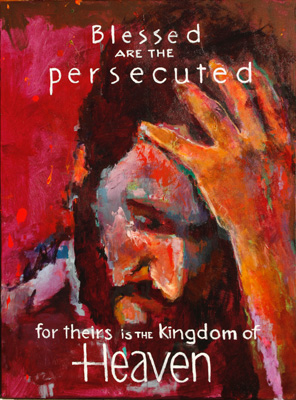
*Above painting by Hyatt Moore

Matthew 5:8 – Blessed Are the Pure in Heart

“Blessed are the pure in heart,
    for they will see God.” (NIV)

“You’re blessed when you get your inside world—your mind and heart—put right. Then you can see God in the outside world.” (MSG)

“What bliss you experience when your heart is pure. For then your eyes will open to see more and more of God.(TPT)

“A pure heart means a single heart, a heart in which only one desire lives: love.”

Peter Kreeft

An Impure Scenario

Suppose a young man courts a young woman. They get to know one another, fall in love, and get married. On their wedding day, as they leave the church building and speed away, the young couple reminisce about love and life.

But when the groom begins to speak about a future together, the bride, with a smile on her face says, “Okay, you can pull over now.” The groom, completely smitten with his new bride, does exactly what she asks. The young woman gets out of the car and, blowing a kiss, says, “This was fun. Maybe I’ll see you around sometime.”

“I don’t think this is funny,” says the groom. “Hey, we had a great time, right!?” the perky bride says. “Yes, responds the groom, “and it will last forever.” “Oh, you are such a darling,” the bride says, and with a wry smile, “but I’ll be in touch.”

“Huh, what!?” the confused groom says. “Yeah, I’ll call. We’ll get together,” says the bride without flinching. The groom, now also feeling heartsick says, “I don’t understand. What’s going on?”

“Dear, I just need my space. It’s not like I don’t care! I have other things to do. Other men to see….”

Yes, a ridiculous and improbable scenario. Yet one which is repeated every day, multiple times a day. For the groom is the Lord God almighty; and the bride is the church….

Purity and God

Purity is a big deal to God. The phrase, “pure in heart,” is Christ’s way of upholding the biblical call to holiness. To be pure is to have no mixed motives, no hidden agendas, and no side job of moonlighting with the world while being an upstanding kingdom citizen during the day. It isn’t letting Jesus court us and marry us, only to have us walk away and do whatever the heck we want. It’s not only impure and unholy. It’s plain wrong and messed up.

Through blessing the pure in heart, Jesus was connecting us to the Old Testament ethic of being holy. The book of Leviticus, rarely the focus of any preacher or parishioner alike, is completely given to the topic of holiness. The detailed laws about daily life, including what to wear and not wear, what to eat and not eat, even who to marry and not marry, were given for a reason.

God wanted the ancient Israelites to have daily reminders that they are a holy people. So, there was to be no mixing of fabrics, no meat and cheese together, no impurities introduced into any part of life. Everything about the Jewish lifestyle was to be holy, set apart to God, reminding the people that God is their husband, committed to them with responsibilities on the part of both. It was called a “covenant.”

Leviticus 19 leaves no stone unturned on the activities of life:

The Lord said to Moses, “Speak to the entire assembly of Israel and say to them: ‘Be holy because I, the Lord your God, am holy’….

Do not steal. Do not lie. Do not deceive one another. Do not swear falsely by my name and so profane the name of your God. I am the Lord. Do not defraud or rob your neighbor….

Do not pervert justice; do not show partiality to the poor or favoritism to the great but judge your neighbor fairly….

Do not go about spreading slander among your people. Do not do anything that endangers your neighbor’s life. I am the Lord. Do not hate a fellow Israelite in your heart. Rebuke your neighbor frankly so you will not share in their guilt. Do not seek revenge or bear a grudge against anyone among your people but love your neighbor as yourself. I am the Lord.

Do not mate different kinds of animals. Do not plant your field with two kinds of seed. Do not wear clothing woven of two kinds of material.” (Leviticus 19:1-2, 11-13, 15-19, NIV)

Yes, indeed, purity is a big deal to God. The “Holy” Spirit is the Divine Person completely devoted to doing only the will of the Father and Son – never going rogue. The Spirit is the One who effects sanctification, becoming holy, within the life of the believer. Each year we celebrate “Holy” Week, a stretch of days designed to be different than the rest – devoted to journeying with Jesus and not mixing with the fickle crowd who would scream at the end of the week, “Crucify him! Crucify him!”

Purity and Us

To follow Jesus in true righteousness is to be pure in heart, that is, set apart wholly and completely for him. Purity of heart is a fruit from the trunk of righteousness, which grew up in the soil of God’s grace, with roots of humility and meekness – all watered by the tears of godly mourning.

The pure in heart are those who acknowledge their sin, deal with it, and live with a clear and clean conscience before God and the world. They have an awareness of their wrongs and shortcomings without succumbing to self-criticism because of an equal awareness of God’s grace. They keep short accounts with others concerning what they have done or what they should have done. They are holy. They are sanctified. They are pure in heart.

The pure in heart will see God. They know they cannot make themselves pure, so they keep looking to Jesus for their forgiveness because they hunger for righteousness.

One cannot whitewash a wishy-washy commitment with Jesus and be pure. This blessed Beatitude has to do with our motives and what takes place in our thinking and in our hearts.  What do you think about when your mind slips into neutral?  Is it coveting after things or people, or does thinking go toward what is true, noble, right, pure, lovely, and admirable?  Sometimes we struggle with purity of heart because we are focused not on Jesus, but on our own performance and perfection instead of letting God fill our hungry hearts.

Purity results from true righteousness.  A stalk of corn might look good, but if you shuck it and it’s filled with worms, it isn’t going to be worth much. Legalistic righteousness and empty promises of doing better are concerned to look good, not to mention they are obsessed with performance, perfection, and possessions. 

But the righteousness of God fills our hungry hearts and makes us pure and holy, set apart for divine use and divine purposes. How, then, shall we live? What will we do?

The earth is the Lord’s, and everything in it,
    the world, and all who live in it;
for he founded it on the seas
    and established it on the waters.

Who may ascend the mountain of the Lord?
    Who may stand in his holy place?
The one who has clean hands and a pure heart,
    who does not trust in an idol
    or swear by a false god.

They will receive blessing from the Lord
    and vindication from God their Savior.
Such is the generation of those who seek him,
    who seek your face, God of Jacob. (Psalm 24:1-6, NIV)

The person with integrity shall see God. Those made pure with the cleansing blood of Jesus Christ will someday stand before God at the Last Judgment and there find mercy and acceptance.

So, for now, until that time, we daily have the opportunity to focus on our one true love with loyalty and commitment, enjoying God’s presence continually. Because the Lord will never leave us, nor forsake us, even when we sometimes forsake him.

Almighty God, to you all hearts are open, all desires known, and from you no secrets are hidden. Cleanse the thoughts of our hearts by the inspiration of your Holy Spirit, that we may perfectly love you, and worthily magnify your holy name, through Christ our Lord. Amen.

Matthew 7:7-11 – Ask. Seek. Knock.

“Keep on asking, and you will receive what you ask for. Keep on seeking, and you will find. Keep on knocking, and the door will be opened to you. For everyone who asks, receives. Everyone who seeks, finds. And to everyone who knocks, the door will be opened.

“You parents—if your children ask for a loaf of bread, do you give them a stone instead? Or if they ask for a fish, do you give them a snake? Of course not! So, if you sinful people know how to give good gifts to your children, how much more will your heavenly Father give good gifts to those who ask him. (New Living Translation)

In the dog days of summer, and the long season of Ordinary Time in the Church Calendar, it is good to be reminded of what it is we need to keep doing without giving up.

At the conclusion of his Sermon on the Mount, Jesus issued a warning about the pitfall of failing to persist in a trusting relationship with God. We are to have an ongoing dynamic of asking, seeking, and knocking.

We might too often neglect to ask, seek, and knock because we rely on our own determination, abilities, education, or observations. The action of the three action words is a reference to prayer. The idea is that it is difficult to live a virtuous life, so we must continually ask, seek, and knock to receive an answer.

The demands of Christian discipleship are significant. Throughout Christ’s Sermon, he not only dealt with the outward actions of a follower but also the inward state of the heart.

Humility, meekness, mercy, purity, and peace characterize the inner person who walks in the way of Christ. Not only is murder wrong, but the bitter anger which it produces is to be dealt with. Adultery is also a violation of God’s law, along with the impure thoughts and intents of the heart which bring it about. Love for enemies, giving from the heart, praying with appropriate motives, fasting in secret, and building treasure in heaven are all expectations of the devout Christian believer.

These are inner attitudes and outward behaviors which require a constant stream of asking, seeking, and knocking on the door of heaven. They are more than natural abilities; what Jesus is looking for is to live a supernatural life. This, then, requires supernatural resources.

“I am the door, and the person who enters through me will be saved and will be able to come in and go out and find pasture.”

Jesus (John 10:9, NCV)

No one enters God’s realm because of sheer determination. God’s kingdom is only accessed through humble prayer. God is the One with the supernatural resources to help us live the Christian life.

And God is pleased to provide what we need to live that life. The Lord answers in love and not begrudgingly. Out of the infinite storehouse of grace, God delights in hearing our asking’s, responding to our seeking’s, and answering our knocking’s. With God, there is no daydreaming while we ask, no avoiding us when we seek, and no pulling the shades as the door is being knocked.

In love, God looks forward to our asking, seeking, and knocking.

The key takeaway from today’s Gospel lesson is repetition – not vain repetition which believes that the more prayer is repeated, the greater possibility of the answer we want – but a routine lifestyle of persistently and consistently praying.

Ask

You want things, but you don’t get them. So, you kill and are jealous of others. But you still cannot get what you want. So, you argue and fight. You don’t get what you want because you don’t ask God. Or when you ask, you don’t receive anything, because the reason you ask is wrong. You only want to use it for your own pleasure. (James 4:2-3, ERV)

James, learning from his brother, Jesus, gets behind the asking to the heart of why we ask and why we do not ask. This, in no way, is to discourage us from asking or to be doubtful whether God cares about our asking, or not. James also said:

But anyone who needs wisdom should ask God, whose very nature is to give to everyone without a second thought, without keeping score. Wisdom will certainly be given to those who ask. Whoever asks shouldn’t hesitate. They should ask in faith, without doubting. Whoever doubts is like the surf of the sea, tossed and turned by the wind. People like that should never imagine that they will receive anything from the Lord. They are double-minded, unstable in all their ways. (James 1:5-8, CEB)

Seek

If you seek the Lord your God, you will find him if you seek him with all your heart and with all your soul. (Deuteronomy 4:29, NIV)

Seek the Lord while he may be found, call upon him while he is near. (Isaiah 55:6, NRSV)

Prayer is much like a wrestling match. It requires a great deal of effort. In fact, every good thing in life demands blood, sweat, and tears. We are to keep on seeking, to continue searching and looking for God amid our life circumstances. The Lord will be found.

Knock

God has said, “When you pray, I will answer you. When you call to me, I will respond.” (Isaiah 58:9, GNT)

The balance to the continual searching and diligently seeking is the immediate answer to our knocking on heaven’s door.

And God has also said, “I will answer their prayers before they finish praying.” (Isaiah 65:24, CEV)

It is to God’s glory whether our prayers are answered quickly, or not. It is to our glory that we exercise our own ability to enter God’s throne room and ask, seek, and knock. We have the assurance that whatever the answer is from God, it will always be a merciful response.

For God mercifully gives us what we ask for, and also mercifully does not give us what we ask for.

We do not know what tomorrow may hold for us. All we know for certain is that we are known by a God who hears when we ask, is worth seeking, and answers when we knock.

O God, you are my God, early and often I will seek you. New are your mercies every morning, O Lord; and great is your faithfulness. Pour out on all who desire it the spirit of grace. Deliver us, when we draw near to you, from coldness of heart and wanderings of mind, that with steadfast thoughts and affections we may worship you in spirit and in truth, through Jesus Christ our Lord. Amen.

Matthew 16:5-12 – Beware of Bad Teaching

Later, after they crossed to the other side of the lake, the disciples discovered they had forgotten to bring any bread. “Watch out!” Jesus warned them. “Beware of the yeast of the Pharisees and Sadducees.”

At this they began to argue with each other because they hadn’t brought any bread. Jesus knew what they were saying, so he said, “You have so little faith! Why are you arguing with each other about having no bread? Don’t you understand even yet? Don’t you remember the 5,000 I fed with five loaves, and the baskets of leftovers you picked up? Or the 4,000 I fed with seven loaves, and the large baskets of leftovers you picked up? Why can’t you understand that I’m not talking about bread? So again, I say, ‘Beware of the yeast of the Pharisees and Sadducees.’”

Then at last they understood that he wasn’t speaking about the yeast in bread, but about the deceptive teaching of the Pharisees and Sadducees. (New Living Translation)

I tend to think in metaphors, which is probably one reason I like the teaching of Jesus so much. While on this earth, he used a range of metaphors from common everyday life to communicate his point. Seems as though the disciples were more concrete thinkers.

Yeast was a common symbol for evil, which is why the Jews ate unleavened bread. Jesus was trying to get the point across to his disciples that, like yeast, even just a little bit of unhealthy teaching can have far-reaching effects. Partaking of bad teaching works through the whole batch of dough and ruins the spiritual life.

We might think that after seeing Jesus heal the sick, raise a paralyzed man, cure the blind, restore the demon-possessed, walk on water, and feed the masses with only a few loaves of bread that his disciples would be clamoring with praise and responding with a big “Wow! Look at what Jesus did!  Tell us what to do next!”  Instead, they stood around mumbling about how to interpret the great feeding of the four thousand.

The math lesson Jesus explained to the disciples about the basketfuls of food that they had gathered was that the less the disciples had and the bigger their problem, the more Jesus did. 

Jesus Math adds up to grace.  And grace means that who we are, or are not, and what we have, or do not have, is immaterial; what matters is that we have Jesus. We give him what little we have, along with ourselves, and let him do the work.

We must avoid the trap and the temptation of thinking, “If only I had ___; If only I were ___.”  This is unsound doctrine because it denigrates the image of God within us and the good gifts God has already given to us, as if we ourselves are not enough. Yet, even if we have next to nothing, with few abilities, when offering it to Jesus, he turns it into a miraculous bounty of blessing for the world.

Seeing ourselves, our relationships, our stuff, and our world through the person and work of Jesus Christ is our task.  It does not take great powers of interpretation to see that the times are evil and bad information gets disseminated and spread.  What is more difficult for us is discerning that there is a great opportunity for mission and service amid this decaying world. 

We will miss that wonderful opportunity if we partake of bad teaching.

It is imperative that we feed upon sound teaching and be very discerning about who we listen to and what they are really saying to us. Words which are heavy with judgment and light on grace are to be suspect because such teaching is antithetical to the gospel.

Instruction which sets apart and demonizes groups of people or characterizes certain individuals as monstrous or animalistic is completely out of step with the way of Jesus Christ.

We are to be on our guard against any teaching which places an unrealistic and dispassionate heavy load of guilt and shame upon people. We must be vigilant to not accept teaching that plays upon people’s fear and twists reality, making groundless and unsubstantiated claims without evidence. In short, the Holy Scriptures are not to be used as a club to beat people into submission toward our way of thinking and acting.

The spiritual abuse and objectification of others by using the Bible is a terrible condition which unfortunately exists in today’s world. The sad reality is that there are people who engage in harassing others by using God’s Holy Word.

People have been created in the image and likeness of God, and therefore deserve to be treated with respect and civility, regardless of their creed, color, or condition.

So, let me be clear and deliberate about the use and abuse of God’s revelation to us:

I do not condone any use of the Bible which seeks to intimidate, bully, impede, or affect any person’s ability: to work effectively at their jobs, to worship joyfully at their church, or to live without fear of being blacklisted or redlined to the periphery of society.

I do not condone any use of the Bible which intends to control either by threat or by use of physical force any person, their family, and/or their property through inducing fear.

I do not condone any use of the Bible which justifies touching any person without their consent, or coerces, or physically forces another person to engage in a sexual act against their will.

I reject any use of the Bible which encourages any sort of hate crime, act of violence, or hate speech against any person regardless of their gender, sexual orientation, race, ethnicity, class, or religion.

I reject any use of the Bible by any clergy and/or church leadership which demeans and marginalizes women in their basic humanity, role, function, or leadership.

I reject any use of the Bible by any church member and/or attender which demeans and discounts the worldwide Christian community.

I uphold any use of the Bible which seeks to communicate its theology and message gently, carefully, graciously, and lovingly for the spiritual edification and healing of all people.

I uphold any use of the Bible which intends to cultivate one’s own soul and develop a teachable spirit.

I uphold any use of the Bible which looks for truth, wisdom, beauty, and humility.

I champion use of the Bible for both personal and corporate encouragement.

I champion use of the Bible for critical inquiry, scrutiny, and learning.

I champion use of the Bible for all people, regardless of age, including genuine seekers and spiritual misfits, as well as the hurt, abused, lonely, lost, confused, and concerned.