Matthew 5:27-36 – Lusting, Liquidating, and Lying

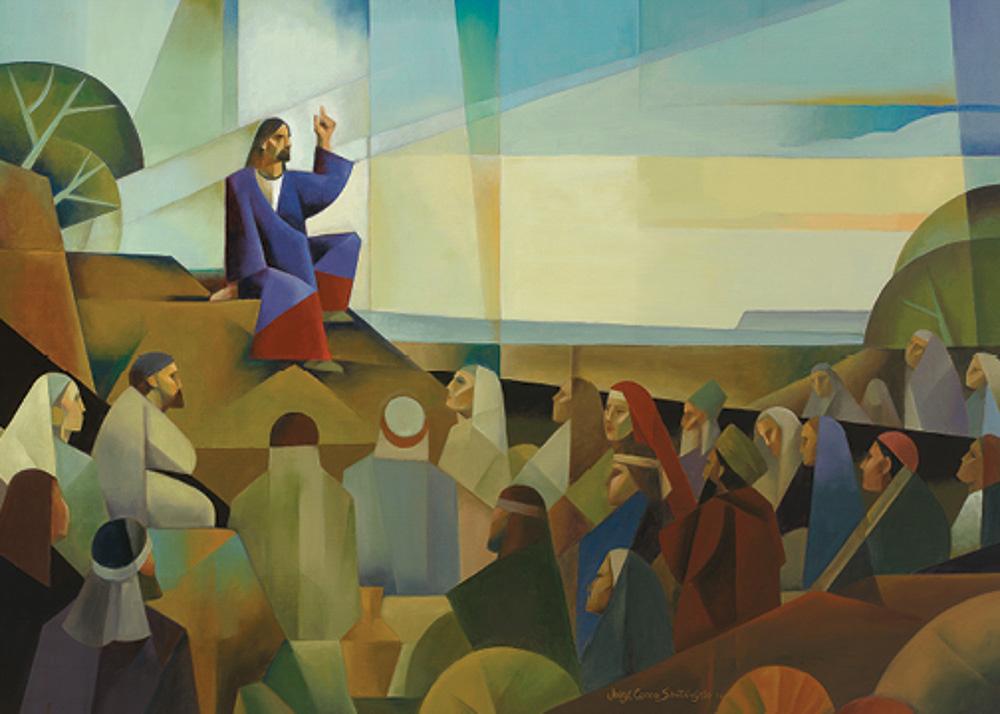
Sermon on the Mount by Argentine artist Jorge Cocco Santángelo

“You have heard that it was said, ‘You shall not commit adultery.’But I tell you that anyone who looks at a woman lustfully has already committed adultery with her in his heart. If your right eye causes you to stumble, gouge it out and throw it away. It is better for you to lose one part of your body than for your whole body to be thrown into hell. And if your right hand causes you to stumble, cut it off and throw it away. It is better for you to lose one part of your body than for your whole body to go into hell.

“It has been said, ‘Anyone who divorces his wife must give her a certificate of divorce. ’But I tell you that anyone who divorces his wife, except for sexual immorality, makes her the victim of adultery, and anyone who marries a divorced woman commits adultery.

“Again, you have heard that it was said to the people long ago, ‘Do not break your oath, but fulfill to the Lord the vows you have made.’ But I tell you, do not swear an oath at all: either by heaven, for it is God’s throne; or by the earth, for it is his footstool; or by Jerusalem, for it is the city of the Great King. And do not swear by your head, for you cannot make even one hair white or black. (New International Version)

Adultery. Divorce. Oaths. Jesus chose these topics from the Ten Commandments (7, 9, and 10) to uphold the ethical law of God.

In Christ’s Sermon on the Mount, Jesus gets to the heart of immorality and unethical behavior. The physical act of adultery arises from mental adultery. Divorce results from hardness of heart. Breaking oaths as a form of lying.

Adultery

Pornography is a 60 billion dollar a year industry, worldwide. It is the church’s problem, as well:

  • 53% of Christian men consume pornography.
  • 51% of pastors say porn is a temptation.
  • 69% of pastors started looking at porn out of curiosity.
  • 37% of pastors say it’s currently a struggle.
  • 35% of men have used pornography in the past month.
  • 4 in 10 of pastors looked at porn today.
  • There are 100,000 websites that offer illegal child pornography.
  • 90% of 8-16 year old’s have viewed porn online (most while doing homework).
  • 20% of men, and 13% of women, admit to viewing pornography at work.
  • 70 percent of all internet porn traffic occurs during the 9-to-5 workday.

Adultery initially occurs when someone feeds on mental sexual activity with another person. As with most of Christ’s solutions, he lays out a radical means of overcoming it.

Jesus is not condemning normal gender attraction, nor sex itself (which is a gift of God). Rather, Jesus condemns the leering upon another with sexual fantasy. All adulterous relationships and inappropriate sexual relations start with the “look.”

“Lust” is to intensely desire and burn for something, to seek mastery over another. The reason people stare, and lust, is not because of the other person’s manner or dress; it’s because they already have an adulterous heart. 

Whenever we are caught in physical or mental adultery, decisive and drastic action is needed. Jesus used hyperbole to drive his point home about the need of dealing with adultery. The approach is not applying a band aid; it is amputation.

The reason many men and women are snared by adultery, and seem unable to stop, is that they deal with it on their own. The radical action needed is accountability; confession must be offered.

Trying to manage lust on our own is like one individual attempting to contain a nuclear meltdown.

Jesus leaves no room to think it is okay to lust in the heart because I am not hurting anybody. Pornography enslaves its users and degrades women.

As powerful and addictive lust is, God’s grace is bigger and more powerful. There’s no need to be burdened with shame and guilt when the cross of Christ has already taken care of it.

There would not be a multi-billion dollar industry if there were not places in our hearts that are black. Now is the time for forgiveness, grace, and healing.

Sermon on the Mount by American artist Bill Bell

Divorce

Today in America more than one-third of all adults have experienced divorce.

Unfortunately, many divorced persons feel their faith community provided rejection rather than support and healing. There is a lot of room for improvement when to help families, and those having experienced divorce.

Please know Jesus condemns the cavalier divorce, and not all divorce. Anybody who doesn’t like their spouse doesn’t have ground for divorce. They entertain the thought of having a better spouse, even though there is no marital unfaithfulness. 

This is yet another form of mental adultery (and idolatry) which believes someone else can better meet my needs. 

Jesus clearly makes provision for divorce to occur in certain circumstances. Yet, he will not bend to liquidating a marriage over unhappiness with what God has joined together.

The intent of Old Testament legislation on divorce is to avoid a casual stance toward marriage (Deuteronomy 24:1-4). Over the centuries, people found creative ways of getting around the law. Although a divorce may be legal, it might not be ethical. Jesus wanted divorce practiced with concern for the woman, so that her rights and needs were considered.

Many took a loose view of divorce and focused solely on “indecency” as grounds for divorce. They did not interpret the term solely as sexual infidelity, as Jesus did, but had a broad understanding of indecency.

For example, if a husband did not like his wife, or, in the words of one rabbi, she continually burns the supper, he may “put her away” (divorce her). Jesus, however, insisted divorce must not happen because of a hard time getting along; or don’t love your spouse anymore; or that your spouse keeps irritating you. 

Being frustrated or unhappy are not biblical grounds for divorce. The answer to most marital problems does not lie in a new spouse, but in the hard work of identifying the idols of our hearts, overthrowing them, and re-connecting. Sin is crouching at the door, but you and I must master it.

Jesus said the ground for divorce is marital unfaithfulness, that is, any sexual activity outside the bounds of the marriage relationship. And, even in this case, divorce need not be an option, if the two people can reconcile.

Christ sought to defend women who are genuine victims. In biblical times, if a wife was given a certificate of divorce, she had four options: 1) Return to her family of origin; 2) Become a beggar; or 3) Become a prostitute to make ends meet; or, 4) Marry again, thus committing adultery if she was divorced because her husband didn’t like her. 

Jesus doesn’t take sides between spouses. Instead, he lifts the original intent of marriage: oneness. Divorce was never meant to be. Separating two people is damaging. However, it obviously occurs. (Matthew 19:1-12)

Divorce exists because of the heart’s hardness in one or both of the marriage partners. Divorce, really, is a legal testimony verifying that a separation has already occurred. It’s a recognition that disunity and non-oneness is already present. Legal divorce affirms that a terrible break already happened, damaging the people involved.

Just as God is one, two marital partners are to be one. Oneness is the primary goal of any marriage relationship. God did not institute marriage for people to live as roommates, but to be a new entity operating as one.

If God found it necessary to divorce his own covenant people, then it is inevitable divorce will occur among people (Jeremiah 3:1-8).  Therefore, let’s be discerning in how we handle each individual situation of marital difficulty.

Sermon on the Mount by Janice Elizabeth Steward

Oaths

“I swear on a stack of Bibles I won’t…” “I will, if I get around to it….” These are a few of the caveats we give when making a promise or oath. Oaths communicate our level or ability of getting it done, or not.

That’s fine. What isn’t fine is making excuses or false promises with no intention of doing what you say you will do. So, Jesus wants all the extraneous language out. Say “yes” or “no” and then follow through. And if you don’t, you’re a liar.

We often lie because we don’t want to do something to begin with. “Yes” and “no” are clear boundary words. Boundaries are needed so there is no oath-breaking.

Boundaries define where I end and someone else begins, leading me to a sense of ownership. Knowing what I am to take and not take responsibility for gives me freedom.

  • Boundaries keep the good in and the bad out. Setting boundaries involves taking responsibility for your choice of “yes” and “no” and living with the consequences.
  • Boundaries protect us from “gaslighting.” Gaslighting is a form of emotional abuse. The abuser manipulates another into doubting their thoughts, feelings, judgments, perceptions, and/or memories.
  • Boundaries hold people accountable for their words and actions. Without boundaries, we can easily feel used and mistreated.

Jesus wants us to clarify our values and live them out; make wise decisions; identify what we will accept and reject; and follow through on what we say we will do.

Conclusion

Adultery, divorce, and oaths are related. Boundaries – making and keeping promises – deals with outside forces trying to compromise our values. Accountability in naming our struggles mitigates covetousness.

Dissolved marriages and broken promises still happen. Yet, Jesus is there offering grace, not judgment. We may become emotionally damaged, however, there is healing available through the mercy of Christ. Amen.

Matthew 18:6-9 – Say “No” to Temptation

“If you cause one of these little ones who trusts in me to fall into sin, it would be better for you to have a large millstone tied around your neck and be drowned in the depths of the sea.

What sorrow awaits the world because it tempts people to sin. Temptations are inevitable, but what sorrow awaits the person who does the tempting. So, if your hand or foot causes you to sin, cut it off and throw it away. It’s better to enter eternal life with only one hand or one foot than to be thrown into eternal fire with both of your hands and feet. And if your eye causes you to sin, gouge it out and throw it away. It’s better to enter eternal life with only one eye than to have two eyes and be thrown into the fire of hell.” (New Living Translation)

It’s probably a good idea not to get on the wrong side of Jesus.

Throughout the Gospels, Jesus utilized a variety of teaching methods to communicate his message. In today’s Gospel lesson, Christ used the language of hyperbole to arrest attention and get his point across.

A universal truism of this world is that sin exists. In Holy Scripture, sin is anything people do or say – or fail to do and say – which damages or destroys another’s or one self’s physical, mental, emotional, or spiritual wellbeing.

Greed, envy, gluttony, sloth, anger, lust, and pride abound no matter where one goes on this planet. Sin is downright awful. It causes people to stumble, and, when unchecked, leads to personal and corporate chaos, unrest, and destruction. 

Whenever sin is viewed merely as a character flaw, or simply part of the fabric of organizations and institutions, then hellfire is not far off. Hell exists because of sin. 

We get the flavor that Jesus took sin quite serious. Christ considers sin so terrible and heinous that he deliberately used the height of hyperbole to communicate that radical, drastic, and decisive action must unequivocally be taken to get rid of it. 

The Lord Jesus wanted there to be no mistake in his communication: Sin is not something to dabble in or take a shallow approach; rather, sin must be eradicated, at all costs. The language is severe: If your hand, foot, or eye causes you to sin, cut it off. It’s better to enter life crippled or blind rather than be thrown into a suffering hell.

Temptations will inevitably come. Yet, how we handle those temptations and what we do with them is of eternal significance. 

We must get to the root of the sin – which happens through succumbing to temptation – and re-arrange our lives, alter our schedules, and change our lives in a radical way to remove putting ourselves in a position to sin. 

Solid daily spiritual habits of Scripture reading and prayer; time for sleep and rest; attention to Sabbath; and a regular exercise regimen are all ways to help ensure that temptation will not win the day.

And God forbid that we cause another to sin because we are hangry, tired, and out of shape because we’ve neglected ourselves for far too long. Self-care isn’t a luxury; it’s a necessity. Other people get hurt when we hurt ourselves.

Your self-care is always a valid excuse to say “no.”

If we take the words of Jesus to heart, perhaps we will gain awareness of the ways we need to metaphorically cut off a hand or gouge out an eye. For many people, this means learning to say “no.”

There doesn’t always need to be an explanation for assertively and courteously saying the word “no.” If an explanation is warranted, it should be brief. The word “no” doesn’t mean we are selfish pricks trying to wriggle out of responsibility. “No” simply realizes we are finite creatures with limited time, energy, and resources. Unlike God, we cannot do it all.

Setting personal boundaries is both wise and necessary. Without them, we let others chain us in bondage to their agendas. A lack of personal boundaries also typically means that the boundary-less person continually violates others’ boundaries. Since there are no fences in their own lives, they feel they can hop anybody else’s fence in front of them.

Violating someone’s space through mental or emotional manipulation, spiritual abuse, or bodily harm is sin. Jesus wants radical action to deal with such offense of others.

For the Christian, priority must be given to saying “yes” to Jesus, which then allows a “no” to come when there are competing priorities. A person unclear on their values and priorities will chronically violate others. If you have a specific plan of doing the will of God before being confronted with another person’s request, you’re more likely to stick to your original plan.

Jesus continually said “yes” to the Father. This framed and formed his earthly life so that he crossed social boundaries to speak to a Samaritan woman, a tax collector, and a leper – while maintaining the respect of another’s personal boundary by asking if they want to be helped and healed.

Sin is horrible – which is why Jesus went to the ultimate length to deal with it. He sacrificed himself and suffered an ignominious death so that sin’s power would be crushed, so that you and I could say “no” to temptation.

Holy God, you sent your Son to this earth to deal decisively with the world’s sin.  I choose today to walk in the forgiveness you offer through Jesus, and to avail myself of the Spirit’s power to forsake temptation in all its forms.  Amen.

Matthew 5:13-20 – Live as Salt and Light

“You are the salt of the earth. But if the salt loses its saltiness, how can it be made salty again? It is no longer good for anything, except to be thrown out and trampled underfoot.

“You are the light of the world. A town built on a hill cannot be hidden. Neither do people light a lamp and put it under a bowl. Instead, they put it on its stand, and it gives light to everyone in the house. In the same way, let your light shine before others, that they may see your good deeds and glorify your Father in heaven.

“Do not think that I have come to abolish the Law or the Prophets; I have not come to abolish them but to fulfill them. For truly I tell you, until heaven and earth disappear, not the smallest letter, not the least stroke of a pen, will by any means disappear from the Law until everything is accomplished. Therefore, anyone who sets aside one of the least of these commands and teaches others accordingly will be called least in the kingdom of heaven, but whoever practices and teaches these commands will be called great in the kingdom of heaven. For I tell you that unless your righteousness surpasses that of the Pharisees and the teachers of the law, you will certainly not enter the kingdom of heaven. (New International Version)

There is a world of people in our sphere of influence, who need to see that Christianity is real and that it works.

Jesus used a few metaphors to help his followers understand their role in society and their effect on the world.

Salt

Obviously, in the ancient world, there was no refrigeration. So, salt was used to preserve food, with the added result that it brought some flavor when the food was eaten. Christians are meant to be a preservative in the culture, helping to stave off worldly decay and rot.

Sometimes, believers in Jesus feel a compulsion to complain about eroding cultural mores, the sad state of public affairs, or the declining value of religion. However, Christians can play a positive role, rather than a negative stance, by being salt in the world.

Christianity is meant to be therapeutic and helpful, adding value to culture and society – and not an added burden to an already bad situation.

Jesus said if Christians lose their saltiness, and are no longer impacting society, they are useless to the culture. Nobody would miss them if they were thrown out into the garbage dump of the street to be trampled on and forgotten.

Christians were never meant to simply exist for themselves. They are on this earth to be the continuing presence of Christ in the world by means of God’s Spirit.

This is not an exhortation from Jesus to be salt, because he says we are salt. It is rather a matter of allowing the world to taste Christianity and find it compelling and flavorful. 

For example, instead of being worried or upset that a low income housing project is being built next to church property, leading to discussions of erecting a fence, a salty Christian response would be to imagine creating a sidewalk so that the neighborhood kids will wander over to the church’s grounds.

Saltiness is a fundamental way of thinking and acting which orients itself around the common good of everyone and the community needs surrounding where Christians live, work, and play.

To drive his point home even deeper, Jesus used a second metaphor to describe what Christianity’s relation to the world is to be like….

Light

In the ancient world, there were no artificial lights. At night, it was pitch black. In the dark, any light, even a small candle, makes a real difference.

An individual person may mistakenly believe their life does not make much of a difference. Yet, it does! One person exhibiting the characteristics of humility, gentleness, grace, and peacemaking is able to have significant penetration into the darkness.

Here are some ways the church has always brought light into the darkest times of history:

  • Taking-in and adopting unwanted children who would otherwise be victims of infanticide.
  • Ministering to the sick and dying during periods of plague and disease, while others fled.
  • Caring for prisoners who had no family to provide them with necessary food and clothing.
  • Giving benevolence and kindness to the poor – especially to immigrants, widows, and orphans.

Christianity is designed to take a proactive approach – and not just a passive policy of waiting for needy people to show up – by searching, identifying, and meeting the needs of people.

The reason religious people wondered about Jesus and his teaching is because Christ offered a different perspective than what they typically heard. 

Jesus was concerned to uphold basic Old Testament ethics by offering a distinct interpretation that the Law is fulfilled in himself. For example, the entire book of Leviticus (which reads something like a B-grade slasher film) is a detailed account of regulations concerning the sacrificial system – with the actual intent of all these laws to expose sinfulness, and the need for a once-for-all sacrifice that would take care of the sin issue altogether. The ceremonial law was not intended to be permanent, but to be fulfilled by the Messiah, Jesus.

Christ made it clear that all of Scripture is important; not the slightest detail is unimportant. True righteousness shows itself when Christians do the right things for the right reasons.

Christians are people of the Word. They are to learn Scripture, know it, and live it. One opportunity of doing this is based on an ancient way of reading the Bible called Lectio Divina (Latin for “spiritual reading”):

  1. Lectio (reading with a listening spirit)
  2. Meditatio (reflecting or meditating on what are hearing from God)
  3. Oratio (praying in response to what I hear from God)
  4. Contemplatio (contemplating what I will do to live out the text)

Through listening, reflecting, praying, and obeying, Christians allow Holy Scripture to spiritually shape and form them into the people of God – thus becoming salt and light in the world.

May you discover the light of God’s grace through being a person of the Word.

May you be salty, flavorful and preserving the world in which you live.

May you know and connect with Jesus.

May Christianity be seen, felt, and known as the contribution to this old world it was always meant to be. Amen.

Matthew 23:29-39 – Against Hypocrisy

You religious teachers are nothing but show-offs, and you’re in for trouble! You build monuments for the prophets and decorate the tombs of good people. And you claim that you would not have taken part with your ancestors in killing the prophets. But you prove that you really are the relatives of the ones who killed the prophets. So, keep on doing everything they did. You are nothing but snakes and the children of snakes! How can you escape going to hell?

I will send prophets and wise people and experts in the Law of Moses to you. But you will kill them or nail them to a cross or beat them in your meeting places or chase them from town to town. That’s why you will be held guilty for the murder of every good person, beginning with the good man Abel. This also includes Barachiah’s son Zechariah, the man you murdered between the temple and the altar. I can promise that you people living today will be punished for all these things!

Jerusalem, Jerusalem! Your people have killed the prophets and have stoned the messengers who were sent to you. I have often wanted to gather your people, as a hen gathers her chicks under her wings. But you wouldn’t let me. And now your temple will be deserted. You won’t see me again until you say,

“Blessed is the one who comes
    in the name of the Lord.” (Contemporary English Version)

Christ’s scathing and damning critique is against a distorted spirituality, a false Christianity, a controlling leadership that stifled and snuffed-out the true worship of God.

Here is what Jesus is getting at with his woe on the leadership who are so concerned with the tombs of the prophets: Honoring dead people, while ignoring live people, is not good.  Respecting the prophets and pastors and godly people of the past means nothing if we ignore the prophet and pastor that is right in front of our face. 

The surest way to hell is to give credence to those long gone yet fail to honor their teaching and the people keeping the true spirit of that instruction. It is to call evil good, and good evil.

The telltale signs of hypocrisy include:

  • Not practicing what they preach, rather than embodying and modeling the message.

The goal I pursue is the prize of God’s upward call in Christ Jesus. So, all of us who are spiritually mature should think this way, and if anyone thinks differently, God will reveal it to him or her. 16 Only let’s live in a way that is consistent with whatever level we have reached. Brothers and sisters, become imitators of me and watch those who live this way—you can use us as models. (Philippians 3:14-17, CEB)

  • Keeping people out instead of inviting them in.

I tell you for certain that I am the gate for the sheep. Everyone who came before me was a thief or a robber, and the sheep did not listen to any of them. I am the gate. All who come in through me will be saved. Through me they will come and go and find pasture. (John 10:7-9, CEV)

  • Focusing on externals and refusing to do one’s own inner work.

God does not see as humans see. Humans look at outward appearances, but the Lord looks into the heart. (1 Samuel 16:7, GW)

  • Majoring on the minors through upholding the letter of the law while forsaking the spirit of the law.

You keep meticulous account books, tithing on every nickel and dime you get, but on the meat of God’s Law, things like fairness and compassion and commitment—the absolute basics! —you carelessly take it or leave it. Careful bookkeeping is commendable, but the basics are required. Do you have any idea how silly you look, writing a life story that’s wrong from start to finish, nitpicking over commas and semicolons? (Matthew 23:23-24, MSG)

Despite the presence of hypocrisy and the misplaced energy of people, the last word to everything is God’s grace.

At the end of his tirade, Jesus did something we would do well to follow: He broke into a tear-filled, heart-rending love song for his wayward people. Today’s Gospel lesson is not just a blast-the-bad-guys message; it is a deep concern for people to know the true worship of God.

Keeping the law only truly happens when we can connect our action to a face. For example, if we follow safety protocols at work because we have to, someone will get hurt sooner than later. But if we do it with the faces of people in mind, desiring to do what is best for them, there will likely be fewer incidents.

Jesus wants people to honor God’s law so they will live well. The Lord sees faces and the stories behind those faces. He doesn’t want people damaging one another with their detached sense of moral superiority.

So, let’s be gracious, merciful, and kind – not only because we must – but because we desire to be compassionate toward our fellow humanity, as well as honor our God.

Merciful God, help us to realize when we’re being judgmental of others. Lord, I confess I am neither above you nor the master of all things. I am your servant and your child. Thank you that you have wild and abundant grace for me. Teach me your ways and help me be receptive to them, so I will not fall. I surrender all my ways, thoughts, opinions, perceptions and decisions to you, Lord Jesus. Amen.