Jesus the Mentor (Mark 3:13-19)

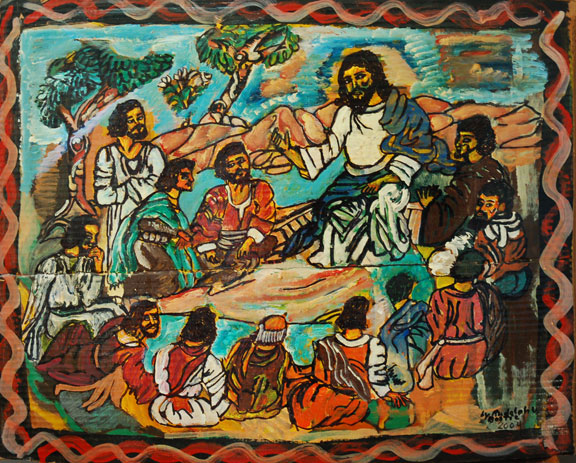
Jesus and the Disciples, by Rudolph Bostic

Jesus went up on a mountainside and called to him those he wanted, and they came to him. He appointed twelve that they might be with him and that he might send them out to preachand to have authority to drive out demons. These are the twelve he appointed: Simon (to whom he gave the name Peter), James son of Zebedee and his brother John (to them he gave the name Boanerges, which means “sons of thunder”), Andrew, Philip, Bartholomew, Matthew, Thomas, James son of Alphaeus, Thaddaeus, Simon the Zealotand Judas Iscariot, who betrayed him. (New International Version)

For me, every place in Holy Scripture is significant, even the seemingly mundane portions of it. Today’s verses might appear rather insignificant. However, there is some important meaning to recording who Christ called as his disciples and why he did it.

Jesus appointed twelve Jewish men to be his close disciples, his apostles. In choosing them, let’s not read into it something that isn’t there. This choosing, in no way, is meant to convey that church leadership boards are always supposed to have twelve men. It seems to me, that if such churches believe this, they ought to go all the way by insisting that they ought also to be Jewish Christians – no Gentiles on the election ballot at the annual meeting!

Excluding women, maintaining a particular number of people to a group, or considering only one ethnicity to leadership is nowhere to be interpreted in this text of Scripture. I can imagine Jesus sitting at the right hand of the Father raising a Spock-like eyebrow to such hermeneutical gymnastics and stating the lone word, “fascinating!”

A disciple is a follower. An apostle is one who is sent out with a specific purpose. Jesus called these particular people in order to send them out with a mission. In other words, Christ’s disciples are really missionaries. And these apostles, these missionaries, are appointed in order that they might be with Jesus, follow him everywhere, learn from him, and then have the received authority to go out and accomplish the mission given them to do.

An apostle can only properly carry out the instructions of the Teacher by first being a disciple who spends copious amounts of time in that Teacher’s presence. Indeed, if we are looking for some contemporary application in these more mundane texts of Scripture, let us find here an insight into our own Christian formation.
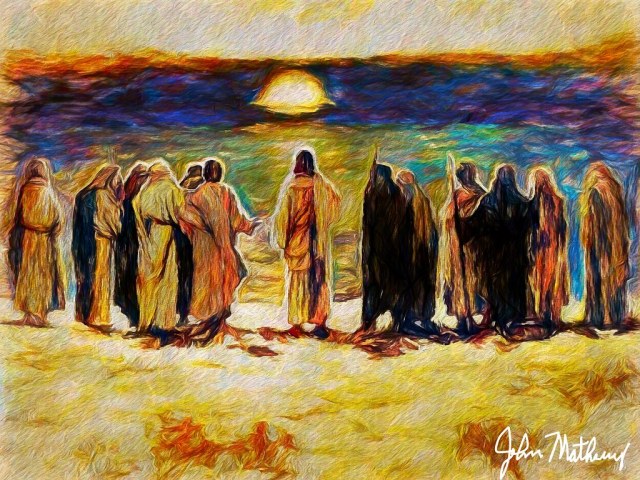
Jesus and the Disciples, by John Mathews

Christian ministry is rightly patterned after the Teacher we follow, Jesus our Lord. Christ himself demonstrated for us the way of mentoring or discipling, through his own words and actions. He called particular individuals, taught them, and equipped them for spiritual warfare in this world by granting them authority to do the work.

If we need a pattern, there it is. It’s a model of mentoring others in the ways of Christian mission and ministry. The idea is that we call, teach, equip, and authorize others in the words and ways of Jesus. I really don’t much care what you call it: Christian discipling, relational mentoring, small group teaching, spiritually forming, or any other word or phrase.

The important thing is to actually understand and do this very Christ-like work of developing mature followers of Jesus who can do the important work of spiritual warfare and ministry, then in turn, develop others. We are to pass on a body of faith and doctrine, of mission and ministry, to a group of people who will do the work. And they then do the same for others.

I rather like the word “mentoring” because for most people it evokes the idea of putting time and effort into some relationships for a specific purpose. And when we look at Christianity as a great mentoring project, perhaps we will see why church is becoming a byword in many parts of the Western world. This also ought to perhaps clue us into how we might move forward as Christians.

I am suggesting that, generally speaking, we have neglected this pattern of Jesus in calling, teaching, equipping, and authorizing. It is one large reason why there is such a decline in church attendance (and participation) in the West. And until we collectively take up this mantle of mentoring ministry, we shall continue to lessen, because we are irrelevant to people’s daily lives – both inside and outside the church.

As a first course of action, I invite you – no matter your age or stage in life – to make it a priority to simply “hang out” with individuals and groups of people. Maybe that sounds like an extrovertish sort of thing to do. However, this invitation is coming from me, an introvert. I didn’t say you have to be the life of the party, or engage in a lot of talking. But I am saying that mature followers of Jesus ought to strongly consider some intentional relationships with people other than family and a few friends.

Hang out around any given church, on any given Sunday, after any given worship service, and you are likely to see small groups of people talking with each other. Those groups typically center around friends according to age. What is often lacking are intentional interactions between the generations.  

Ethiopian Orthodox Church depiction of Christ and his disciples

The younger generations (particularly persons aged 18-29) often need and want to have relationships with more experienced (older!) believers in the faith. Younger adults, however, tend to lack the confidence to go after older adults in order to be mentored or influenced by them. I believe the onus is on the older generations to go after the younger.  

Maybe I’m just old, but it seems like younger generations have an incredible array of relationships, differing levels of friendship, and a complexity to their interactions that I didn’t have “back in my day.” What’s different, it seems, is that their relationships are more gray, and less black and white. And they appear to do a solid amount of hanging out.

Hanging out is typically sitting around with a group of people, eating and drinking, watching movies, studying (or doing bible study) or any other activity. Its doing just about anything, but doing it together with others. And this is the perfect environment for initially establishing how to begin living into the words and ways of Jesus to mentor others.

One of the things we older folks can do is to really understand the reality of younger generations’ relational interactions. For example, when I lived in a university town I used to often just “hang out” with college students, with no agenda other than just being with them. The local Perkins restaurant was at its busiest at midnight, filled with college students hanging out.

There are places in every town and city where young adults go, especially the bar scene. Bars aren’t just places to drink, but are locations of conviviality where persons have the chance to be around one another in a kind of secular church where fellowship happens, looking for a chance to relate meaningfully with others.

All people desire intimacy and want to know that someone else cares about them. This is a very real and felt need. How that need is going to be met can be either legitimate or illegitimate. And we can help with that.

One of the best things we can do for others is to communicate to them that we “have their back,” that we care, love, and genuinely like them.

No one can sniff out a disingenuous attitude quite like a young adult. So, our interactions have to be an authentic desire to be around them. Also, this does not mean we have to pretend to be younger than we are. Instead, one of the greatest needs a young person has is to be in a mentoring relationship with someone older and wiser who can help them navigate life and bring some sort of definition to relationships that they may lack.

The older generations could learn to “hang out” with younger generations and find individuals for whom they can build a solid one on one or group relationship with. If they can have such relationships now, it will serve them for a lifetime.

It seems to me that, as I look at the biblical text, being a mentor, and walking alongside another with love, grace, and wisdom, is built into Christianity by Jesus himself. So, let’s consider how we might best go about this important work.

May your love overflow more and more with knowledge and full insight to help you to determine what really matters, so that in the day of Christ you may be pure and blameless, having produced the harvest of righteousness that comes through Jesus Christ for the glory and praise of God. (Philippians 3:9-11, NRSV)

Follow Me (Mark 1:14-20)

Come Follow Me, by Jorge Cocco Santángelo 

Now after John was arrested, Jesus came to Galilee proclaiming the good news of God and saying, “The time is fulfilled, and the kingdom of God has come near; repent, and believe in the good news.”

As Jesus passed along the Sea of Galilee, he saw Simon and his brother Andrew casting a net into the sea, for they were fishers. And Jesus said to them, “Follow me, and I will make you fishers of people.” And immediately they left their nets and followed him. As he went a little farther, he saw James son of Zebedee and his brother John, who were in their boat mending the nets. Immediately he called them, and they left their father Zebedee in the boat with the hired men and followed him. (New Revised Standard Version)

For all the talk of leadership, developing leaders, and being a leader, there is precious little conversation these days about becoming a follower. Perhaps we have such a dearth of leadership for this very reason, because one can only become a good leader if they experientially know what being a follower is.

The Call of Jesus

The call of Jesus is to pursue him, and he will develop us. Follow Jesus, and he’ll show you how to fish for people. All of Christ’s original disciples listened to Jesus, dropped everything they were doing, and immediately followed him.

I am wondering what would make you drop literally everything you are presently doing to pursue an entirely new life. I am curious what would cause you to follow Jesus without any conditions attached whatsoever. 

I am impressed that Peter and Andrew immediately responded to Jesus. They didn’t question Jesus as to whether this was a short term project or a long term assignment he was calling them to. They did not seek a contract with Jesus or ask how he would impact their stock portfolio. 

The first disciples simply dropped everything and left with Jesus.

I suspect they followed Jesus for the same reason I originally decided to follow him – because Jesus is such a compelling person, so gracious, interesting, and loving, that it was really no decision at all. Everything else pales in comparison with Jesus.

Read all four Gospels and the book of Acts and you will find that believers in Jesus follow Jesus; and those who do not follow Jesus are not believers. Followers follow, and those who do not follow are not Christ’s followers.

Jesus still calls people. He calls us to follow him and he will make us fishers of humanity. Maybe you are concerned about this and say, “I have no idea how to fish for people.” The good news is that Jesus said he would make us fishers of people. Jesus is not looking for people with skills he can use; instead, he calls, then develops people into fishers.

Christ always forms people with the ability to follow his call. Jesus will train us; we only need to answer the call to follow. 

When I was five years old my Dad took the training wheels off my bike and told me to ride it. I told him I couldn’t. He told me to get on the bike and he would run beside me. I got on the bike and started to ride with him holding it. When I began to panic, approaching a tree, I started talking to my Dad. But he didn’t answer… because he wasn’t beside me. He dropped out from shagging me a long way back.

We are not called to follow Jesus based on our skills, but on the lack of them so that Jesus will do in us a work of total allegiance and loyalty to the kingdom of God. 

Jesus will make sure to develop the skills we need in order to do what he has called us to do. We only need to hear and answer the call of Jesus to follow. The following is a parable about the church and being fishers of people: 

“Now it came to pass that a group existed who called themselves fishermen. Week after week those who called themselves fishermen met in meetings and talked about their call to fish, the abundance of fish, and how they might go about fishing. They discussed the importance of fishing and that fishing is the task of every fisherman.  They listened to special speakers talk about fishing and they promoted fishing and looked at all the latest equipment for fishing. They built large buildings called ‘Fishing Headquarters’ so that they could tell as many people as possible about fishing. They organized boards of people to send out fishermen to other places. They offered teaching and classes on how to fish and the best and latest fishing methods. With much training a good many persons got their fishing licenses and became upstanding members of Fishing Headquarters. There was just one thing that they did not do: They didn’t fish. When one person dared to suggest that those who do not catch fish are really not fishermen, the group became angry and kicked that crazy person out their group.”

The Message of Jesus

Jesus said the kingdom of God is near, so repent and believe the good news. For Jesus, the word “kingdom” means God’s intentions and will for this world to come true. Jesus was saying that he is creating a new society – which meant Caesar was not Lord and that people’s loyalty was not ultimately to the Roman Empire. 

The kingdom of heaven, God’s dream society, will eventually spread across the entire earth so that the whole world is God’s sacred space, devoted to love, shaped by justice, living in peace, and abounding with wisdom.  Jesus encouraged us to pray consistent with this idea saying, “May your kingdom come and your will be done on earth as it is in heaven.” (Matthew 6:10)

If we find ourselves not really working toward Christ’s idea of kingdom, then we need to “repent and believe the good news” that God is working toward restoring all things to their original beauty and luster. The word “repent” means a change of mind which leads to a change of behavior. And “believe” means to put all your eggs in God’s kingdom basket.

None of this is a suggestion, but is rather a straightforward call to follow Jesus in his kingdom building enterprise on this earth. It would, therefore, be a travesty to simply think about the message for a while and follow Jesus if we feel like it, or get around to it.

Jesus wants to make fishers within family systems, workplaces, neighborhoods, and all the places within a typical sphere of living: This requires the following:

  1. Go where the fish are. Fishing would be easy if we could put a basket by the water and have the fish jump into them! But that is not how it works. Rather, it takes intentional activities that connect people together.
  2. Cast the nets. Peter and Andrew did more than take their boat out to the middle of the lake. To catch fish, they threw their nets into the water. Here is what I believe this means for us: We do what is fair and just to our neighbors. We extend compassion to them and are steadfast in our love, even when others are unlovely. And we do not take ourselves too seriously.
  3. Obey Jesus and walk with him. After Christ’s resurrection, Jesus came to some of the disciples, who had fished unsuccessfully all night. He told them to throw their nets on the other side of the boat – which seemed like nonsense, but they did it anyway. It resulted in a great catch (John 21:1-14). During the three years of Christ’s earthly ministry, the disciples did everything with him – they walked, talked, and ate with Jesus. And when he ascended to heaven, they acted on the Great Commission given to them by Jesus to make other disciples.

May God cleanse our lips and our lives so that we might proclaim the good news of Christ’s kingdom with glad and sincere hearts to the glory of Father, Son, and Spirit.

Eternal God, the refuge and help of all your children, we praise you for all you have given us, for all you have done for us, for all that you are to us. In our weakness, you are strength, in our darkness, you are light, in our sorrow, you are comfort and peace. We cannot number your blessings; we cannot declare your love: For all your blessings we bless you. May we live as in your presence, and love the things that you love, and serve you in our daily lives, through Jesus Christ our Lord. Amen.

Baptism of the Lord (Mark 1:4-11)

The Baptism of Jesus, by Rosalind Hore

So John the Baptist showed up in the desert and told everyone, “Turn back to God and be baptized! Then your sins will be forgiven.”

From all Judea and Jerusalem crowds of people went to John. They told how sorry they were for their sins, and he baptized them in the Jordan River.

John wore clothes made of camel’s hair. He had a leather strap around his waist and ate grasshoppers and wild honey.

John also told the people, “Someone more powerful is going to come. And I am not good enough even to stoop down and untie his sandals. I baptize you with water, but he will baptize you with the Holy Spirit!”

About that time Jesus came from Nazareth in Galilee, and John baptized him in the Jordan River. As soon as Jesus came out of the water, he saw the sky open and the Holy Spirit coming down to him like a dove. A voice from heaven said, “You are my own dear Son, and I am pleased with you.” (Contemporary English Version)

Why is the baptism of Jesus important?    

The baptism of the Lord is a regular staple each year on the Christian Calendar, because Christ’s baptism is a theologically profound event that announces the fact of his divinity in a dramatic way. The story of his baptism helps us understand Christ’s identity, as well as his mission.

Because God the Father acknowledged Jesus as God the Son, we are encountering God’s will for us through the words and actions of Christ. Jesus is the hinge upon which all history turns. The centrality of Jesus for everything we say and do is confirmed and expected through the event of his baptism.

Baptism is a ritual that signals new life. Jesus came to be baptized by John in the Jordan River – not because he personally needed to repent of sin – but so that he might identify with us as humans and signal for us the true way of life for people.

Jesus’ Baptism, by Laura James

With the Father’s affirmation of Christ, the Lord Jesus is our authority. All authority on heaven and earth has been given to him. He is the author and finisher of our faith. So we must pay careful attention to Jesus.

Here we are, two millennia removed from the earthly ministry of Christ. For some, the name of Jesus might be so familiar that they end up ignoring him. Or, others might become so disappointed with Jesus that, over time, they simply slip away from him. That’s why the author of the book of Hebrews exhorted: 

We must give our full attention to what we were told, so we won’t drift away. The message spoken by angels proved to be true, and all who disobeyed or rejected it were punished as they deserved. So if we refuse this great way of being saved, how can we hope to escape? The Lord himself was the first to tell about it, and people who heard the message proved to us that it was true. (Hebrews 2:1-3, CEV)

By remembering our own baptisms, and the authoritative claim Christ has upon us, we are able to keep what is most important in front of us at all times.

Why is the descent of the Holy Spirit significant?

If God the Father established the authority of Jesus over all things, then the Holy Spirit coming upon Jesus empowered him to exercise that authority over everything, especially the demonic realm. Jesus was given the Spirit so that he would confront evil in the world.

Our own baptisms are a participation in the baptism of Christ. We receive the same power. We are called to the same practice of self-denial in order to confront evil in our lives and in the world. The descent of the Spirit in Christ’s baptism opens to us a road of carrying our cross daily, and losing our lives in order to save them.

In Christ, we died to guilt and shame. We were baptized into Christ, and were therefore baptized into his death.  That means Jesus has opened the way for us to live a new life and no longer be slaves to sin. It furthermore means that we have been given the Spirit to deal with the continuing presence of sin in this life. 

Through Jesus Christ the Spirit of life set us free from sin and death. Therefore, we have been given the power to resist the devil and set our minds on what the Spirit desires. 

Baptism of Christ, by He Qi

So, we have an obligation, and it’s not to the sinful nature. Our responsibility is to put to death the misdeeds of the body. We can do this because we have not been given a spirit that makes us slaves to fear, but have received the spirit of sonship. (Romans 8:1-17)

Thus, God is not only Father of Jesus, but our Father, as well. We can cry “Abba and have all the help of heaven behind us in our quest to follow Jesus. This is all possible because of the descent of the Spirit in Christ’s baptism – a baptism that we participate in through our own baptisms.

How does heaven opening help me today?

Heaven was ripped and torn open, letting us know the striking reality that God does not remain far away, but has come near to us in the Son, the Lord Jesus.

Long ago in many ways and at many times God’s prophets spoke his message to our ancestors. But now at last, God sent his Son to bring his message to us. God created the universe by his Son, and everything will someday belong to the Son. God’s Son has all the brightness of God’s own glory and is like him in every way. By his own mighty word, he holds the universe together. After the Son had washed away our sins, he sat down at the right side of the glorious God in heaven. (Hebrews 1:1-3, CEV)

Heaven was again ripped open at the death of Christ. The curtain of the temple that separated the inner sanctuary from everything else was torn in two from top to bottom – signifying that once and for all, God is near, and has become close to us in the person of Jesus Christ.

So whenever we are in need, we should come bravely before the throne of our merciful God. There we will be treated with undeserved grace, and we will find help. (Hebrews 4:16, CEV)

What is our appropriate response to the baptism of the Lord?

Since Jesus is the rightful ruler of the universe; the authority over all things; a faithful high priest always living to intercede for us; the power to transform and give new life; the Deliverer from sin, death, and hell; then our proper response is confession, repentance, and the expectation of change.

The Lord’s baptism exposes all the things we rely upon other than Jesus, such as our own ability to set goals and accomplish them through sheer willpower; ideas and ingenuity; hard work and experience.

Yet we can rely on Jesus, and have the sort of change that he can bring. Rather than expecting everyone else, and every circumstance to change, God calls us to change through the empowering presence of the Holy Spirit – the same Spirit given to Jesus.

We have the opportunity and the invitation to trust Jesus. Just as it took humility for Jesus to be baptized by John in the Jordan River, so it takes humility for us to come to Christ and admit our need for help and inner transformation.

Almighty ever-living God,
who, when Christ had been baptized in the River Jordan,
and as the Holy Spirit descended upon him,
solemnly declared him your beloved Son,
grant that your children by adoption,
reborn of water and the Holy Spirit,
may always be well pleasing to you. Amen.

Jesus the King (Mark 11:1-11)

Entry Into the City, by John August Swanson (1938-2021)

As they approached Jerusalem and came to Bethphage and Bethany at the Mount of Olives, Jesus sent two of his disciples, saying to them, “Go to the village ahead of you, and just as you enter it, you will find a colt tied there, which no one has ever ridden. Untie it and bring it here. If anyone asks you, ‘Why are you doing this?’ say, ‘The Lord needs it and will send it back here shortly.’”

They went and found a colt outside in the street, tied at a doorway. As they untied it, some people standing there asked, “What are you doing, untying that colt?” They answered as Jesus had told them to, and the people let them go. When they brought the colt to Jesus and threw their cloaks over it, he sat on it. Many people spread their cloaks on the road, while others spread branches they had cut in the fields. Those who went ahead and those who followed shouted,

“Hosanna!”

“Blessed is he who comes in the name of the Lord!”

“Blessed is the coming kingdom of our father David!”

“Hosanna in the highest heaven!”

Jesus entered Jerusalem and went into the temple courts. He looked around at everything, but since it was already late, he went out to Bethany with the Twelve. (New International Version)

We are presently in the 12 Days of Christmas (December 25–January 5), the annual celebration of Christ’s birth on the Christian Calendar. It may seem odd that the Revised Common Lectionary daily readings have included a text associated with Palm Sunday. However, this is reminder to us that Jesus was born a king – which is why old King Herod saw a little baby as such a threat. (Matthew 2:1-18)

“Christ” is not the surname of Jesus, but instead is a title, meaning “anointed one.” In other words, in the New Testament Gospels, Jesus is referred to as an anointed king. It was broadly understood, within the religious milieu of the ancient Jews, that the Messiah (the Hebrew term for Christ) would come and beat up God’s enemies, restore God’s people to their former glory, and usher in an everlasting state of peace.

Jerusalem had a history as the royal city – the place where ancient Jewish kings lived and ruled. So, most ancient Jews made a clear connection between the Messiah, the king, returning to reign in Jerusalem. They anticipated that the City of David would once again be the seat of power, without any meddling Gentiles to complicate things.

Nativity, by John August Swanson

So, when Jesus entered Jerusalem – in what turned out to be the final week of his earthly life – many people looked upon this as a triumphal entry. He was close to ascending the ancient throne. The disciples of Jesus were waiting for this, and ready for a future of greatness and glory alongside their Rabbi.

Not only did people lay their palm fronds on the road in front of him declaring the ancient refrain, “Blessed is he who comes in the name of the Lord!” (Psalm 118:26) but they also added an explicit reference to the days of King David stating, “Blessed is the coming kingdom of our ancestor David!” The city was awash in the messianic hope of no longer being subject to foreign rule.

Yet we know the tragic and ironic end of the week. Jesus knew it, too, even at the time. He knew what fate awaited him by entering Jerusalem (Mark 8:31; 10:33-34). And Jesus knew without a shadow of a doubt that he was not going to be a king who gains and keeps power through military might and the bloodshed of war. Instead, only his own blood would be offered, as a sacrifice for many. The power of Love will overcome any and every earthly power.

Those with the eyes to see and the spirit to discern could understand this Jesus riding on a humble donkey instead of the proud warhorse. It made complete sense. Jesus did not enter this world with the fanfare of the rich and powerful, but quietly slipped onto the earth in a non-descript and poor Jewish family. His birth, life, and ministry, were all counter cultural. So, why not also his eventual death, resurrection, ascension, and glorification?

Yes, Jesus is a king. But no, he is not a king in any conventional sense. It is Jesus, beginning with his incredible and unexpected incarnation, who helps us reimagine what power and authority can and ought to look like.

All the trappings of control we can get so enamored about, such as wielding influence through economic wealth, social status, political power, and religious weight, all get tossed aside as mere stuffed animals compared to the real deal of moral dignity, ethical love, and compassionate justice shown to people who had absolutely no ability to either pay back Jesus or prop up a throne for him to sit upon.

Jesus is a king who gives his life for the healing of humanity – all people everywhere – including the ones we don’t much like or care about. I have no problem calling Jesus a king, just as long as we understand what sort of kingship we are actually talking about.

I serve King Jesus because he throws a monkey wrench into oppressive systems that seek to keep other people under a heavy hand of injustice. My allegiance is with Christ the Lord because he uses his prodigious authority to bring peace, light, wholeness, and integrity to all the places of the world (and the human heart) that are dark and clueless.

Today I celebrate in this Christmas season the birth of a baby who was born to die to the world and for the world. I rejoice with the angels that Christ is born in Bethlehem, the king of kings and lord of lords, the prince of peace who himself became peace so that we might live in peace.

May you discover deliverance from guilt, shame, and regret, through the One who came and was wounded for us so that we might be healed. Amen.