Luke 6:27-31 – Love Your Enemies

“But to you who are listening I say: Love your enemies, do good to those who hate you, bless those who curse you, pray for those who mistreat you. If someone slaps you on one cheek, turn to them the other also. If someone takes your coat, do not withhold your shirt from them. Give to everyone who asks you, and if anyone takes what belongs to you, do not demand it back. Do to others as you would have them do to you.” NIV)

“Maturity is looking at every person we meet and saying to yourself, ‘I will never, God helping me, do anything to harm you: not by angrily lashing out at you, lusting over you, faithlessly slipping away from you, verbally hitting back at you, or even justifiably disliking you.’”

–Frederick Dale Bruner

Here are a few rhetorical questions, considering the astounding words from Jesus to love enemies: Have you ever had someone not like you?  Offend you? Purposely say or do things that upset you? I once had a next-door neighbor who was plain mean. Once, when my dog accidentally strayed into her yard and left a package, she picked it up and placed the package directly in front of my backdoor. 

When such things happen, it is tempting to respond in kind with the same behavior as the obnoxious person.  Many of us have sly passive aggressive tendencies of getting back at others when they do or say offensive things, and we consider them an enemy.

The situation with my neighbor was frustrating, yet quite benign. It is an entirely different matter trying to love someone who has deeply hurt us. Their words of malice or actions of abuse are evil, and we naturally seek to defend and respond by hurting them back. This is no trite saying of Jesus to proclaim that we are to love the enemy. It will be hard to love a villain apart from the grace of God, and Jesus knew what he was asking of us.  He does not ask of us anything that he himself has not already done.

We are often pleased with ourselves if we love our family and friends, because even that is a struggle for us, at times. We need to treat all people with respect and kindness, even active love, because that is what God does.

Jesus did not say anything new in calling for neighbor love. The Old Testament clearly says to do so: 

You must not take revenge nor hold a grudge against any of your people; instead, you must love your neighbor as yourself; I am the Lord. (Leviticus 19:18, CEB)

Nowhere in the Old Testament does it say to hate your enemy. However, over time, the idea became popular that if we are told to love our neighbor, then we must hate our enemy (who is not our neighbor). Jesus was once asked, “Who is my neighbor?” He responded by telling the parable of the Good Samaritan. The conclusion to that parable is that everyone I encounter is my neighbor, and so must be shown mercy when they are in need. (Luke 10:25-37)

Jesus let us know that when we walk in the way of love, we will sometimes be treated harshly by the world (Matthew 5:10-12).  When that happens, Christ says we must not exact revenge or retaliate. Even more, we are to respond with overt gestures of love, rather than simply ignoring them.

We are to pray for our enemies. It is hard to hate someone or a group of people when we are devoted to praying for them. Pray the Spirit would open their eyes so they can see the error of their way. Make sure to leave the judgment to God, for that is divine business, not ours.

We are to love because God loves. To love those who offend us emulates God’s benevolence. When we love our enemies, without expecting anything in return, we imitate God’s character as children of God:

Watch what God does, and then you do it, like children who learn proper behavior from their parents. Mostly what God does is love you. Keep company with him and learn a life of love. Observe how Christ loved us. His love was not cautious but extravagant. He did not love to get something from us but to give everything of himself to us. Love like that. (Ephesians 5:1-2, MSG)

If we have no love for our enemies, then we are no different from them. Christians are to be distinctive because of the way they treat others, especially outside the faith. We are to model our lives after God’s love, not by the standard of niceness to those who are nice to us. God does not expect us to live as followers of Jesus by only showing reciprocity, that is, just giving back to those who already have given something to us. Instead, we give even when we are persecuted. We do this because God shows no distinction in the distribution of sunshine and rain. Showing basic respect and goodness to all people, no matter who they are, can be God’s rain and sun toward others.

“To return evil for good is devilish. To return good for good is human. To return good for evil is divine. To love as God loves is moral perfection.” Alfred Plummer

Grace, undeserved kindness, is not something we can just conjure up, as if we might will ourselves to love our enemies. It is not natural – it is supernatural, and so must come from a supernatural Being. 

During World War II, a Lutheran pastor, imprisoned in a German concentration camp, was tortured by an S.S. officer who wanted to force him to a confession.  The pastor did not respond to the torture.  His silence only enraged the officer to such a degree that he hit the pastor harder and harder until he finally exploded and shouted at him, “don’t you know that I can kill you!?”  The pastor looked him the eye and said, “Yes, I know – do what you want – but I have already died.”  At that point, the officer lost power over the pastor.  All of the officer’s cruelty had been based on the idea that the pastor would hold onto his life as his most valuable property and would be willing to give a confession in exchange for his life.  But with the grounds for his violence gone, torture had become a ridiculous and futile activity.

Our human relationships may easily become subject to verbal violence, bitterness, and destruction, when we make enemies of each other and treat people as properties to be defended or conquered instead of precious gifts to be received. If we have nothing to defend, then we have no enemies who can harm us.

Jesus, Prince of Peace,
you have asked us to love our enemies 
and pray for those who persecute us.
We pray for our enemies and those who oppose us.

With the help of the Holy Spirit, 
may all people learn to work together 
for the justice which brings true and lasting peace.
Holy Spirit of God, we ask you for the strength and the grace to love those who harm us, that we may shine as beacons of Christian light in a world of revenge, retaliation, and darkness.

We pray for those who have hurt us.
Bless them always and in every way, Lord.

We pray for those who hate us.
Bless them always and in every way, Lord.

We pray for those who insult us.
Bless them always and in every way, Lord.

We pray for those who have stolen from us.
Bless them always and in every way, Lord.

We pray for those who will not hear us.
Bless them always and in every way, Lord.

We pray for those who have hurt our church.
Bless them always and in every way, Lord.  Amen.

Christmas Eve – All I Want for Christmas is Faith

Luke 1:26-38 tells us what led to the observance of Christmas Eve, the holy night for Christians everywhere. Nothing is outside the power of God to accomplish the impossible. Click the videos below and we will remember and observe the coming of the Christ child…

Josh Groban – O Holy Night
Silent Night – Concordia Christmas Concerts, 2016

May the joy of the angels, the eagerness of the shepherds, the perseverance of the Magi, the obedience of Joseph and Mary, and the peace of the Christ child be yours this Christmas. And the blessing of God almighty, the Father, the Son, and the Holy Spirit, be upon you and remain with you always.  Amen.  

All I Want for Christmas Is Faith

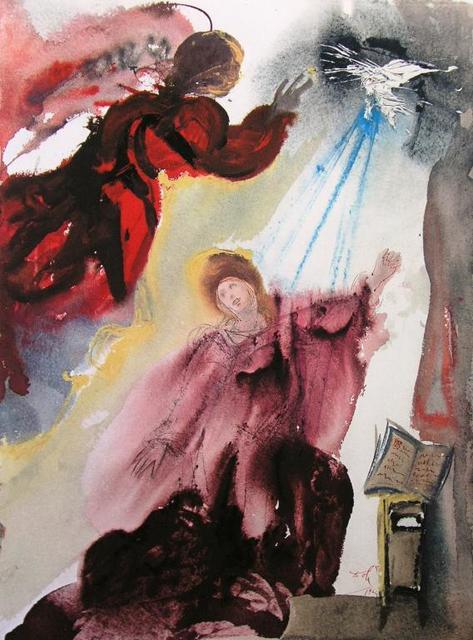
Annunciation to Mary by Salvador Dali, 1965

In the sixth month, God sent the angel Gabriel to Nazareth, a town in Galilee, to a virgin pledged to be married to a man named Joseph, a descendant of David.  The virgin’s name was Mary.  The angel went to her and said, “Greetings, you who are highly favored!  The Lord is with you.”

Mary was greatly troubled at his words and wondered what kind of greeting this might be.  But the angel said to her, “Do not be afraid, Mary, you have found favor with God.  You will be with child and give birth to a son, and you are to give him the name Jesus.  He will be great and will be called the Son of the Most High.  The Lord God will give him the throne of his father David, and he will reign over the house of Jacob forever; his kingdom will never end.”

“How will this be,” Mary asked the angel, “since I am a virgin?”

The angel answered, “The Holy Spirit will come upon you, and the power of the Most High will overshadow you.  So, the holy one to be born will be called the Son of God.  Even Elizabeth your relative is going to have a child in her old age, and she who was said to be barren is in her sixth month.  For nothing is impossible with God.”

“I am the Lord’s servant,” Mary answered.  “May it be to me as you have said.”  Then the angel left her. (Luke 1:26-38, NIV)

Most of life is lived in the mundane, even in a time of pandemic. For the most part our everyday lives involve going about our business and dealing with the daily grind. That is because we are common ordinary people. So, we can especially relate to Mary because she is quite plain. 

To put Mary’s life in our contemporary vernacular, at the time of this encounter with the angel, she is of junior high age but has never attended school. She wears mostly clothes from Goodwill, and occasionally can get some from Wal-Mart. She cannot read because girls of her day rarely did. Her parents make all the decisions that affect her life, including the one that she should be married to an older man named Joseph. We do not know if she even liked him. She lives in a small town that most people cannot point to on a map. 

One night, into the bedroom of this young girl comes the brightly beaming divine messenger Gabriel whose name means, “God has shown himself mighty.” Mary stands there in her ratty old flannel nightgown, her life very quickly moving from the ordinary to the extraordinary. The juxtaposition could not be more pronounced:  a mighty angel and a plain teen-ager; a messenger of the Most High God and a girl barely past puberty; a holy angelic light which beams in a simple candlelit bedroom; an awesome power encountering complete vulnerability.

Annunciation by Mexican painter Angel Zárraga (1886-1946)

Mary, compared to Gabriel, is defenseless, fragile, and overwhelmed. She is in way over her head. That is why we can relate to her. We can get our human arms around Mary. She is like us. She has faced life with little power to make it turn out the way she planned. Forces beyond her have rearranged her life and altered it forever. She is the Matron Saint of the Ordinary. We can totally understand why Mary responds the way she does.

Mary’s initial reaction was to be “greatly troubled.”  She was disturbed and shaking in her hand-me-down slippers. The angel confidently told Mary that she had found favor with God. In other words, Mary was literally “graced” by God. The situation was not that Mary had some extreme spirituality, but that God simply chose her to be the mother of Jesus. And Mary needed to come to grips with what was happening to her.  This was well beyond anything she could have expected.  Becoming pregnant with the Savior of the world was not even remotely on her radar. 

Mary immediately sensed the crazy disconnect between what was being told to her and who she was. After all, she was a plain ordinary girl from the hick town of Nazareth and was being told that she would raise a king.  Maybe somebody in heaven screwed up. Maybe Gabriel got the wrong girl. Maybe his Google map sent Gabriel on a wild goose chase. Relating to Mary, we can totally understand that she would question how in the world all this was going to happen.  Not only is Mary ordinary and far from royalty, but she is also very much a virgin.  Nothing about any of this made any sense.

But the angel let Mary know that God specializes in the impossible. English translators chose to phrase the original rendering of Gabriel’s words as “for nothing is impossible with God.” I rather prefer the more literal translation which is “for there is nothing outside of God’s power.” To me, that is beautiful. There is nowhere we can go, no place on earth, no situation whatsoever that is beyond God’s ability and reach to affect divine power.

We do not always get straightforward answers to our questions about God, but Mary asked a question and got a straight answer: She really can be pregnant with Jesus because the Holy Spirit will come upon her, will overshadow her with power. If the story were to end there it would be a great story. But to me the most astonishing part of the narrative is Mary’s response to what was happening to her.

Mary believed the message and submitted herself completely to God’s will. I think we would completely understand if Mary simply said in her ordinary way that she was not prepared for this. We would totally “get it” if Mary pushed back on what the angel said to her. We could relate if Mary just dismissed the angel’s presence, like Scrooge in the Christmas Carol, as if Gabriel were just “an undigested bit of beef, a blot of mustard, a crumb of cheese, a fragment of an underdone potato. There’s more of gravy than of grave about you, whatever you are!”

Yet, Mary not only believed; she also humbly submitted herself to what was happening. And this is what I believe we need to relate to most about Mary – not her being just a plain ordinary person in a non-descript village but stepping up to the calling she received. We, too, have received a calling in our lives. We, too, have been given the power of the Holy Spirit.  We, too, are ordinary people who have been given a very extraordinary task. 

Our response today can be the same as Mary: “I am the Lord’s servant; may it be to me as you have said.” The Church is pregnant with possibilities because of the Holy Spirit. We know the end of Mary’s story. She gave birth to Jesus. She raised him in her plain ordinary way. She watched him grow up. She saw him embark on his ministry to proclaim the kingdom of God has become near. Mary did not always understand what Jesus said or what he was doing. And she experienced every mother’s nightmare in seeing her beloved son killed in a terribly gruesome manner right in front of her eyes. 

Yet, just as the Holy Spirit was with the birth of Jesus, so the Spirit was with Jesus at his resurrection from the dead. Jesus lived an ordinary life in a very extraordinary way. Furthermore, today Jesus invites us to do the same. Because Christ accomplished his mission of saving people from their sins and establishing a kingdom that will never end, he has given us the same Holy Spirit to follow him forever and call other people to follow him, too. 

To trust and obey is God’s only way to live into the life of Jesus. The Christian life may often be difficult, but it is not complicated. It is rather simple, just like Mary. Mary responded to God’s revelation with faith, choosing to fully participate in what God was doing. “I am the Lord’s servant” is our confession, as well. Along with Mary we declare, “May it be to me as you have said.”

Luke 1:46-55 – Mary’s Magnificat

The Magnificat, a woodcut by Sr. Mary Grace Thul

Mary responded,

“Oh, how my soul praises the Lord.
    How my spirit rejoices in God my Savior!
For he took notice of his lowly servant girl,
    and from now on all generations will call me blessed.
For the Mighty One is holy,
    and he has done great things for me.
He shows mercy from generation to generation
    to all who fear him.
His mighty arm has done tremendous things!
    He has scattered the proud and haughty ones.
He has brought down princes from their thrones
    and exalted the humble.
He has filled the hungry with good things
    and sent the rich away with empty hands.
He has helped his servant Israel
    and remembered to be merciful.
For he made this promise to our ancestors,
    to Abraham and his children forever.” (NLT)

Mary’s great song of praise, having grasped the reality of being pregnant with the Messiah, affirmed that the all-powerful God “has done great things for me.”  Indeed, the Lord shows mercy to everyone who worships and adores such mighty acts. It strikes me that Mary, instead of being full of worry and afraid of the future, and as an unmarried teen with child, is full of the Spirit and faith.  Mary neither complained nor fretted for the nine months of her pregnancy; she praised God and was clear-headed about the grace shown to her.

Mary’s canticle gives us insight into the mystery of the incarnation: God chooses the weak, those of low esteem, and the powerless. Mary was quite ordinary for her day. She had no wealth and nothing which would cause anyone to pick her out of a crowd. Yet, she is the one chosen by God. And her wonderful response to grace demonstrated that there is so much more to any person than what we can see with our eyes and perceive through our earthly glasses of high positions and strength of personalities.

What is more, Mary had the wisdom to discern that her situation typified the Lord’s egalitarian work of leveling the field so that all persons have what they need. Her son, the Messiah, would carry this into his own life and ministry – declaring good news to the poor, comforting the brokenhearted, proclaiming freedom for captives, telling those who mourn that the time of the Lord’s favor has come.

God is full of grace, mercy, and power to those who are powerless and in need of help. The Lord has our backs. Perhaps if we all, both individually and corporately, continually used our words to identify and declare the great things God has done we would realize the consistent blessing of the Lord. 

I encourage you to take some time today and journal the ways in which God has been good to you in this Advent season, and like Mary, offer praise for each act of mercy. Mary exhibited no helplessness but had her heart calibrated to detect the grace of God when it was present.

Great and mighty God, I will praise you with all my heart.  You care for me and always show mercy to those who worship you.  Fulfill all your good promises in me, and in all your people, for the sake of your Son, the Lord Jesus.  Amen.