Luke 8:4-15 – Christ’s Parable of the Soils

While a large crowd was gathering and people were coming to Jesus from town after town, he told this parable: “A farmer went out to sow his seed. As he was scattering the seed, some fell along the path; it was trampled on, and the birds ate it up. Some fell on rocky ground, and when it came up, the plants withered because they had no moisture. Other seed fell among thorns, which grew up with it and choked the plants. Still other seed fell on good soil. It came up and yielded a crop, a hundred times more than was sown.”

When he said this, he called out, “Whoever has ears to hear, let them hear.”

His disciples asked him what this parable meant. He said, “The knowledge of the secrets of the kingdom of God has been given to you, but to others I speak in parables, so that,

“‘though seeing, they may not see;
    though hearing, they may not understand.’

“This is the meaning of the parable: The seed is the word of God. Those along the path are the ones who hear, and then the devil comes and takes away the word from their hearts, so that they may not believe and be saved. Those on the rocky ground are the ones who receive the word with joy when they hear it, but they have no root. They believe for a while, but in the time of testing they fall away. The seed that fell among thorns stands for those who hear, but as they go on their way they are choked by life’s worries, riches and pleasures, and they do not mature. But the seed on good soil stands for those with a noble and good heart, who hear the word, retain it, and by persevering produce a crop. (New International Version)

The Parable

“Whoever has ears, let them hear,” said Jesus. Truly hearing Christ’s words and listening with focused attention is paramount to the Christian life. Our ears are the soil of our lives. Ears attentive and devoted to listening to Jesus are good soil; ears distracted, inattentive, and stopped up with ear wax are bad soil. Receptive listening to the Word of God brings a fruitful harvest of righteousness, peace, and joy in the Holy Spirit. Genuinely believing what we hear from Jesus is crucial. God’s Word falls on four different soils….

  1. The seed on the path. A path is for walking, which is why the seed never takes root. Here there is no listening. When we act without listening, our actions will be misguided. 
  2. The seed on rocky soil.  Here there is no deep listening. A lack of attentive hearing results in a shallow person who perhaps relies more on Christian clichés or on their personality or abilities instead of the sown Word.
  3. The seed on the thorny soil. Here there is significant listening. However, there is too much listening to a cacophony of voices and not enough singular listening to the sown Word. Listening to the wrong voices will cause an unfruitful life. So, we must be careful to whom we are listening.
  4. The seed on good soil. A devoted listening to the Word without distraction leads to a productive, fruitful believer.

“There is a difference between listening and waiting for your turn to speak.”

Simon Sinek

The Nature of Parables

A parable is a genre of biblical literature. Parables are as much about concealing truth as they are conveying truth. A person must give focused attention to the story to learn from it, much like a good novel conveys truth about the human condition without being preachy or outright saying the truth. Or it’s much akin to a good movie relying on character development and the power of story for its message, instead of being a straightforward documentary.

Jesus neither strong-arms people nor puts them in a full nelson to force them into God’s will. We will miss out on God’s working, if we are looking for a big dramatic hoo-ha of an event. That’s because it comes as an awareness within people and works its way out. For those not intent on changing, they will find Christ’s words confusing. They might “hear” Jesus, yet fail to really listen, since they have their own ideas about how God ought to operate.

Yet, grace is still present. The very fact that Jesus addressed the crowd of people demonstrates he cared enough to communicate. He could have said, “Hey, you guys, get lost, I’m just going to interact with people who really listen to me.” Instead of coming at the crowd and bursting through the front door, Jesus mercifully came to them through the side door so that they would be able to receive the message. 

Puking the good news of Jesus all over people without really listening is a bad idea. Neither is being worried about saying something offensive, so nothing is said at all. A better approach is asking permission to tell your story of what Jesus means to you, or what you are learning from God’s Word.
The Parable Interpreted

The focus is the experience of the seed in a variety of soils. Outside powers acting on the Word – devouring birds, rocks, the burning sun, choking thorn-bushes – demonstrate the Word is central and needs to be received well:

  1. The path is the inability to hear God’s Word because of hard-heartedness. The devil snatches it before any real understanding can take place.
  2. The rocky soil is hearing just enough to respond with joy. But the person drops out when hard circumstances occur. “I didn’t sign up for this!” is their cry. They needed to count the cost of discipleship before responding to the message. This is merely a professing Christian, nothing more.  Rather than listening and internalizing the Word, there is only positive affirmation without any action or practice. So, tomorrow the message is gone and forgotten. When difficulty comes, there are no supporting words to draw from, so the person fades away, unable to navigate life successfully.
  3. The thorny soil also hears and responds to the message. This person is also a professing Christian, nothing more. The issue here is that they also listen to voices of worry and wealth. In a sort of spiritual attention-deficit-disorder, there is no ability to filter all the voices calling out, and so, no growth.
  4. Listening with the intention of understanding and putting into practice the message heard is what brings about fruit. Receiving the Word through careful listening brings about spiritual growth. God brings the growth when we focus on the Word. And when a whole group does this, then it creates a greenhouse effect in which people cannot help but grow in the Lord.

Conclusion to the Parable

The simple reception of God’s Word leads to fruitfulness. The first soil did not receive the Word, though it listened. The second received it with joy but under pressure let it go. The third received it with only one hand because the other hand was busy. Only the fourth soil received the Word with both hands.

Blessed is the one who does not walk in step with the wicked or stand in the way that sinners take or sit in the company of mockers, but whose delight is in the law of the Lord, and who meditates on his law, day and night. That person is like a tree planted by streams of water, which yields its fruit in season and whose leaf does not wither—whatever they do prospers. (Psalm 1:1-3, NIV)

The old adage that we were created with two ears and one mouth, so that we will listen twice as much talk, is a truism. It’s hard to receive any words of encouragement, help, or reproof if you’re tongue is flapping in the wind.

Careful listening, attention to memory, and patient application are the pathways to realizing an abundant spiritual harvest of righteousness and peace.

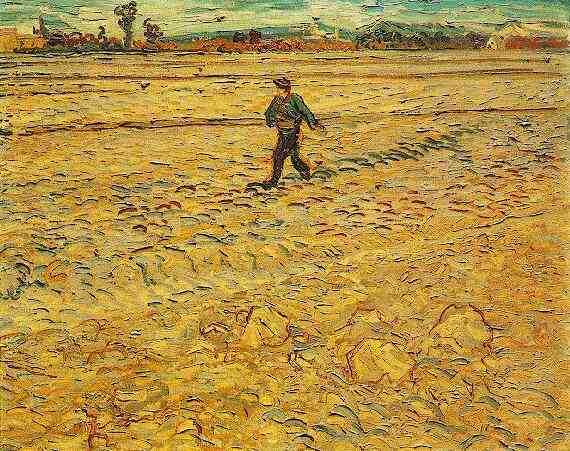
*Above paintings, The Sower by Vincent Van Gogh, 1881 & 1888

Luke 22:24-30 – Just Shadow Jesus

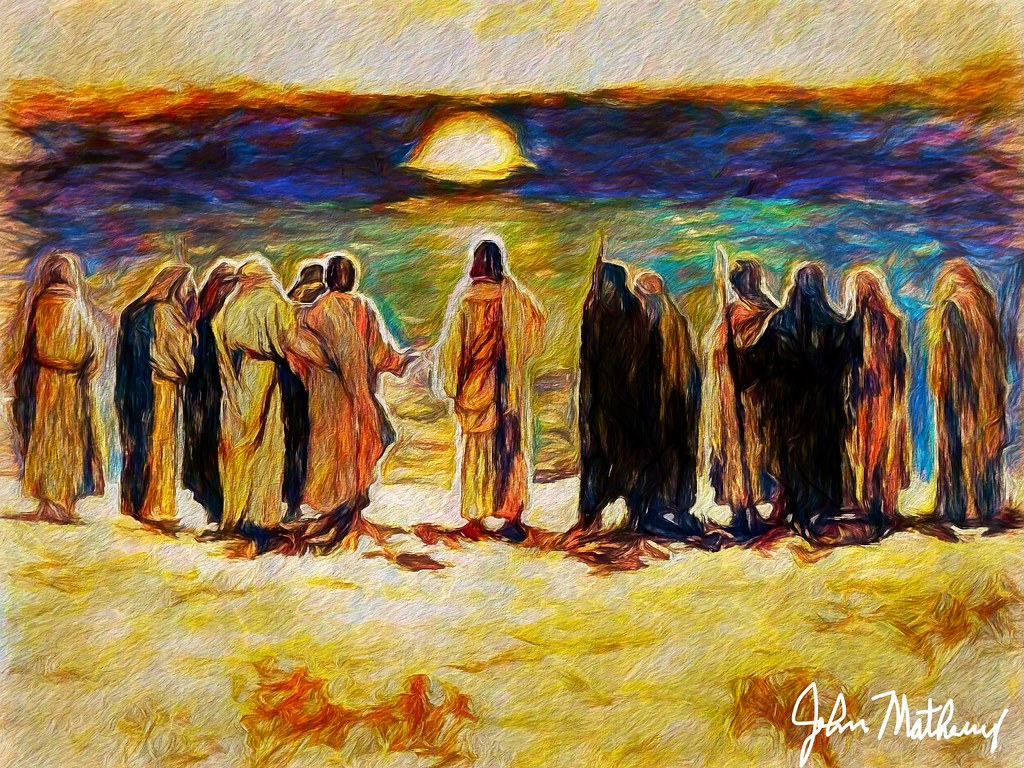
Digital painting of Jesus and the disciples by John Mathews

A dispute also arose among them as to which of them was considered to be greatest. Jesus said to them, “The kings of the Gentiles lord it over them; and those who exercise authority over them call themselves Benefactors. But you are not to be like that. Instead, the greatest among you should be like the youngest, and the one who rules like the one who serves. For who is greater, the one who is at the table or the one who serves? Is it not the one who is at the table? But I am among you as one who serves. You are those who have stood by me in my trials. And I confer on you a kingdom, just as my Father conferred one on me, so that you may eat and drink at my table in my kingdom and sit on thrones, judging the twelve tribes of Israel. (NIV)

Jesus is a different sort of leader.

While the kings of his day were concerned with power and using their authority to ensure even more power and privilege, Jesus went about things differently. In a world of patronage where it was necessary for the lower classes to connect with and suck-up to the higher classes, Jesus operated by a different system.

Jesus, Lord of the universe, King of creation, absolute Leader of the Church, and Ruler over God’s realm was and is a servant of the people.

“Follow my example: Even the Son of Man did not come for people to serve him. He came to serve others and to give his life to save many people.”

mark 10:45, erv

On the surface, striving to be the best might seem noble and good. Yes, working toward being the greatest might motivate us to do all things with excellence. It can solve a lot of problems and issues. On the other hand, it may also result in attitudes and behavior which fosters unhealthy competition and an inordinate focus on becoming the greatest.

Think about it. Not everyone can be the greatest. If everyone is, nobody is. This results in lower self-esteem for nearly everybody. And it creates ripe conditions for leadership paranoia in which the greatest is always looking over their shoulder worrying about being toppled from their lofty position. At the least, all this ballyhoo about greatness only takes away from caring for the people who most need our efforts – family members get the shaft from someone with an imbalanced life who is laser-focused on getting to the top and staying there.

It’s as if a person is living a one-dimensional existence in a three-dimensional world. It won’t work. Fortunately, we don’t have to live like that.

Jesus shows us a better way.

Jesus was present to his disciples. He is present to us in the person of the Holy Spirit. Christ encouraged relational connections and using one’s gifts, talents, and abilities for the common good of all people. For Jesus Christ, the dynamics of power and authority are not to be leveraged for personal greatness but for collective uplift. Authority is to be carefully applied for everyone’s benefit, including those we think don’t deserve it.

The disciples understood far too little about the community their leader was trying to build. Judas Iscariot is likely the one disciple who first realized what Jesus was truly up to. The greatest are the least and the least are the greatest. It wasn’t what Judas signed up for, so he cut his losses and betrayed Jesus.

True exaltation is a gift of grace. The kingdom of God turns on mercy and operates on the economy of grace. It is those who faithfully serve who will sit with Jesus, the ultimate Servant, at the table. Peacocks and pretenders will never realize their dream to be the center of attention.

In a great twist of irony, those who wish to compete and occupy a high standing will discover they have worked to obtain the lowest rung on the ladder leaning against the wall of Satan’s kingdom.

Jesus consistently, patiently, and carefully established the kingdom of God on earth. He went about his task in a manner none of us would even consider. He focused on character, not skills; willing hearts, not intelligent brains; new life, not reformed habits. On the job orientation involved following Jesus around everywhere.

Just shadow Jesus.

Here I am washing your feet. Do the same. Here I am being present to and serving the poor, the lonely, the outcast, the moral failure, and the lowest of society. Do the same. Here I am showing sacrificial self-emptying unconditional love. Do the same. Just shadow me. Do what I do, period.

An obsession with greatness will inevitably lead to petty kingdom building enterprises. Instead, we are to love the neighbor next to us. We make room at the committee table for somebody who looks, acts, and talks different than me. We freely let Jesus live through us, thus, giving the gift of him to those we encounter. We purposely look for ways to serve underprivileged communities rather than use the people living there in ways to make us look better.

Indeed, this following Jesus thing is subversive – even for many professing Christians.

What will you do?

Go in peace to love and serve the Lord, in the name of Christ. Amen.

Luke 19:41-44 – The Place of Tears

Man of Sorrows by James B. Janknegt, 1990

“As Jesus came to the city and observed it, he wept over it.  He said, ‘If only you knew on this of all days the things that lead to peace. But now they are hidden from your eyes.  The time will come when your enemies will build fortifications around you, encircle you, and attack you from all sides.  They will crush you completely, you and the people within you. They won’t leave one stone on top of another within you, because you didn’t recognize the time of your gracious visit from God.’” (CEB)

There are Christians who believe in as much withdrawal from the world – its earthly political and cultural realm – as is humanly possible this side of heaven. There are yet others who believe in as much accommodation as possible to the world, its structures and society. And there are others who believe that the world and the church are simply two distinct realms which Christians simply move back and forth within, like taking one hat off and doffing another.

Let us leave that all aside for a moment and just observe the pathos of Jesus. He came to the city of Jerusalem, a city which was both deeply religious and very worldly. Jesus stood and looked affectionately and longingly at the city… and he wept. This was not a quiet shedding of a tear. No, the word “wept” means that Jesus openly cried aloud over the city. Think of the kind of crying which takes place when a person is in the throes of grief.  These were great heaves of loud weeping.

The reason Jesus was lamenting with so much feeling was that the city did not recognize they had a gracious visit from God. The Lord looked at the city and saw all the future disaster which was coming. He knew it could be different, and he was emotionally undone by the city’s inability to see God, right in front of their own face.

Now let us return to our view of the world and our involvement in it. Taking some cues from our Lord Jesus, the first and foremost posture we are to take toward the worldly city is not separation, accommodation, or dual citizenship – it is, rather, to grieve and lament.

The longing Jesus had in his heart was to see the city of Jerusalem annexed and incorporated into the kingdom of God. The way of peace, of shalom on this earth, is to bring all things and all the world under the benevolent reign of God. It is as if there are Twin Cities, like Minneapolis and St. Paul, which exist side-by-side but have different municipal structures. 

The kingdom of this world and the kingdom of God exist next to each other. Jesus wanted to bring the earthly kingdom into the peaceful and gracious realm of God’s kingdom. But the people would have nothing to do with it. Both the religious establishment and the secular authorities of the city wanted their own municipal conceptions of how things should go – and they both rejected the Christ who could bring them all true harmony.

We are about to enter the season of Lent. It is a time set aside in the Christian Year for repentance and preparation to receive King Jesus as our rightful benevolent ruler. Let us lament the world full of both religious and secular people who do not recognize the time of God’s visitation. Let it be a time to journey with Jesus and follow him in his Passion for this world and all its inhabitants.

Blessed Father, Son, and Holy Spirit, the holy Trinity whom I serve – the world and even sometimes the church is estranged from grace – they have not recognized your gracious coming and presence. I lament such a state of things, and ask you, blessed Spirit may draw all people to the Savior, Jesus Christ, in whose name I pray.  Amen.

Luke 5:1-11 – Generous

Miraculous Draught of Fishes by John Reilly

One day as Jesus was standing by the Lake of Gennesaret, the people were crowding around him and listening to the word of God. He saw at the water’s edge two boats, left there by the fishermen, who were washing their nets. He got into one of the boats, the one belonging to Simon, and asked him to put out a little from shore. Then he sat down and taught the people from the boat.

When he had finished speaking, he said to Simon, “Put out into deep water, and let down the nets for a catch.”

Simon answered, “Master, we’ve worked hard all night and haven’t caught anything. But because you say so, I will let down the nets.”

When they did, they caught so many fish that their nets began to break. So, they signaled their partners in the other boat to come and help them, and they came and filled both boats so full that they began to sink.

When Simon Peter saw this, he fell at Jesus’ knees and said, “Go away from me, Lord; I am a sinful man!” For he and all his companions were astonished at the catch of fish they had taken, and so were James and John, the sons of Zebedee, Simon’s partners.

Then Jesus said to Simon, “Don’t be afraid; from now on you will fish for people.” So, they pulled their boats up on shore, left everything, and followed him. (NIV)

One of the most fundamental characteristics of God is generosity. God’s benevolent nature defines the divine stance toward humanity. This may not seem overly remarkable with only cursory thoughts about God. Yet, when the infinite holiness of God intersects with the prideful arrogance of sinful people, gracious generosity is the unpredictable and amazing result.

Many people on planet earth have been raised with a god who is aloof and curmudgeonly. Such a god gets easily angry and zaps people with lightning or some natural disaster. It is no wonder so many persons have fled from belief in God. Can we, however, entertain the notion that the Creator God of the universe is quite the opposite? In Jesus, we have on display the basic disposition of the Divine.

The Miraculous Catch of Fish by Belgian artist Erik Tanghe

On one occasion, Peter (a guy who could raise the ire of most gods) was going about his business fishing in the Sea of Galilee. Having not yet encountered Jesus but stopping to listen to his words, Peter ended up having this stranger literally get in the boat with him, uninvited. There was something remarkably different and compelling about Jesus since Peter did not immediately toss him out. Such a calm, confident, and gracious nature – nothing like Peter had expected. So, here is this plan fisherman face-to-face with the Christ of God. 

Jesus told Peter to put the boat out and cast the nets. Peter, an experienced fisherman and knowledgeable about the water, knew for certain that he would not catch anything. But, out of deference to Jesus, he did so, anyway. The result was such a large catch of fish that the nets nearly broke from the weight.

Peter’s response is instructive. He fell at the feet of Jesus and said, “Depart from me, for I am a sinful man, O Lord.”  Peter came up against his own small faith. He rightly discerned that he did not deserve such generosity from Jesus, an overflowing abundance given to him despite his unbelief. In the face of such grace, in the vortex of an incredible mercy, having seen the generosity of God directed squarely at him, Peter left it all behind to follow Jesus.

So, here we have the nature and character of God before us. No cranky deity. No exasperated God ready to raise a storm and toss the boat over with Peter in it. No, Jesus, the Son of God, does not operate that way. There is no strong-arming people into faith. God’s tactics steer clear of manipulation through guilt, or mind-twisting others through shaming them. 

Instead, God is beautifully and simply present with people – showing grace and generosity in places where one would least expect to find it. When confronted with such love, what would you do?

Early in my life, I viewed God as some eternally bored deity who would occasionally get out his divine BB gun and shoot people in the rear, just for something to do. God, in my understanding, cared nothing for the real lived experiences of people on earth. But much like Peter of old, Jesus showed up unannounced in my life. And what I found was like Peter – a kind, benevolent Being who showered such generous love on me that my heart was immediately captured. I have never looked back since.

We intuitively know down in our gut, in our bones, when genuine Love is among us because it immediately connects with the deepest needs of our lives. No evangelist must convince us with offering free gold crosses or promised blessings. None of that matters when love incarnate is present, when the great God of all is among us. Peace, hope, and faith are the results of divine presence. They cannot be conjured or ginned up through excessive asceticism or extreme discipline. Love is a gift. Love is a person. And it is given generously and graciously from the One whose very nature is charitable and hospitable.

Gracious God, you sent your Son to me even though I was neither looking for him nor expecting anything from him. Thank you for breaking-in to my life so that I could break-out for you with glory, honor, and praise.  Amen