It Is Not Yet My Time (John 7:1-9)

Later Jesus was going about his business in Galilee. He didn’t want to travel in Judea because the Jews there were looking for a chance to kill him. It was near the time of Tabernacles, a feast observed annually by the Jews.

His brothers said, “Why don’t you leave here and go up to the Feast so your disciples can get a good look at the works you do? No one who intends to be publicly known does everything behind the scenes. If you’re serious about what you are doing, come out in the open and show the world.” His brothers were pushing him like this because they didn’t believe in him either.

Jesus came back at them, “Don’t pressure me. This isn’t my time. It’s your time—it’s always your time; you have nothing to lose. The world has nothing against you, but it’s up in arms against me. It’s against me because I expose the evil behind its pretensions. You go ahead, go up to the Feast. Don’t wait for me. I’m not ready. It’s not the right time for me.”

He said this and stayed on in Galilee. (The Message)

For some Jews in the ancient world, if the Messiah were to come, it would certainly happen in the most celebrated month of the Jewish year (Tishri, in the Fall season).

The New Year celebration happens on the first and second of the month; the Day of Atonement on the tenth day (Yom Kippur); and leads to the joyous celebration of the fifteenth to twenty-second days in the Festival of Tabernacles (Booths or Shelters, also known as “Sukkot”).

That is the time of year in which faithful followers of God leave their homes and live in temporary shelters. It serves as a powerful reminder of their deliverance and divine preservation in the wilderness. It’s a celebration of the harvest, a time to remember the Israelites’ journey through the Sinai desert and God’s protection throughout that time. 

This festival also symbolizes unity and inclusivity, and looks forward to the Messianic age when all nations will come to Jerusalem to worship God.

The Feast of Tabernacles, by Bible Art

So, it only made sense to the people who knew Jesus, that he would want to make a big splash during the month of Tishri – a time of high celebration where everyone is together, recalling God’s gracious actions.

Christ’s own family were insistent that he take advantage of the festival’s timing and clearly show himself to the world. But Jesus wasn’t having it. Why not?

Jesus responded that it is not yet his time. By that he meant it wasn’t the right festival season. The timing of Christ would be for Passover, not Tabernacles. His role was not as the Divine Warrior who would beat up the Romans and establish an earthly rule in the vein of King David.

Instead, Christ’s purpose was to take on the role of the Suffering Servant, the dying Messiah. A joyous public spectacle during Tabernacles to announce deliverance from Roman oppression was not the reason he came to this earth.

Jesus had no intention of being pressed into something that wasn’t his understanding of God’s will.

Indeed, Christ’s time of glorification would come. But at the time of Tabernacles, when the feelings of the people were drawn to Jesus, and expectations were high for divine deliverance from Gentile rule, a capitulation to the crowd would be akin to the devil’s temptation of throwing himself from the Temple, so that everyone could see the Jewish Superman in action.

Jesus is not that sort of Messiah. Ostentatious displays of power and authority were not his path for the people’s salvation. That is the way of the world, not heaven; it’s the concrete road of the proud, not the dirt path of the humble.

Evil needed to be dealt with, once and for all – and not only for the sake of the Jews, but for all creation. And it had to have to divine effectiveness, not a worldly solution.

It still remains yet to this very day, that those with unbelief demand a strong leader and a powerful sign of authority. They want a take-charge sort of person who looks good and has style.

Such worldly-minded persons insist that the strong leader get out there and have lots of exposure. Pay attention to the optics, and engender supreme confidence in others. Engage and change the situation with all of the proven tactics of the world’s power base.

Yet those who truly believe, discern that life does not consist of grand imperial displays of opulent strength and worldly control. Rather, the heavenly virtues of wisdom, patience, and a settled hope surround them. They pay no attention to bombastic pronouncements and empty promises.

The believer is able to see Jesus for who he truly is, and not for what they want him to be.

In other words, up is down, first is last, suffering before celebration. These are not the ways of the unbelieving world; they are the practices of the faithfully devoted ones.

Even though Christ’s brothers strongly urged him to openly show himself in an ancient version of mass marketing, Jesus patently forsook it. He was not seeking to enhance his own reputation, to get his brand recognition out there and impress the crowd.

Jesus Christ will only act as his heavenly Father commands and wills him to – even if his own family want him to do different.

And that is why the world “hates” Jesus. Because he will neither operate according to, nor submit to, its prevailing cultural, political, and familial standards. Pride mocks humility. Arrogance disdains the meek and gentle. Worldly strength wants nothing to do with any sort of perceived weakness.

Metamorphosis of Narcissus, by Salvador Dali, 1937

Yet, the world does not realize that ultimate power, control, and authority comes not through public shows of toughness, but by private practices which embrace spiritual disciplines and knowing oneself.

I myself have no stomach for the supposed follower of Christ who merely seeks to honor Jesus in order to make the Name of Jesus serve their own name’s purpose.

And I gag every time I observe the self-centered leader try and act as if they care for important things, when in reality their only concern is self. Their worldly actions and attitudes betray their true feelings and purpose.

“It is better to incur the world’s hatred, by testifying against its wickedness, than gain its good will by going down the stream with them.”

Matthew Henry

We live in a world of indecision; there is no real decisive action which champions the common good of all citizens. We stick our finger in the air to see which way the wind is blowing. Our insecurity as a people is profound and palpable.

We seem incapable of sound and just public decision-making, let alone making personal choices which foster and engender spiritual and emotional growth.

This world is in desperate need of good, right, and just people who will faithfully occupy places and positions of trust. For me, that means following the narrow way of Jesus, and not the broad highway of destruction paved by narcissistic leaders.

Do you and I have the courage to take a hard look at ourselves, our relationships, and most of all, Jesus? Will we seek discernment as to what is really the world, and what is truly the words and ways of Jesus? Can we gain a sense of divine timing?

Almighty and ever-living God, ruler of all things in heaven and earth: Strengthen the faithful, arouse the careless, and restore the penitent. Grant us all things necessary for our common life, and bring us all to be of one heart and mind within your holy Church; through Jesus Christ our Lord. Amen.

What Will You Do with Jesus? (John 5:1-18)

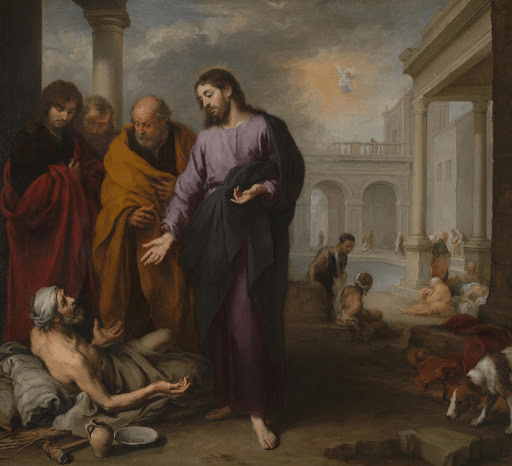
Healing the Paralytic, by Bartolomé Esteban Murillo, 1670

Sometime later, Jesus went up to Jerusalem for one of the Jewish festivals. Now there is in Jerusalem near the Sheep Gate a pool, which in Aramaic is called Bethesda and which is surrounded by five covered colonnades. Here a great number of disabled people used to lie—the blind, the lame, the paralyzed. One who was there had been an invalid for thirty-eight years. When Jesus saw him lying there and learned that he had been in this condition for a long time, he asked him, “Do you want to get well?”

“Sir,” the invalid replied, “I have no one to help me into the pool when the water is stirred. While I am trying to get in, someone else goes down ahead of me.”

Then Jesus said to him, “Get up! Pick up your mat and walk.” At once the man was cured; he picked up his mat and walked.

The day on which this took place was a Sabbath, and so the Jewish leaders said to the man who had been healed, “It is the Sabbath; the law forbids you to carry your mat.”

But he replied, “The man who made me well said to me, ‘Pick up your mat and walk.’ ”

So they asked him, “Who is this fellow who told you to pick it up and walk?”

The man who was healed had no idea who it was, for Jesus had slipped away into the crowd that was there.

Later Jesus found him at the temple and said to him, “See, you are well again. Stop sinning or something worse may happen to you.” The man went away and told the Jewish leaders that it was Jesus who had made him well.

So, because Jesus was doing these things on the Sabbath, the Jewish leaders began to persecute him. In his defense Jesus said to them, “My Father is always at his work to this very day, and I too am working.” For this reason they tried all the more to kill him; not only was he breaking the Sabbath, but he was even calling God his own Father, making himself equal with God. (New International Version)

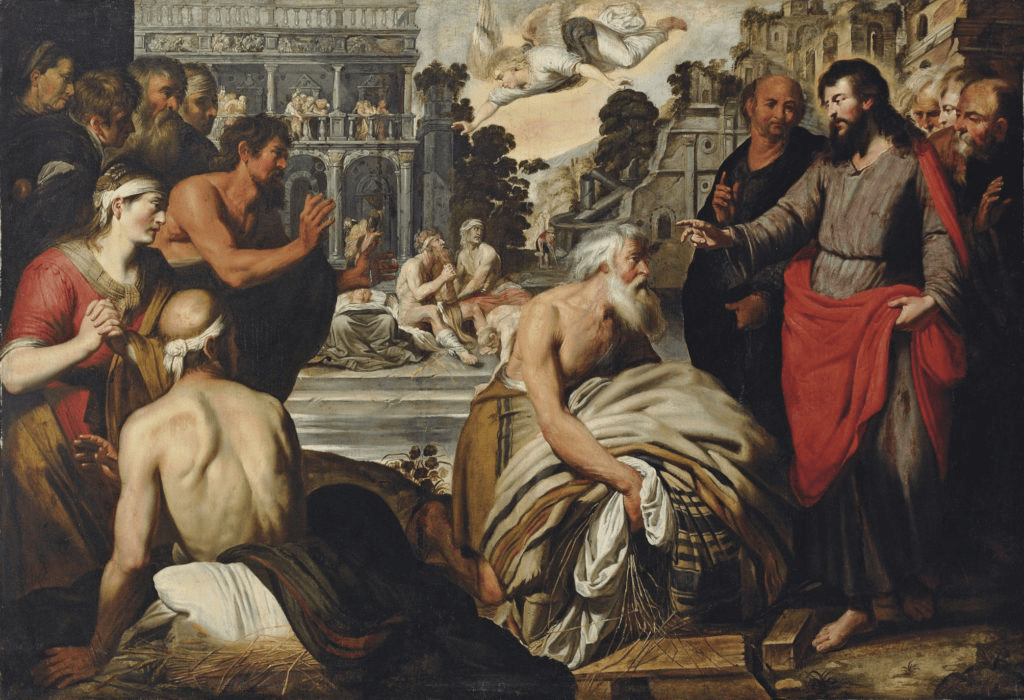
Christ at the Pool of Bethesda, by Artus Wolffort, c. 1625

During one of the yearly Jewish festivals, on a Sabbath day, a miracle happened. Miracles of healing are typically accompanied by celebration and joy. But not so much with this one.

It’s one of those things about living in a messed up world of broken systems, that an invalid can start walking and there are people who have frowns and furrowed brows about it.

Granted, the man who was healed by Jesus may seem a bit hard to like in some ways. We don’t really know what he was into, but when Christ bestows healing on you, then says to stop sinning, it’s probably a significant sin to warrant the Lord’s exhortation.

Regardless of any sort of sin, the man appears to be paraplegic. Especially in the ancient world, this meant all sorts of problems had to be navigated – such as needing others to literally carry you around (no wheelchair or handicapped accessible anything), long periods of social isolation, lack of bodily control over your bowels and bladder, and the continual needs for cleanliness.

This made the man hard to like by many people just because he likely had strong body odors and had to crawl to get around if no one would help. He would not have been pleasant to look at. But he would have to make sure you did because, in the absence of any charity, the guy’s only option was to beg.

I’m glad there are greater forces in the world than indifference and dislike. There is grace – which is an act of bestowing honor and/or forgiveness to another person. It is not dependent upon whether one deserves it. Grace chooses not to hold something over or against another. It is a deep concern for others that comes from within and not from without.

“I do not understand at all the mystery of grace – only that it meets us where we are but does not leave us where it found us.”

Anne Lamott

Another gracious act that Jesus did was to honor the man’s dignity by respecting him with a question. By asking a question, we don’t assume we know what’s best for another. Sincere questions acknowledge another’s basic humanity. “Do you want to get well?” Jesus asked.

In the life of being an invalid and having little control over much of anything, including one’s own body, being asked a question is to receive the gift of autonomy.

There are many times in my work as a hospital chaplain that I speak with patients who don’t have a lot of control in their lives. I go out of my way to ask questions such as, “May I come in?” “Is it alright with you if I pull up a chair and sit down?” “Would you be okay telling me about what is going on?” “May I pray with you?”

This is important, because there are too many other people in this world who would just barge into a room, act like they own the place, and talk at them, and not with them – hence reinforcing to the person that they’re nothing compared to others, that they don’t have any real say.

The man’s response to Jesus was to essentially say that he is alone. He has no one to help him. Even though the man is in a city, surrounded by hundreds and thousands of others, he is lonely.

Not anymore. Jesus saw him, even inquired about him and learned about the man. Jesus Christ, the Lord of all, cared about a non-descript invalid and was sincerely curious about him. In a world of everyone for himself, Jesus championed the lonely and the lost.

A simple command to obey was all. Christ told the man to pick up his mat and walk. That’s it. Just as words created the world, so a few words created a whole new life for the man. So, he got up, and he walked.

It’s interesting that the religious leaders never seemed to notice the man when he was lame, but now that he’s up and walking around, they pay attention to his apparent work on a Sabbath.

The invalid was validated by Jesus, but Jesus, the one validated by the Father, was invalidated by the religious leaders, who are the spiritual invalids.

It was against the (their) rules to carry something around. Apparently, it was okay for people to be lonely, not contribute to society in meaningful and dignifying ways, and to suffer; but it’s not okay to walk and carry a mat.

Even worse, is anyone who would heal on the Sabbath and tell the healed person to walk and carry a mat. It was so bad, apparently, that it warranted persecuting such a person. But that’s what happens when people are forced to serve rules, instead of the rules serving people.

On top of it all, Jesus was working; and he justified it by stating that his Father keeps working. This was dangerously close to blasphemy by likening himself to God. For the religious leaders, not only was Jesus unethical in breaking the law, but he was also theologically immoral; he claimed a special relation with God.

The more that laypeople get to know Jesus, the more compelling he becomes; they want to follow him. But the more that clergy discover Jesus, the more angry they become and want to do away with him.

Ultimately, it is Jesus we must contend with, and not the law and our interpretations of scripture. We need to decide what we are going to do with Jesus… what will you do?…

In Need of Integrity (John 7:19-24)

Pharisees, by German painter Karl Schmidt-Rottluff, 1912

It was Moses, wasn’t it, who gave you God’s Law? But none of you are living it. So why are you trying to kill me?”

The crowd said, “You’re crazy! Who’s trying to kill you? You’re demon-possessed.”

Jesus said, “I did one miraculous thing a few months ago, and you’re still standing around getting all upset, wondering what I’m up to. Moses prescribed circumcision—originally it came not from Moses but from his ancestors—and so you circumcise a man, dealing with one part of his body, even if it’s the Sabbath. You do this in order to preserve one item in the Law of Moses. So why are you upset with me because I made a man’s whole body well on the Sabbath? Don’t be hypercritical; use your head—and heart!—to discern what is right, to test what is authentically right.” (The Message)

One of my ardent desires for every person on planet earth, is that they will experience an integration of themselves – that they will know their true selves. And with this awareness, their head, heart, and gut will all be in alignment with each other. Every part of oneself will be acknowledged and work in harmony with the other parts.

I’m talking about wholeness. This is what produces peace, unity, harmony, joy, and strength of spirit. For me, this is the consummate Christian path of discipleship to walk. Jesus has gone before us to clear the way as the pioneer of our salvation. He makes it possible to realize wholeness. Christ has the ability to make us well and to live well. To know Jesus is to be whole.

People who are a bundle of disparate parts – with some of those parts suppressed and unacknowledged – are disturbed. They always seem to be upset with something because the parts of themselves are unable to communicate with each other. With them, there is no peace or wholeness. There is only a myopic view, usually coming from only using the head, only thinking.

But to have thoughts of God, to think about God’s law, and to police how God is thought of and how God’s law is implemented – without the heart or the gut involved – leads to fragmentation and disruption.

To only think, and withhold feelings and intuition, is to sin.

It’s impossible to know God and live God’s commands without involving your entire self. A head without a heart cannot affect humanity with the good that it so desperately needs.

A heart without a head cannot effectively steer the rudder into accomplishing sustained goodness.

And a head and a heart without a gut cannot sense the danger around the corner and loses its good plans and intentions.

Jesus was addressing religious leaders and a large chunk of fragmented people. Many of those persons were unable to discern who Christ actually is, because only the person of integrity and wholeness can do that. So, each one came at Jesus from their own limited place of disintegration. And none of them were able to truly see themselves as they actually are – blind to the reality that they were not keeping God’s law.

Christ and Pharisee, by Russian artist Ivan Filichev, 1993

A fragmented person’s perspective comes at things like this: “I’m obeying the law, although there are some laws I’m not really holding to.” Yet, Jesus understood that to break just one law makes us lawbreakers and in need of healing and wholeness.

Jesus healed a man on the Sabbath. The disintegrated person only saw Jesus working on the Sabbath, which in his head is a no-no. It requires work to heal someone. Therefore, it can wait until tomorrow. Thus, this Jesus fellow sinned against God and disobeyed God’s law. In fact, it only stands to reason that he is in league with a demon, the fragmented person reasons.

But that is to make a poor discernment of the situation. It is, however, only what the fragmented person can do. However, a wise understanding of the man’s healing by Jesus is to observe that Love has come among you – that Sabbath was made for humanity, not humanity for the Sabbath – and that this bringing of wholeness to a person, in restoring not only his health but his ability to connect with society, family, and community, is a knowable good thing. This is most certainly not what any sort of demon would do.

Perhaps one ought to test the spirits and make a good, right, and just discernment. Just maybe, Jesus is the one who can guide us to wholeness, goodness, and integrity. It could be that God is among us, and we didn’t even know it.

Constant criticism of others only deflects from paying attention to our own spirit; and always living in your head keeps you from experiencing the heartache of love.

Merely giving-in to the heart without engaging the head creates a caregiver who has no idea how to care for themselves; eventually they become bitter and gain a critical spirit that no one is caring for them as they care for others.

Blurting-out gut-reaction judgment at another may be truthful, but it will be taken as a severe and discouraging criticism because there was no thought or heart behind it.

There are a lot of upset people in this world. Yet, there are precious few persons with the wholeness to speak from the head, heart, and gut as a unified whole, bringing words and actions of life to others.

The persecuted person is one who has become wonderfully whole, namely because there are far too many fragmented people who view them as a threat, and see them as demonic. Fragmented folk believe they need to put the integrated person in their place, if not done away with altogether.

And that is exactly why Jesus was arrested, tortured, and killed. But fragmentation, disintegration, oppression, and sin do not have the last word. They are not the judge. There is resurrection, new life, and abundant joy because the grace of God in Christ always has the last word.

Christ’s Sermon on the Mount, by Argentine artist Jorge Cocco Santángelo

There’s trouble ahead when you live only for the approval of others, saying what flatters them, doing what indulges them. That’s the way of the fragmented ones; they will find themselves cursed. However, the blessings of God’s rule and reign recognize and affirm the whole person. Jesus said:

You’re blessed when you’re at the end of your rope. With less of you there is more of God and his rule.

You’re blessed when you feel you’ve lost what is most dear to you. Only then can you be embraced by the One most dear to you.

You’re blessed when you’re content with just who you are—no more, no less. That’s the moment you find yourselves proud owners of everything that can’t be bought.

You’re blessed when you’ve worked up a good appetite for God. He’s food and drink in the best meal you’ll ever eat.

You’re blessed when you care. At the moment of being ‘care-full,’ you find yourselves cared for.

You’re blessed when you get your inside world—your mind and heart—put right. Then you can see God in the outside world.

You’re blessed when you can show people how to cooperate instead of competing or fighting. That’s when you discover who you really are, and your place in God’s family.

You’re blessed when your commitment to God provokes persecution. The persecution drives you even deeper into God’s kingdom. (Matthew 5:3-10, MSG)

May you live into who you are, and avoid who you are not, to the glory of God. Amen.

Born from Above (John 3:1-17)

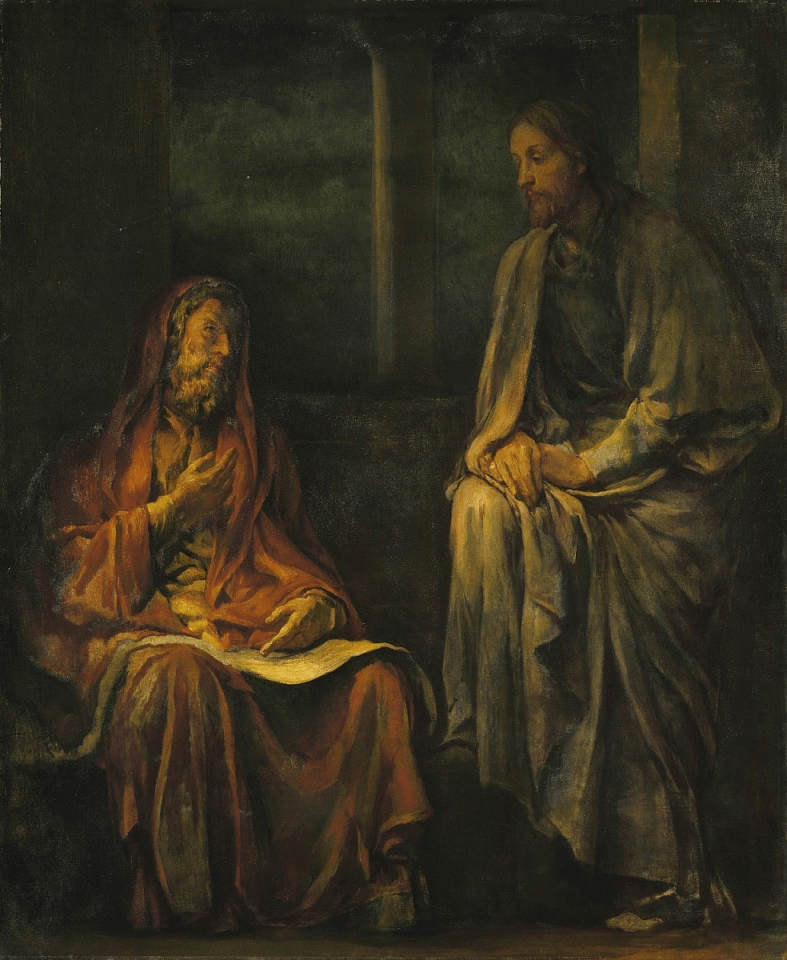
Visit of Nicodemus to Christ, by John LaFarge, 1880

Now there was a Pharisee named Nicodemus, a leader of the Jews. He came to Jesus by night and said to him, “Rabbi, we know that you are a teacher who has come from God, for no one can do these signs that you do unless God is with that person.” 

Jesus answered him, “Very truly, I tell you, no one can see the kingdom of God without being born from above.”

Nicodemus said to him, “How can anyone be born after having grown old? Can one enter a second time into the mother’s womb and be born?” 

Jesus answered, “Very truly, I tell you, no one can enter the kingdom of God without being born of water and Spirit. What is born of the flesh is flesh, and what is born of the Spirit is spirit. Do not be astonished that I said to you, ‘You must be born from above.’The wind blows where it chooses, and you hear the sound of it, but you do not know where it comes from or where it goes. So it is with everyone who is born of the Spirit.” 

Nicodemus said to him, “How can these things be?” 

Jesus answered him, “Are you the teacher of Israel, and yet you do not understand these things?

“Very truly, I tell you, we speak of what we know and testify to what we have seen, yet you do not receive our testimony. If I have told you about earthly things and you do not believe, how can you believe if I tell you about heavenly things? No one has ascended into heaven except the one who descended from heaven, the Son of Man. And just as Moses lifted up the serpent in the wilderness, so must the Son of Man be lifted up, that whoever believes in him may have eternal life.

“For God so loved the world that he gave his only Son, so that everyone who believes in him may not perish but may have eternal life.

“Indeed, God did not send the Son into the world to condemn the world but in order that the world might be saved through him. (New Revised Standard Version)

Christians serve a triune God – Father, Son, and Spirit. This Holy Trinity of three persons, yet one God, conspires to plan and orchestrate the deliverance of people from sin, death, and hell. The Lord makes it possible for people to be born again.

Maybe you’re ready to tune out with the phrase “born again” or “born from above” because either this is old hat to you; or you want to distance yourself from the obnoxious evangelist who is the pester pup toward others’ salvation.

However, today’s Gospel lesson is for me and you. So instead of tuning out, consider the person of Nicodemus in the story:

  • Served God
  • Good guy
  • Upstanding Jewish citizen
  • Devout and pious man
  • Faithful temple worship attendance
  • Member of a prestigious religious group 

And yet, it was to Nicodemus that Jesus said, “You must be born again.” But why? Because although Nicodemus was a really good egg, he was an adoring fan of Jesus, but not a committed follower of Jesus.

Nicodemus Visiting Christ, by Henry Ossawa Tanner, 1899

Admiration and kudos isn’t the same as taking up your cross and following Christ. Nicodemus didn’t need to adjust his life and make some tweaks here and there; it was time for a new life in walking the path of discipleship with Jesus.

The further away we are from birth, the easier it is to take God for granted; and to have a spiritually settled way of life in which the mystery, wonder, and awe of life is slowly drained from us. That’s why I think two year olds probably know more about God than anyone around – since they can articulate the wonder of life being only a few short years from their birth. 

One night I came home and walked into the kitchen to find my then four-year old grandson unashamedly crawling on all fours with his face barely off the floor. I said, “What in the world are you doing?” He looked up at me with a twinkle in his eye and a serious tone in his voice and said, “I’m sniffing for clues.” 

I honestly do not expect you to sniff for clues on your kitchen floor. But would any of us be found sniffing for clues of God? Would we seek hard and doggedly pursue the Lord? 

Because Nicodemus was such a good guy, he did not see himself in need of new life. Meeting Jesus at night is deeply symbolic of the fact that Nicodemus was literally in the dark about his spiritual condition. He was actually clueless to many of God’s ways, and how the world works in God’s kingdom. Nicodemus maintained a respectable distance as a fan of Jesus.

How do we move from being a fan to a follower of Jesus? 

Believe. To believe in Jesus means to move from only an intellectual faith of acknowledging doctrinal beliefs about Christ and God. There is to be movement from observing the works of God to a life of complete trust as a dedicated follower of Jesus.

Christian discipleship is more than asking Christ to help out in a jam or bad situation. And it is certainly more than praying a particular prayer. Rather, it’s letting Jesus decide what to do with us and remove any shortcomings, character defects, guilt, shame, and general crud from us.

We are to be made pure, to be cleansed – as if we were a new person or born again, from above. There is the willingness to depend on something other than myself, my resources, and my connections.

In Christianity, Jesus is much more than a wise teacher and a miracle worker; Christ is Savior for whom the follower gives complete allegiance to. In other words, we let Jesus use us for divine purposes, instead of us using Jesus for our own puny human purposes.

Let us intentionally and deliberately relinquish control of our lives, and of everything, to Jesus and become his faithful followers. Information is not transformation; and, seeing transformation in another person’s life is not a substitute for transformation in my own life.

Interview Between Jesus and Nicodemus, by James Tissot (1839-1902)

Nicodemus had to grab ahold of the reality that Jesus did not only come to save others, but to save him, as well.  We must be born from above, to have a new life, to be “born of water and spirit.” Nicodemus would have immediately been reminded of John the Baptist’s ministry of a baptizing for the repentance and forgiveness of sins. 

Jesus was letting Nicodemus know that he, too, needed repentance from trusting in those good deeds, and of simply acknowledging Christ. The practices of fasting, praying, and giving; and the dedication to thrift and morality is quite admirable. Yet, these are not the things which move a person from darkness to light. And they don’t give us a leg up to heaven.

Jesus is the One who has worked hard for us. God conceives us as Christians, and then nurtures us in the womb of faith. At some point, we come to full term, and God births us spiritually into new life. 

Maybe it’s time to move from darkness to light; from staying warm and cozy inside the womb to the bright outside world; from being a fan of Jesus to a follower of Jesus; from being in the dark audience to the bright lights of the stage for all to see. 

The issue is not in saving yourself, but to let God be God; and let God do the work in you that God wants to do. 

If there is no gestation from Jesus as Teacher to Jesus as Savior, there is no birth. If there is no gestation from Jesus as Miracle-Worker to Jesus as Savior, there is no birth. 

The Apostle John was making the point here in describing the conversation that if Nicodemus, who is the upstanding religious citizen, needed to be born again by Jesus, then how much more do we need to have a new life, to move from the comfortable confines of being a fan to the playing field of being a follower of Jesus?

Jesus does not need a bunch of groupies admiring him at night. But conversely, we need Jesus.

Fans sometimes confuse their admiration for devotion; people mistake their knowledge of Jesus for an actual relationship with Jesus. Fans assume that their good works and good intentions are sufficient. Yet, new life requires giving up an old life. And that, my friends, is what’s at stake in Christian discipleship.

May God the Holy Trinity make us strong in faith and love, and birth us into new life through Christ our Lord. Guide us in truth and peace; and may the blessing of God Almighty – Father, Son, and Holy Spirit – be among us, and remain with us always. Amen.