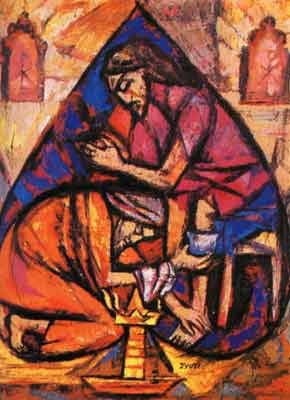
Children of God, Loved by God

By Unknown artist

See what great love the Father has lavished on us, that we should be called children of God! And that is what we are! The reason the world does not know us is that it did not know him. Dear friends, now we are children of God, and what we will be has not yet been made known. But we know that when Christ appears, we shall be like him, for we shall see him as he is. All who have this hope in him purify themselves, just as he is pure.

Everyone who sins breaks the law; in fact, sin is lawlessness. But you know that he appeared so that he might take away our sins. And in him is no sin. No one who lives in him keeps on sinning. No one who continues to sin has either seen him or known him.

Dear children, do not let anyone lead you astray. The one who does what is right is righteous, just as he is righteous. (1 John 3:1-7, NIV)

True children of God, Christians, are loved by God – that is their status and identity. This cannot be changed any more than a tiger can change his stripes.

True children of God live, remain, abide, and continue in their identity as Christians. They know who they are and how they are to live.

Who We Are

When Jesus was on this earth, he was misunderstood by a lot of people. Christians must learn to expect the same. True children loved by God will neither fit in with the world nor seek the world’s affirmation and accolades. The practical difference between Christianity and the world is that Christians locate their primary identity, allegiance, and purpose in Christ, whereas the world finds their identity elsewhere.

Being loved by God brings assurance, peace, security, and hope. These qualities cannot be manufactured by us because they are results of being loved. The world cannot give us these characteristics. This does not mean that Christians always have it all together. We are continually in a process of discovering our identity and growing more and more into that uniqueness. The reason Jesus lived his life without needing the world’s recognition is that he was firmly and securely assured of the Father’s love and care for him. 

Christians continue to learn what it means to be loved by God in Christ. This love helps fortify our faith so that we will not find our identities in worldly roles, however intrinsically good those roles might be. For example, a parent with the primary identity as mother or father will view salvation as coming through the family. Or a person with the primary identity as teacher will see deliverance coming through education. 

When Christians have their primary identity as children of God, loved by God, then they see deliverance from guilt, shame, darkness, and oppression as coming through Jesus. When the church, living and serving together, secure in their identity as children of God, loved by God, then she can withstand any adulterous flirtations from the world to woo them away from Jesus.

We are children of God. We are not children of the world’s institutions, systems, organizations, ethos, mores, and values. Everyone who has hope in Christ is pure and holy. When we locate our primary identity in being loved by God, we avoid defiling ourselves with the world’s grime. We take regular spiritual baths which cleanse us from the world’s crud. We keep reminding ourselves and each other of our true status as God’s children. We do not allow any other identity to topple or replace our wonderful reality of being loved by God.

How we view ourselves will determine how we live our lives.

How We Are to Live

True children of God abide by the law because they abide in Christ. Jesus said all the law could be summed up in two commands: Love God. Love neighbor. Breaking the law means:

  • Hating instead of loving.
  • Working to undermine someone instead of seeking their best interests.
  • Excluding others instead of including others.
  • Dividing and opposing instead of unifying and cooperating. 

No one abiding in Christ continues the same trajectory they had before knowing Christ. Jesus came to take care of the sin issue once for all through the cross. Therefore, Christians, loved by God, cannot be lawbreakers if they are abiding; the two cannot co-exist with each other.

So, our primary task as Christians is to abide in Jesus and remain firmly in our identity as children of God, loved by God. We are to love by remaining in God’s love and allowing love to shape all our thoughts, words, and actions. We will continue to be steadfast in that love. We will not be led astray. We will abide in Christ.

Identity and life work together. For example, I am currently a citizen of the state of Wisconsin. I not only geographically live in Wisconsin, but I am to abide in the state as a responsible person. Being a Wisconsinite is different from the rest of the world. Wisconsinites are readily identifiable by their sports and their food.

Lambeau Field, home of the Green Bay Packers

Diehard Green Bay Packer fans forsake any identification as Lions, Bears, or the god-forsaken pagan Vikings. They like their prep and collegiate sports, flock to curling clubs, get married in bowling alleys, and observe time through the various hunting seasons. Citizens of Wisconsin like their food and drink. Nothing compares to the Friday night fish fry, cheese curds, venison, mustard – all washed down with either a Spotted Cow, Leinenkugel’s, or a trip to the bubbler.

We are to become more and more like Christ. Our identity as loved by God means we will seek to live in Christ by living a life of love. The people of Wisconsin have a general reputation of being polite and helpful, not rude and unhelpful. All their citizens should live into this identity and behavior. And as Christians whose primary identity is in being children of God, loved by God, we should abide in Christ through love and obedience. 

“I am the true vine, and my Father is the gardener. He cuts off every branch in me that bears no fruit, while every branch that does bear fruit, he prunes so that it will be even more fruitful. You are already clean because of the word I have spoken to you. Remain in me, as I also remain in you. No branch can bear fruit by itself; it must remain in the vine. Neither can you bear fruit unless you remain in me.

I am the vine; you are the branches. If you remain in me and I in you, you will bear much fruit; apart from me you can do nothing. If you do not remain in me, you are like a branch that is thrown away and withers; such branches are picked up, thrown into the fire and burned. If you remain in me and my words remain in you, ask whatever you wish, and it will be done for you. This is to my Father’s glory, that you bear much fruit, showing yourselves to be my disciples.

As the Father has loved me, so have I loved you. Now remain in my love. If you keep my commands, you will remain in my love, just as I have kept my Father’s commands and remain in his love. I have told you this so that my joy may be in you and that your joy may be complete. My command is this: Love each other as I have loved you. Greater love has no one than this: to lay down one’s life for one’s friends. You are my friends if you do what I command. I no longer call you servants because a servant does not know his master’s business. Instead, I have called you friends, for everything that I learned from my Father I have made known to you. You did not choose me, but I chose you and appointed you so that you might go and bear fruit—fruit that will last—and so that whatever you ask in my name the Father will give you. This is my command: Love each other.” (John 15:1-17, NIV)

Conclusion

A true Christian is a child of God, not the world. Our behavior flows from who we are. If our primary identity is securely in being a loved child of God, then what comes out of us will be loving words and actions, even to those in the world who might not believe or understand.

When we think about our world, it can be a sad place, devoid of love. People from different cultures and backgrounds often do not get along with each other. Political parties have difficulty finding common ground. Some Christians cannot seem to get along with other Christians. In the world, differences often divide us. Can people different from each other get along? 

The early church did. And they did it without all the stuff we have – sanctuaries, church buildings, programs. Those early believers did it through the message of the cross using the basic tool of love. Not every Christian will serve on the foreign mission field or serve in a professional ministry position. However, every Christian can be loving.

True children of God are loved by God. They are characterized by the Christian practices of hospitably loving the immigrant and stranger, loving their enemies, forgiving those who have sinned against them, and obeying God’s commands. These practices stem the tide of evil and hate in the world and usher in the love of God in Christ.


John 12:44-50 – The Light of Christ

Photo by Adrien Olichon on Pexels.com

Then Jesus cried out, “Whoever believes in me does not believe in me only, but in the one who sent me. The one who looks at me is seeing the one who sent me. I have come into the world as a light, so that no one who believes in me should stay in darkness.

“If anyone hears my words but does not keep them, I do not judge that person. For I did not come to judge the world, but to save the world. There is a judge for the one who rejects me and does not accept my words; the very words I have spoken will condemn them at the last day. For I did not speak on my own, but the Father who sent me commanded me to say all that I have spoken. I know that his command leads to eternal life. So, whatever I say is just what the Father has told me to say.” (NIV)

Jesus is the light of the world. (John 8:12)

Jesus told his followers they are the light of the world. (Matthew 5:14)

Simple observation: Neither Jesus nor his followers become light. They are light. So, what does that mean?

To be light means we take a particular posture toward the world. It means we have a unique role in society.

Sometimes its important to say what something is not before we talk about what it is. To be light means we are not:

  • The Judge. The incarnation of Jesus was not for the purpose of playing Sheriff in the Old West, riding into the town of this world and gunslinging the bad guys either out of town or into the cemetery. Just because the world shot the sheriff, does not mean they’re off the hook for not shooting the deputy. There is judgment coming. It’s just that you nor I are the judge. “Do not judge,” said Jesus, unless you’re interested in getting judged yourself. (Matthew 7:1-2)
  • Cave-Dwellers. Rabbit-hole Christians. Dorm toads. Or any other metaphor for separating oneself from society and hiding out. Cave-dwellers want to hide out and start little fires that will only warm themselves. A rabbit-hole Christian scurries from hole to hole trying to avoid the world. Dorm toads never leave the friendly confines of their apartment swamp.

Rather than judging and hiding, people of the light possess are:

  • Encouragers. They speak constructive words of edification. Encouragers know there is a bit of light in everyone, so they see through the darkness to the good which can be enlightened and called forth in others. People who encourage have a glow about them which is attractive and winsome.
  • Aware. Being light causes one to see themselves in high definition. Both the image of God and the fallen nature of humanity is seen and held together. People of the light are aware of their identity. They are then able to act with humility, gentleness, and meekness. Since they know they are infinitely loved by God, this brings a great freedom to speak and act with confidence.
  • Believers. Faith begins with receiving grace. It then works its way from an internal truth to an outward expression. People of the light follow in the footsteps of their Lord Jesus. They love, lead, and linger in society as spiritual beings who help illumine the path.
  • Merciful. Since they were once in darkness themselves, people of the light set aside pre-meditated judgment and deal compassionately with those who are spiritually blind.
  • Pure. The light has its way of exposing impurities. People of the light squarely face their own reality and purposely seek purity in all their dealings with society.
  • Peacemakers. Being characterized by the light means we not only possess personal peace; we also make peace through creating and sustaining harmonious relations with others. The light enables us to be spiritual ombudsmen who carefully and effectively bring peace between warring factions.

Jesus is the light of the world. We are the light of the world. That means we do not hide but are present and involved in our families, neighborhoods, communities, local institutions, national affairs, and world problems. Being characterized as followers of Jesus causes a person and a faith community to be visible, to show the world who Jesus is, and what he is like.

The earliest followers of Jesus allowed their light to shine in the world through:

  • Taking in unwanted children, orphans, and babies left exposed to infanticide.
  • Ministry to the sick and dying during times of plague and disease, as well as visiting those in prison without families.
  • Help and kindness to the poor, foreigners, immigrant strangers, and widows, especially when no one else would.

Where light is present, no one needs to remain in darkness. Even a small flickering flame can illumine enough to make a way. And when many small flames come together, there is a great light for all to see.

Our message is not about ourselves. It is about Jesus Christ as the Lord. We are your servants for his sake. We are his servants because the same God who said that light should shine out of darkness has given us light. For that reason, we bring to light the knowledge about God’s glory which shines from Christ’s face. (2 Corinthians 4:5-6, GW)

May the light of Christ, the living Word, dispel the darkness of our hearts so that we may walk as children of light and sing the praises of a merciful God throughout the world. Amen.

John 13:1-17, 31-35 – Maundy Thursday

Welcome, friends. The Gospel of John, chapter 13, provides the last words and final actions of Jesus Christ for his disciples. And it all centers in humble love. Click the videos below, and let us observe and remember…

Maundy Thursday, Pastor Tim Ehrhardt
Behold the Lamb (Communion Hymn) – sung by Keith & Kristyn Getty, words by Stuart Townsend, 2009

Holy God, you give us this meal of bread and wine in which we celebrate your great compassion; grant that we may work with you to fulfil our prayers, and to love and serve others as Christ has loved us; this we ask through Jesus Christ our Redeemer, who is alive with you in the unity of the Holy Spirit, one God, now and for ever. Amen.

John 13:1-17, 31-35 – Maundy Thursday

Jesus Washes Peter’s Feet

It was before Passover, and Jesus knew that the time had come for him to leave this world and to return to the Father. He had always loved his followers in this world, and he loved them to the very end.

Even before the evening meal started, the devil had made Judas, the son of Simon Iscariot, decide to betray Jesus.

Jesus knew that he had come from God and would go back to God. He also knew that the Father had given him complete power. So, during the meal Jesus got up, removed his outer garment, and wrapped a towel around his waist. He put some water into a large bowl. Then he began washing his disciples’ feet and drying them with the towel he was wearing.

But when he came to Simon Peter, that disciple asked, “Lord, are you going to wash my feet?”

Jesus answered, “You don’t really know what I am doing, but later you will understand.”

“You will never wash my feet!” Peter replied.

“If I don’t wash you,” Jesus told him, “you don’t really belong to me.”

Peter said, “Lord, don’t wash just my feet. Wash my hands and my head.”

Jesus answered, “People who have bathed and are clean all over need to wash just their feet. And you, my disciples, are clean, except for one of you.” Jesus knew who would betray him. That is why he said, “except for one of you.”

After Jesus had washed his disciples’ feet and had put his outer garment back on, he sat down again. Then he said:

Do you understand what I have done? You call me your teacher and Lord, and you should, because that is who I am. And if your Lord and teacher has washed your feet, you should do the same for each other. I have set the example, and you should do for each other exactly what I have done for you. I tell you for certain that servants are not greater than their master, and messengers are not greater than the one who sent them. You know these things, and God will bless you, if you do them….

Now the Son of Man will be given glory, and he will bring glory to God. Then, after God is given glory because of him, God will bring glory to him, and God will do it very soon.

My children, I will be with you for a little while longer. Then you will look for me, but you won’t find me. I tell you just as I told the people, “You cannot go where I am going.” But I am giving you a new command. You must love each other, just as I have loved you. If you love each other, everyone will know that you are my disciples. (CEV)

Jesus Washing the Feet of His Disciple by Japanese artist Sadao Watanabe (1913-1996)

We all need to receive love and to give love. Without love, there is little to live for. Apart from love, relationships devolve into silent standoffs and destructive triangles. Indeed, with an absence of love the world ceases to spin on its axis.

Yet, where love is present all things are beautiful. Personal relations have meaning and joy. All seems right and just in the world.

Love, however, comes at a cost. Because we live in a broken world full of pride and hubris, greed, and avarice, hate and envy, we are victims of loveless systems and unjust actions. We need love to rescue us, to redeem us from the sheer muck of existence. It’s as if we are constantly walking knee deep through sludge so thick, we can barely get anywhere. We need saving. We need Jesus.

Christians everywhere around the world are journeying through Holy Week, the most sacred time of the year for followers of Christ. When we think about Holy Week, we are familiar with Good Friday and certainly Easter, but Maundy Thursday? 

On this day, the Church remembers the final evening Jesus shared with his disciples in the upper room before his arrest and crucifixion. The experiences in the upper room were highly significant because this was the last teaching, modeling, and instruction Jesus gave before facing the cross. Jesus was careful and deliberate to communicate exactly what was important to him: to love one another.

Maundy Thursday marks three important events in Christ’s Last Supper with his disciples: 

  • The washing of the disciples’ feet (the action of loving service)
  • The instituting of the Lord’s Supper (the remembrance of loving sacrifice)
  • The giving of a “new” commandment to love one another (the mandate of a loving lifestyle). 

For Jesus, his last night with the disciples was all about love, God’s love. On that fateful night, having loved his disciples for the past three years, Jesus showed them the full extent of his love by taking the posture of a servant and washing each one of the disciples’ feet, including Judas. After demonstrating for them humble service, Jesus said,

“I have set you an example that you should do as I have done for you” (John 13:15, NIV). 

This was an incredible act of love. Jesus Christ loves me just as I am, and not as I should be. He loves me even with my dirty stinky feet, my herky-jerky commitment to him, and my pre-meditated sin. 

The Last Supper by Indian artist Francis Newton Souza (1924-2002)

Not only did Jesus wash the disciples’ feet, but he lifted the cup of wine and boldly asserted: 

“Take this and divide it among you.  For I tell you I will not drink again of the fruit of the vine until the kingdom of God comes.”  And he took the bread, gave thanks, and broke it, and gave it to them, saying, “This is my body given for you, do this in remembrance of me.”  In the same way, after the supper he took the cup saying, “This cup is the new covenant in my blood, which is poured out for you” (Luke 22:17-20, NIV). 

Because of these words, the church throughout the world, for two millennia, have practiced this communion so that we might have the redemptive events of Jesus pressed firmly into our minds and our hearts by means of the visceral and common elements of bread and wine. We are to not just know about Jesus; we are to experience being united with him.

Having washed the disciples’ feet, and proclaiming to them the meaning of his impending death, Jesus gave them a clear commandment: 

“A new command I give you: Love one another. As I have loved you, so you must love one another.  By this everyone will know that you are my disciples, if you love one another.” (John 13:34-35, NIV)

Love one another, insisted Jesus, by imitating his humble service. We represent Christ on this earth when we carefully, diligently, and persistently practice love. Although love was not a new concept for the disciples, in the form and teaching of Jesus love was shown with four distinctions: 

  1. Jesus is the new model of love.
  2. A new motive of love, that Christ first loved me.
  3. A new motivator to help us love, the Holy Spirit.
  4. A new mission, the evangelization of the world, utilizing the power of Christ’s love to accomplish it.

Maundy Thursday is a highly significant day on the Church Calendar – one which deserves to be observed, and an opportunity to remember the important words and actions of Jesus on our behalf.  Through Jesus Christ we are to live always in love, modeling our life and church ministry after him. 

In Christ, love is to characterize our life together as we proclaim God’s love in both word and deed. A watching world will only take notice and desire to be a part of our fellowship if we are deeply and profoundly centered in the love of God in Christ. This is the reality Maundy Thursday brings to us.