John 4:31-38 – Real Food

Meanwhile his disciples urged him, “Rabbi, eat something.”

But he said to them, “I have food to eat that you know nothing about.”

Then his disciples said to each other, “Could someone have brought him food?”

“My food,” said Jesus, “is to do the will of him who sent me and to finish his work. Don’t you have a saying, ‘It’s still four months until harvest’? I tell you, open your eyes and look at the fields! They are ripe for harvest. Even now the one who reaps draws a wage and harvests a crop for eternal life, so that the sower and the reaper may be glad together. Thus, the saying ‘One sows, and another reaps’ is true. I sent you to reap what you have not worked for. Others have done the hard work, and you have reaped the benefits of their labor.” (New International Version)

Today’s Gospel narrative reads something like the stereotypical mother concerned for her son saying, “Sit down and eat some of Mama’s pasta. You need some food!” As if preparing and serving a meal will make everything better.

Food has both the power to bring us together, as well as separate us. A meal can create the conditions for fellowship, acceptance, and enjoyment. Eating can bond people together through hospitable love. On the other hand, sitting down to eat can also be a way to avoid painful emotions. In this manner, eating becomes an obstacle to giving and receiving love.

It seems Christ’s disciples were doing the latter. They were uncomfortable and perhaps a bit stressed. Looking to fill up with food instead of with God, the disciples’ sense of unfulfillment was coming out sideways by opening the refrigerator, poking through the meager leftovers, and putting the emphasis on feeling better.

I know we can be hard on the disciples in the Gospels. Their ups and downs from faith to fear and back to faith again can be weird. Yet, through it all, I believe their hearts (excepting Judas Iscariot) were in the right place.

Jesus could see through the entire scenario and put the focus off eating. He addressed the disciples’ soul hunger through putting the spotlight on doing the will of God. Deep within they were hungering and thirsting for righteousness.

Paying attention to our vocation and discovering our humble work in the service of God, rather than a vacation to the pantry to cover our unwanted feelings, is the essence of Christ’s interaction with his disciples.

People are much more ready for the gospel of Jesus than we think. There are times we can become so insular, and lost within our own heads, that we are then unable to see the world as ripe for a harvest of people who are actually eager to be gathered into the community of the redeemed.

Jesus just had a significant interaction with the Samaritan woman. Back in that day, you just didn’t have dialogues with half-breed Samaritans – an unholy mix of Jewish and hated ancient Assyrian Gentile blood – let alone a man talking with a woman of disrepute who experienced several failed marriages.

Christ had a way of doing the will of God, despite conventional thinking of the time. And a lot of people got their undies in a bundle from it. The disciples, having a front seat to most of Christ’s shenanigans, did a few too many palms to the forehead, believing their Rabbi’s un-orthopraxis was going to make him unpopular. They feared no one would follow him.

Looks like the disciples didn’t quite get that one right.

The Samaritan woman received Jesus as Living Water, having her ultimate needs met by the penultimate Lord of all. The disciples hadn’t quite caught up to this, so fell back on their old ways of physical food and drink to assuage the weirdness happening inside them.

The woman was gushing over with Living Water, becoming a wellspring of good news to her community. Whereas the disciples (eventually becoming an incredible fountain of the gospel after Christ’s death and resurrection) are here nothing but an annoying drip from the kitchen faucet.

A non-descript ethnically suspect woman of dubious character coming to faith was meant by Jesus to open the disciples’ eyes to a new reality: The good news of Christ is meant for the world, not just Jewish men.

The disciples were given the opportunity to participate in the world’s takeover – a mission of bringing the love of God where love wasn’t present, of helping all kinds of people awaken to the deep spirituality within them, of lifting their downcast faces of guilt and shame to see the Living God wanting to bless the world with the body and blood of Jesus.

For this is real food and real drink.

Many believers in Jesus today think they are working hard for the Lord by seeking people for their churches. Yet, the real work is being done by the triune God – the heavenly Father who scans the world and seeks spiritual misfits to bless; the gracious and truthful Son who put hands and feet to that blessing; and the wild Holy Spirit who moves in unpredictable ways – are working infinitely harder for our churches, our families, our neighborhoods, and our world.

All of our work, no matter how big or small, is made possible by the pre-work of the Holy Trinity. The great Three-in-One has done all the preparations of chopping the onions, mincing the garlic, slicing the carrots, and peeling the potatoes so that we, his followers, can make a savory stew of diverse people sharing a common pot of God’s love and hospitality.

This is the food we know nothing about, and that God knows intimately.

O God, you made us in your own image, and you have redeemed us through your Son Jesus Christ: Look with compassion on the whole human family; take away the arrogance and hatred which infect our hearts; break down the walls that separate us; unite us in bonds of love; and work through our struggle and confusion to accomplish your purposes on earth; that, in your good time, all nations and races may serve you in harmony around your heavenly throne; through Jesus Christ our Lord. Amen.

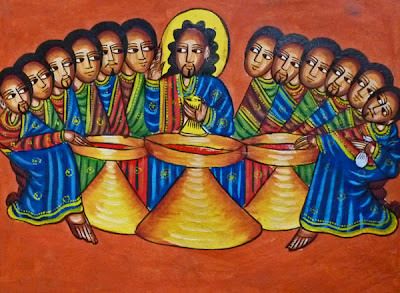
*Above painting: Ethiopian Orthodox Church depiction of the Last Supper

John 15:18-20, 26-27 – Moving in with Jesus

“If the world hates you, keep in mind that it hated me first. If you belonged to the world, it would love you as its own. As it is, you do not belong to the world, but I have chosen you out of the world. That is why the world hates you. Remember what I told you: ‘A servant is not greater than his master.’ If they persecuted me, they will persecute you also. If they obeyed my teaching, they will obey yours also…

When the Advocate comes, whom I will send to you from the Father—the Spirit of truth who goes out from the Father—he will testify about me. And you also must testify, for you have been with me from the beginning.” (New International Version)

Two characters: Jesus and Emmet

Scene:  Emmet is moving in with Jesus as a roommate.

Emmet enters….

“Nice digs, Jesus. Not quite what I was expecting – looks good and clean – but just ordinary.”

“I’m glad you decided to take up my offer and come live with me in my house, Emmet. Well, it’s actually my Father’s house.”

“Yeah, well, it wasn’t working out so well with my girlfriend, Jezebel. She was into a lot of weird stuff, like some crazy real estate schemes, especially with vineyards – the woman is obsessed with buying up vineyards. Besides, she told me she hates me. That really hurt.”

“Emmet, I think you will find I’m into a different kind of vineyard and real estate. And there isn’t any hate there. It’s called ‘the kingdom of God.’”

“Kingdom, huh?  Sounds like a pretty big gig to me, Jesus.”

“Oh, yes, it is. The biggest. You know, Emmet, by living and abiding with me here you will get to know all about the kingdom.”

Sounds groovy, man… or should I say, ‘Son of Man!’ Hey, Jesus, you got any beer and chips in this joint?  I’m starving.”

“No, sorry, I’m afraid not right now. But I do have some wine and some bread.”

“Well, okay, Jesus. I’m super hungry. I could go for about anything.”

Here you go Emmet.” (Jesus gives Emmet a wafer and communion cup – Emmet just stands there and looks at it). “Make yourself at home in my love, Emmet.”

“Um, hey, Jesus, not to be ungrateful or anything, but is this all you have?”

“Just try it, Emmet. I think you will find it rather satisfying.”

(Emmet takes the bread and drinks the cup). “Holy Communion, Jesus! Whoa! I’m actually full! What in the world is in that stuff, anyway?”

“There’s no world in it, at all, Emmet. I am the vine. You are the branch. When you drank, you ingested me.  You’re joined with me, and I with you. Apart from me you are always going to be hungry and thirsty, no matter how much other food you eat and how much beer you drink. But if you stay here and settle in with me, make this your permanent home and not just a place to hang your hat, you can be sure that I will always listen to you and do whatever you ask of me.”

“That’s heavy, man. Very cool. I can dig it!”

“I have told you this for a purpose, Emmet – that we might enjoy being roommates together. By the way, I have just one rule in my house that I expect to be obeyed, always: Love other people in the same way that I love you.  Never forget, Emmet: If you ever get locked-out of the house, it is love which opens the door to my place.  Remember, Emmet, that love is the key.”

“You know, Jesus, you’re kind of odd, but I like you, dude. I’m glad I chose to come here.”

“Emmet, you did not choose me; I chose you and brought you here because of my love. And I am sending you into the world to love. Remain here with me, abide with me in this place, and you will see things happen beyond what you can even think or imagine. Go, now, and bear the fruit of love in my kingdom, and when you come back, I’ll have a place for you to sleep and you will rest like you have never rested before.”

“I really appreciate your hospitality, Jesus. But what if I mess up? Or forget about your rule?”

“When you came here, Emmet, you probably saw someone standing just outside the door.”

“Yeah… I did see some dude who looked way out there, man, like he was from another universe, like maybe New Jersey, or something.”

“That was the Advocate. He will come whenever you mess up or forget about my love. The Advocate will help you remember the truth.”

(Jesus walks Emmet to the door). “There’s nothing to worry about. Just go and love others like I love you. Good-bye, Emmet.”

“Bye, Jesus. I’ll be back after I go spread some love around, just like you taught me….”

*Above Photo by Amina Filkins on Pexels.com

John 7:37-39 – Come and Ask for What You Need

On the last and greatest day of the festival, Jesus stood and said in a loud voice, “Let anyone who is thirsty come to me and drink. Whoever believes in me, as Scripture has said, rivers of living water will flow from within them.” By this he meant the Spirit, whom those who believed in him were later to receive. Up to that time the Spirit had not been given since Jesus had not yet been glorified. (New International Version)

Anyone Can Come

Let’s take Christ’s words at the end of the Jewish Festival of Booths (or Tabernacles) at face value. Jesus said that if anyone is thirsty, they could come to him and drink. This is an unconditional statement with no caveats, qualifications, or fine print to it. Jesus did not say if anyone is spiritual enough or strong enough or committed enough that then they could come to him.

The only qualifications one must have in coming to Jesus is to be needy. To be thirsty and want a drink is it, period. No interviews. No jumping through any hoops. No red tape. No having to go through one of the disciples to get to Jesus. No obstacles whatsoever. Sheer need and want gets anybody an audience with Jesus.

“Thirsty” is Christ’s simple metaphor for need. Whenever we long to have our needs met, there is always the opportunity and possibility of going to Jesus. And we know that all of us are thirsty because every single person has needs that aren’t getting met. These important and vital words of Jesus to us encourages us to admit and say to him, “I need you, Lord.”

And what is the Lord’s response to such a humble expression of need? “Please come here to me and drink till you are full.” No judgment. No condemnation. No big sighs. No snarky comments. No disappointed looks. Our confession of need accesses divine compassion and help. Who will help?

Anyone Can Receive Help through the Helper

The Holy Spirit will help. Christ ascended and gave us the Spirit. On this day before the Christian celebration of Pentecost, we are reminded that Jesus delivered on his promise to give help. There is no better assistance in all the world than having a permanent live-in guide, helper, and advocate who is continually alongside us, even in us.

Ask. Seek. Knock. That’s it. We have a popular commercial figure in my city, a lawyer, whose one-liner is, “One call. That’s all!” And help will come. All we need do is express our needs and wants. And yet, that is so awfully hard for so many people. It seems weak or selfish to come right out and say what we need and what we want. Yet, if we are to embrace any sort of Christian discipleship, straight forward asking will be involved.

Believers simply can state their needs to be breathed on by the Spirit and have their thirst satiated. If we make it more complicated than that, we lose the incredible simplicity of the gospel – that it is good news for needy people. Yet, we sometimes make it complicated by not coming out and saying what we need. Why do we do that?

Why Don’t We Come?

For many people, they have never been given permission to do so. They were never encouraged to express their needs and wants. However, it is perfectly acceptable to state what you want, and what you really need. Ask for what you want, and you may be surprised at how often you get it.

The lack of asking goes much deeper than this. Our fear of vulnerability and being judged by God (and others) prohibits us from asking for what we really want. We must come to the point of seeing that vulnerability is crucial to having our needs met. Only through being open enough to share what you need will relational connection happen. A relationship with Jesus is based on such humility and vulnerability. Without it, there is no relationship.

We also might be afraid of not getting what we ask for, so we don’t ask, at all. Or, conversely, we may be afraid of receiving our asking! On some level, it’s more comfortable to stay in a familiar situation. We think we want something different, but we’re worried about the downside of getting it. We fret and wonder about it, not trusting ourselves. So, we become paralyzed, unable to say what we really want or need.

All of this comes down to our own image of self. It’s as if we don’t believe we deserve to be treated well. But the reality is: This isn’t about whether you deserve to have something; it’s about your needing or wanting it. Plain and simple. There’s no shame being in want or need.

Some people are so used to putting others first and meeting another’s need that they become stymied by their own inability to state what they need. So, they try and feel better by meeting everyone else’s need. And when they become bitter about being emotionally depleted, when they are thirsty for someone to meet their needs, they don’t ask for help. Because they feel they can’t.

Anyone Can Ask, Seek, Knock

You can and you must. Jesus says so. We don’t always get what we want in life. But we won’t get it if we don’t ask. It’s good to focus on what you want or need in life, instead of questioning whether you’re worthy to receive it. Jesus said:

“Keep on asking, and you will receive what you ask for. Keep on seeking, and you will find. Keep on knocking, and the door will be opened to you. For everyone who asks, receives. Everyone who seeks, finds. And to everyone who knocks, the door will be opened.” (Matthew 7:7-8, NLT)

So, what are you waiting for!?

John 16:16-24 – There Must Be Suffering Before Glory

Jesus went on to say, “In a little while you will see me no more, and then after a little while you will see me.”

At this, some of his disciples said to one another, “What does he mean by saying, ‘In a little while you will see me no more, and then after a little while you will see me,’ and ‘Because I am going to the Father’?” They kept asking, “What does he mean by ‘a little while’? We don’t understand what he is saying.”

Jesus saw that they wanted to ask him about this, so he said to them, “Are you asking one another what I meant when I said, ‘In a little while you will see me no more, and then after a little while you will see me’? Very truly I tell you, you will weep and mourn while the world rejoices. You will grieve, but your grief will turn to joy. A woman giving birth to a child has pain because her time has come; but when her baby is born, she forgets the anguish because of her joy that a child is born into the world. So, with you: Now is your time of grief, but I will see you again and you will rejoice, and no one will take away your joy. In that day you will no longer ask me anything. Very truly I tell you, my Father will give you whatever you ask in my name. Until now you have not asked for anything in my name. Ask and you will receive, and your joy will be complete. (New International Version)

“Even a happy life cannot be without a measure of darkness, and the word happy would lose its meaning if it were not balanced by sadness. It is far better to take things as they come with patience and equanimity.”

Carl Jung

An Unpopular Message

Jesus often said things that were neither expected nor wanted. Jesus consistently told his disciples there must be suffering before glory. The disciples either could not or would not hear of it. They didn’t sign up to follow Jesus into suffering! Trying to get people to pay attention to suffering is like trying to get a bunch of Baptists to put their names down on a sign-up sheet at church.

Christ was speaking to his disciples in the Upper Room, the last meal he had with them before his death. When they were called by Jesus three years earlier, the disciples were not expecting all the gibberish about leaving and grieving. To put this in contemporary terms, the disciples’ response was akin to saying, “I only think positive. I don’t listen to things that are negative.”

Suffering, death, and grief were far from the disciples’ expectations of how things would and should shake-out. They had such a hard time understanding what the heck Jesus was saying because his words were out of alignment with their assumptions. Yes, there would be glory and joy. First, however, there must be suffering and grief.

A Real Message

Just as a woman experiences terrible pain in childbirth, then ecstatic joy over seeing her child for the first time, so the Christian’s excruciating pain in this life points to the inevitable joy at the end of that suffering. In the scope of eternity, adversity and pain last only a moment. Glorious joy, however, will be forever.

In talking with his disciples about their disappointment, even depression, about Christ’s words of leaving and grieving, Jesus graciously gave them the gift of joy. Yes, there can be and is joy even in the mourning. Not every story has a happy ending.

I can say, however, that the grandest story of all – Jesus Christ’s suffering and death – has resulted in resurrection and ascension. It will all be complete when Christ returns to judge the living and the dead. Then, the grand narrative of redemption will realize its conclusion of no more crying, tears, or pain. There will be only unending joy.

For now, however, we still experience heartache along with the great joy of resurrection and new life. It can be confusing, living in the awkward state of simultaneous grief and joy. Yet, keep in mind, the grief is temporary. The despair will not last. Joy, on the other hand, has staying power and will be the permanent state of the believer. It is only the smaller stories which may or may not end well. The big story of redemption already has the ending written – joy without grief.

A Good Message

Christians serve a risen and ascended Lord. Therefore, we need not wait to be happy, and we need not expect everything must go our way. The good news is that there are always fresh opportunities to be happy through asking and receiving. Imagine a Partridge Family sort of bus coming around to all the bus stops of life. Happy times and music arrive around the clock. Chances are the opportunity to be happy has already arrived. Often, it is right in front of us; we just missed the bus because we were daydreaming about a future state of joy.

We are living days of constant change followed by ever new normal. Just as there was no going back to a three-year hiatus of walking with Jesus for the disciples, so we need to embrace new and different ways of life together here on planet earth. We have the gift of joy. Its just a matter of unpacking it.

Now to him who can do immeasurably more than all we ask or imagine, according to his power that is at work within us, to him be glory in the church and in Christ Jesus throughout all generations, for ever and ever! Amen.