A Spiritual Wedding (Psalm 45:1-2, 6-9)

My thoughts are filled
with beautiful words
    for the king,
and I will use my voice
as a writer would use
    pen and ink.

No one is as handsome as you!
    Your words are always kind.
That is why God
    will always bless you…

You are God, and you will rule
    forever as king.
Your royal power
    brings about justice.
You love justice and hate evil.
    And so, your God chose you
and made you happier
    than any of your friends.
The sweet aroma of the spices
myrrh, aloes, and cassia
    covers your royal robes.
You enjoy the music of harps
in palaces decorated
    with ivory.
Daughters of kings are here,
and your bride stands
    at your right side,
wearing a wedding gown
    trimmed with pure gold. (Contemporary English Version)

A Royal Wedding?

Today’s psalm is a love song meant to be used for a wedding. Whether it was designed only for royal weddings, or for ordinary couples to be a king and queen for a day, the psalm’s overall challenge is for the groom to exercise a right use of power.

Back in biblical times, within a patriarchal society, men held the power and authority within every aspect of the culture, especially in the family.

If the psalm is meant for only royal weddings, it communicates that, in effect, the king has been placed on the throne by God, and acts as God’s extension of justice and righteousness to the people.

And if the psalm is intended for any leader, or anyone who possesses power and authority, then being in such a position requires great responsibility. Power is to be wielded for good, with an eye toward doing what is just and right for all of the people in which the leader exercises authority over.

So, whether one is in a hierarchical or an egalitarian structure, all persons in authority are to give themselves to being faithful.

Symbolism and Allegory

There is a symbolic and allegorical aspect to the psalm. Just as the royal robe or wedding clothes of the groom emit sweet aromatic spices, so the leader who loves justice and acts with integrity is pleasing to all those under their authority.

But thanks be to God, who always leads us as captives in Christ’s triumphal procession and uses us to spread the aroma of the knowledge of him everywhere. For we are to God the pleasing aroma of Christ among those who are being saved and those who are perishing. To the one we are an aroma that brings death; to the other, an aroma that brings life. And who is equal to such a task? (2 Corinthians 2:14-16, NIV)

Those in responsible positions – and those sharing authority with one another – are to do what is life-giving for people; and not do things which are death-dealing. Promoting connection and being encouraging are vital. Causing division and being critical are destroyers of people’s welfare.

The psalmist praises a king who loves righteousness and hates wickedness. Such a ruler defends the cause of truth and upholds justice. These are ideals which have a pertinent message for public servants in every age.

Christ the Bridegroom, and the Church as Bride

For most of church history, Christian interpreters took a committed Christ-centered approach to the psalm. They saw Jesus as the beautiful king who reigns in justice and righteousness, faithfully ruling the people.

Through this view, every psalm, in some way, points to Jesus. In Psalm 45, the wedding poem directs believers to the coming wedding of Christ and the Church. The king is Jesus, who is worthy of praise and adoration. The bride is Christ’s Church.

Whether one discerns the psalm as literal or allegorical, the Christian understands that Jesus Christ is the ultimate fulfillment of all God’s promises. So, in that sense, everything in Holy Scripture – including the Old Testament and all of the Psalms – have to do with Christ.

All good earthly kings, rulers, and leaders hold an office which points forward to Christ, who rules over a kingdom to end all kingdoms. In looking at Psalm 45, the author of the New Testament Book of Hebrews takes such a view, since he looks back to this very psalm in speaking about Jesus:

But about the Son he [God] says,

“Your throne, O God, will last for ever and ever;
    a scepter of justice will be the scepter of your kingdom.
You have loved righteousness and hated wickedness;
    therefore God, your God, has set you above your companions
    by anointing you with the oil of joy.” (Hebrews 1:8-9, NIV)

The Reformer John Calvin (1509-1564) stated the reason we know the Psalm is about Jesus, because neither Jew nor Gentile talks this way about any human king – therefore, it is a reference to Messiah.

From St. Augustine to Martin Luther, scholars and interpreters saw in Psalm 45 a praise to Christ, who is the betrothed king.

The psalm’s celebration exalts the union of Christ and the Church. The song of love anticipates the great wedding feast at the end of the age, sung in honor of Jesus the bridegroom and the Church as the bride of Christ.

Weddings Are About Love

The psalmist unabashedly loves the king, and wants everyone to know it. Indeed, it is love which makes life worth living. It’s love that animates our words and actions. Apart from love, we are lost and lonely – languishing without an object of love to orient life around.

An affectionate love for Jesus Christ drives the Christian to live into goodness, justice, and righteousness. And we become what we love – which is why Christianity has the power to change the world for the better (and not in the weird sense of trying to conquer the world through politics and Christendom).

Such love elicits praise and adoration. Love brings about God’s good purposes. And God is determined to bring a spouse for his Son.

“God created the world to provide a spouse and a kingdom for His Son: and the setting up of the kingdom of Christ, and the spiritual marriage of the spouse to Him, is what the whole creation labors and travails in pain to bring to pass.” Jonathan Edwards (1703-1758)

It is far too easy for one’s love to fade in the Christian life. Living an ethical life, and maintaining doctrinal purity, may be kept up; and yet, it all can be done without love behind it.

Jesus said to the Church at Ephesus:

I know your deeds, your hard work and your perseverance. I know that you cannot tolerate wicked people, that you have tested those who claim to be apostles but are not, and have found them false. You have persevered and have endured hardships for my name, and have not grown weary. Yet I hold this against you: You have forsaken the love you had at first. (Revelation 2:2-4, NIV)

Let’s allow today’s Psalm to evoke and stir up our love for God by reminding us of God’s great love for us in Christ, and the love we have, or once had, for Jesus.

Let us see what great lengths God went to love us through Christ. And let us retain and maintain the joyous passion of life with God in Christ, by means of the Spirit.

Amen.

How To Live When Things Are Bad (Isaiah 33:10-16)

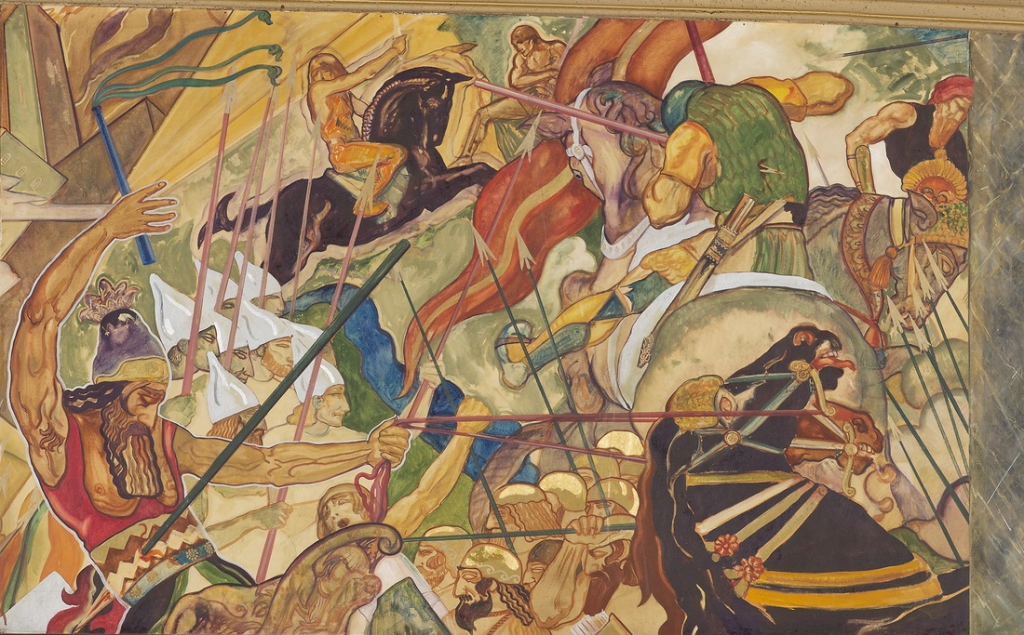
Mural depicting the wars of Israel and Judah with the surrounding nations, Wilshire Boulevard Temple, Los Angles

But the Lord says: “Now I will stand up.
    Now I will show my power and might.
You Assyrians produce nothing but dry grass and stubble.
    Your own breath will turn to fire and consume you.
Your people will be burned up completely,
    like thornbushes cut down and tossed in a fire.
Listen to what I have done, you nations far away!
    And you that are near, acknowledge my might!”

The sinners in Jerusalem shake with fear.
    Terror seizes the godless.
“Who can live with this devouring fire?” they cry.
    “Who can survive this all-consuming fire?”
Those who are honest and fair,
    who refuse to profit by fraud,
    who stay far away from bribes,
who refuse to listen to those who plot murder,
    who shut their eyes to all enticement to do wrong—
these are the ones who will dwell on high.
    The rocks of the mountains will be their fortress.
Food will be supplied to them,
    and they will have water in abundance. (New Living Translation)

The Assyrians were a nasty bunch. So were the people of Jerusalem, at the time of Isaiah’s prophecy. Maybe the folks in Judah played the comparison game and thought they were better than their foe. After all, the Assyrians were experts in war and torture.

Jerusalem was understandably terrified of the Assyrian army. And they trusted God, that is, to a degree. There’s a difference between looking to the Lord because you’re between a rock and a hard place, and placing faith in God because that is the default response of your life.

Easy for me to say. I’ve never stood on a city wall watching a powerful army surrounding me like a bunch of bullies on the playground.

Jerusalem was intimidated to the point of letting the Assyrian ruffians take their gold and silver. Well, actually, it wasn’t their gold; it was God’s. And when the army left, the city was still intact. But for how long?

It was humiliating. Being the victim of a bully always is. And because they’re bullies, it’s never enough. Like feeding the neighbor’s cat, the Assyrians end up going nowhere. They want more. In fact, they never really intended on leaving anyway. It was all a double-cross.

Judah, out of their fear and anxiety, made a bargain with the devil. A bully is a bully because they can be. Give in to them, and it only enables them to keep bullying. The Assyrians were ready for battle. It’s what they always did: fight and conquer.

It was at this point that Jerusalem finally got the clue that they’d been living with God in the background, not the foreground. They did their own thing, much like the hated and dreaded Assyrians.

So, the only recourse the people of Judah had was the mercy of their God. Yet, even though they ought to have petitioned the Lord from the get-go, at least they noticed the Lord is still there.

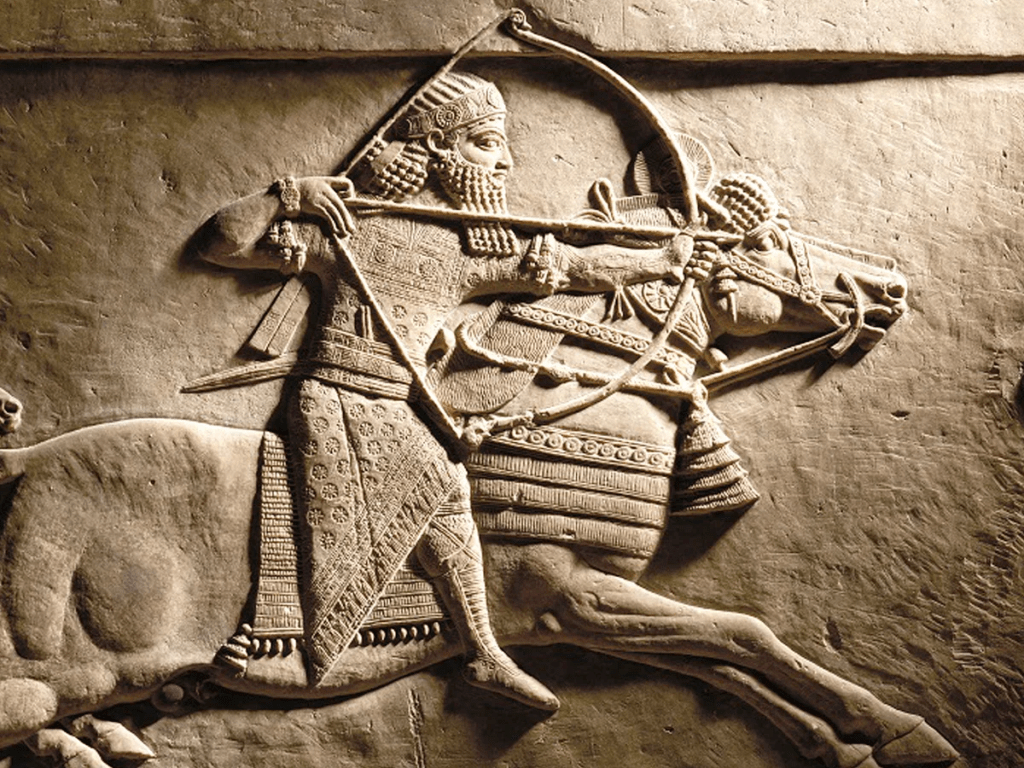
Assyrian king, British Museum

Unfortunately, most of our repentant overtures are way overdue. And yet, because of divine grace, the crazy mess we make of our lives is the very same place where a merciful God meets us.

Any sort of help is surely undeserved. It always is. The Lord, however, avoids making us grovel in our own vomit. God accepts us where we are, and not where we ought to be.

In truth, we all need to make a change, and not just the bullies. The sheer reality of God demands that we pay attention to what is right, just, and good. And the prophet Isaiah informed the people exactly how we must live in a world full of bullies and busted dreams.

We are to have an awareness of ethics and morality, a concern for humanity, and an orientation to help everyone thrive and flourish in this life.

The answer to life’s question of how to exist in this world and do more than just survive comes down to human morality:

  • Live right
  • Speak the truth
  • Despise exploitation
  • Refuse bribes
  • Reject violence
  • Avoid evil pleasures

The safe and stable way to live is to participate in the rhythms of mercy and justice that are woven into the fabric of the universe. The path to a contented and satisfying life is through goodness, not hatred.

Security and satisfaction don’t come through control of all circumstances; it comes by discerning that God has ultimate control, and that this God is good, not evil; just, not unjust; and righteous, not capricious.

According to the prophet, God will determine when the suitable time for assistance will come for us. And the Lord will deal with the ungodly according to the divine timetable, and not when we believe judgments should be rendered.

None of this is in our purview. Sometimes, talking about this sort of theology is a way of taking the focus off of our own need for an ethical and moral life. Sometimes, it is a helpful way of coming to grips with what is happening. Discernment is needed with oneself in these matters.

Trusting God means to exercise patience and perseverance, to focus on faith, to discipline ourselves in prayer, and to express confidence in hope.

We are not necessarily ruined whenever our circumstances are dire. The worse things become, the greater the display of divine power that can come.

By orienting ourselves around God and God’s strength and will, we grow in courage and develop in faith. We learn to trust in the worst of situations. We discover that the Lord knows the score of things, that God understands what’s going on.

And God laughs at the ungodly who believe they can bully the godly around. The most brilliant of military commanders is like a little toddler before the sovereign Lord of the universe. The fiery words they blow will blow back on them and consume their arrogance.

So, let us not harden our own hearts, but exercise a change of heart to let God be God, and to want for nothing but the courts of the Lord.

Let us not be like the bullies of Assyria who lived without a thought to the divine reality in front of them. Let us not become tormented, as if a fire were devouring us with inward anguish of soul, but instead:

  • Walk in right relations with others and with the Lord
  • Maintain truth and integrity in everything
  • Be free from corruption and offending others and God
  • Act with love toward your neighbor and your God
  • Refuse to accept a bribe
  • Restrain evil impulses
  • Open wide the spigot of goodness and justice

God is our refuge and strength, an ever-present help in trouble. Safety and abundance of good things is provided by the Lord. God protects. And God supplies. Rely upon God’s promises, and not the empty bellowing of others.

Be safe. Be strong. Be spiritual. We are all in this life together.

O God, my refuge and strength: In this place of unrelenting light and noise, enfold me in your holy darkness and silence, so that I may rest secure under the shadow of your wings. Amen.

Abundant Life (1 Kings 8:1-21)

Solomon dedicates the Temple at Jerusalem, by James Tissot (1836-1902)

Solomon then summoned to Jerusalem the elders of Israel and all the heads of the tribes—the leaders of the ancestral families of the Israelites. They were to bring the Ark of the Lord’s Covenant to the Temple from its location in the City of David, also known as Zion. So all the men of Israel assembled before King Solomon at the annual Festival of Shelters, which is held in early autumn in the month of Ethanim.

When all the elders of Israel arrived, the priests picked up the Ark. The priests and Levites brought up the Ark of the Lord along with the special tent and all the sacred items that had been in it. There, before the Ark, King Solomon and the entire community of Israel sacrificed so many sheep, goats, and cattle that no one could keep count!

Then the priests carried the Ark of the Lord’s Covenant into the inner sanctuary of the Temple—the Most Holy Place—and placed it beneath the wings of the cherubim. The cherubim spread their wings over the Ark, forming a canopy over the Ark and its carrying poles. These poles were so long that their ends could be seen from the Holy Place, which is in front of the Most Holy Place, but not from the outside. They are still there to this day. Nothing was in the Ark except the two stone tablets that Moses had placed in it at Mount Sinai, where the Lord made a covenant with the people of Israel when they left the land of Egypt.

When the priests came out of the Holy Place, a thick cloud filled the Temple of the Lord. The priests could not continue their service because of the cloud, for the glorious presence of the Lord filled the Temple of the Lord.

Then Solomon prayed, “O Lord, you have said that you would live in a thick cloud of darkness. Now I have built a glorious Temple for you, a place where you can live forever!”

Then the king turned around to the entire community of Israel standing before him and gave this blessing: “Praise the Lord, the God of Israel, who has kept the promise he made to my father, David. For he told my father, ‘From the day I brought my people Israel out of Egypt, I have never chosen a city among any of the tribes of Israel as the place where a Temple should be built to honor my name. But I have chosen David to be king over my people Israel.’”

Then Solomon said, “My father, David, wanted to build this Temple to honor the name of the Lord, the God of Israel. But the Lord told him, ‘You wanted to build the Temple to honor my name. Your intention is good, but you are not the one to do it. One of your own sons will build the Temple to honor me.’

“And now the Lord has fulfilled the promise he made, for I have become king in my father’s place, and now I sit on the throne of Israel, just as the Lord promised. I have built this Temple to honor the name of the Lord, the God of Israel. And I have prepared a place there for the Ark, which contains the covenant that the Lord made with our ancestors when he brought them out of Egypt.” (New Living Translation)

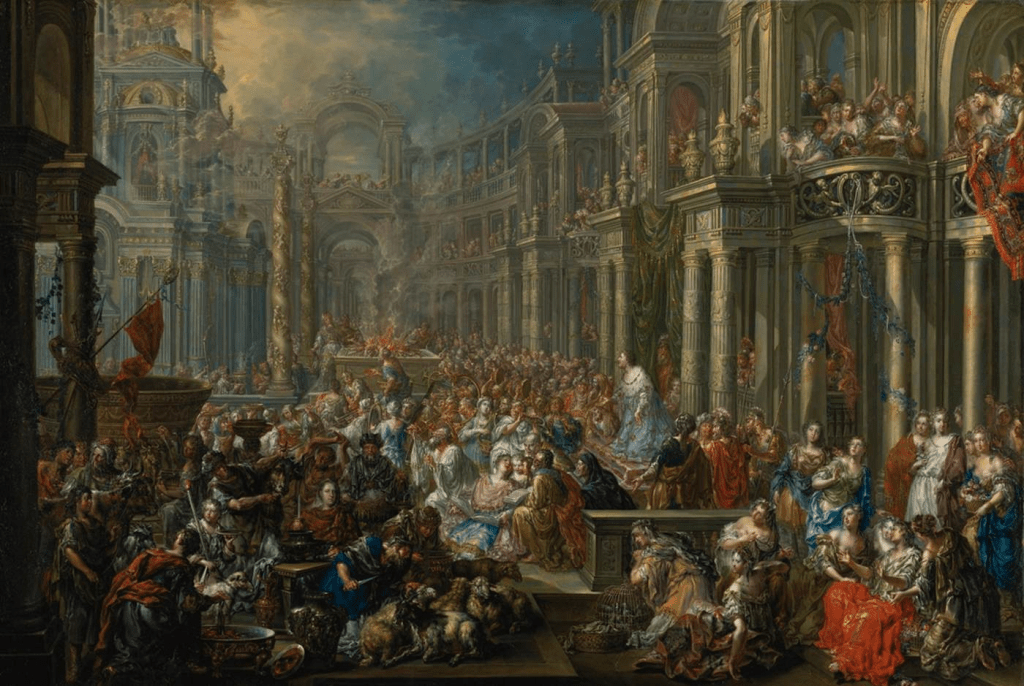
Dedication of Solomon’s Temple in Jerusalem, by Johann Georg Platzer (1704-1761)

I admit, at many times, that I am prone to melancholy. I tend to be quick at accepting blame, and rather slow at owning my good work. Another way of putting this is that it is easier to give than to receive.

Those who have endured a lot of hard circumstances, and persevered through many adversities, can sometimes be reticent to accept the good, the abundant, and the beautiful, whenever it comes to us in this life.

Waiting for the other shoe to drop, far too many people hold back themselves from receiving and enjoying the really good things in life. They worry that the goodness will disappear, or be taken away; and so, they withhold gratitude and blessing, whenever they are in the presence of great abundance.

Just so you know, in case there are those of you who need to hear it spelled out plainly: That’s messed up.

People are meant to be abundantly generous, as well as wildly receptive. It’s likely why there are so many spiritually unhealthy persons in the world.

Bless their hearts, they give a lot, without receiving much, and then their spiritual diarrhea makes it so they can’t give anymore. And they oftentimes give to those who are in such a habit of receiving (and not giving) that the receiver’s spiritual constipation becomes a terrible problem.

Let’s avoid both extremes by letting ourselves both give and receive with equal abandon. No one can be spiritually growing, healthy, and mature without the dynamic of giving and receiving.

Solomon knew how to do both. King Solomon was the king of abundance. He accepted and received big; and he gave and blessed big. Nobody before him or after him received and gave more.

The Temple, in all of its glory and grandeur, with the Ark of the Covenant encrusted with gold as the central object in the building, was all for a God who doesn’t live in houses, a God who is invisible.

In Solomon’s dedication of the Temple, he made it clear that the God of Israel is not, and cannot, be restricted to, or located within, a single place. Thus, the Lord is limitless, and not subject to any human manipulation.

God is free to give with great abandon. And God is also free to take away. Blessed be the name of the Lord God. If we continually try and anticipate or predict what God will do, we will likely be a nervous ball of anxiety all of the time, wondering when the unexpected and/or unwanted will visit us.

It is much better to receive the good things the Lord gives us, and enjoy them while we have them.

“I came that they may have life and have it abundantly.”

Jesus (John 10:10)

Nothing is permanent, with the exception of relationships and love. So, if we can connect the temporal material things of this life in service to the immaterial realities of this universe, then we are in a position to experience peace, joy, and satisfaction.

If and when the material disappears, or is taken away, then it shall neither defeat us, nor destroy us. For our relational connections with God and others exist, and are free flowing, with the energy of gracious receiving and giving as the conduit of abundant life.

Melancholy is important and has its place for us in this present life; yet, so do things like celebration, dedication, joy, exuberance, emotional commitment, and open love. Indeed, to have these in abundance is a reflection of the God of abundance, in whose name we are bold to pray:

God of abundance, you have fed us with the bread of life and cup of salvation; you have united us with Christ and one another; and you have made us one with all your people in heaven and on earth. Now send us forth in the power of your Spirit, that we may proclaim your redeeming love to the world and continue forever in the risen life of Christ our Savior. Amen.

For the Sake of Beauty (1 Kings 7:1-12)

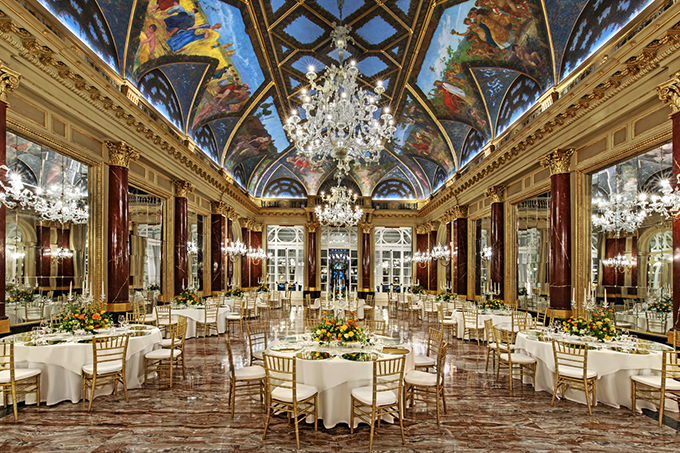
King Solomon’s throne room, by Edward Poynter, 1890

Solomon’s palace took 13 years to build.

Forest Hall was the largest room in the palace. It was 44 meters long, 22 meters wide, and 13.5 meters high, and was lined with cedar from Lebanon. It had 4 rows of cedar pillars, 15 in a row, and they held up 45 cedar beams. The ceiling was covered with cedar. Three rows of windows on each side faced each other, and there were three doors on each side near the front of the hall.

Pillar Hall was 22 meters long and 13.5 meters wide. A covered porch supported by pillars went all the way across the front of the hall.

Solomon’s throne was in Justice Hall, where he judged cases. This hall was completely lined with cedar.

The section of the palace where Solomon lived was behind Justice Hall and looked exactly like it. He had a similar place built for his wife, the daughter of the king of Egypt.

From the foundation all the way to the top, these buildings and the courtyard were made out of the best stones carefully cut to size, then smoothed on every side with saws. The foundation stones were huge, good stones—some of them four and a half meters long and others three and a half meters long. The cedar beams and other stones that had been cut to size were on top of these foundation stones. The walls around the palace courtyard were made out of three layers of cut stones with one layer of cedar beams, just like the front porch and the inner courtyard of the temple. (Contemporary English Version)

By Bible Art

Having secured the throne after his father’s death, King Solomon set himself to the task of following his father David’s ardent desire to build a temple for the Lord. The work took seven years to complete. (1 Kings 5-6)

Then, Solomon turned to building a royal palace with a complex of buildings (or halls). It seems these had the purpose of being both residences and government structures. This architectural achievement took nearly twice as long as constructing the temple of God.

Some commentators are rather hard on Solomon about this fact of taking so much time to build himself a palace. They interpret him as being distracted, almost self-absorbed – that somehow his heart was more into his own buildings than God’s temple.

I don’t really buy into that line of thinking. It seems to me this reads more into the text than what’s there. They could be right. However, it appears such commentary does an anachronistic reading of the text. Taking a standpoint of Solomon’s later devotion to his many wives, and hence their many other gods, a lack of commitment is then superimposed upon the construction projects. It’s as if Solomon finished the temple stuff in order to get his real architectural passions.

I think there’s a more plausible explanation for King Solomon’s dedication to erecting buildings in addition to the temple. The editor of 1 Kings includes the detail and dedication that went into the temple.

Let’s keep in mind that King David had been stockpiling and preparing materials, and planning for the temple, well before he died. Just because the Lord told David that he would not be the one to build it, that Solomon would, did not mean that David kept his thoughts and his hands off of getting as much ready as he could for his son.

What’s more, once Solomon put together such a marvelous and intricate building as the temple, the experience gave him a desire to work on other projects, as well. Solomon had an expansive vision of his kingdom.

As the wisest person on earth, he put his money where his mouth was, by constructing beautiful structures given to justice, and reflecting the abundance of a goodness and justice which comes through living by God’s covenant code.

Did Solomon go overboard? Yes, and no. It depends on the project, and with whom you talk to. The issue of Solomon’s building projects, as I would frame it, has much more to do with demonstrating a particular theology.

The theology I believe Solomon was trying to reflect was that Israel serves a God who is given to beauty, justice, and abundance. And those qualities are also seen in the New Testament. I think of the story when Mary came to Jesus with her expensive and beautiful perfume:

Mary took a very expensive bottle of perfume and poured it on Jesus’ feet. She wiped them with her hair, and the sweet smell of the perfume filled the house.

A disciple named Judas Iscariot was there. He was the one who was going to betray Jesus, and he asked, “Why wasn’t this perfume sold for 300 silver coins and the money given to the poor?” Judas did not really care about the poor. He asked this because he carried the moneybag and sometimes would steal from it.

Jesus replied, “Leave her alone! She has kept this perfume for the day of my burial. You will always have the poor with you, but you won’t always have me.” (John 12:3-7, CEV)

I would argue that Judas Iscariot was the one distracted – and not Mary. Thus, returning to the story of Solomon’s building the palace complex, I would also argue that perhaps some of the commentators, with an eerily familiar criticism, are actually the ones distracted – and not Solomon.

Anyway, I like my positive reading of today’s Old Testament lesson, rather than the others’ negative reading. What about you?…

O heavenly God, who has filled the world with beauty: Open my eyes to see what is beautiful, to behold your gracious hand in all your works. Open my mind to know what is true. Open my heart to love what is good. May I learn to serve you with gladness, justice, and righteousness. Amen.